Showing posts with label projection. Show all posts

Thursday, March 20, 2014

CLEO Magazine Interview

I was contacted a few months ago by an editor from the Australian women's magazine, CLEO, asking if I could answer a few questions for an article that would be in their March 2014 issue. I agreed, and we exchanged the questions by e-mail.

In the end, my answers were quoted considerably in the article, as was the post Men Don't Fall in Love the Same Way Women Do. The editor was kind enough to send me a hard copy of the magazine, as well as an electronic copy of the article, so I've included it in full as images in this post (you can click on the images to enlarge them, or open them in a new tab or window to zoom in and read the text).

Not all of the interview was quoted, of course, but as it touched on some interesting points about men and women, and gives a nice "meta" view of the blog, I thought it might be of general interest. The full text of the interview follows.
_____________________________

1. How did ‘The Rules Revisited’ come about?

I’d say The Rules Revisited was conceived out of the convergence of three factors in my life. The first was the process that I went through myself in learning how to attract women. This started soon after I graduated from college, and in many ways is still on-going; but it showed me that self-improvement is a very real possibility – even for someone like me, who at first felt utterly powerless with the opposite sex. The second was my love of writing and the need for a substantial way to exercise it. Initially I considered starting a blog for men, but most of the ideas that I found engaging and useful had already been pretty well articulated by others. The third factor was the recognition that, in spite of there being this vast network of men producing material to help each other improve their chances with women, there really wasn't anything out there for women trying to improve their chances with men. It felt a bit one-sided, especially because I knew from my own dating experience how badly the advice was needed. With that realization, the concept of the blog was obvious, and I immediately sat down to write the first few posts. I haven’t stopped since.

2. Your advice is quite blunt and to-the-point – what was the initial response like from readers?

It was very positive, actually. To this date, I've never received a single complaint about the tone of the blog being too harsh or too blunt; but I've received hundreds of e-mails from readers expressing their appreciation for the bluntness specifically. In hindsight this doesn't surprise me. Women today are absolutely starved of honesty. Less attractive women are constantly told that “inner beauty is all that matters” (yet their experience tells them exactly the opposite), while more attractive women are plagued by the insincerity of men trying to get them into bed, or being transparently nice to them just because they are pretty. If a girl asks a male friend for dating advice, she knows that it is liable to be skewed by his attraction to her; and her girlfriends can sometimes be too nice, or even jealous. The tone of the blog was never something premeditated; it is just the way I think and write. But I understand why it is appreciated.
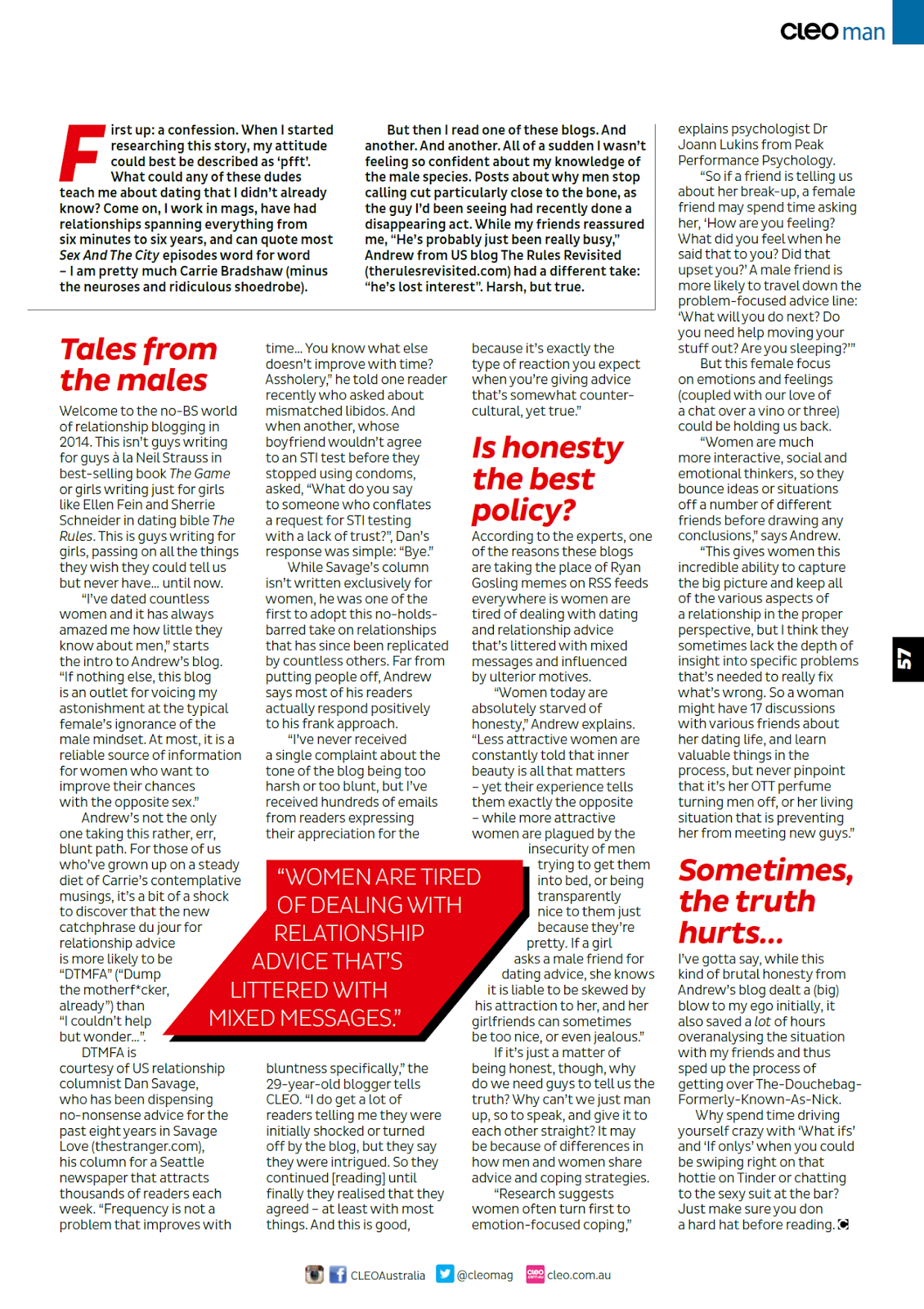
(Right-click and choose "Open link in new tab," then you can zoom in on the text)
I do get a lot of readers telling me that they are initially shocked or turned-off by the blog; but they say that they were intrigued. So they continued… and continued… until finally they realized that they agreed – at least with most things. And this is good, because it is exactly the type of reaction you expect when you are giving advice that is somewhat counter-cultural, yet true. Of course, I have to assume that some readers never get passed the “shocked” phase; I just never hear from them because they close their browser and move on. But that is expected also. Not everyone has an attention span and an open mind.

Ultimately, I understand that my readers appreciate my blog because they can trust it. They’d rather read a blog that they disagree with occasionally but trust completely, than a book or website that is trying to sell them something – even if it sounds good every time.

3. Has that response changed at all over time? How so?

It hasn't really, no. The number of people giving feedback has increased dramatically, but the types of responses (and the relative percentages of each type) haven’t changed.

4. What have been some of your most popular topics/posts?

One of the most popular has definitely been The Importance of Silence After a Breakup. Even though I wrote it fairly recently, it has already accumulated the second highest amount of traffic, and has by far the highest number of comments, which are overwhelmingly positive. I am in the final stages of writing a book that expands considerably on this topic, and how to handle breaking up with a man in general.

The post with the highest number of hits is Men Don’t Fall In Love The Same Way Women Do. The comments aren't all positive, but it has the largest number of and +1s on Google by far. I suspect its popularity is partially driven by the number of girls searching the internet for “how men fall in love,” (which is the number one search term leading to my blog) and the absolute absence of other material trying to explain it. I am in the process of writing a better post on the same topic at the moment.

A few others that have been very popular are:
What Men Think of You Without Makeup (this gets shared a lot on beauty forums)
What Men Think About Older Women (fairly controversial, as judged by the comments)

Some of my best posts are the newer ones, which dig a little deeper:

5. Your blog tagline says that, in your experience, women understand very little about men and the male mindset. Why do you think this is?

Well, for starters, it definitely isn't just women who are confused about the male mindset; men are equally confused about the female mindset – I just happen to write for women. There is a notion floating around that it has “always been this way,” but I absolutely disagree. A hundred years ago in Western societies, men knew what women wanted and women knew what men wanted. Even if they weren't happy with the rules of the game, and even if the rules were wrong, everyone knew them and played by them. But all that has recently changed, because we've rejected the old script. We live in a hugely tumultuous time for male-female relations. Men and women are “equal” now, but no one knows what to do anymore to attract the opposite sex. In the absence of any authority telling us how to behave, both sexes hear the word “equal,” shrug their shoulders in confusion, and assume that it means “the same.” We conclude that men want from women the same things that women want from men, and we act accordingly. But it isn't true. Social evolution (let alone biological evolution, which I think plays a part) doesn't occur that quickly. Both sexes still want significantly different things, but no one is telling us this anymore. And even though there is some overlap in our desires, this actually makes things more confusing, because it just serves to further mask the differences. Both sexes are currently standing in the rubble of a social battlefield, each trying to give the other what it doesn't want – mainly because we just don’t know any better.

6. In your opinion, what are the main differences in how men and women give each other dating advice?

That is a great question, because there are enormous differences. One of the largest symptoms of this difference, as I explained before, is actually one of the reasons that I started The Rules Revisited, and that is the complete lack of dating advice available for women on the internet – or in the media in general, for that matter. In the last 15 years, men have generated thousands upon thousands of books, blogs, websites, videos, businesses, etc. – each picking apart a different aspect of attracting women: overcoming approach anxiety, being authentic in a woman’s presence, mastering one-night stands, attracting women online, and so on. The sheer volume is impressive, and actually a huge testament to how much the male world revolves around the pursuit of women. But when you search for similar books or websites for women, you find very few – and many of them are actually written by men.

In my experience, women tend to seek dating advice mostly from friends. For example, my female acquaintances often ask me for dating advice; and I know that girls discuss it amongst themselves all the time. They love discussing it. They love telling their friends about what “he” said or did, gauging their friends’ reactions, and comparing related stories. Such a discussion is an event, to be enjoyed in-and-of-itself, whereas for men it is brief and purely practical – if it occurs at all.

There obviously are some women turning to the internet for dating advice, otherwise The Rules Revisited wouldn't have an audience. Probably this number is increasing, as people in general become more familiar with the power of the internet, realizing what lies at their fingertips. But there is no question that women lag men significantly in their use of written and internet-based dating advice.

In any case, we can say that the female approach to dating advice tends to be more social and discursive, while the male approach tends to be more individual and analytic.

7. Why do you think men and women approach dating advice so differently?

The sexes approach dating advice differently because the sexes think differently. The male mind is more inclined towards the kind of obsessive focus one needs in order to scrutinize even the tiniest of social interactions and break it down into usable rules. This is what we know how to do best, so this is the kind of advice we know how to follow.

Women are much more interactive, social and emotional thinkers. So they do what they do best: they bounce ideas or situations off of a number of different friends before drawing any conclusions. They feel their way through their questions, focusing on their gut instincts more. I also suspect that they are much more in tune with their friends’ and family’s emotional reaction to their dating situation, which is something that many men would never even consider.

I think it is important to point out that both approaches have certain strengths, but also certain flaws. The masculine ability to analyze is impressive, but men can get too easily trapped in a single problem, losing sight of the forest for the trees. For example, a man might perfect his online dating profile to the point that he has cute girls messaging him daily, or learn exactly how to react when his girlfriend tests his honesty or courage, only to realize – years later – that he still doesn't know how to keep a girl interested for more than three months.

The female strategy, on the other hand, gives women this incredible ability to capture the big picture and keep all of the various aspects of a relationship in the proper perspective; but I think women sometimes lack the depth of insight into specific problems that is sometimes needed to fix what’s wrong. So a girl might have 17 discussions with various friends about her dating life – and learn valuable things in the process – but never pinpoint that it is her short hair that’s turning men off, or her living situation that is preventing her from meeting new guys.

To borrow from the adage: a man is liable to forget the forest for the trees, while a woman is liable to forget the trees for the forest.

8.  Do you read other dating/relationship blogs? If so, which ones?

I read HookingUpSmart.com, written and run by Susan Walsh, which I very highly recommend for both sexes. For men I very highly recommend the sections of AnimusEmpire.com that are dedicated to “Manliness” and “Dating.”

Wednesday, August 28, 2013

If a Man Talks to You, He Likes You

I have made this point before, but only briefly; and as simple as the point is, it warrants further explanation.

If a man goes out of his way to interact with you, he is interested in you romantically or sexually - at least to some degree. A lot of women don’t realize this, because when they approach a man (for example, to ask directions in the street), they don’t do so with romantic or sexual intention. They wrongly project their own lack of intention onto the men who approach them. They think “When I approach a man, I don’t have romantic or sexual motives; so this guy asking me for directions has no ulterior motives.” But they are wrong.

If you are skeptical about this, consider that the same phenomenon is manifested in men. Men always “get the wrong idea” when a woman responds to their texts, or engages them in conversation in a bar, or doesn't spit on them and walk off when they ask her for directions. The truth may be that the girl is just being polite, or that she genuinely believes the guy just needs directions, but the man projects his own intentions onto her. He thinks “When I talk to a woman even for casual reasons, it is because I like her. This woman is talking to me, so she must like me.”

Yes, of course, there are exceptions to this rule. Sometimes a guy genuinely needs directions, or really is just talking to you to kill time at the bus station. But the point is that these exceptions are far rarer than you think. In fact, the exceptions are so rare that you are better off always assuming that men who approach you are interested than you are questioning it each time. In the rare instances that a man isn't interested, you have nothing to lose by assuming that he is; and the increased confidence you’ll have knowing that he is into you will help you to be your best self in his presence, which will attract him further.


Related Posts

Thursday, March 14, 2013

Yeah, That's About Right


Hi Andrew,

I would like to start this email with a sincere compliment about how much I have enjoyed your blog over the past few months since I discovered it. You have given me so much food for thought, whether I agree with you or not, and challenge my opinions and perceptions of the male-female dynamic. I am thankful that you take the time to write this blog.  : )

I have a suggestion for one of your blog posts. I very frequently find that women are quite obtuse when it comes to knowing when a man is hitting on her. When I was younger, my father once said, "Nicole, if a man you don't know is talking to you for any reason, he is hitting on you."

When I share this piece of information with my females friends, they scoff. "NO! That's not true! What if he needed directions? Or help picking out a ripe cantaloupe at the market? Or the best bus to take to get downtown the fastest?" The list goes on and on. On the flip side, when I share my dad's advice with another guy and ask his opinion of it, their response is almost always, "Yeah, that's about right."

The reason I bring this up is because I think there are many women out there that may not be able to recognize when a man is hitting on them or trying to pick them up. Perhaps if women were more attuned to when they were being hit on, their success of flirting and engaging with men would be greater. If you agree, I have a feeling that a post about this would be very helpful to your female readers.

Thanks so much and keep up the good work!

Much love,
Nicole
____________________________________________

Nicole,

Yeah, that's about right.

Andrew


Related Posts
1. Misconceptions
2. "The Wong Kind of Attention"
3. Why Women Don't Know What Men Want
4. Why You Don't Get Approached by Men

Sunday, March 10, 2013

Men Don't Fall in Love the Same Way Women Do

A reader recently asked me if I've learned anything new about women from writing this blog. I have. To be specific, I've learned one thing - one important thing. I want to explain that one thing here, because the corresponding lesson for women is equally important.

So many of the women that write to me for advice have stories that go something like this...
I met my boyfriend through mutual friends. I wasn't very attracted to him at first. He wasn't the best looking guy in the world and he was a little quiet. I never really considered him a potential boyfriend, but then he asked me out. I agreed because I wanted to give it a chance, and I hadn't been on a date in a while.
The first date went OK, so we kept seeing each other. Before long I started getting attached and soon I found myself falling for him. We spent a lot of time together, and by three months I was in love. Now we are five months into the relationship and things have stagnated a little. He seems to be losing interest. Our phone calls are getting shorter, we see each other less frequently, and he's been answering my texts sporadically. In general the excitement he showed at the outset seems to have faded. I don't know what to do... I am completely in love with him and don't know if I can handle a break up. Is there any way I can re-spark his interest? What can I do??
Obviously this is just a paraphrase; the details of each story vary. But the common thread among them, and the thing that I found so interesting, was that the woman's love grew gradually, over months, often starting as complete indifference. It amazed me that a woman could end up being so in love with a man that, initially, she wouldn't have seriously considered dating.

In fact, I was so surprised by this that I initially doubted the truth of the stories. I speculated that the women writing to me were subject to some kind of wishful thinking or tunnel-vision, by which they focused only on the good in their boyfriend rather than the advantages of other men. But this really couldn't explain the phenomenon. A woman couldn't wishfully think herself into a degree of love so strong that she would feel compelled to write me for help. I eventually realized that these women were being genuine, and I was forced to admit that there was a uniquely feminine mechanism at work.

By now most of you have probably recognized the important point for women, which is implicit in my astonishment: men do not fall in love gradually, and they do not find themselves suddenly falling for women in whom they weren't initially interested. I was surprised because I had wrongly assumed that women work the same way as men in this respect. But this is not the case.

Now, let me qualify a couple things before going any further. By "love" I mean deep romantic attraction, as opposed to lust or long-term attachment. Lust is primary, physical and fleeting for both sexes, and long-term attachment takes years of shared experience to develop in either sex. Also, I am not saying that this is the only way women fall in love, or the most common. I recognize that women can experience something closer to "love at first sight."

The important thing to recognize is that you cannot expect (much less make) a man gradually fall in love with you in the same way that you might fall in love with a man. It doesn't work that way for us. Male romantic love is something that either starts early and continues, or else doesn't start at all.

Since recognizing this difference in the sexes, I've had time to consider why it exists, and I think I have a reasonable understanding of what is going on. The information that a man needs to trigger romantic love is information that he can perceive within a few interactions with a woman. I believe this is true for a couple reasons:
  1. A great deal of his attraction to a woman is physical, and her approximate physical beauty can be demonstrated by seeing her in a handful of outfits (or, to some degree, through photos).
  2. A great deal of his attraction to a woman is rooted in her personality and energy, which can be demonstrated by experiencing her in a handful of moods. This takes longer than the physical attraction, but is still possible within a fairly limited number of encounters.
Other data, such as a woman's religious or political beliefs, her social class, her family, etc. are either immediately available to a man via conversation, or else far less significant in garnering his attraction. So, in general, a man can evaluate a woman quite quickly.

Now, for women, the situation is different. Many of a woman's triggers for romantic love are less immediate:
  • His personal strength and emotional stability, which can only be demonstrated by seeing him react to challenging situations, and these are unlikely to arise on a daily basis.
  • His intelligence and confidence, which - although more readily assessed - can also take time to evaluate, as they are best demonstrated via situations in which his wit or knowledge is pitted against others', or by seeing how he responds to other men in a variety of real-life social situations.
  • His commitment, which is only demonstrated in proportion to its duration. The longer he is with you, the longer he is likely to stay with you.
In other words, while a man judges his woman primarily in relation to himself, which he does quite quickly, a woman evaluates her man on how he relates to the outside world, and this takes longer. In addition, and perhaps more importantly, a woman needs to gauge her man's reliability, and this demands time.

From an evolutionary biology standpoint, this makes good sense: the man who propagates his genes successfully does not need months to judge the reproductive potential of his mate, or her ability to nurture and raise children; he can see these things from physical cues, as well has her energy, moods, and her instinct to take care of him. But the woman who propagates her genes is one who accurately judges whether the man with whom she mates is not only strong, but also stable - that is, capable of protecting and providing for her children until they are grown.

The implications of this are enormous for both sexes in dating, but let me underline the biggest lesson for women: if a man isn't falling for you from an early stage - say, the first month - it isn't going to happen. Don't wait around for his feelings to "grow" the way yours sometimes do. They will not. While this doesn't necessarily mean that he should be ruled out as a potential boyfriend or husband, it does mean that he will never be the woozy, infatuated lover you've seen in the movies. And if this is something you can't live without, you'd do better to break up with him now than to become more emotionally or sexually invested before breaking up with him later.

-------------------------------------
If you liked this post, you'll definitely like my book, Beyond the Breakup, which explains everything you need to know about dealing with you ex: what he's thinking, what is motivating him to stay friends with you, how to maximize your chances of getting him back - and if that doesn't happen, how to focus on your future.


Related Posts
1. Why Women Don't Know What Men Want
2. The Female's Internal Conflict
3. The Analogy Between Confidence and Beauty
4. The Analogy Between Sex and Commitment

Monday, March 4, 2013

Less Masculine = More Feminine

I pulled the following statement from the comments of the post The Analogy Between Confidence and Beauty:

So I had a revelation about a few weeks ago...and it pertains almost exactly to this post. I'm a confident 7, well-spoken girl but have always wondered why I'm having such issues with attracting the right type of guys when I have such a well-rounded personality. So I started to experiment with how I acted around guys. I became more feminine, I would act more sweet, talk less, be less witty or sarcastic and it was crazy how many more guys came flocking to me. It was kind of disheartening though that I had to become this demure thing to attract more guys. I felt like I was compromising myself, and at times not even being myself because I had to bite my tongue so much and watch what I said. I don't want to be a bobblehead airhead girl, but it seems as though that's what guys want. How do I attract the men I want without compromising myself?

I want to share my response, because I have had similar questions from other readers, and it is an important point for any woman trying to understand her feminine self in the modern world:

You only think of behaving in a more feminine manner as "compromising yourself" because you've been conditioned to think of your personal value in purely masculine terms. But why is it "compromising" to be MORE feminine? You are too fixated on the fact that you are being LESS masculine. Yes, you are LESS ambitious, LESS witty, LESS assertive; but why think of these changes in negative terms? What about the fact that you've become MORE receptive, or MORE radiant, sweetER, or MORE beautiful?
Men and women are two halves of a whole: one typically active (male) and one typically passive (female). But neither one is more important or better than the other, any more than an electrical plug and socket - which are typically referred to as "male" and "female" - are more or less important when it comes to conveying electricity.
It is only because "success" in our society is defined in masculine terms that you feel like you have reduced or compromised yourself as a person by this change. So instead of considering what you've subtracted or "repressed" by being LESS male, focus on what you've added or improved by being MORE female.

There is one more important point here: even though the "bobblehead airhead girl" gets good responses from men, this doesn't mean that she therefore represents the ideal of femininity that men seek. Men prefer her because there are elements of the "bobblehead" that they like: her carefree spirit, her flirtiness, her willingness to be led, her cheerfulness, etc. Her characteristic stupidity and lack of substance are things that men merely tolerate in order to experience the feminine qualities that they desire so deeply - that is, the qualities that men do not typically have in themselves and cannot get from masculine women.

If this seems unfair or counter-intuitive, consider that women behave similarly in their selection of men: they often tolerate insensitivity, excessive pride or stubbornness (i.e. they date "assholes") only because these qualities are unfortunately common in most of the men who have the masculine qualities that they want: strength, aggression, unshakable confidence, ambition, etc. - in other words, the qualities that women do not typically have in themselves and cannot get from feminine men.


Related Posts
1. Femininity, Authenticity and Compatibility
2. Are You Repressing Your Femininity?
3. Misconceptions

Saturday, February 23, 2013

Why You Can't Get the Men You Want

Most women who complain that they "don't get any attention from men" actually mean that they don't get attention from the men they want. And the simple advice for women in this situation (which I have seen on other blogs, and have occasionally given out myself) is sometimes appropriate: "you aren't hot enough to get the guys you want; lower your standards." However, in most cases, I think there is deeper phenomenon at work.

Women tend to be aware of and rate their looks fairly accurately. I know this because a lot of readers send me pictures saying "I think I am an X out of 10, can you tell me what I really am?" Although I always refuse to give them my numerical opinion (because all men think differently), their guesses are usually very close to what I would have ranked them.

So why would they set the bar so much higher than what they know they can get? Some might point out that their "delusion" is caused by their experiences getting men who are out of their league for sex and casual dating. And though I agree that this happens, it doesn't capture the whole picture. Women just aren't that easily deceived about their own physical attractiveness. It shouldn't be surprising, then, that the problem is primarily an internal one.

Each of us has an inherent knowledge of our own capabilities and dispositions. We know the inner workings of our own mind: how honest we are, how prone we are to mood swings, our insecurities and strengths, what we've experienced, what we still need to learn, the strength of our ambitions, etc. This translates into an excellent knowledge of our personal capabilities, our personal potential. We all know roughly what we could achieve, whether or not we have achieved it. Occasionally we modify this self-perception when we realize the extent of strengths we didn't know we had, or weaknesses that have greater implications than we'd imagined. But in general, we know ourselves well; we know what we are capable of becoming. This is true in all aspects of our lives: business, working out, academic learning - everywhere. It also applies to dating. Because we know ourselves, we also know roughly what we should be able to get when it comes to the opposite sex.

A statement that often accompanies women's complaints about not getting the men they want is something to the effect of "I know I am a catch. I have so much love to give a man. Why can't men see that??" This is a symptom of the above-described phenomenon: you know that you have the right "raw material" to attract the kind of man you want (in fact, "the kind of man you want" is partially defined by your self-knowledge), but you are confused about why it hasn't happened for you yet.

The reason for this is simple: your self-perception of your potential is roughly accurate, but you aren't living up to that potential. You aren't the person you know you can be. You have the capability, but you haven't used it. You have the potential, but you haven't fulfilled it. You know you can be a fun and exciting person to be around when you feel comfortable, but you haven't confronted your insecurity in social situations, so men don't realize this. You know you have a great figure, but you haven't learned yet to show it off by correcting your posture, so no one notices it. You know you have great hair, but you don't put the effort in to style it well, so it does you little good. You know you are pretty, but you haven't confronted your fear of looking a little awkward, and this has dramatically slowed your efforts at learning how to dress yourself well. Your are well aware of your inner feminine self and you instincts to nurture and love, but you suppress them (as you've been implicitly told to do by your parents or the culture around you) and men assume you are cold and boring. You know that you are an incredibly sexual person, but because of your strict conservative upbringing, you cloak it in "modesty" and men are turned off.

The reason women can't get what they think they deserve is that we (men and women alike) always peg our standards to what we know we can be, not to what we are, while members of the opposite sex judge us - understandably - only on what we are currently. They have no access to the inner workings of our mind; and even if they did, they would have no guarantee that we'd ever reach the potential this would reveal to them. So your discontent in dating boils down to the fact that you aren't living up to your own standards - yet. Incidentally, this also explains why most people have such an aversion to settling: our subconscious knowledge of what we "should" be able to get is achievable (if not currently accurate), so it seems defeatist to accept something less.

I've illustrated an example of this in the diagram below. A woman who is a 5.5 out of 10 has the potential to be a 7.5, so she "knows" that she can get men of that caliber (red arrows). She is constantly setting her sights on men who are in the 7-8 range (dark blue arrows), and she is constantly being rejected by them. She doesn't understand why, since she thinks these men are in her league, when the truth is that she could get into their league. Her situation isn't helped by the fact that a lot of the men she wants haven't met their full potential yet either, meaning that they - also wrongly - have their sights set on women of an even higher caliber (light blue arrows).

Rank out of Ten (Combined Looks and Appearance)

So the bad news is that you probably can't get the men that you think you can get. But the good news is that you probably can eventually get the men that you think you can get - assuming you are willing to work at it, and do. The biggest takeaway, though, is that if you aren't getting the men you want (but you think that they are in your league), your first move shouldn't be to lower your standards, it should be to self-improve.


Related Posts

Friday, February 8, 2013

The Analogy Between Sex and Commitment

A recent post on Hooking Up Smart really grabbed my attention. The first item in the post 7 Reasons Why Women Reject Eager Men reads:

Women understand the male role as the gatekeeper of commitment, just as we [women] are the gatekeepers of sex. In the same way that a man may question the long-term potential of a woman who grabs his junk on the first date, women are wary of men who are “emotionally promiscuous.”

This idea is huge, and it has been on my mind since I read that post. I've practically been able to feel the gears in my head turning as I've considered the various implications, and recalled instance upon instance in which I've seen it demonstrated. It's been eye-opening just thinking about it. I thought I would share some of the ways I've recognized the concept at work in typical inter-sex dynamics:

  • Men are always trying (and failing) to elicit sex from women; women are always trying (and failing) to elicit commitment from men.
  • A man doesn't owe a woman his commitment any more than a woman owes a man her body.
  • Women complain about men being "afraid of commitment" when the men refuse to date them seriously, in the same way that men complain about women being "prudes" or "bitches" because they won't go home with them.
  • Ideally, in a long term relationship, a man freely gives his loyalty to his woman, and a woman freely gives her body to her man.
  • This blog and books like The Rules or Why Men Love Bitches - which all essentially try to help women attract and get commitment from men - are the perfect analogues to the thousands of blogs and books teaching men how to get laid.
  • Men and women are both disappointed by the opposite sex equally: women get dumped (or not called back) by men just as often as men go home from the bar or club empty-handed.
  • Men don't respect women who have sex too soon; women don't respect men who say "I love you" too soon.
  • While neither of these are something either sex looks for in the other, a man is unsurprised if a girl has given herself to many men emotionally in the past (i.e. committed to them), just like a woman is unsurprised if a man has fucked a lot of girls (i.e. given himself to them sexually).
  • Men like that a woman can easily attach to a man emotionally, just like women like that a man can easily attract women sexually.
  • Men get frustrated at women who deny them sex after dating for a long time in the same way that women get frustrated with a guy who won't say "I love you" after dating for a long time.
  • A man feels bad when his woman says "I love you" before he is ready to reciprocate the expression, in the same way that a woman feels bad telling a guy she isn't ready to sleep with him when he tries to have sex with her. 
  • Some women feel drawn towards a man when they learn that he has never been in love before, while some men have fantasies about taking a woman's virginity.
  • Women love to discuss relationships and each others' involvement in them (who has commitment from whom) with the same enthusiasm men have for discussing their sexual escapades.
  • Men usually escalate a relationship physically (towards sex) whereas women usually escalate a relationship emotionally (towards commitment).
  • Women take pride in being able to get a guy to want and commit to her (even if she isn't that into him) in the same way that men take pride in getting a girl to let him have sex with her (even if he isn't that into her).


Related Posts

Tuesday, August 16, 2011

Why Women Don't Know What Men Want

As human beings, we always try to project our own perceptions on those around us. We call the person driving in front of us an asshole because they are going too slowly when we are in a hurry, even though they are 10 mph over the speed limit. On another day we call the person who speeds past us an asshole because they are not content with driving the speed limit, though we are just out for a casual drive. We get pissed off because we honestly believe in that moment that the other driver is being unreasonable, which is perfectly true if they are going slowly when everyone is in as hurry, or if they are speeding when there is no need; but in neither instance does that accurately reflect the situation.

The tendency manifests itself elsewhere as well:
  • We rush through explanations of ideas that we find easy to understand even if our audience is completely ignorant of them (a group of trainees at work, for example).
  • We are dumbfounded by the way foreigners act, even though their actions are shocking only when considered in light of our beliefs - in light of theirs they make perfect sense.
  • We find a book fascinating and recommend it to others, fully expecting them to think the same, but not realizing it was only interesting to us because of our unique experiences.
  • We are less confident when we go out looking like shit because we assume everyone else thinks so too.

The list is endless.

We do this because it is efficient, even if at times it is inaccurate. We probably could afford to consider the culture of a foreign country before gasping in disbelief at the actions of their citizens; however, it is less likely that before we walk out the door for the evening we will have time to consider the variety of opinions everyone who lays eyes on us will have about our choice of clothes. Or it would be ridiculous to thoroughly interview each of the new employee we are tasked with training so that we'll know exactly what each of them has learned previously, in order to avoid skipping any nugget of new material. Sure, these things are possible, but it is simpler and usually inconsequential to simply assume you look to everyone else the way you thought you did in the mirror, or assume the things that are obvious to you are also obvious to the new hires. This is how we operate as humans. It doesn't always work but usually it gets us by - and what else are we going to do, given limited time and resources?

This same phenomenon explains why men and women are so clueless about one another and what the other wants. Because Western society has championed the idea that the sexes are equal (which I don't deny), we have also started to assume that they are the same (which I very strongly do). At least, we have allowed ourselves to get used to this idea enough that when we consider what is attractive to the opposite sex, we are far less prone to interrupt our default course of action. In other words, we are far less likely to hesitate before we project our own ideas of attractiveness onto the opposite sex. To whatever degree we allow ourselves (or are allowed) to make this projection, we will believe that what is attractive to us must also be attractive to them. And this is where things get all fucked up.

Here is a list of things that each sex tends to think the other likes, erroneously:

Men believe that women like...
  1. Physically attractive men (pretty boys)
  2. Nice guys
  3. Men that have no hair on their bodies
  4. Sensitivity
  5. Peaceful men
Women believe that men like...
  1. Women that are elusive or "hard to get"
  2. Tall women (heels)
  3. Confident women
  4. Women who can drink liquor straight
  5. Women with status

Now, I realize that women do like nice guys and attractive guys, and I actually have male friends that have told me they are kind of into girls with status. Granted. Probably there are exceptions to all of the other items on the list. If there wasn't some element of truth to each item, none of them would be believable in the first place and I wouldn't be writing this. But I am sure that everyone has seen a girl throwing back a shot of whiskey to impress a group of guys, or a guy talking up the fact that he's cried in movies before because he thinks the girl listening will be into that. What is surprising is not that there are exceptions to the listed items; it is the level of importance that each sex is placing on them when they are infinitely more accurate as descriptions of their own sex's attractive attributes. To see this just consider the lists reversed:

Women actually like...
  1. Men that are "hard to get"
  2. Tall men
  3. Confident men
  4. Men who drink liquor straight
  5. Men with status
Men actually like...
  1. Physically attractive women
  2. Sweet girls
  3. Women that have no hair on their bodies
  4. Sensitive girls
  5. Peaceful girls

Men and women would be so much more successful if they tried to emulate the reversed lists. Some members of both sexes obviously get this, and do. However; a surprising number don't, and it is due to the self-projection of our own desires onto the opposite sex.

I started by saying that we always try to project our perceptions on others because we do retreat when strong evidence indicates that our perceptions are incorrect, or at least, inapplicable. We might retract our judgement of the "asshole slow driver" if our passenger points out that he's actually 10 mph over the limit and we can afford to be a few minutes late. Likewise, an explanation of this phenomenon applied to sexual attraction might help some women understand that (for example) men are not attracted by female elusiveness, or that it makes perfect sense for them to dump the nice guy with no balls, and date an asshole with confidence. Overcoming this misconception is a huge first step in the right direction for women who want to make themselves more attractive to men.