Showing posts with label attractiveness. Show all posts

Tuesday, September 15, 2015

Older Women Can Still Be Sexy

I recently spent a couple weeks in Europe. While there, I noticed something that genuinely surprised me: older European women are sexy. I found myself attracted to women over the age of 35 or even 45 much more frequently than I do in the U.S., where I almost never notice women over the age of 35. In Europe, it was a regular occurrence.

It didn't take me long to realize why. The difference is obvious. My attraction to these women could be almost completely attributed to the following factors:


This was kind of a revelation to me. I'd thought that wrinkles, loose skin, and thinning hair (the most obvious signs of aging) were the main factors reducing a woman's attractiveness. But this simply isn't true. Feeling my neck instinctively turn and my eyes involuntarily drawn to the hips of these European women as they walked by put an end to that idea. Perfect skin and perfect hair simply don't matter that much. My hormones were saying "YES" over and over again to women without either one.

This was a powerful realization for a couple reasons. The first was the simple satisfaction of realizing that it reinforces a couple points I've been making all along: that feminine beauty is highly controllable and that no women needs to be ugly.

But more importantly, it was powerful because it gave me hope. Yeah that sounds like exaggeration and maybe even a little gay, but it's true. I'd always had this background fear that after getting married and enjoying several years of physical attraction and great sex with my wife, she'd inevitably lose her physical beauty, I'd lose my physical attraction, and sexual fidelity would become a burden. A perpetually satisfying sexual relationship with an aging woman seemed impossible. And given that I never want to cheat on my future wife, that was a pretty disheartening belief. It essentially meant that I had to choose between having a family or a sex life.

I believed this was inevitable because I saw it happening all around me in the United States: the vast majority of women here become unattractive after 35. Physical attraction is by no means everything, but it's pretty damn important. So realizing that I could be legitimately attracted by women over 35 was a huge breath of fresh air. Sure, I'd always known it was possible for women to remain attractive as they age, but in the United States this is a rare exception, and seemingly impossible to predict. In Europe, however, it is the norm. And the fact that almost a whole continent of women can do it proves that it's totally achievable.

But here is the thing: European women don't just happen to wear heels and keep their hair long; it isn't a stroke of genetic luck or some fluke of cultural development. The decision to do those things is rooted in their mindset, in their beliefs. They do these things because as they age, European women continue to think of themselves as sexual beings. The wear dresses and stay in shape because they have zero doubt that they can still be very attractive to the opposite sex - and they are absolutely right.

In the United States, women either don't believe this, or they aren't motivated by American men to do this.* Probably it is some combination of these two factors, but I am skeptical about the importance of the latter, mainly because most European men are pussies, and they still manage to motivate their women to look sexy. Anyway, for the sake of not turning this post into a critique of cultures, I am limiting the discussion to the point about belief - or more specifically, American women's disbelief.

So let's get right to the point: that disbelief is unfounded, because you can totally look sexy to men well into your 50s. The exact same things that make you attractive to men in your 20s continue making you attractive well into your later years; there is no reason to abandon them.

Get rid of this idea that some clothes are "age-inappropriate," or that you have to somehow limit your wardrobe as you get older. The only clothes that are age-inappropriate are those that make women who aren't ready for sex look sexual. If anything, increased age should expand your wardrobe, since you'll be more confident, have stronger boundaries, and therefore be able to pull off sexier looks.

Nope, you don't need more makeup, and you don't need a boob job. Yes, believe it or not, your body is still sexy in spite of the wrinkles and grey hairs. Shit, I don't care if your hair is completely grey. If you are in good shape and you dress in a feminine, sexual manner, you are going to give men erections for a long, long time. The male need for Viagra says just as much about women's unwillingness to think of themselves as sexually desirable beings as it says about the impotence of their men.

Yeah it might be tough to see yourself getting older, especially in light of knowing how much men care about looks. I get that. But it is flat-out wrong and incredibly short-sighted to think that just because you are on a downward slope, the game is over.

Remember this as you age. And for those of you already well past your prime, recognize that it is never too late to reverse your thinking. You can still be sexy; you just need to make an effort and shed these puritanical American ideas. True, you'll be fighting your culture in doing so, and you'll have to learn to come to terms with looks of disapproval from the women who decided that it was acceptable to wear sneakers to the grocery store. But if your personal style is rooted in a firm belief about the kind of woman you want to be, you'll see those criticisms for what they are: comments from women motivated primarily by jealousy and the will to believe they don't have to work.

---------------------------------------
* Some people might argue that American women stop trying to be sexy because the ones who get married and have children foster a culture that prioritizes raising children over being sexually attractive. This might be true, but it misses the point. The error lies not in American women's efforts to be good mothers, but in their belief that this somehow precludes being sexy. There is no reason why women can't do both, as evidenced by European women, who are also great mothers. In fact, this is a topic for another post, but I would argue that you actually can't be a great mother without continuing to think of yourself as a sexual being.


Related Posts
1. Female Game for Women in Their 30s
2. The Advantage of Dating After 30
3. Some Older Women Are Smart
4. What Men Think About Older Women

Tuesday, June 9, 2015

Your PhD Is His Eight-Pack

Everyone's talking about the whole "dadbod" thing, so it's been on my mind recently.

Before I say anything else, let me just make it clear that I resent having to reference something with such a retarded name. Modern American culture's tendency to come up with stupid names for stuff like this is almost as obnoxious as its ability to miss the point.

In any case, while on the surface the whole "dadbod" phenomenon looks like nothing more than a justification for men and women who want to be lazy about their appearance, I think there is something valuable in the idea, even if it lies a little beneath the surface. But in order to draw an important comparison to it, I first need to explain something else I've been thinking about recently, thanks to a recent podcast on Animus Empire and conversations with a couple girls I know...

These days, a lot of women out-perform men in the ostensible measures of "success." Whether this be with achievements in the workplace, academic degrees, financial earnings, or just the capability to make things happen, many women feel like they are better than men at their own game. And many women are.

But at the same time, a woman's physiology compels her to want to "marry up." In spite of the desire and ability to be successful by traditionally male standards, she also feels incapable of settling for a man who doesn't impress her with respect to those same standards.

Source: Snyder and Dillow, 2012

This is obviously problematic. When you as a woman are earning $100k + per year or have dual Bachelor's degrees and a Master's, it is going to be pretty tough feeling like you've found someone impressive, because the vast majority of men earn about $45k and drink their way through laughable degrees. I've met many girls in this situation – accomplished in all respects, but unhappy in their relationships and dissatisfied by their supposed success. (Perhaps unfulfilled is a better word, for reasons I explain in my new book.)

Most women don't intentionally choose this situation. They were raised in a culture that told them their personal worth was dictated by the position they could win in the office, or the degree they could earn in school. When they were too young to think for themselves and understand what their post-pubescent selves would want, they were pointed in the direction of traditionally masculine success, and told that they'd better work hard and marry their "equal" if they wanted to be happy in life. But anyone over the age of 30 knows that this is bullshit. Sure, no one wants to go back to 17th century and arranged marriages; but the idea that a woman can be happily married to a man who has no abilities in excess of her own is absurd. She might find a way to be content in that kind of marriage, sure, but content people take Zoloft.

This isn't something that only applies to women, by the way. Both sexes want spouses that are "better" than them; we just want the opposite sex to be better than us in very different and complimentary ways. Women typically want a man who is better than them when it comes to providing and protecting their family, while men typically want a woman who is better than them when it comes to raising children, creating a "home" (I mean this in the widest possible sense of the word) and keeping the family connected to the outside world. I discuss one small aspect of this dynamic in the post The Analogy Between Confidence and Beauty. If you haven't read yet, I suggest taking a minute to do so before finishing this one. The point is that women want men who are stable and capable ("confident"), while men want a woman who is fertile and a light in their life ("beautiful").

This is what your PhD or upper management position looks like.
Anyway that brings us to the "dadbod." As I said, at first glance, the claim that women like men with mediocre bodies looks like an excuse for men to be sloppy and for women to lower the standard of comparison for their own bodies. And for many people, this is exactly how the concept will be used, without further consideration. But for those of us who are willing to think and work, there is a lesson to take away from the "dadbod." After all, the article that started it all was only popular because it touched on an important yet controversial truth, namely, that women and men want different things in relationships. Both sexes want to be better at certain things than their partner, and both sexes want the other to be better than them in some ways. To some degree, it actually does makes sense for a woman to be "the pretty one." This doesn't excuse men from looking after themselves, but it does mean that men who think that they have to tone and sculpt themselves into a Greek God in order to get girls are missing something much more important than bodyfat.

As usual, the useful takeaway here is reached by flipping the comparison to the other side of the sexual divide. Most women struggle with the concept that men don't like them for their accomplishments. They see accomplished men and feel attracted, so they have a hard time understanding why that same standard doesn't apply to them too. At the same time, most women - even if they don't agree that "dadbods" are sexy - at least can identify with wanting to be the pretty one in the relationship and disliking feelings of competition with their own partner. By this point, you probably get what I am going to say: as a man, dating a woman who is highly accomplished in traditionally male arenas is a lot like being a woman and dating a man with a perfectly sculpted body. Or we could state it like this: guys feel the same way about dating women who are more accomplished than them as you feel about dating men who are sexier than you.

Now, by all means, the correct solution for a girl who feels inclined towards guys with "dadbods" is to hit the gym and learn how to present herself (so she can get guys without "dadbods"); just like a guy who feels tempted to date stupid girls should find his purpose in life and work his ass off (so he can feel confident dating smart and accomplished girls). The fact that the sexes want different things doesn't mean it is right for guys to stop working out any more than it means that it is right for women to intentionally dumb themselves down intellectually. As I've stated in a million different ways on this blog, the answer isn't a reduction of the other, it is an augmentation of the self.

No, the whole "dadbod" thing doesn't excuse laziness, but it does serve as a reminder (albeit an awkward one) that each sex is looking for reciprocal qualities in the other. So think twice before pouring several years into developing the very quality you are looking for in the opposite sex. You only have so much time and energy to spend in developing yourself - spend it wisely.


Related Posts
1. No, Your Intelligence Is Not Your Problem
2. Men Don't Care About Your Accomplishments
3. The Analogy Between Sex and Commitment
4. Human Energy Is Conserved

Tuesday, January 20, 2015

Interpreting Male Compliments

When people change something about their appearance – their hairstyle, clothes, makeup, hair color, etc. – they often rely on the feedback that they get from others in deciding whether or not they themselves like the change. I hear people say all the time (after updating their look) “Yeah, I wasn’t so sure about it, but people seem to like it." Of course, this often goes unspoken, but in general people take others’ compliments at face value. This is the problem I want to address.

Let me start with a couple examples. A female coworker recently showed up at the office with short hair. Whereas previously it had been mid-back length, she’d cut it to be only a few inches long. It looked OK at best; but she looked significantly worse than she had with long hair. When she walked into our area of the office for the first time, the “feedback” started…
Guy 1: “Oh, wow you cut your hair – it looks great!”  
Guy 2: “Yeah, wow, looks good.” 
Guy 3: “You look much younger.”
(I didn’t contribute, because I’d run into her earlier in the day and after expressing my surprise at barely recognizing her, told her it looked “stylish” in an unenthusiastic tone.)

When she walked out of our area and out of earshot, we all looked at each other. Guy 1, who had previously always talked about how sexy this girl was, burst out immediately: “Maaann, it looks horrible! What did she do???” We all agreed.

Another time, a girl walked into the same area of our office wearing a new shirt, which was bright green. It drew attention, but it looked horrible. It didn't work with her complexion at all. Immediately, one guy – who is particularly attractive to most of the girls in the office – said “Nice shirt. Good color; green looks good on you.” I am sure she walked away thinking to herself “Wow, I guess green is my color.”

In the first example, obviously the intention behind the compliment was to make the cute girl feel good, or at least to avoid making her feel bad. This is fairly easy to recognize and understand. But something different is at work in the second example, and I've been recognizing it happening more and more in my daily life as I've come to realize what is going on: people respond positively to the things they notice, not to things that are positive. A person might see a friend and think “wow look at that new belt” because it really stands out, or “wow her hairstyle (or color) is completely different today.” But then, because it is so noticeable, they feel the need to acknowledge it. Once they've acknowledged it, the same phenomenon at work in the first example kicks in: they feel the need to make the person feel good about it, and an inaccurate compliment is the result. So in the end, “nice haircut” actually just means “I noticed your haircut.” And if you subscribe to the school of style that says "you should wear your clothes; your clothes shouldn't wear you," then you realize that this is more often a bad sign than a good one.

I've occasionally been given compliments like "you look good in grey." However, knowing what I do about wearing colors that compliment my complexion (I look OK in grey, but not great. I wear grey because it is an easy color to find in stores and doesn't look horrible on me), and recognizing that these compliments came from someone with the desire to make me feel good, I realize that what they really meant was "You look good," and "you wear a lot of grey." But the causal link between those two facts what purely in the eye of the beholder - or rather, the complimenter.

But the problem isn't only that people get inaccurate feedback when they wear or change things in extreme or otherwise noticeable ways. The problem is that when people change things in subtle-yet-powerful ways, they get no feedback whatsoever. The best changes more often than not draw no feedback, while the worst changes draw compliments. If you pay attention to others’ opinions, you’ll end up with a completely skewed opinion of what makes you look good.

The best compliments are those that are mistaken, or indefinite. I've had this happen to me several times. One time my receptionist told me “Andrew, you look great today! Did you change your hair?” I hadn't touched it. In fact, nothing was different about me that day except for my shirt. It happened to be one that I didn't normally wear, but which, in retrospect, perfectly complemented my complexion. Her compliment of my hair was actually a compliment of my shirt.

So pay attention when people give you general or indefinite compliments: “you look very… vibrant today,”  or “something looks different; I like it,” or “did you change your hair?” (even though you haven’t). If you reflect when you receive compliments like this, you can often decipher them to understand their source. And if you succeed, you can rely on your interpretation of that vague or mistaken compliment far more than you can rely on normal “compliments,” which are often little more than sugar-coated observations.


Related Posts

Wednesday, December 17, 2014

No, Your Intelligence Isn't the Problem

I get e-mails from girls all the time telling me that they are attractive, sweet, well-dressed, fun, etc. but can't seem to get the guys they want. They then point out that they are working on a PhD and conclude their question by asking whether or not their intelligence is intimidating men and therefore turning them off. I get similar questions about career success: "I am doing everything right but I am very highly paid - does that intimidate men?"

This is the equivalent of a guy pointing out that he is smart, tall, reasonably good-looking and successful in his job, but struggles to attract girls - then asking if it is because his muscles are too big. I mean, after all, maybe that's what is keeping the girls at bay, right?

If you are a rocket scientist, there is a chance that your academic prowess might be intimidating to an average guy, in the same way that a steroid-injected meat-head's muscles might be a a little much for the average girl. Yeah, sure, there is a risk that pouring too much of your energy into academics will turn guys off a bit, especially if it is done as a mask for your feelings of inadequacy with respect to other women. It's the same risk that a guy runs when he devotes the majority of his free time to getting jacked, especially when it is done as a mask for his feelings of inadequacy relative to other men. But the muscles themselves aren't the chief problem, and neither is your degree or your job.

It's way more likely the case that you are underestimating the importance of your weight, or that you cut your hair way too short, that your posture is horrible, that you talk like you want men to believe you're stupid, or that you don't realize how much your lack of boundaries is making men dismiss you. These are the kinds of things that actually turn men off, in the same way that low self-esteem and low intelligence are the kinds of things that actually turn women off (not coincidentally, these are common problems among meatheads).

The women who ask this question are always asking "why don't I get any attention from the men I want?" Their question is never "why do I get tons of sexual attention from men, but none stick around?" (some do ask this question, but they never then go on to blame it on their degree or job). If a woman were asking the latter question, I still wouldn't jump to the immediate conclusion that her degree or salary was the problem; I would look first to her personality. But if a girl isn't even getting sexual attention from the guys she is concerned about intimidating, I guarantee her hypothesis about her threatening intelligence is wrong. Why? Because there is a remote possibility that men will be intimidated or turned off by a woman's brains or job when they are considering her as a girlfriend or spouse, but there is no possibility that it will prevent at least some guys from trying to get in her pants. None whatsoever. Men go for the girls they are physically attracted to, then choose from those the ones they are personally attracted to. Only after that do they take into account things like brains and (much later) salary or professional success. You can't blame academic or financial intimidation on your inability to get a boyfriend or husband if you aren't at least getting sexual attention from the men you want; it'd be like blaming the power outage in your house on a government conspiracy or that neighbor you hate... during a raging thunder and lightening storm.

No, in all likelihood, your academic degree or high-paid position isn't the fundamental problem; but it is an very convenient scapegoat - and an ego-boosting one at that. It is a hell of a lot easier and more satisfying to blame big muscles or advanced degrees for your lack of success with the opposite sex than it is to find out (or admit) what's really wrong. And for women, what is really wrong almost always has something to do with your looks or personality, which, thankfully, are both very much controllable.


Related Posts
1. Men Don't Care About Your Accomplishments
2. The Importance of Personal Boundaries
3. Human Energy is Conserved
4. Are You Repressing Your Femininity?
5. What Men Think About Your Intelligence

Monday, October 20, 2014

Fat Women Look Hotter in Tight Clothes

I hear the following conversation regularly:
Guy 1: “Man, check out that girl in the yoga pants [or any tight article of clothing] over there.”
Guy 2: “Damn, she is hot. I love when girls wear yoga pants.”
Guy 1: “Yeah, me too… except fat girls, that is just disgusting.”
Guy 2: “Haha well yeah, not fat girls. That is just gross. They shouldn't be allowed to wear stuff like that.”
This line of thinking always bothers me. The implication is that, while tight clothes make fit women look more attractive, they make fat women look less attractive, and should therefore be avoided by any woman that is overweight. But this simply isn't true. Fat women, though unattractive, still look more attractive in tight clothes than they do in loose ones.

I know a lot of readers will initially disagree – men included. There was a time when I disagreed myself. In fact, I used to participate in the very kinds of conversation I am criticizing. But eventually I started paying attention to fat women rather than just dismissing them, and in doing so I realized that what we were saying wasn't true at all. What happened was that, on a few occasions when out with female friends or acquaintances, they started criticizing heavy-set girls for wearing tight clothes. They said things like “She shouldn't be wearing that, look at her stomach!” or "That girl needs to go home and lose 20 lbs before getting in a swimsuit like that!" But when I looked at the same girls they were criticizing, I found myself attracted to them, precisely because of their tight clothes. I had enough imagination to recognize that the very same girls in loose clothes would do absolutely nothing for me; but in a tight dress or yoga pants, I was checking them out.

Look, here is the thing: the female figure has evolved to be attractive to men, and it shines most when its natural curves can be seen. This holds true even when those natural curves are covered in fat; which makes sense, because (except in severe cases of obesity), the woman's proportions still exist. Loose clothes only serve to mask a woman’s figure. When a fat woman wears loose clothes, it makes her look like a mass of floating fabric. You not only still know that she is fat, but you also forget that she is a woman. True, a tight dress might show that a woman has a gut, but loose clothes don't hide it - they just hide her femininity.

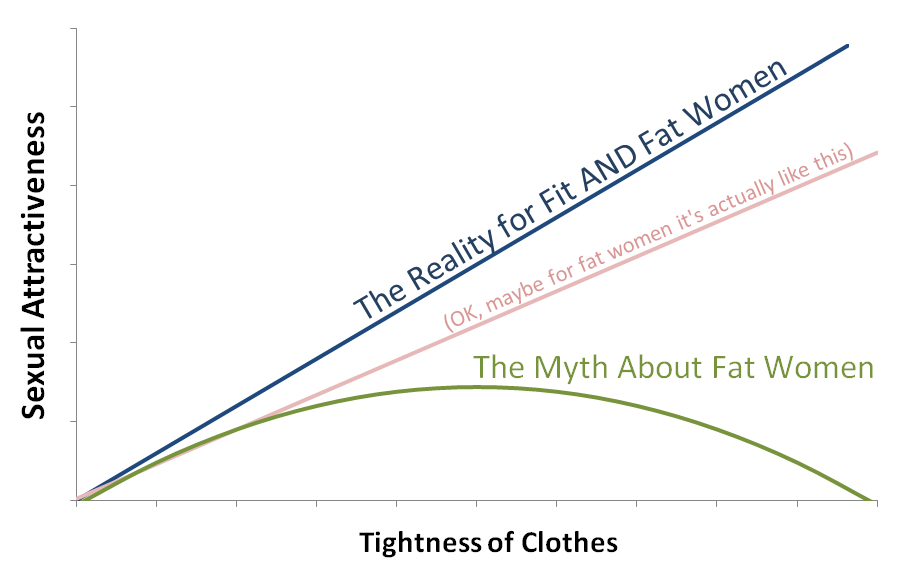
Granted, there is probably a way in which an overweight woman can choose clothes very carefully in order to play down her weight while playing up her curves; but these clothes won't necessarily be loose. Anyway it is somewhat beside the point, which is that, on the whole, tight clothes still make fat women hotter, even if they don’t make fat women hot. You might be able to argue that fat women gain less attractiveness than fit women by wearing tight clothes - great, no problem; I am just saying that they don't lose it.

It's been too long since I illustrated anything on here, so let's do so with a plot:


If you still aren't convinced, it might be worth pointing out that the mistake I am accusing people of making is actually a very common one in human reasoning. It’s easy to think that something is a certain way (i.e. unattractive) because of something rather than in spite of something. In other words, it is very easy to believe that a fat woman is unattractive because of her tight clothes, when the reality is that she is unattractive in spite of the tight clothes. The tight clothes make a woman's BMI a little more evident, so people are more prone to make this logical leap; but that doesn't mean they are right in doing so.

Conversations like the one above happen because men like to indulge in the idea that fat women are unattractive. It makes them feel better about their own sexual attractiveness to look down on someone else’s. If they have to slip through a logical loophole in order to do so, they aren't going to lose sleep over it. And the girls who mock fat girls for wearing tight clothes usually just aren't secure enough with their own bodies to wear something that tight. They aren't mad at what you are wearing, they are mad because it reminds them of their own insecurities. Of course, it is easier to mock the fat-but-confident girl than it is to face up to your own body issues, so that is exactly what they do.

Anyway, fat and overweight ladies: don’t be shy about wearing tight stuff to the gym, bikinis on the beach or tight dresses to the club. You can ignore the guys and girls that claim you should cover up, because their complaints say a lot more about their self-confidence (or lack thereof) than anything about how you look in spandex. And yoga pants might not make you look like a supermodel, or even thin, but they still turn guys on more than your baggy jeans.


Related Posts

Sunday, October 12, 2014

The Fantasy of Nightlife

When women go out, they are done up: they have makeup on, their hair is done, they are wearing heels, wearing their best clothes, etc. In addition, nightlife venues are almost always dimly lit, so that any cosmetic imperfections are hidden. In other words, they look their "best."

Men also get dressed up when they go out; but more importantly, they drink. The alcohol makes them more social and confident, more willing to go for what they want. And the magnum of Grey Goose they bought makes them look more important than they are. The loud music and bustling environment makes it unnecessary for them to lead a real conversation, so any lack of social skills is masked. In other words, they also look their "best."

Granted, men often over-drink, in the same way that girls often over-dress. Taking extra shots is the male equivalent of wearing too short of a skirt, or too much makeup. But the point is that, in nightlife, men and women lean on the crutch of added confidence or beauty (respectively) in order to appear more attractive to the opposite sex. The interesting thing is that, in addition to leaning on their own crutch, both sexes actually lean on the opposite sex’s crutch as well…

When men go out, they indulge in the belief that they can get girls who look like supermodels. The truth, of course, is that these guys can only get girls who look like supermodels in the club, and only when they themselves have liquid courage to assist, or loud music to mask their insecurity, or when they have the best table in the club to hide the fact that they are a run-of-the-mill manager in a medium-sized company.

When women go out, they indulge in the belief that they are attractive enough to get confident and powerful men to approach from across a room; but the reality is that they can only attract the men who can act confident after a couple drinks, or guys who know how to look powerful in a nightclub.

While this dynamic is far more exaggerated in nightclubs than it is in bars, it still exists in degrees wherever women are dressed up and men are drinking. Women lean on their appearance and sex appeal to be more attractive than they are normally, men lean on alcohol and status symbols to be more attractive than they are normally; and both sexes bask in the glow of the “results” they get in those circumstances.

This isn't necessarily a problem as long as you recognize what is going on, and enjoy it for the fantasy that it is. But it can be a problem if you let yourself slip into the mentality of “I get a lot of attention from the opposite sex,” when the reality is that you only get a lot of attention from the opposite sex when you go out – in other words, when you participate in the fiction of nightlife. This is significantly different from being able to attract someone in normal life, and assumptions to the contrary might be fueling your complacency.


Related Posts
1. The Analogy Between Confidence and Beauty
2. Bars Are a Bad Place to Meet Women
3. Bars Are a Good Place to Meet Guys – Part 1
4. Nightlife Tip 1 – Create Space at the Bar

Friday, September 26, 2014

Nice Guys Don't Exist

Everyone adapts their behavior to the people around them, and in response to the situation at hand. We are nice to people we like and mean or bitchy to people we don’t. We are friendly and cheerful when things go well and short-tempered or depressed when they don’t. Yeah, sure, there are some people who are generally more disposed to (for example) mean or more egocentric behavior than others, just as there are some people who are more disposed to (for example) kind or generous behavior than others; but even they are more mean or kind to some people, and less egocentric or generous to others. And of course there are some people whose behavior is less affected by circumstance than others, but not to the point that it isn't affected at all – and not even to the point that it isn't affected significantly. We like to think of personality as static and constant, intrinsic to each person. But the reality is that personality is merely a name we give to a set of behaviors coming from an individual; and those behaviors are very much mood-driven, situational and dynamic.

This misconception plays into our perception of the opposite sex significantly. Consider how frequently you change your behavior towards the men in your life…

If I approach a girl in a bar awkwardly, and then speak to her in a low voice because I am nervous, she isn't going to be attracted, and isn't going to respond well. The fact that she is short with me, or excuses herself immediately to go to the bathroom doesn't mean that she is a "bitch;" it just means that I didn't attract her enough. The next guy who approaches her might approach her confidently and genuinely, and have her wrapped around his finger the rest of the night.

If I have a dead-end job and lack ambition, my girlfriend isn't going to respond to me in the same way as the guy she dates next (i.e. after she dumps me), who is intentional in his career and gainfully employed in a position he truly enjoys. I might tell my friends that she was “cold” or “distant” but they'll know as well as I will that her next boyfriend probably has none of the same problems. Or maybe she is the one complaining that he is cold and distant.

The same kind of girls that ignored me when I was young and lacked confidence now treat me entirely differently, because I am older and far more sure of myself. At twenty years old, it was tempting to view those girls as stuck-up or bitchy; but the reality is that they were probably acting like angels towards some 30-year-old who was much more attractive due to his age, maturity and position in life.

I am not saying all of this to make a point about women, but to make a point about men – because men work exactly the same way. It is easy to believe that a certain guy is an asshole because he dumps you without an explanation, or that another is an authentically nice guy because he treats you well. But I am telling you: those men behave in entirely different ways with different girls.

The guy who you think is a player because he hits on three other girls before taking you home, then never calls you the next day – I guarantee that he is genuine and respectful and serious with other girls he dates. I know this because I've been that guy plenty of times. Some women I treat well and with respect, and others I don’t. If I see a girl I'm attracted to and whom I respect, I change my game completely. My male friends do the same.

The guy who is a dismissive asshole to you is a babbling, nervous idiot with the girl he is crazy about, and the guy who is such a gentleman to you absolutely crushes the hopes of girls that he doesn't find attractive, or doesn't respect. Likewise, the guy who never calls you back isn't “flaky,” he just doesn't care that much about you. I am sure there is a girl out there who has complained that he was needy and contacted her too much. And I am equally sure that the guy you were dating who seems to have “commitment anxiety” has at some point in his life practically begged to be in a relationship with a girl.

The thing is, nice guys don’t exist. “Douchebags” don’t exist. The behaviors we describe with these terms are not innate and static characteristics of any given person; they are behaviors that change depending on the other person involved and the circumstances surrounding the interaction. Of course there are men out there who are more disposed to certain types of behavior than others; but the degree of attraction a man feels for you will affect his behavior towards you far more than anything intrinsic to his personality, and the degree of attraction he feels for you is significantly affected by the kind of behavior you'll accept from him.

So instead of complaining about the dearth of nice guys or the abundance of douchebags, start thinking about what you can do to make then men in your life treat you the way you want. Because that is what is going to make the difference – not finding some "perfect guy" with some supposed personality type. You don't find perfect men, you elicit perfection from men.


Related Posts

Monday, June 30, 2014

The Importance of Variety in Your Appearance

There is a girl in my office that is extremely attractive. She is good-looking, but she is much more than that. She has great posture, always fixes her hair well, smiles frequently, is confident, and she generally radiates an air of femininity that is painfully lacking in many girls’ demeanor.

One thing that always stands out about this girl is the way that she dresses – specifically, the variety of clothes she wears. Every day she wears something completely different. In fact, I don’t think I have ever seen her wearing the same thing twice. I am not making a statement about the quantity of outfits she owns or the size of her wardrobe; I know plenty of girls who wear different outfits every day but still look boring. This girl actually looks different every day. One day she will be wearing jeans and a blouse, the next day she will be wearing a long, close-fitting dress, the next day cotton dress-pants with a loose, flowing top, and the day after that a pencil skirt. I've seen this girl wear clothes and dress types that I didn't even know existed. I realize that might not be saying much coming from a guy, but the point is that she is very clearly an outlier relative to other girls when it comes to the variety of clothes she wears.

It would be hard to underestimate how much men love this – and I say that with confidence because I've talked about it with several other guys and they agree categorically. Her daily choice of clothes is the topic of our lunch conversation more often than is probably healthy. It’s worth pointing out that this attention isn't the wrong kind of attention. Plenty of girls could work their way into our conversation by wearing short dresses, small tops or tight skirts. In fact, plenty do, and we talk about them too. But we come back to this girl way more than the others because we are constantly surprised and impressed with the variety. It’s hugely refreshing to see her every day in a different outfit.

While I am sure that women can appreciate variety in male fashion also, I am convinced that this is something men appreciate much more than women. I've explained before how strongly men crave sexual variety, and I've explained the importance of visual stimulation. By varying her appearance, a woman appeals to both of those masculine desires. Of course she can’t actually be someone else; but by looking different every day, she can come close enough. I don’t have a huge amount of evidence to support that claim, but when I think about how tempted I would be to cheat on the girl I am describing versus other girls that are equally attractive, there isn't much of a competition.

Having thought about it a bit recently, I can break down this girl’s fashion success into three factors:
  1. She takes risks. This girl doesn't always look good. In fact, I've seen her look downright horrible at times. One day she came in wearing these shitty gypsy-looking baggy pants and an ugly shirt, and I almost cried. A couple times she's worn colors that washed her out completely. I’d say that roughly 5-10 % of the time, she looks bad. But I realize that no one can pull off the kind of variety I am advocating without fucking up occasionally; besides, the variety and successes are both well-worth the mistakes. In fact, I would even be fine with more mistakes if it meant I’d get a girl who was equally dynamic in her wardrobe.
  2. She doesn't pay attention to office fashion norms. In other words, she doesn't think “this is a professional environment; a sun dress is inappropriate.” She might not always be wearing clothes that are “appropriate,” in the sense that they play down or divert attention from her looks, but neither is she dressing overly sexy or provocatively. Trying to bring women into the workplace and expecting them to dress like men is about as ridiculous as asking men to stay home with the kids and forcing them to dress like women. Women need to be allowed to be women, and “appropriate” has unfortunately been defined largely by a society that doesn't fully understand that.
  3. She enjoys looking good. There is no way that a girl will be able to force herself to dress in such a varied manner if she doesn't enjoy doing it. And although you shouldn't try to force yourself to enjoy it, you can let yourself enjoy it to whatever degree you naturally do. I said a lot about this in the post Femininity, Authenticity and Compatibility, so I won’t repeat myself here; but I want to make one additional point in that regard: you don’t need to be a supermodel to enjoy looking great, and you don’t even need to be hot for men to appreciate how you dress. Let yourself enjoy looking your best in as many ways as possible.
Of course, these principles apply to make-up and hair also. The important principle is appearance variety, not just wardrobe variety - but you can draw the analogies.

For the record, I recognize that having a wide variety of clothes can be expensive. And I am not going to pretend that women with less income are without a disadvantage here. That's life. If it helps stomach that fact, you can remind yourself that wealth disparities affect men in their dating lives far more than they affect women. But anyway there are plenty of ways to work the concept of variety into your wardrobe without breaking your bank, and there are plenty of girls reading this post right now who spend all kinds of money on wardrobes bigger and more boring than this girl’s. Make the most with what you have.

Now, all this being said, there is some value in the adage “looking good every day is more important than looking different every day.” While I suspect this statement was popularized more more with men’s fashion in mind than women’s, I also want to make it clear that I am not advocating wearing ugly clothes or crazy make-up only for the sake of variety. You need to indulge in variety wisely, choosing colors and cuts that look good on you. But within the limits of what you know suspect makes you look good, don’t be intimidated by the pressures of “what is acceptable” or what feels safe at the expense of what is different. Different counts for a lot.


Related Posts:
1. The Most Important Time to Dress Well
2. Feminine Beauty is Highly Controllable
3. Men and Sexual Variety
4. The Importance of Taking Fashion Risks

Tuesday, April 8, 2014

Stop Lying to Your Friends

Girls are famous for complimenting each other and supporting each other with their words. On the surface, this seems like a good thing. Telling your girl friend that she looks hot before a night out will boost her ego; telling her that the guy who just dumped her wasn't worth her time will help her get over him faster; and telling her that she has a "Beyonce butt" will make her feel more comfortable about her body... right? Wrong.

When you do these things, you are letting your girlfriend wallow in her mediocrity. If you tell your friend that she looks good when she doesn't, she isn't going to make an effort to look better next time. If you tell your friend that the guy wasn't worth her time, when the truth is that he definitely was worth her time, you are only going to prevent her from doing what she needs to do to make herself more attractive to the next guy of that caliber. And if you tell her that her big ass is sexy, she isn't going to lose the weight she needs to make it look better. 

Granted, your girl friend probably isn't naive enough or dishonest enough with herself to completely believe you when you say these things; but I am willing to bet that neither is she wise enough nor honest enough with herself to disbelieve them completely. By telling her anything less than the complete truth, you are placing a Band-Aid over the wound; you aren't substantially helping her. Or worse, you are cowering from your fear of telling her the harsh truth, only because you want to avoid the confrontation that it might cause. Even your excuse about making her feel good about herself falls flat, because a girl's "need to feel beautiful" cannot be satisfied by empty or equivocated compliments.

The problem with this kind of "support" is deeper than just the effect that you have on your friend. Not only are you wrong about the fact that you are helping her, you are probably also wrong in believing that your motive was to help her in the first place. You tell her that she looks hot because you think she needs to hear that she looks hot. But that is just a symptom of the fact that, if you were in her situation, you would feel the need to hear that you look hot - precisely because you wouldn't believe it. And you tell her that her ex wasn't worth her time mainly because, if you were in her situation, you wouldn't be comfortable with accepting the harsh reality that he was absolutely worth your time, but you lost him. And if you had an ass that size, you'd want to believe that the shape compensated for the size, because you'd hate having to face the reality that your ass is huge, and that you actually need to start a real workout, rather than just reading magazines on the treadmill three times a week. In other words, your inability to be honest with your friend is a reflection of your discomfort being honest with yourself.

Granted, there are right ways and wrong ways to break the news to your friend that she is fat, or looks bad, or just lost the man of her dreams - or any other news she isn't going to want to hear. I am not suggesting that when she asks "doesn't my ass look big in this?" you reply "yeah, like huge!" There are ways to get the truth across tactfully, one of which is not embarrassing her in front of others. For example, in that situation (assuming there were others present), you could say something like "It's probably not the right dress for you" and then later - in person - tell her that she should throw it away.

Also, pointing out problems without solutions is the hallmark of un-helpfulness. So the other important thing to do is to help her find a way to improve whatever it is you are giving her honest feedback about. After you tell her that you actually thing she lost a great guy, for example, don't just stop there and let her believe (wrongly) that she has an inherent lack of ability to get a quality man; tell her that you think you know a couple reasons he might have left, and offer to help her improve in those areas.

By starting to be more honest with your girl friends, you aren't going to start a revolution in the way that women give each other feedback and advice. This is something rooted in female nature, in the same way that the male inability to engage each other emotionally is rooted in theirs (and neither is a strength). But you could do something far more important, in the sense that it affects you a lot more: you could change the culture in your group of friends. If one or two of you start breaking the insincere compliment cycle, the others will catch on, and soon realize that yours is a better course of action. The more you foster that culture among your group of friends, the more you all will benefit from the mutual honesty, the more you will improve yourselves and your chances with the opposite sex.


Related Posts

Thursday, February 20, 2014

There Is Nothing Modest About Loose Jeans

Every now and then I meet or see a girl wearing loose jeans. By "loose" I don't mean that the crotch is sagging around her knees, I just mean that there are places on her hips, ass and upper legs where the fabric is not touching her skin. I suspect that girls do this for one of three reasons:

(a) They think their figure isn't attractive enough to wear tight jeans.
(b) The think that tight jeans are immodest.
(c) They don't care about their appearance and loose jeans are more comfortable.

I realize I won't convince group (c) of anything, so I am only going to address (a) and (b). Let's start with group (a)...

No matter how fat you are, or how badly your ass is shaped, loose jeans make it look worse. Tight jeans might not make your ass or legs look good, but loose jeans will make you look like a man.

As for the group concerned with modesty: you need a reality check. Tight jeans are not provocative; they are normal. Despite what your parents probably raised you to believe, modesty is not something objective. What looks "appropriate" or "slutty" or "conservative" changes significantly depending on two things: context and social norms.

If you were to walk down the street of your city in a bikini in the middle of winter it would shock people and look slutty. Any man who saw it would be turned on. But on the beach, bikinis are normal. Men are much less turned on by them because they are expected. They don't look slutty at all. This is what I mean by context.

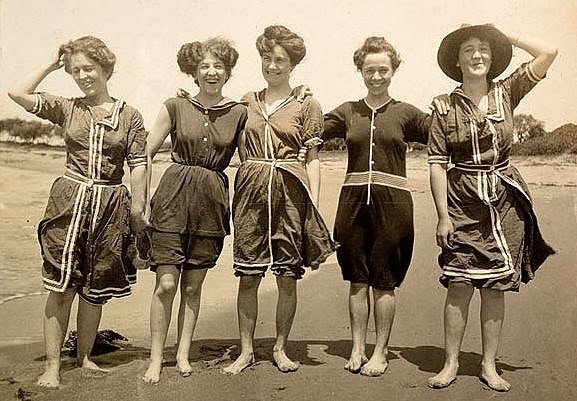
In Victorian times, swimsuits were less-revealing than most women's dresses are today. Today, swimsuits are more revealing than most women's underwear in Victorian times. Dress-like swimsuits didn't seen slutty or over-conservative in Victorian times, and neither do bikinis today. This is what I mean by social norms.

Here is the thing: modesty isn't a function of the quantity of skin you show, or the tightness of the clothes you wear; it is defined by how much your outfit makes men (or people in general) think that sex with you is imminent. The more you incite in men the thought that they can bang you easily, the less modest your outfit is. This is why short dresses are so much more sexual than pants. Men see you in a short dress and part of their subconscious recognizes that your vagina is essentially exposed (i.e. from the bottom). Sex seems much more accessible and immediate because there is only one thin layer of clothing covering the most sexually intimate part of your body.

But the threshold for triggering a man's thoughts of sexual proximity - the criterion for immodesty - is entirely relative to social norms and context. The man on the beach doesn't think sex is imminent when he sees you wearing a bikini, because every woman on the beach is wearing in a bikini, and he knows it is for swimming or sunbathing. But in 1910, if a man saw a woman on the beach in a bikini, he'd be sure that she was a woman of loose morals - and he'd probably be right.

Anyway, the point here is that wearing tight jeans in everyday American life is about as shocking as wearing a bikini on the beach in 2014. And wearing loose jeans in everyday American life is far more similar than you think to wearing a Victorian bathing costume to a Las Vegas pool party. Perhaps more importantly, when you use your clothes rather than your behavior to be modest, you are far more similar than you think to the girls who use their clothes rather than their behavior to get sexual attention. Don't be so sure that you are more intelligent just because you made the mistake about modesty rather than sexuality.

Is there an opposite extreme, where tight jeans start to look like a bikini on a Victorian-era beach (i.e. slutty)? Yeah, probably, but that's not the point - there are always excesses on both extremes. Today I happen to be calling out the conservatives.

So remember: wearing loose jeans doesn't avoid the wrong kind of attention; it just makes you look terrible.


Related Posts
1. "The Wrong Kind of Attention"
2. How to Get "The Right Kind of Attention"
3. Don't Wear Sneakers
4. The Most Important Time to Dress Well

Sunday, January 26, 2014

5 Winter Fashions Men Like

Most men are familiar with the "75 degree rule," which refers to the fact that, in Spring, women seem to come out from their Winter hibernation once the temperature rises above 75 degrees Fahrenheit (for those of you not burdened by an archaic system of scientific units, that is 24 degrees Celsius). Spring comes, and hot girls are suddenly out everywhere wearing shorts, dresses, small t-shirts and skirts. When I first heard of the rule, I remember speculating that perhaps girls weren't actually indoors any more than men during the winter; it was just that we noticed them less when it was cold because they were all bundled up in clothes that hid their beauty.

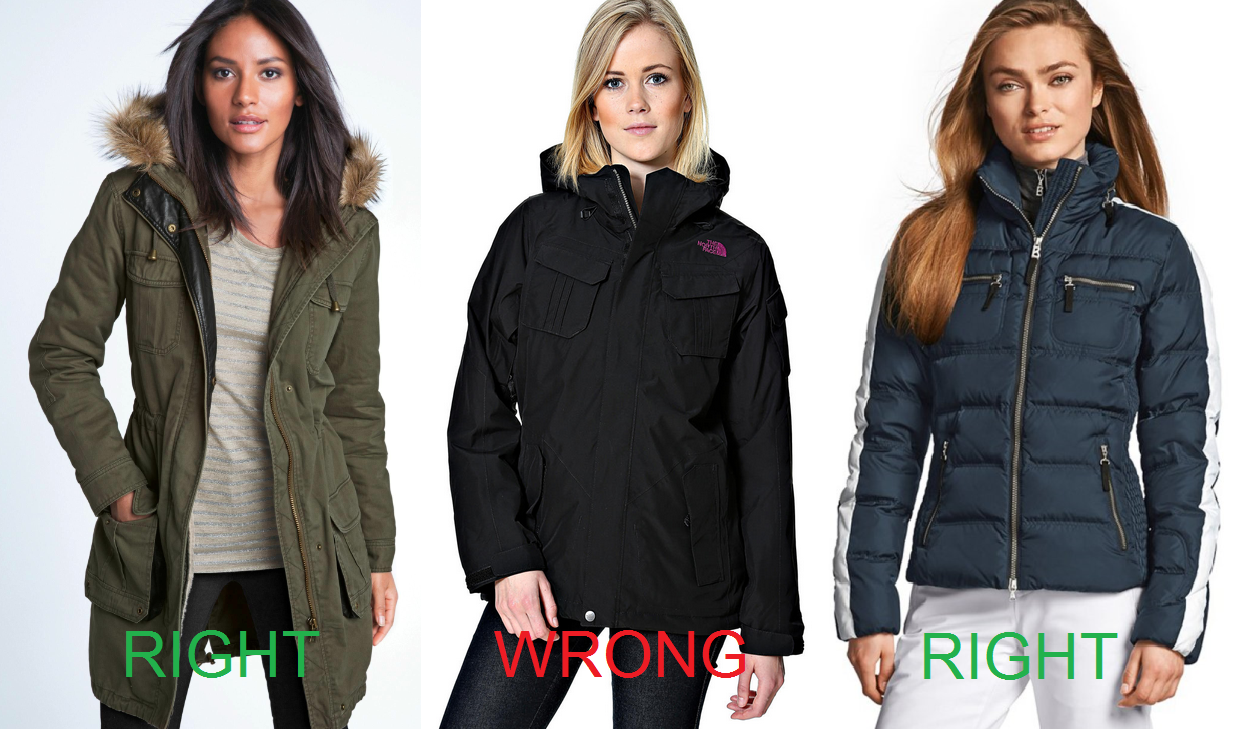
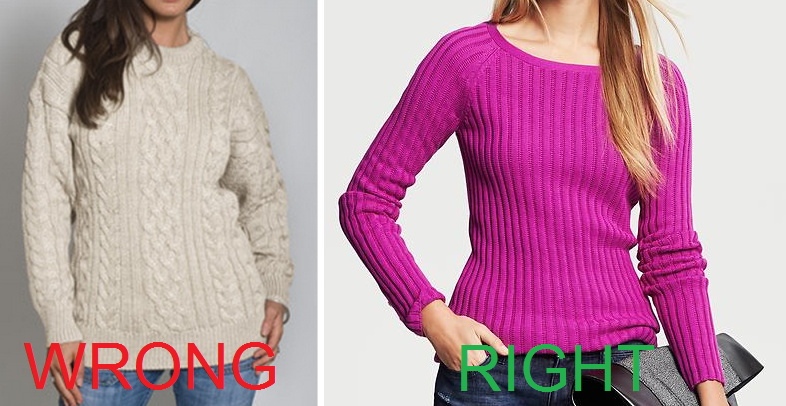
I still stand by my speculation, because the simple truth is that the feminine figure is more attractive when it isn't concealed  (yes, even if the woman is overweight), and the more delicate and feminine parts of a woman's body - like her neck, jawline and breasts - add nothing to her attractiveness when they are covered by a jacket or scarf. So female winter fashion is all about minimizing the effect of the extra material. To this end, the fit of your winter clothes is more important than anything else. The more your clothes follow the natural lines of your figure, the better. This doesn't mean that you always need to wear tight clothes, but it does mean that the bulky jacket your mom bought for you last year probably makes you look like a man. Three tight layers are far better than one heavy layer.

Anyway, here are five female winter fashions/considerations that will make men find you more attractive in winter. There are obviously plenty of other ways to look attractive in cold weather, but these are good starting points:

1. A Jacket That Fits You. For the purposes of looking good in cold weather, nothing is more important than the fit of your jacket. Men should be able to see your curves when you are wearing your jacket. This means that it should follow the curves of your waist and hips. It also means having sleeves that don't add bulk to your arms. And then there are the general aesthetics related to having as few wrinkles as possible from excess material. Most popular clothes stores design and cut their clothes for "average" people, which in the United States, means fat people. So for many girls, getting a jacket that fits will mean having to buy something that is more expensive, or else having a cheaper jacket altered by a tailor. A draw-string at the waist can also help to achieve this effect.


2. Fur-Trimmed Hooded Jackets. I've often told my guy friends how much I like these, and they always agree. The fur is extremely soft, warm and playful = feminine; and if you choose the color to properly complement your complexion, it can be extremely attractive visually as well. Popular fashion seems to have caught on to this in the last year or so, and more girls are wearing them. Because of this, you might not stand out as much by wearing one, but it also means that it is much easier to find them in stores. Besides, "looking like every other girl" is only problematic when every other girl looks bad. Here is an example:


3. Tight Sweaters. A tight sweater embraces everything I said above about the importance of wearing well-fitted clothes. There is something both sexual and nurturing about a woman wearing a tight sweater. It is sexual for the obvious reason that it shows off her figure, but it is nurturing because it gives her an air of warmth and comfort. (Note: We left turtle-neck sweaters in the 90s for a reason: they are hideous on both sexes. Never wear one.)


4. Tall, Heeled Boots. Uggs are great if you want to look like a little girl; but if you want to attract guys over the age of 15, you will need to embrace a more mature look. Tall, heeled boots are sexy. They achieve all of the effects of attractive posture that you get from high heels, and their height draws attention to your thighs and waist. Heels are more important than height, but if heels aren't possible, tall boots without heels are still better than most other shoes - probably warmer too. All three of the examples below are great.


5. Leggings. Because they contain no vital organs, your limbs are the parts of your body least prone to the effects of cold weather; so most women are capable of going outdoors in leggings, even in the middle of winter. This is good, because they are sexy as hell. They make every woman's legs and ass look 10 - 20 % better than normal, and because they are so popular and reveal no skin, no one thinks they look slutty. Yes, they are hotter than a pair of tight jeans - probably because cotton can never conform to your body as well as synthetic, stretchy materials. And no, you don't need to be thin for them to make you look better. Black is obviously the most versatile color, but designs and patterns can work too, as long as they aren't overly obnoxious (e.g. cartoon characters or logos). Wear two or three pairs if it's too cold.

If any of these looks seem like they "aren't you" it is probably only because you haven't tried them yet.


Related Posts
1. The Most Important Time to Dress Well
2. Appearance Checklists
3. How to Make Any Outfit Better
4. Don't Wear Sneakers
5. Sexy Versus Cute

Tuesday, March 26, 2013

What Men Think About Your Disability

Hi Andrew,

I don't think I'm your target audience but found myself agreeing with many of your posts (mercifully they are short, to the point and well written).

When I am out and about I get a fair amount of attention from men and women. People smile often, say hello, compliment me on my hair, generally really nice to me. Well the women do. I even have complete strangers pouring their heart out to me. I notice men looking at me and once in awhile they smile. Without appearing 'full of myself' I know I have a nice, friendly, open face and personality. I do get very nervous if I'm aware a man might be interested in me. Consequently, all that easy breezy confidence I usually have disappears.

The thing is, I have weakness in my legs and I use a walker. I think this is an impediment (along with my age, although most people think I'm much younger than I am). I have had men approach me even though it's clear I need an aid. Mostly they do not. Most people really do notice my face first and then their eyes wonder down to notice my walker; they look back up then away.  My guess is that a lot of people are intrigued by the dissonance: a young looking, pretty woman using an "old lady" walker.

I appear very normal other than using a walker. I'm only interested in meeting a guy to date seriously. By the way, I'm 46.

I know my physical disability slashes my chances with most men but do you have any suggestions about how I may increase them?

Kind regards,
Nancy
__________________________________________

Nancy,

If I imagine myself in a public place where I was open to meeting women, and I saw an attractive woman with a walker, my reaction would be something like this:
"Woah, she is good looking. Is that a walker? That's kind of strange... but also interesting. It might be a little awkward trying to 'talk around' it [i.e. avoid bringing it up in conversation, or making sure to do so tactfully] but I still want to meet her. I wonder if it affects her ability to have sex? Would it be weird dating a girl like that? Would the walker be in the way all the time? I bet she is a good and interesting person." 
Then a series of images would flash through my mind about how the walker might play into a relationship with her. I might imagine helping her get seated at dinner, getting into and out of the car, etc.

This is not just a hypothetical situation for me. I had a similar experience one time, fairly recently, when I came across a cute girl's profile on a dating website. When I clicked-down into her photo album, I saw that she had deformed legs and a wheelchair. I remember thinking essentially the same things I've paraphrased above.

You can be 100 % sure that the sex question will go through any guy's mind if he is otherwise interested in you - whether it is for a temporary or long term relationship. In fact, I think it is safe to say that for any guy, this will be his biggest question, even if it seems obvious to you that there wouldn't be any issue. While it would be pretty awkward to convey your ability to have sex in a spoken conversation, you might consider internet dating, where you could literally add a note about it to your profile - maybe just a sentence at the bottom saying something like "By the way, even though I have a walker, I just want to put it out there that I am still capable of normal sexual relationship." This might seem a little awkward to post online, but it would be well received by the men, and it would remove an impediment - again, probably the largest - from their willingness to contact you.

If you date a guy and you get to a point where you would be comfortable having sex, I suggest letting him know indirectly that you are capable of it. You can do this by taking a natural opportunity in conversation to point out that your disability "doesn't prevent anything except your ability to walk." No need to wink, raise an eyebrow or even say it in a suggestive tone. Even if he doesn't understand that you are trying to convey your ability to have sex (in fact, it would be better that he didn't), that comment will be in the back of his mind when he thinks about having sex with you later, and it will have helped to form his understanding of the limited effect of your disability. He will therefore be more comfortable making a sexual advance. If he makes an advance before you are comfortable having sex, I suggest pointing out the reason why you aren't ready (maybe it's just too soon, or you are waiting for marriage, etc.), so that he knows that it isn't because of your disability. I do not suggest making an advance yourself.

The second biggest consideration will be the overall effect of the walker on day-to-day activities. I don't see this being a huge problem to an open-minded guy, but some men would prefer not to have to deal with it at all. The latter group of guys are probably not the kind you are interested in anyway, and I suggest just being happy that they won't waste your time. However, the ignorant and open-minded guys are the extremes on a scale. Different guys will consider your disability a "big deal" to different degrees, and it will play into each's decision accordingly. So with all guys, the best thing to do will be to help them become familiar with its minimal effect on your life as soon as possible. You can do this mostly by showing him how casual you are about it: if you go on a date, be nonchalant about your walker in any situations it creates. Mention the walker in passing without focusing too much on it, or casually telling a story in which it played a role, but moving on naturally in the conversation afterwards. Your casual references will speak volumes about the normal-ness of the walker in your life.

Humor will be a very big tool for you in this regard. In fact, I think it can be your biggest ally if it isn't too forced. For example, I envision you talking with a girlfriend and a guy you like, and you telling a story that happens to involve a funny situation that was caused by your walker. For a split second after the punch line, the guy is mildly uncomfortable (because he doesn't know how he "should" respond), but that awkwardness instantly melts away when he sees you and your friend talking casually and laughing about the whole thing. Then you return to normal conversation, just like after telling any funny story - except that he now realizes a bit better how natural it is for you, and how natural it would be for him if he were to date you. If you can show him that you can laugh about your walker and disability, he will be much more comfortable with the idea of dating you.

The converse is also true: nothing will turn off men more than to get the impression that your disability is a big deal, and is awkward, and is an impediment to a normal relationship. The girl I mentioned earlier with the wheelchair on the dating website made one huge mistake: she put a disclaimer at the bottom of her profile saying something like "and if you send me a message asking about my chair I will find where you live and beat you up." Obviously her threat was a joke (she was tiny), but it showed that she was uncomfortable with any attention drawn to the fact that she was different. She thought her wheelchair was a much bigger deal than it really was, and that was a red flag to me and other men that we would constantly have to tip-toe around the subject. Ugh. I would have been so much more attracted if she'd had written "Oh, and if you think my wheelchair holds me down, just wait 'til I kick your ass on the basketball court! ;)"

The general idea, I think, is that your walker isn't a big deal and you just need to show potential boyfriends this. I can tell from your e-mail that you are very comfortable with its effect on your life. But realize that for the guy, it is a new thing with a lot of associated uncertainty. The sooner you can remove that uncertainty and replace it with normal-ness and humor, the more he will be able to envision himself living with it and you.

It is worth mentioning that your walker is certainly acting at least partially as a filter. If a man approaches you, you know he is interested in something more than sex. Therefore I think you can ignore any advice about gauging his interest or making him wait. This doesn't mean you should take the initiative yourself (asking him out or for his number, for example), because this will come across as needy; but it does mean that you can be more open to his advances than other girls. (If you aren't getting a lot of attention from men at the moment, this openness will probably come naturally, since you will be excited about the prospect of finding a guy.)

So maybe I can summarize by saying I suggest the following:

  • If possible, convey to him that you are capable of sexual relationship
  • Demonstrate immediately that your disability is not a big deal, and that you are comfortable with it
  • Recognize that a man approaching you has already been "filtered" so there is far less need to test him. Be open but not needy.

Oh, and about being nervous when a guy gives you attention: you can be sure that the guy is nervous about giving you attention, and most likely does not notice your nervousness - unless you show some painfully visible sign of it (shaking for example). The first time I hit on a girl at the grocery store I was nervous as hell. I'd passed her in the aisles a couple times and she'd made eye contact back at me, so I suspected she might be interested, but I was still nervous. I forced myself to approach her and she was clearly nervous too (fidgeting, awkward, etc.). All this did was to calm my own nerves, which in turn calmed hers, and we had a nice conversation.

I hope some of this helps. Good luck and thanks for the kind words about the blog.

Andrew
__________________________________________

Hello Andrew,

Thank you so much for your thoughtful and practical advice. It is very helpful. I can't tell you how much I appreciate it.

You have helped me realize that I had made the walker more of an issue than needed. I suppose I lacked faith that any man would look past my disability. I'm glad you pointed out that I need not play hard to get with a man who has shown interest. It is a reminder that we really need to assess our unique positions when reading material on dating.

My confidence has gone up a notch. Now, all I need to do is get out there.

You really ought to write a book if you haven't already.

Once again; thank you.

Kind regards,

Nancy
_________________________________________

Andrew,

I was thinking if and when the time comes, do I need to be completely honest about how far my disability has affected my life? For instance, I am in continual pain but I have learnt how to manage it. Or do you think it would be better if I don't make an issue of it?

Nancy
__________________________________________

Nancy,

I would focus more on making sure he knows that you are used to it than trying to point out how bad it is. Just telling him how much it hurts isn't the whole story, because, as you say, you have learned how to manage it.

Recently my coworker and his wife bought a new house. They got a great deal on it, but realized only after they moved in that it was under the flight path of a local airport.

When they first moved in, they started hearing the planes, and were worried that they'd made a huge mistake. But after a couple weeks they literally couldn't even tell you when an airplane had passed because they were so used to it. If the real estate agent had shown them the home during heavier airplane traffic, or called their attention to it, they'd probably have immediately walked away, not realizing how minor a disturbance it would actually be. They would have missed out on a great deal.

Likewise, if it comes up in conversation for some reason, I would be honest and admit that yes, it hurts - sometimes a lot - but emphasize that you know how to manage it and it isn't a big deal because of that. I wouldn't even go into detail about how you manage it, because that calls more attention to it than it warrants. The point is that you do manage it, and it isn't a huge thing. End of story.

Hope that helps,

Andrew


Related Posts
1. You Are Responsible for Your Own Romantic Happiness
2. Self-Improvement Takes Time
3. Why You Don't Get Approached by Men

Monday, March 18, 2013

Ten Ways to Improve Your Skin

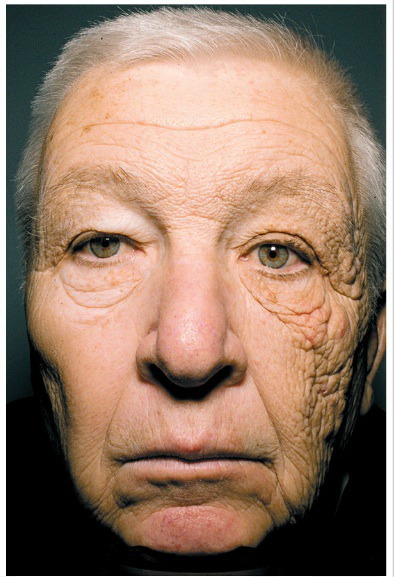
The effects of UV radiation (sunlight). See item #1 for an explanation.
I am at the age where my skin is starting to showing initial signs of aging. So in the last year or so, I've done some research on skin care. The lessons I've learned apply just as much to women as they do to men, so I want to share them here. Some of these points will be obvious to some readers, but they will be news to others - as they were to me. Full, vibrant, healthy skin is the primary sign of a your youth, and your youth plays a big role in your physical attractiveness. Whether consciously or subconsciously, men notice your skin; so take care of it.

1. Wear a daily moisturizer with sunblock. Wearing sunblock daily should be something you do as regularly as brushing your teeth. Get into the habit of realizing that when you walk out into the daylight without protection, your skin is being abused and bombarded with UV radiation - even when it is cloudy (clouds don't block UVA light).

If it is difficult to recognize the severity of this effect, take a look at the picture here of William McElligott, a 66-year-old truck driver, who didn't wear sunblock. He spent 28 years on the job. While driving, half of his face was shaded from the sun by the cab of his truck, which reduced the effects of UV radiation. The effect is obvious. Imagine your face looking like his (but on both sides) every time you go outside, and you will probably find yourself motivated to start wearing daily moisturizer with sunblock.

SPF 15 should be enough for most people (use a higher SPF is you spend more time outside than average). Note that it is also worth getting a daily moisturizer that has anti-oxidants such as green tea and cucumber extracts, vitamins C and E.

(I shouldn't need to mention that tanning beds are the devil. By tanning, you are seeking out the skin abuse described above and merely trading a nice but temporary skin tone now for premature aging later in life - and possibly cancer.)

2. Use Retinol, which is a form of Vitamin A. It essentially tells your skin to act and look younger. It is the drugstore version of the FDA-approved anti-wrinkle compounds often prescribed for aging skin and wrinkle treatment (retinoids). Make sure retinol is an ingredient in the anti-ageing or tone-correcting serums you use. Neutrogena makes a great fragrance-free and oil-free option: Neutrogena Healthy Skin Anti-Wrinkle Night Cream. (Don't worry if your skin feels dry or a tad flaky for the first few weeks of use - it will wear off.) You can find more information about Retinol here.

3. Wear facial moisturizer while you sleep. This will lock in moisture, which will be used to repair your skin while you sleep. There are special types for night use, but the general rule of thumb is that you should use a thicker cream if you have drier skin, while those with oily or acne-prone skin should use a lotion or gel. Try CeraVe PM or Clinique Dramatically Different Moisturizing Gel.

4. Wash your pillowcases frequently, at least every time you do a load of laundry. Your pillow case accumulates dirt from your hair, face, hands, and even from the air (dust). This is all transferred straight to your face every time you lay your head down at night. Get two sets of pillowcases and get in the habit of putting the fresh ones on every time you take a load out of the dryer

5. Pad your face dry after you shower or, even better, let it air-dry. Don't scrub your face dry with the towel the way you dry the rest of your body, as this will irritate the newly washed skin and push bacteria into your pores.

6. Use lukewarm water to wash your face, even in the shower. When water is too hot or too cold it shocks your skin and can cause capillaries to rupture. This brings with it discoloration, which is unattractive.

7. Choose your soap/cleanser carefully. Soaps dissolve dirt, but in the process remove the oils that your skin produces to protect itself. The ingredients that hold most bar soaps together also clog your pores, and the added fragrances can be irritating. Many people are still accustomed to using bar soaps, and remain victim to the heavy marketing of their favorite soap's scent (they can't feel clean without it). Don't follow their lead. Choose a fragrance-free and sulfate-free cleanser, such as CeraVe or Cetaphil foaming face wash - particularly for use on your face. These will clean without the loss of oils and irritation.

8. Exfoliate with caution. While exfoliating scrubs are praised (and heavily marketed) as giving a deep clean, your skin doesn't need a deep clean every day. When you use exfoliating scrubs, you are using abrasion to remove impurities and dead skin; but in the meantime, the abrasive particles cause damage to the healthy skin underneath. You are effectively putting thousands of tiny scratches on your face - removing the bad stuff, but also creating potential sites for infection. Pay particular attention to #5 and #4 when you are exfoliating, and moisturize immediately afterwards  Note that scrubs with polyurethane beads, (round, plastic, smooth ones) will not tear skin and are fine for use as an exfoliant. There are also chemical exfoliants available that have anti-aging properties.

9. Wash your towels frequently. Just like your pillowcase, your towel accumulates dirt. When you touch it to your face, especially right after washing it, you are infecting your open pores with bacteria.

10. Moisturize immediately after washing your face or showering. You know that "dry" feeling you get after standing in front of the mirror for a few minutes after showering, especially in the winter when the weather is cold and dry? That is the feeling of the immediate evaporation of moisture due to the lack of oils in your skin. Shorter showers with lukewarm water will prevent this, but you should also apply moisturizer immediately to your still-damp skin after getting out of the shower. This will lock in the moisture.

Thanks to reader and medical esthetics student Laura Payne for her help in adding some depth to these points for me, as well as the product recommendations. Check out her work here: (Blog) (Twitter) (YouTube)


Related Posts
1. How to Improve Your Hair
2. Your Skin Color Matters
3. One Way to Improve Your Look