Showing posts with label posture. Show all posts

Thursday, July 18, 2013

The Importance of Personal Boundaries

A lot of girls have e-mailed me asking for my opinion of the book Why Men Love Bitches. I'd heard of the book a couple times outside of the blog as well, so about six months ago, after a handful of these requests, I decided to get a copy to see what it was all about. My conclusion was that the book is saying something true, but also saying it poorly.

The truth is that men are attracted to bitches, but we don't love them because they are bitches; we just love women that happen to be bitches. In other words, men are attracted to bitches for a quality other than their bitchiness - a quality that any woman (bitch or not) can have. A similar thing is true of women who like "assholes." They only like those men because they are also strong, or confident, or powerful. They don't like them because they are assholes, they like them in spite of their being assholes.

The book Why Men Love Bitches doesn't make this distinction strongly enough for my taste. It skirts around a point that many women desperately need to hear without ever directly addressing it. It plays on an attention-grabbing title, at the expense of clearly telling women the crucial point - namely, that being a bitch, in-and-of-itself, is actually very unattractive to men. My worry is that some women read the book and start being bitchy in an attempt to attract men, just like many men try to be assholes to attract women. Both strategies are dangerous because they are often partially successful, despite missing the real point.

In any case, this criticism obviously begs the question: what are “bitchy” girls doing right? If women like men who are assholes, not because they are assholes, but because they are confident or strong in some other way, then what is the analogous quality in "bitches" that attracts men? And the answer is simple: bitchy women have strong personal boundaries.

Personal boundaries are the limits at which you "draw the line" and prevent other people from infringing on your personal world, that is, your personal rights and emotions - essentially, they are the limits of "what you will put up with." Boundaries apply in both big and small matters, and in all areas of your life: romantic, practical, physical, emotional, spiritual. Some people draw their boundaries quite close to themselves, allowing others to infringe upon their personal world dramatically, without resistance. Others draw expansive boundaries, protecting even their smallest and least significant rights and emotions relentlessly. Balancing between these two extremes is critical. But before saying more about how they play into male-female dynamics, I want to illustrate the concept with a few examples...

Example 1 – A woman is riding a busy train. There is one seat available, but a businessman is using it for his laptop bag while he works intently on his computer. The woman wants to sit down, and certainly has a right to the seat, but she will handle the situation differently depending on the strength of her boundaries. If they are very strong, she will walk up to the man and ask him politely to move his bag so that she can sit down. If she has medium boundaries, she might walk into his field of view, a little tentatively, hoping that he will take the initiative to move his bag himself – but standing if he doesn't. If she has weak boundaries, she will be too nervous about upsetting him, and will tell herself "I can just stand, it isn't that far," which is exactly what she will do.

Example 2 – A woman is asked out by a man who doesn't show up for a date, and doesn't apologize. If the woman has strong boundaries, she won’t hesitate to delete his contact information, and tell him when he calls back three days later that he can go fuck himself. If the woman has medium boundaries, she will probably keep his contact info and ask him what happened, but ultimately agree to another date – despite being under-impressed with his excuse. If she has weak boundaries, the woman will probably just pretend nothing happened, assume that she must have misunderstood the plans, and maybe even apologize for the text she sent that night asking what happened (which he never answered).

Example 3 – A girl walking down the street is asked to contribute to an organization or charity whose ideals she does not believe in. The person asking for donations is enthusiastic and persistent. If the girl has strong boundaries she will say "no" immediately, ignore the second request, and maybe even snap back "I said no!" if asked a third time. If the girl has medium boundaries she is likely to apologize and makes an excuse about not having any money on her, in order to avoid donating and compromising her beliefs. A girl with weak boundaries will first try to avoid the person asking for money altogether; but once she is asked, she will immediately give in, and actually donate a generous amount because she sees on the list that other people have done the same.

Example 4 – A girl is throwing a neon-themed party, and wants to invite a guy she has a crush on. The idea of the party is that anyone who attends has to wear all neon, and the girl knows that if she lets one person come in normal clothes, others will too, and the theme will be spoiled. Upon inviting the guy she likes, he tells her that he'd like to come, but he has nothing neon to wear, and that he has no time between now and the party to buy something. A girl with weak boundaries will immediately tell the guy that it isn't a strict requirement, and that he should just come anyway. A woman with medium boundaries won't bend on the requirement, but she might offer to help him find some neon clothes. A woman with strong boundaries will smile, maybe throw in a wink or a nudge, and tell the guy that if he really wants to come, he will find a way to get something neon (she isn't going to let him ruin the party just because she likes him).

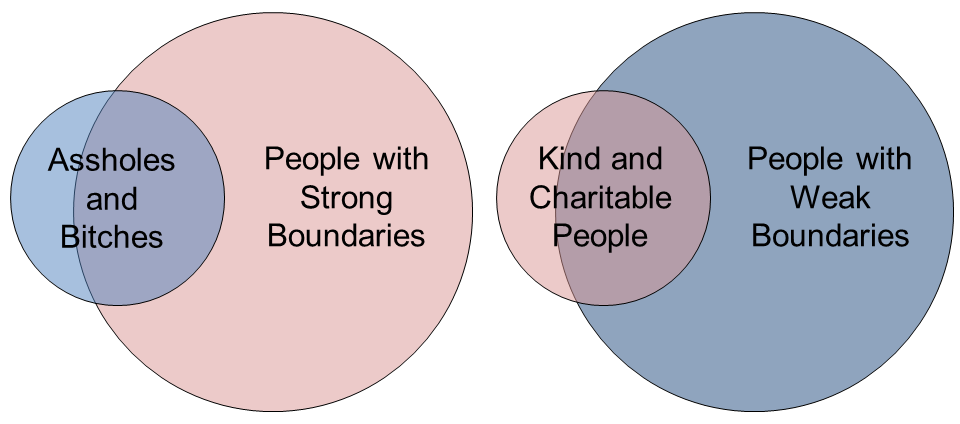
Often people with weak boundaries are thought of as kind or charitable, and a lot of people with strong boundaries are perceived as assholes and bitches, but these labels are inaccurate. It is perfectly possible to have strong personal boundaries without being an asshole (best illustrated in example 1, where the woman is firm, but polite), just as it is perfectly possible to have weak personal boundaries without being kind or charitable (best illustrated in example 3, where the girl gives to charity, but not for altruistic motives). Assholes and bitches are just a subset of the group of people with strong boundaries, just as kind and charitable people are just a subset of the group of people with weak boundaries.

This can be illustrated quite simply with a Venn diagram. There is some overlap between the groups, but there are plenty of people with strong boundaries outside the set of assholes, just as there are plenty of people with weak boundaries outside the set of kind people. Neither group completely encompasses the other.
Perhaps the primary way in which we judge another person's value (and I mean primary both in the sense of "main" and in the sense of chronologically first) is by evaluating what they appear to think about themselves. We do this by observing their confidence, their posture, their grooming, the way they dress, and most importantly, the way they interact with others. We form an opinion of their self-esteem and bearing.

We do this because - unless we know them extremely well - we are privy only to a limited amount of information about their capabilities, talents, and weaknesses (i.e. the things that actually define their value); so we are forced to make a second-hand judgment, an inference. But in general, this judgment is reasonably accurate, because people usually know their own strengths and weaknesses almost perfectly. This self-knowledge usually informs their level of confidence, such that the way that they carry themselves usually reflects their strengths and weaknesses reasonably well.*

Now, healthy boundaries are a sign of confidence, of someone who respects themselves, of someone who knows their own self-worth. Weak boundaries, on the other hand, are a sign of insecurity and low self-esteem. The woman who asks the man on the train for a seat knows that she is just as good as he is, and just as deserving of the seat, so she has no inhibitions about asking (or even telling) him to move his bag. The woman who lets her date get away with not showing up thinks he is the best she can do (i.e. thinks she is below his league). She is afraid to cut him off because she doesn't want to lose him. The girl who can't say no to a donation request, and then gives more than she wanted, has such a poor self-image that she puts even a random charity worker's opinion above her own money and principles. And the girl who tells her crush not to come to the party out-of-costume does so easily because her sense of self-worth is not contingent on one man's willingness to attend a party – or even on how much he likes her.

I am saying all of this is to make a very simple but crucial point: when a man encounters a woman who has strong boundaries, he knows that she values and respects herself, and he therefore makes the reasonable inference that she is a woman of good character. Assuming she meets his minimum criteria for physical attractiveness, his attraction for her – and I am talking about the long-term kind, the kind that makes men fall in love – will skyrocket.

The opposite is also true. When a man meets a woman who lets him (or others) walk all over her boundaries, or even define them, he concludes that she doesn't respect herself, and therefore, that she must not be someone worthy of respect. Even if she is beautiful, his attraction for her will soon plummet.

In my experience, women tend to have weaker rather than stronger boundaries. My guess is that this is true because, from a young age, their boundaries are often handled by the males in their lives – a protective father or brother, suitors who believe they need to be “gentlemen,” male colleagues who suppress their sexual attraction in the office, etc. Surrounded by this behavior, women have relatively less practice than men (on average) maintaining their personal boundaries, defending their personal space, rights and emotions. As a result, they aren't as comfortable confronting someone on the train about moving his bag, or telling those who mistreat them to go fuck themselves.

It has also been my experience that the more attractive a girl is, the more likely she will be to have weak boundaries. This is a little counter-intuitive, and definitely a generalization, but I think I understand why it is the case. From a young age, beautiful women are surrounded by men who are constantly demurring, constantly meeting their needs, and giving them whatever space or compliments they need. Some women like this still manage to develop strong boundaries, and they are the ones that men would kill to be with. But most do not, because they've never had to "fight" for anything. When a woman like this comes across a man who is confident and attractive, she invariably gets banged, walked all over, then dumped. And it is largely because she doesn't show the men in her life that she is someone of value. If she were to maintain strong personal boundaries, men would see that she respected herself, and would want to trace that confidence to its root by getting to know her.

Do not underestimate the importance of this post. For what I suspect is the majority of my readers, it is probably the most important one I've written. I get e-mails all the time from beautiful women (they attach pictures), telling me that they are doing "everything right," but that they still can't land a man. Other women e-mail me asking how they can really "hook" a guy, how they can make him look past the sex, how they can get him to fall in love. They can attract the men they want, they just can't seem to keep to them. This post is fundamental to answering both questions.

For the girls doing “everything right”…
If you read through the posts on this blog, you will notice that many of them – some of which are linked in the Related Posts section, below – advocate the maintenance of strong boundaries in specific situations; but boundaries are not something that you can apply to your life only in a piece-wise fashion. This is transparent. Even if a girl doesn't fuck on the first date, a guy will know that she has poor boundaries when she accepts a date after he’s admitted that he isn't looking for anything serious. Likewise, a girl who doesn't initiate contact still betrays her weak boundaries if she replies immediately to every text a guy writes her. Doing only the things I've posted about on this blog will only get you a fraction of the way to the correct disposition. This post is meant to explain the underlying principle, so that you really can apply it in everything.

For the girls who can attract but can’t keep a man…
Boundaries are fundamental to getting past the initial attraction phase with a man. Looks only get you in the door. As I have said before, while appearances are essential in getting a guy to approach or getting him to ask you out, they are nowhere near enough to get a guy to commit for the long term. Strong boundaries are a primary and therefore critical indicator of a woman's deep, inner worth – the kind of woman that men are not only willing to commit to, but actually want to commit to. There are plenty of women out there who are attractive, but there are very few who have the substance to go with it. Sound, healthy boundaries set a woman apart from the crowd instantly.

So, yes, "men love bitches," in the sense that they love women with strong personal boundaries; but they do not love bitches because they are mean, manipulative, under-handed or have harsh personalities. Men love bitches because their personal boundaries are rooted in a self-respect that tells him more than anything else about their character and inner-value; and it is only with this kind of woman that men want to settle down.

___________________
* While of course there are plenty of exceptions, they are normally short-lived. In the long run, people who are over- or under-confident almost always run into circumstances that serve to correct their distorted self-image. Some good examples are the delusional American Idol contestants who are finally told by the judges (on public television) how much they suck. Similarly, a person who has no self-esteem will eventually find a talent or social niche, and realize that they really aren’t as dumb or awkward as they thought.


Related Posts
1. The Importance of Silence After a Breakup
2. Don't Try to Be One of The Guys
3. Never Tell a Guy When You'll Have Sex With Him
4. No, You Can't Be "Just Friends"
5. Men That Like You Will Explain Themselves
6. Men and "Friends with Benefits"
7. The Downside to Cohabitation Before Marriage

Friday, December 28, 2012

Living Vulnerably

I read the blog POSTMASCULINE regularly. The author is a guy who spent years wading through the bullshit world of pick-up tactics, only to finally break through all of that into a place of confidence and authentic success with women. His blog seeks to help other men do the same.


Recently, he made a hugely insightful post about practicing authenticity (or as he calls it, being vulnerable) with the opposite sex. In it, he gives four example dialogues that perfectly illustrate male-female interactions between different combinations of men and women who are either confident and secure (vulnerable) or else insecure: closed and defensive, seeking affirmation from (rather than connection with) the opposite sex.

I've spoken before about being open in the presence of men. His post gives concrete examples of women (and men) being both open and closed.

Although the post is written for men, the concepts are just as applicable to women. I highly recommend reading this post, especially if you are over the age of 25 (younger women will still get something from it, but less perhaps than those with more life and dating experience).

Here is the link: http://postmasculine.com/vulnerability-and-manipulative-women


Related Posts
1. Femininity, Authenticity and Compatibility
2. Are You Repressing Your Femininity?
3. How To Improve Your Posture

Saturday, September 22, 2012

How to Improve Your Posture - Part 2

In a previous post I pointed out that if you want to control your posture, it is more effective to remind yourself of your strengths each time you catch yourself slouching, than it is to simply attempt to correct the posture itself. This is because poor posture is a symptom of low self-esteem, not just a bad habit.

Here is a good way to put this fact into practice:

Everyone has a few really good photos of themselves - photos in which you look your best (thinnest, hottest, happiest, most confident, etc.). The camera caught you at your best angle, you were wearing your best colors and your hair looks really good. You probably enjoy looking at these pictures because they make you feel good about yourself. It isn't just a matter of looking good; these pictures probably capture a certain poise or spirit of which you are proud - they illustrate you at your best.

Choose the best of these photos in your mind. The next time you catch yourself slouching, remember that photos, and specifically, remind yourself that you are the person in that picture. You will automatically and immediately (albeit temporarily) correct your posture. With repetition, you will begin to see yourself as the person in the photo more than you see yourself as the person who slouches. Before long, perfect posture will be a habit.

Tuesday, January 24, 2012

How To Improve Your Posture

In another post I wrote about the importance of posture to a woman's attractiveness. I suspect this is probably interesting to many women, but not helpful without some indication of how can it be improved - which is what I'd like to elaborate on in this post.

First, I think it is necessary to understand that poor, hunched or closed posture is a deeply subconscious attempt to introvert and close oneself. It is an effort to literally protect the vulnerable front of one's body - that is, the area where our vital organs (groin, gut and neck) are most exposed. Poor posture is a manifestation of insecurity, whether it be physical, social or emotional. The deeply entrenched nature of a person's posture makes it incredibly difficult - indeed, virtually impossible - to change by repeated acknowledgement and correction. I know people who have have been doing this for years, but their posture remains unaffected. I used to have poor posture myself, and for a while made similar "acknowledge-and-correct" efforts, but they were futile.

My posture now is very good. The change was not one I consciously forced, however. Instead, it followed naturally from an improvement in my self-image and confidence. This was a gradual process, but it was was marked by distinct points at which I recognized my value, and more importantly, my potential. This would happened when I saw some similarity between myself and someone I admired, or upon some concrete accomplishment that made me realize that I was capable of things I hadn't thought I could do (or do well) previously. Accomplishment breeds confidence, and accomplishment is the product of initiative and effort - both of which are controllable.

But my personal experience is not the only evidence for my point, by any means. Consider, too, the people you know who have the best and worst posture (aside from the elderly, who have less control over these things). Almost without fail, the ones that slouch are also insecure or very humble, and the ones that stand up straight do so in proportion to their confidence. The correlation is unmistakable.

So rather than straightening up when you recognize your poor posture, you would do better to acknowledge your strengths and excuse your weaknesses, at which point your posture will improve naturally. Far more importantly, if you want to stand up straight, you need to begin to do the kinds of things that will allow you to respect yourself. If you are too timid to carry on a conversation with a man, start practicing so that you grow more comfortable. If you hate the fact that you are overweight, start setting weight-loss goals for yourself and penalties if you fail to meet them. If you have been wallowing in the wake of a bad break-up, shake it off, get back on your feet and start dating again.

These things are not easy to do, but I've seen the effect they can have on a girl's life, and they are worth the effort. They also become easier the more you do them and recognize their benefits. Taking charge of the things that you've previously been unable to master is the best and possibly the only way to improve your self-image, and therefore your posture.

Thursday, January 12, 2012

Posture And Attractiveness

Components of Feminine Beauty by Attention Deserved
I've estimated previously that a woman's posture accounts for 3% of a woman's external attractiveness. And because posture is 100 % controllable, I concluded in the same analysis that it was worthy of 5 % of the time that a woman spends on her appearance. This might not sound like much, but that 5 % was second only to fitness, hair and makeup. In other words, once you take care of those three (obvious) things, you should be shifting your attention - not to your nails, breasts or even the color of your clothes, but to your posture.

Posture is important because it is a direct projection of your sense of self-worth. Looks are critical, even for long term relationships, but without personality and confidence you will not get past a first date or a purely sexual relationship. I plan to write a lot more soon about the importance of personality, and when I do I will make the point that a woman's sense of her own value is vital to her internal attractiveness. Posture is the subtle but primary mode by which that sense of value is conveyed, and men definitely notice - whether consciously or subconsciously. A woman with good posture exudes confidence, and confidence demands attention. Attention, in turn (the good kind at least) breeds attraction. In addition, being the external expression of an internal state of mind, posture is also a large contributor to external attractiveness.

I went to a bar last night, as I am apt to do on Wednesdays, and ran into a girl that I know and occasionally flirt with. She varies between a 7 and a 10 (depending on how she presents herself) - a very good looking girl, and in great shape too. She was sitting on a stool, hunched over - clearly tired and ready to head home. After chatting with her for a little while, her posture started to bother me, so I told her "you should sit up straight, you look a lot better that way," as I placed my hand on her back and shoulder to straighten her out. She laughed, agreed and sat up straight.

I had always known that a woman's posture makes a difference, but this was one of the clearest examples I have ever seen - suddenly she seemed alive. As she lifted her upper body, her back straightened and her chest pushed out, accenting her breasts and diminishing her previously scrunched-up waist; her neck straightened and appeared more slender; her hair fell more naturally over her shoulders and neck: her physical beauty radiated.

But these were merely the physical changes. In addition, her head was lifted - probably by about six inches - so that she became more present in the group, and her beauty was magnified by its sheer prominence (this is an argument in favor of female height that I have perhaps overlooked until now). She also seemed more confident, as if she could accept or reject any guy that approached her - and looking the way she did sitting up straight, she probably could have. Finally, she smiled. The effect of holding herself up triggered the emotions that normally cause her to hold herself that way, and she was visibly happier. A new energy seemed to come over her. While she was slouching she had seemed tired, maybe even ill; but now she appeared healthy, youthful, alert, engaged, exuberant.

But here is perhaps the most interesting and telling part: when this girl corrected her posture, I felt a distinct pang of intimidation. It surprised and dismayed me, because I was sure until that moment that I had this girl wrapped around my finger. Suddenly the roles were decidedly reversed. The impression only lasted a moment, because her mood and attitude were not organic and ingrained; but it still concerned me afterwards - what if she had appeared that way when I first met her? And if she had maintained it, would I have ever been able to gain the upper hand? This is the power of posture.


Related Posts
1. How to Improve Your Posture
2. How to Improve Your Posture - Part 2
3. The Importance of Heels

Sunday, January 8, 2012

How To Look Good During Sex

It has often been said that women are turned on by what they feel, while men are turned on by what they see. There is a lot of truth to this. Of course it may not be so black-and-white; probably men are aroused by what they see only in proportion to how masculine they are, and women by what they feel in proportion to their femininity. But whatever the case, men are primarily aroused by what they see. While certain moves, positions or behaviors also play a role in arousing a man during sex, visual stimulation is the most important yet most frequently overlooked aspect of a woman's sexual performance. In addition to making yourself as attractive as possible by using non-bedroom techniques such as working out, doing your hair, etc. the following list of things should help to catch his eye. I've been careful not to list things that some guys like and others don't - this list should only be the things that apply to the vast majority of men.

1. Leave the lights on, at least enough so that he can see the form of your body, your hair, etc. Without light, nothing else on this list will be as effective. Dimmed is probably better than leaving them full-on, but darkness is not sexy at all to a man.

2. Arch your back. This is the single most potent bedroom posture a woman can assume. Most women do this naturally during heightened sexual pleasure, and he becomes more aroused by seeing you aroused. Do it regardless of being face down, face up, or on your side.


3. Point your feet down as if you were standing in high heels. I haven't figured out why this is sexy yet, but rest assured: it is. Do this when you are lying on your back with your feet in the air, crawling across the bed, or in any other situation in which your feet are free. Consider leaving your heels on during sex, as it assists and heightens effect.


4. Throw your head back. This is also done naturally during heightened sexual pleasure. Combine with #2 and #3. Also try turning your head to the side, as if the pleasure is too intense to look directly at him. In addition to demonstrating your pleasure, both of these actions slightly contort and accentuate the neck, one of the most delicate and feminine parts of a woman's body. Close your eyes or it will seem unnatural.


5. Wear matching underwear. This makes you more comparable to the supermodels he fantasizes about routinely, and generally looks a lot better on you (models do it for a reason). Simple colors and types of underwear are perfectly acceptable. Also, let him initiate the removal of your underwear. I am usually disappointed when a woman takes hers off too soon. It looks sexy and I don't get to see it very often, so I want to enjoy it for a minute before I rip it off.

6. Don't pull his upper body down towards you during missionary or similar positions (e.g. to make out or hold him while he penetrates you). This will prevent him from watching himself enter you, which is hugely erotic.

7. Put your arms above your head. This widens the upper portion of your body, accentuating the relatively small width of your waist and bringing out your curves. A small hip-to-waist ratio is extremely sexy to men, and by doing this you give yourself more of an hourglass shape. This is also an open posture - one which uncovers and "opens" the vulnerable front of your body, indicating your gift of yourself to him, and therefore your trust and love. This openness establishes a much deeper connection, which has all kinds of benefits, but is also sexual. The picture below (on top) illustrates the accentuation of the waist, while the photo below (on the bottom) shows a more natural instance of the posture. (Also see the right-most picture under #2.)


8. Make your movements slow, sexy and constant. The general idea is that you are slowly but continually moving in rhythm with and response to his sexual lead - in a sense, "flowing." The movement is something like squirming, but in a slower, more sensual (rather than uncomfortable) way. He will be turned on by watching you respond to the pleasure he is creating in you. The video linked in the postscript illustrates this best.

In some instances, the things above will feel strange and require a little acting on your part; but over time they will become your natural response to pleasure. In addition, it is likely to be self-fulfilling acting, since by doing so you will arouse him, and his resulting lust for you will ultimately arouse you more. If these things aren't natural for you, I suggest that you try to implement only one at a time, otherwise you will likely disengage from the sex itself by focusing too much about your body. It shouldn't be too forced.

Sunday, October 30, 2011

You Can Control How Attractive You Are

I already have a fairly lengthy post making this point, but I am not convinced I made it strongly enough. I want to present it again in another medium, namely, photos.

Example one:


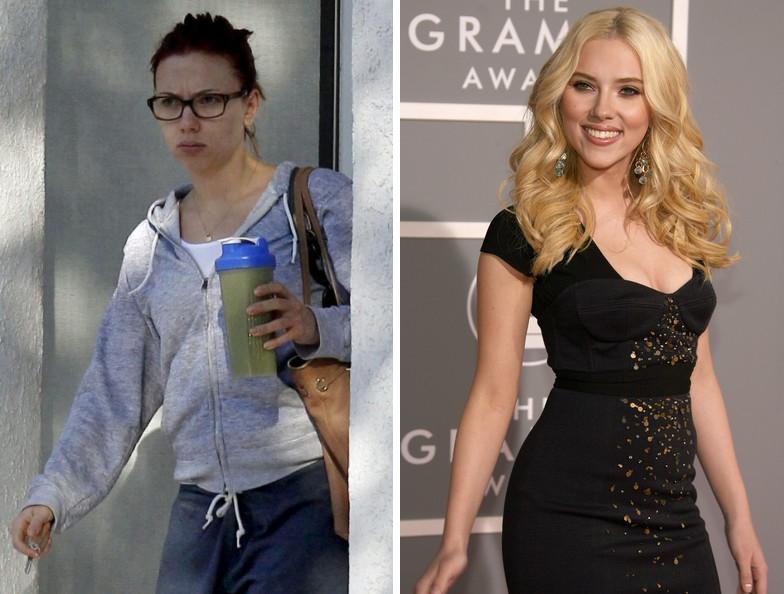
Notice the difference between Scarlett Johansson's attractiveness in the two photos above. The contrast is impressive. On the left, where she is dressed the way many American college girls dress for their morning classes, I'd say she is about 5, and I am probably padding that number just because I know she is a celebrity and can look the way she does on the right, where she is close to a 10. The only uncontrollable element of Scarlett Johansson's attractiveness between the two photos is the lighting, which counts for very little. Same girl, different level of attention paid to her appearance, dramatically different result.

It is true, of course, that Scarlett Johansson has professionals working with her to help her look this good. However, I could not disagree more that cosmetologists make a difference in excess of what any girl can do for herself, assuming she is willing to invest the time and effort to learn how. And I don't think the amount of time or effort required is as large as you might think. Cosmetologists are professionals only because they know how to make any woman attractive. They know the principles and are experts at applying them quickly for a variety of people. But you only need to become an expert on one person - yourself - and this is significantly easier.

Here is another example, less extreme but still telling:


On the left, Jenna Fischer is about a 5, maybe a 5.5. On the right, she is a 7.5. The difference is in her hair, posture, makeup and the color of her clothes. If she wore better clothes still I think she could get up to an 8.5, but she rarely does, judging from the photos I could find online.

Another example:


On the left, Carrie Underwood is a solid 7. On the right, she is a 9.5. In this case, the discrepancy has a lot to do with wearing her best colors getting the right amount of contrast, her hair, eyebrow shape and the hoop earrings. I'd argue that Carrie Underwood has maximized her attractiveness in the right photo. Nakedness, heels and lingerie might bump it up a notch, but otherwise she is playing all the right cards.

Here is a a non-celebrity example:


I don't know who the girl is, but on the left, she is about a 3. On the right, I'd say she is a 5. In this case, most of the change comes from hair length (yes, she is probably wearing extensions, but eventually she could grow it), plucked eyebrows, better clothes and a little makeup. By losing weight, spending more time on her hair and choosing her clothes even more carefully, she has potential to be a 7 maybe even an 8. You wouldn't believe this by looking at the photo on the left, but it is much more obvious once the improvements have been started.

Here is Kate Gosselin:


Left: 2; center: 4; right: 7.5. That is an overall increase of 5.5 points, largely accounted for by hair length, clothes and most importantly, weight loss (apparently a tummy tuck too, but she did have sextuplets... I call it fair). I don't know if she could look much better, but she'd done a damn good job leveraging what she has to work with.

If you want to see more examples, try using the term "makeover before and after" in an image search, or search for pictures of celebrities without makeup. You might argue that all of the women above have pretty faces, so they all have some initial potential to be attractive. There is some truth to this, namely, that they have the potential to be more attractive; but it does not mean that a girl with an asymmetric face, enormous nose or irreparably crooked teeth is doomed to be ugly. I've seen pretty girls that match all of those descriptions. True, a girl like this probably can't become as attractive as Carrie Underwood, or maybe even Kate Gosselin. However, the ability to improve her look is still there; she will just have to focus on the other aspects of feminine beauty to make that improvement, and there are many to choose from. The main reason I didn't put up photos to demonstrate this is that I couldn't find any. Most of the "before-and-after" photos on the internet are of famous people, and most famous people have attractive faces. But consider Lady Gaga or Paris Hilton: neither of them have pretty faces, but both of them (can) look attractive. Also, consider this woman:


Although she actually has a decent facial structure, a lot of people would say that she has an ugly face if they only saw the left photo. But on the right, when the same face is presented well, it is clear that the problem is not facial structure, but rather, presentation. So be careful about assuming you have a bad face. Most likely you do not, and even even if you do, there is still a lot you can do to improve your look.

Anyway, the ultimate point, again, is that no one has to be ugly. By making an effort, you can drastically improve your appearance and attractiveness, and in many instances, girls can transition from "ugly" to attractive. And while you may think you have optimized your own look, it is unlikely that you have. Think carefully about your weight, the color and cut of your clothes, your hair style, grooming, makeup, posture, etc. All of these things can make a huge difference, and can be leveraged to increase you attractiveness.

Monday, October 10, 2011

The Importance of Heels

Heels are the single most powerful item in a woman's wardrobe for improving her attractiveness to men. I routinely recognize this when I go to nightclubs, where almost all of the girls are wearing them. I also notice it at work, where some of the women occasionally wear them, and I find myself suddenly taking a second look (normally I wouldn't look once, as they have about 20 years on me and need to work out). While having a general knowledge of clothing fit and color (for example) matters more, it is not a single item than can be put on or removed with the same simplicity of heels. Heels require no instructions. Most women understand the effectiveness of heels to a degree, but too few realize why and how well they work, and therefore have trouble using them to their full potential.

Some women believe that heels are effective because they make a woman's calves look good, and although this isn't entirely wrong, it falls short of the truth. The majority of women think heels are attractive because they make a women taller. But men are not attracted to women because they are tall. This may make a girl look imposing or powerful, but any student of the most basic aspects of sociology knows that men are not attracted to power (women are attracted to power). Men are attracted to sexual pleasure and fertility, so it should not be surprising that the potency of heels lies in their ability to make a woman look sexual, even if only mildy so.

When a woman wears heels, it points her toes down in a more graceful manner, makes her butt stick out, and pushes out her chest. Most importantly, it arches her back, which emphasizes her feminine curves, and is an unequivocal sign of intense sexual pleasure. Look through the ads in magazines like Cosmopolitan or Maxim if you are skeptical. In many of them (and all of them intending to display sexuality), the women are posed in such a way that they resemble at least one of the postures I've described. All of these are strongly attractive to a man, but they are also very subtle, which makes them all the more effective. Most men have no idea why a women looks better to them in heels; they just feel it in their gut. Ask them. You'll probably get a shrug and something like "because they make you taller?"

For the taller women out there, yes, you are at a slight disadvantage. Despite how much heels improve your posture, I recommend you not wear them very often if they make you more than one inch taller than most of the men you want to attract. Find your other strengths and do what you can to highlight them (for example, height probably means you have long legs, so work them out a lot and make sure you are showing them off).

For all of the other women out there, and especially those of you who are short or the perfect female height, wear them frequently, and be liberal about deciding when they are appropriate. Just like a man that comes dressed well to a casual event, a woman stands out when she wears heels at a dive bar or in the grocery store.

Wednesday, September 21, 2011

Feminine Beauty Is Highly Controllable

Advice abounds for women looking to score a guy, and some sources actually have solid suggestions. But while these sources tell women all kinds of strategies for being approachable or meeting new people, none of them address the most important matter: appearance. A number of the articles I've read have promising titles or sub-titles, but they qualify the initial admonition to "look good" with so many caveats and clarifications that by the end they've essentially told the reader to "be herself" - which is nothing more than a waste of her time.

The topic is avoided because women do not realize how controllable their appearance is. This is understandable, because if female beauty were not controllable, telling a woman she could attract more men if she would just improve her looks would be no more useful than suggesting a paraplegic man "just" learn how to dunk a basketball to impress women. On top of providing no worthwhile advice, it would serve as a painful reminder of her inadequacies. However, the notion that a woman's attractiveness is anything less than highly controllable is patently false.

Time and time again, I see the same thing: the women who aren't getting attention from men fall almost entirely into two categories:
  1. Women that are unfit
  2. Women that do not present themselves well
Hopefully you noticed something important about this list: it does not include women who have "ugly" faces, or even deformities. Obviously, natural good looks cannot be overlooked, but they are given far more credit than they deserve. It is the height of hyperbole - you might even say a myth - that women are either born attractive or not.

To drive this point home, I spent entirely too much time identifying the various components of feminine beauty and quantifying the importance of each one. The result of this effort is shown in the table below. (By clicking on the table or pie charts you can enlarge them.)


Notes about how I generated the numbers in the table can be found here.

  • The 'Importance' percentages simply indicate how much each aspect listed matters to a woman's overall appearance. They collectively add up to 100 %, so they can be literally interpreted as a percentage of overall beauty.
  • The 'Controllability' rankings indicate the amount of control a woman has over the various aspects of her appearance. 0 % represents completely uncontrollable aspects of beauty, while 100 % represents those that are completely controllable. Some items in the table are 0 % controllable to most people, but 100 % controllable to others (for example, breast size and facial structure are both alterable in extreme cases by plastic surgery). The controllability ratings for these items are a guess at the average between those extremes, based on the frequency of occurrence. Or, for example, even though a girl can't change her bone structure, 'height' is rated at a nominal 8 % because there is a small amount of controllability with the size of heels a girl chooses to wear.
  • The 'Attention Deserved' is an index that is calculated by multiplying the Importance by the Controllability, and dividing the product by the collective sum of these products. This can be reasonably interpreted as the percentage of the total time spent on her appearance a girl should devote to each item in need of attention. So a girl that is overweight would be justified in spending 72 % of her time (that is, the time that she invests in her appearance) only on losing weight; or a girl whose clothes don't usually complement her complexion would be smart to spend 8 % of the time she invests in her appearance on shopping for clothes that work well with her look (or on earning extra money for that specific purpose). Obviously, no one is going to count the minutes or hours. The point, though, is that some things are worth spending more time on than others. Don't waste your time worrying about your eyelashes (1 %) when you are overweight (42 %) - go to the gym.

I've also put the data into a few pie charts. This is what you should care about (Importance Rating):

Components of Feminine Beauty by Importance Rating

This is what you should spend your time on (Attention Deserved):

Components of Feminine Beauty by Attention Deserved

Now, even though I have gone to rigorous ends to elicit these ratings from the recesses of my mind, obviously they are still relative to my personal taste. That being said, while men will all disagree over the minutiae of female beauty, few will disagree with the important aspects. This post should give you a solid idea of what matters to most guys, and how much.

While the numbers speak for themselves, I want to highlight one main point: notice how controllable the most important aspects of female beauty are. To wit:

  • 18 % of feminine beauty is more than 100 % controllable. This means that if a girl is not opting to do these things, she is missing out on 1.8 points out of ten due to ignorance or a personal decision. Included in this 18 % are simple things like wearing heels and jewelry or removing excess body hair.
  • 63 % of feminine beauty is more than 80 % controllable. This is the driving point behind this "analysis," expressed numerically. If you take nothing else away from this post, remember this. It means that you are in control of your appearance far more than you think. It means that the time and effort you put into your appearance will produce results. Do not worry if your gut tells you otherwise; your gut is informed by beauty pageants and "100 Hottest Women" lists, and a thousand other influences that both reinforce and reflect the notion that beauty is a matter of winning the genetic gene pool - i.e. a matter of 'haves' vs. 'have-nots.' This notion is bullshit. That 63 % of beauty is at least 80 % controllable means that no girl needs to be less than a five on the ten scale (0.80 x 63 % = 5.0). If you present yourself well and get in great shape, you will be above average. And for those of you that are naturally about average, the sky's your limit.
  • Only 32 % of feminine beauty is less than 30 % controllable. In other words, there is very little about your appearance that cannot be improved.

One final pie chart to summarize these three points:


Far too many women fail to recognize the leverage they have over their own appearance. This leverage translates directly into control over the ability to attract men.

For photos of women improving their appearance, check out this post.