Showing posts with label attraction. Show all posts

Wednesday, December 17, 2014

No, Your Intelligence Isn't the Problem

I get e-mails from girls all the time telling me that they are attractive, sweet, well-dressed, fun, etc. but can't seem to get the guys they want. They then point out that they are working on a PhD and conclude their question by asking whether or not their intelligence is intimidating men and therefore turning them off. I get similar questions about career success: "I am doing everything right but I am very highly paid - does that intimidate men?"

This is the equivalent of a guy pointing out that he is smart, tall, reasonably good-looking and successful in his job, but struggles to attract girls - then asking if it is because his muscles are too big. I mean, after all, maybe that's what is keeping the girls at bay, right?

If you are a rocket scientist, there is a chance that your academic prowess might be intimidating to an average guy, in the same way that a steroid-injected meat-head's muscles might be a a little much for the average girl. Yeah, sure, there is a risk that pouring too much of your energy into academics will turn guys off a bit, especially if it is done as a mask for your feelings of inadequacy with respect to other women. It's the same risk that a guy runs when he devotes the majority of his free time to getting jacked, especially when it is done as a mask for his feelings of inadequacy relative to other men. But the muscles themselves aren't the chief problem, and neither is your degree or your job.

It's way more likely the case that you are underestimating the importance of your weight, or that you cut your hair way too short, that your posture is horrible, that you talk like you want men to believe you're stupid, or that you don't realize how much your lack of boundaries is making men dismiss you. These are the kinds of things that actually turn men off, in the same way that low self-esteem and low intelligence are the kinds of things that actually turn women off (not coincidentally, these are common problems among meatheads).

The women who ask this question are always asking "why don't I get any attention from the men I want?" Their question is never "why do I get tons of sexual attention from men, but none stick around?" (some do ask this question, but they never then go on to blame it on their degree or job). If a woman were asking the latter question, I still wouldn't jump to the immediate conclusion that her degree or salary was the problem; I would look first to her personality. But if a girl isn't even getting sexual attention from the guys she is concerned about intimidating, I guarantee her hypothesis about her threatening intelligence is wrong. Why? Because there is a remote possibility that men will be intimidated or turned off by a woman's brains or job when they are considering her as a girlfriend or spouse, but there is no possibility that it will prevent at least some guys from trying to get in her pants. None whatsoever. Men go for the girls they are physically attracted to, then choose from those the ones they are personally attracted to. Only after that do they take into account things like brains and (much later) salary or professional success. You can't blame academic or financial intimidation on your inability to get a boyfriend or husband if you aren't at least getting sexual attention from the men you want; it'd be like blaming the power outage in your house on a government conspiracy or that neighbor you hate... during a raging thunder and lightening storm.

No, in all likelihood, your academic degree or high-paid position isn't the fundamental problem; but it is an very convenient scapegoat - and an ego-boosting one at that. It is a hell of a lot easier and more satisfying to blame big muscles or advanced degrees for your lack of success with the opposite sex than it is to find out (or admit) what's really wrong. And for women, what is really wrong almost always has something to do with your looks or personality, which, thankfully, are both very much controllable.


Related Posts
1. Men Don't Care About Your Accomplishments
2. The Importance of Personal Boundaries
3. Human Energy is Conserved
4. Are You Repressing Your Femininity?
5. What Men Think About Your Intelligence

Sunday, October 12, 2014

The Fantasy of Nightlife

When women go out, they are done up: they have makeup on, their hair is done, they are wearing heels, wearing their best clothes, etc. In addition, nightlife venues are almost always dimly lit, so that any cosmetic imperfections are hidden. In other words, they look their "best."

Men also get dressed up when they go out; but more importantly, they drink. The alcohol makes them more social and confident, more willing to go for what they want. And the magnum of Grey Goose they bought makes them look more important than they are. The loud music and bustling environment makes it unnecessary for them to lead a real conversation, so any lack of social skills is masked. In other words, they also look their "best."

Granted, men often over-drink, in the same way that girls often over-dress. Taking extra shots is the male equivalent of wearing too short of a skirt, or too much makeup. But the point is that, in nightlife, men and women lean on the crutch of added confidence or beauty (respectively) in order to appear more attractive to the opposite sex. The interesting thing is that, in addition to leaning on their own crutch, both sexes actually lean on the opposite sex’s crutch as well…

When men go out, they indulge in the belief that they can get girls who look like supermodels. The truth, of course, is that these guys can only get girls who look like supermodels in the club, and only when they themselves have liquid courage to assist, or loud music to mask their insecurity, or when they have the best table in the club to hide the fact that they are a run-of-the-mill manager in a medium-sized company.

When women go out, they indulge in the belief that they are attractive enough to get confident and powerful men to approach from across a room; but the reality is that they can only attract the men who can act confident after a couple drinks, or guys who know how to look powerful in a nightclub.

While this dynamic is far more exaggerated in nightclubs than it is in bars, it still exists in degrees wherever women are dressed up and men are drinking. Women lean on their appearance and sex appeal to be more attractive than they are normally, men lean on alcohol and status symbols to be more attractive than they are normally; and both sexes bask in the glow of the “results” they get in those circumstances.

This isn't necessarily a problem as long as you recognize what is going on, and enjoy it for the fantasy that it is. But it can be a problem if you let yourself slip into the mentality of “I get a lot of attention from the opposite sex,” when the reality is that you only get a lot of attention from the opposite sex when you go out – in other words, when you participate in the fiction of nightlife. This is significantly different from being able to attract someone in normal life, and assumptions to the contrary might be fueling your complacency.


Related Posts
1. The Analogy Between Confidence and Beauty
2. Bars Are a Bad Place to Meet Women
3. Bars Are a Good Place to Meet Guys – Part 1
4. Nightlife Tip 1 – Create Space at the Bar

Friday, September 26, 2014

Nice Guys Don't Exist

Everyone adapts their behavior to the people around them, and in response to the situation at hand. We are nice to people we like and mean or bitchy to people we don’t. We are friendly and cheerful when things go well and short-tempered or depressed when they don’t. Yeah, sure, there are some people who are generally more disposed to (for example) mean or more egocentric behavior than others, just as there are some people who are more disposed to (for example) kind or generous behavior than others; but even they are more mean or kind to some people, and less egocentric or generous to others. And of course there are some people whose behavior is less affected by circumstance than others, but not to the point that it isn't affected at all – and not even to the point that it isn't affected significantly. We like to think of personality as static and constant, intrinsic to each person. But the reality is that personality is merely a name we give to a set of behaviors coming from an individual; and those behaviors are very much mood-driven, situational and dynamic.

This misconception plays into our perception of the opposite sex significantly. Consider how frequently you change your behavior towards the men in your life…

If I approach a girl in a bar awkwardly, and then speak to her in a low voice because I am nervous, she isn't going to be attracted, and isn't going to respond well. The fact that she is short with me, or excuses herself immediately to go to the bathroom doesn't mean that she is a "bitch;" it just means that I didn't attract her enough. The next guy who approaches her might approach her confidently and genuinely, and have her wrapped around his finger the rest of the night.

If I have a dead-end job and lack ambition, my girlfriend isn't going to respond to me in the same way as the guy she dates next (i.e. after she dumps me), who is intentional in his career and gainfully employed in a position he truly enjoys. I might tell my friends that she was “cold” or “distant” but they'll know as well as I will that her next boyfriend probably has none of the same problems. Or maybe she is the one complaining that he is cold and distant.

The same kind of girls that ignored me when I was young and lacked confidence now treat me entirely differently, because I am older and far more sure of myself. At twenty years old, it was tempting to view those girls as stuck-up or bitchy; but the reality is that they were probably acting like angels towards some 30-year-old who was much more attractive due to his age, maturity and position in life.

I am not saying all of this to make a point about women, but to make a point about men – because men work exactly the same way. It is easy to believe that a certain guy is an asshole because he dumps you without an explanation, or that another is an authentically nice guy because he treats you well. But I am telling you: those men behave in entirely different ways with different girls.

The guy who you think is a player because he hits on three other girls before taking you home, then never calls you the next day – I guarantee that he is genuine and respectful and serious with other girls he dates. I know this because I've been that guy plenty of times. Some women I treat well and with respect, and others I don’t. If I see a girl I'm attracted to and whom I respect, I change my game completely. My male friends do the same.

The guy who is a dismissive asshole to you is a babbling, nervous idiot with the girl he is crazy about, and the guy who is such a gentleman to you absolutely crushes the hopes of girls that he doesn't find attractive, or doesn't respect. Likewise, the guy who never calls you back isn't “flaky,” he just doesn't care that much about you. I am sure there is a girl out there who has complained that he was needy and contacted her too much. And I am equally sure that the guy you were dating who seems to have “commitment anxiety” has at some point in his life practically begged to be in a relationship with a girl.

The thing is, nice guys don’t exist. “Douchebags” don’t exist. The behaviors we describe with these terms are not innate and static characteristics of any given person; they are behaviors that change depending on the other person involved and the circumstances surrounding the interaction. Of course there are men out there who are more disposed to certain types of behavior than others; but the degree of attraction a man feels for you will affect his behavior towards you far more than anything intrinsic to his personality, and the degree of attraction he feels for you is significantly affected by the kind of behavior you'll accept from him.

So instead of complaining about the dearth of nice guys or the abundance of douchebags, start thinking about what you can do to make then men in your life treat you the way you want. Because that is what is going to make the difference – not finding some "perfect guy" with some supposed personality type. You don't find perfect men, you elicit perfection from men.


Related Posts

Thursday, March 20, 2014

CLEO Magazine Interview

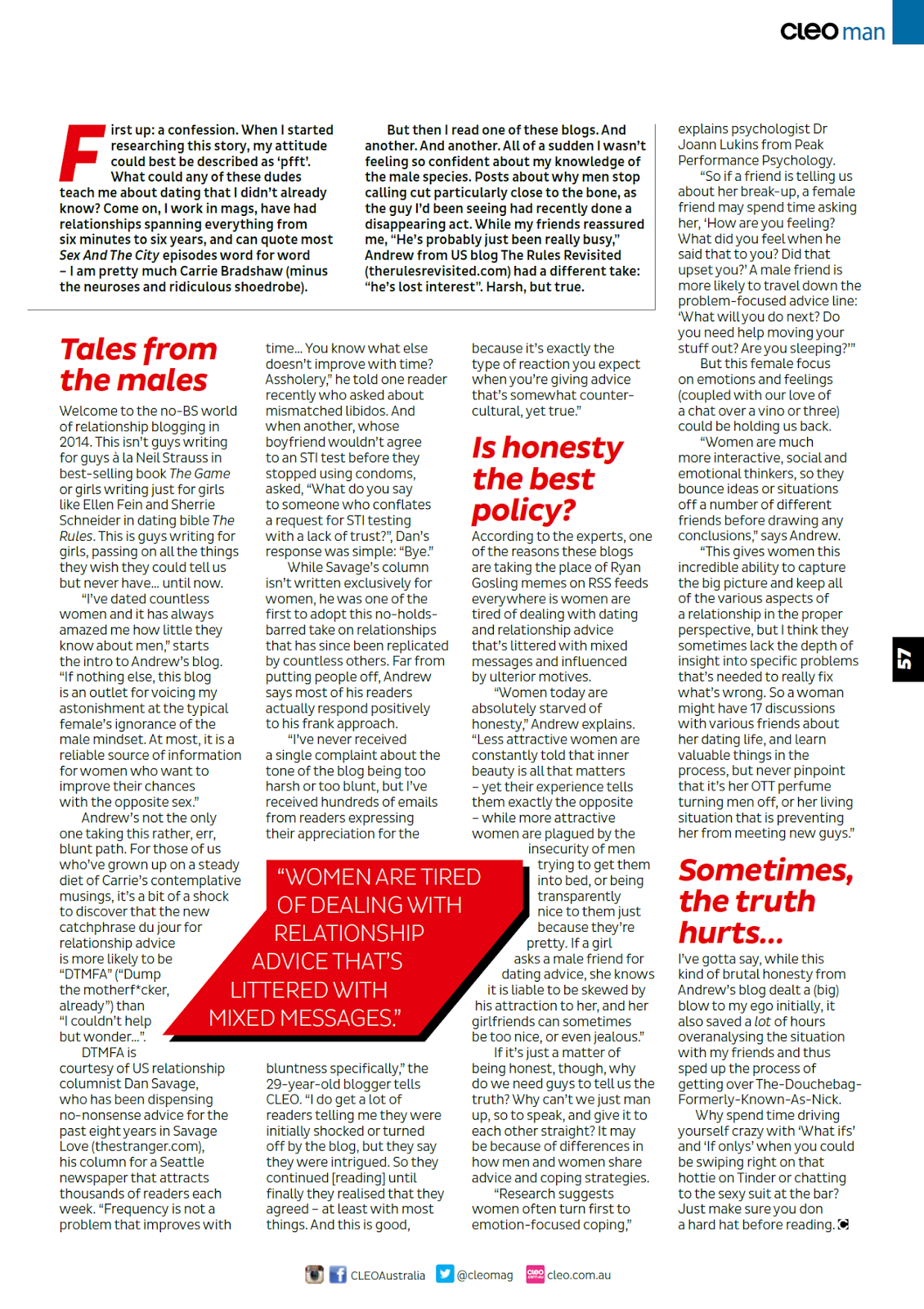
I was contacted a few months ago by an editor from the Australian women's magazine, CLEO, asking if I could answer a few questions for an article that would be in their March 2014 issue. I agreed, and we exchanged the questions by e-mail.

In the end, my answers were quoted considerably in the article, as was the post Men Don't Fall in Love the Same Way Women Do. The editor was kind enough to send me a hard copy of the magazine, as well as an electronic copy of the article, so I've included it in full as images in this post (you can click on the images to enlarge them, or open them in a new tab or window to zoom in and read the text).

Not all of the interview was quoted, of course, but as it touched on some interesting points about men and women, and gives a nice "meta" view of the blog, I thought it might be of general interest. The full text of the interview follows.
_____________________________

1. How did ‘The Rules Revisited’ come about?

I’d say The Rules Revisited was conceived out of the convergence of three factors in my life. The first was the process that I went through myself in learning how to attract women. This started soon after I graduated from college, and in many ways is still on-going; but it showed me that self-improvement is a very real possibility – even for someone like me, who at first felt utterly powerless with the opposite sex. The second was my love of writing and the need for a substantial way to exercise it. Initially I considered starting a blog for men, but most of the ideas that I found engaging and useful had already been pretty well articulated by others. The third factor was the recognition that, in spite of there being this vast network of men producing material to help each other improve their chances with women, there really wasn't anything out there for women trying to improve their chances with men. It felt a bit one-sided, especially because I knew from my own dating experience how badly the advice was needed. With that realization, the concept of the blog was obvious, and I immediately sat down to write the first few posts. I haven’t stopped since.

2. Your advice is quite blunt and to-the-point – what was the initial response like from readers?

It was very positive, actually. To this date, I've never received a single complaint about the tone of the blog being too harsh or too blunt; but I've received hundreds of e-mails from readers expressing their appreciation for the bluntness specifically. In hindsight this doesn't surprise me. Women today are absolutely starved of honesty. Less attractive women are constantly told that “inner beauty is all that matters” (yet their experience tells them exactly the opposite), while more attractive women are plagued by the insincerity of men trying to get them into bed, or being transparently nice to them just because they are pretty. If a girl asks a male friend for dating advice, she knows that it is liable to be skewed by his attraction to her; and her girlfriends can sometimes be too nice, or even jealous. The tone of the blog was never something premeditated; it is just the way I think and write. But I understand why it is appreciated.

(Right-click and choose "Open link in new tab," then you can zoom in on the text)
I do get a lot of readers telling me that they are initially shocked or turned-off by the blog; but they say that they were intrigued. So they continued… and continued… until finally they realized that they agreed – at least with most things. And this is good, because it is exactly the type of reaction you expect when you are giving advice that is somewhat counter-cultural, yet true. Of course, I have to assume that some readers never get passed the “shocked” phase; I just never hear from them because they close their browser and move on. But that is expected also. Not everyone has an attention span and an open mind.

Ultimately, I understand that my readers appreciate my blog because they can trust it. They’d rather read a blog that they disagree with occasionally but trust completely, than a book or website that is trying to sell them something – even if it sounds good every time.

3. Has that response changed at all over time? How so?

It hasn't really, no. The number of people giving feedback has increased dramatically, but the types of responses (and the relative percentages of each type) haven’t changed.

4. What have been some of your most popular topics/posts?

One of the most popular has definitely been The Importance of Silence After a Breakup. Even though I wrote it fairly recently, it has already accumulated the second highest amount of traffic, and has by far the highest number of comments, which are overwhelmingly positive. I am in the final stages of writing a book that expands considerably on this topic, and how to handle breaking up with a man in general.

The post with the highest number of hits is Men Don’t Fall In Love The Same Way Women Do. The comments aren't all positive, but it has the largest number of and +1s on Google by far. I suspect its popularity is partially driven by the number of girls searching the internet for “how men fall in love,” (which is the number one search term leading to my blog) and the absolute absence of other material trying to explain it. I am in the process of writing a better post on the same topic at the moment.

A few others that have been very popular are:
What Men Think of You Without Makeup (this gets shared a lot on beauty forums)
What Men Think About Older Women (fairly controversial, as judged by the comments)

Some of my best posts are the newer ones, which dig a little deeper:

5. Your blog tagline says that, in your experience, women understand very little about men and the male mindset. Why do you think this is?

Well, for starters, it definitely isn't just women who are confused about the male mindset; men are equally confused about the female mindset – I just happen to write for women. There is a notion floating around that it has “always been this way,” but I absolutely disagree. A hundred years ago in Western societies, men knew what women wanted and women knew what men wanted. Even if they weren't happy with the rules of the game, and even if the rules were wrong, everyone knew them and played by them. But all that has recently changed, because we've rejected the old script. We live in a hugely tumultuous time for male-female relations. Men and women are “equal” now, but no one knows what to do anymore to attract the opposite sex. In the absence of any authority telling us how to behave, both sexes hear the word “equal,” shrug their shoulders in confusion, and assume that it means “the same.” We conclude that men want from women the same things that women want from men, and we act accordingly. But it isn't true. Social evolution (let alone biological evolution, which I think plays a part) doesn't occur that quickly. Both sexes still want significantly different things, but no one is telling us this anymore. And even though there is some overlap in our desires, this actually makes things more confusing, because it just serves to further mask the differences. Both sexes are currently standing in the rubble of a social battlefield, each trying to give the other what it doesn't want – mainly because we just don’t know any better.

6. In your opinion, what are the main differences in how men and women give each other dating advice?

That is a great question, because there are enormous differences. One of the largest symptoms of this difference, as I explained before, is actually one of the reasons that I started The Rules Revisited, and that is the complete lack of dating advice available for women on the internet – or in the media in general, for that matter. In the last 15 years, men have generated thousands upon thousands of books, blogs, websites, videos, businesses, etc. – each picking apart a different aspect of attracting women: overcoming approach anxiety, being authentic in a woman’s presence, mastering one-night stands, attracting women online, and so on. The sheer volume is impressive, and actually a huge testament to how much the male world revolves around the pursuit of women. But when you search for similar books or websites for women, you find very few – and many of them are actually written by men.

In my experience, women tend to seek dating advice mostly from friends. For example, my female acquaintances often ask me for dating advice; and I know that girls discuss it amongst themselves all the time. They love discussing it. They love telling their friends about what “he” said or did, gauging their friends’ reactions, and comparing related stories. Such a discussion is an event, to be enjoyed in-and-of-itself, whereas for men it is brief and purely practical – if it occurs at all.

There obviously are some women turning to the internet for dating advice, otherwise The Rules Revisited wouldn't have an audience. Probably this number is increasing, as people in general become more familiar with the power of the internet, realizing what lies at their fingertips. But there is no question that women lag men significantly in their use of written and internet-based dating advice.

In any case, we can say that the female approach to dating advice tends to be more social and discursive, while the male approach tends to be more individual and analytic.

7. Why do you think men and women approach dating advice so differently?

The sexes approach dating advice differently because the sexes think differently. The male mind is more inclined towards the kind of obsessive focus one needs in order to scrutinize even the tiniest of social interactions and break it down into usable rules. This is what we know how to do best, so this is the kind of advice we know how to follow.

Women are much more interactive, social and emotional thinkers. So they do what they do best: they bounce ideas or situations off of a number of different friends before drawing any conclusions. They feel their way through their questions, focusing on their gut instincts more. I also suspect that they are much more in tune with their friends’ and family’s emotional reaction to their dating situation, which is something that many men would never even consider.

I think it is important to point out that both approaches have certain strengths, but also certain flaws. The masculine ability to analyze is impressive, but men can get too easily trapped in a single problem, losing sight of the forest for the trees. For example, a man might perfect his online dating profile to the point that he has cute girls messaging him daily, or learn exactly how to react when his girlfriend tests his honesty or courage, only to realize – years later – that he still doesn't know how to keep a girl interested for more than three months.

The female strategy, on the other hand, gives women this incredible ability to capture the big picture and keep all of the various aspects of a relationship in the proper perspective; but I think women sometimes lack the depth of insight into specific problems that is sometimes needed to fix what’s wrong. So a girl might have 17 discussions with various friends about her dating life – and learn valuable things in the process – but never pinpoint that it is her short hair that’s turning men off, or her living situation that is preventing her from meeting new guys.

To borrow from the adage: a man is liable to forget the forest for the trees, while a woman is liable to forget the trees for the forest.

8.  Do you read other dating/relationship blogs? If so, which ones?

I read HookingUpSmart.com, written and run by Susan Walsh, which I very highly recommend for both sexes. For men I very highly recommend the sections of AnimusEmpire.com that are dedicated to “Manliness” and “Dating.”

Tuesday, January 14, 2014

5 Ways That Men Misunderstand Women

We tend to operate under the assumption that the opposite sex's behavior in a given situations is always informed by a rational understanding of the relevant factors: what you want, what he wants, what really matters in a relationship, etc. But the truth is that there are many times where it is informed by a complete misunderstanding. So while the best way to understand male behavior is to become familiar with men's motivations and modes of thought, the second best way is to become familiar with men's motivations and misunderstandings - because it is unfortunately often that a man's behavior in dealing with women is rooted in misconception.

The following are five of the most common ways in which men misunderstand women, and some of the mistakes they make as a result.

1. Men don't know the difference between making a woman happy and attracting her. A lot of men believe that they will attract a woman by giving her what satisfies her in the moment, rather than doing what will demonstrate their character to her. Often these two things are in conflict. For example, a man will often tell a woman she looks beautiful, when the truth (which she knows) is that she is only looking decent. He will do this because he thinks that her momentary happiness is more important than her long-term ability to trust his opinion, and, by extension, him. Likewise, a man will often try to let a girl choose where to go for their date, because he wrongly believes that her enjoyment of the location is more important than her appreciation of his ability to be decisive and have a plan. These men don't realize that women are more interested in being with a man of character than frivolous things like always believing that they look pretty, or loving the restaurant where they enjoy a man's company. Men misunderstand this because they themselves are always seeking to be satisfied in the moment, and so they project that desire onto the women they date.

2. Men think women experience sex the same way they do. This might seem like a minor detail, as it only manifests itself during sex; however, it is actually central to a relationship, just as sex is central to a relationship. Men need an orgasm to really enjoy sex. It is nothing short of frustrating otherwise. A man who believes that a woman needs an orgasm in order to enjoy sex is misunderstanding something that is much bigger than his partner's desire to feel an orgasm. A man who thinks that his woman needs experience an orgasm to enjoy intercourse is far more likely to neglect the thing that she actually needs in order to enjoy sex: his integrity, openness, pleasure - and most importantly, his desire for her. I've had sex with a lot of women, and the ones who have really liked me could care less whether or not they have an orgasm. They are more than happy just to be fucked by a man that they feel lucky to be with. In fact, the reality is that the less a woman respects and is attracted to her man, the more she will "need" an orgasm to enjoy sex. But men project their own need for an orgasm onto their woman. They work too hard to get her off, and in the end, fail to satisfy her in the more important way: by enjoying her, and letting her be the object of his (as one reader called it) "hurricanes of desire." This misconception manifests itself in things like his performance of obsequious oral sex, his listening to you when you tell him to "come now" (rather than being authentic and coming when it happens naturally), or in general listening to how you tell him to fuck you. More severely, it shows up as performance anxiety.

[Before everyone starts jumping down my throat for this one: I am well-aware that women love having an orgasm during sex. But if you "need" an orgasm in order to enjoy sex, ask yourself whether you'd prefer to be ravaged deeply by your man without an orgasm, or be given an orgasm by a guy who goes down on you for so long that he goes limp and loses interest in fucking you. Of course you want both, but both aren't always possible; and the point is that, when they aren't, men often choose poorly between the two options.]

3. Men think that you know you are hot. Many men feel powerless in the presence of a beautiful woman. Actually, it is more accurate to say that many men feel powerless in the presence of any woman in proportion to how much more beautiful than him she is. This is particularly true in younger men, but some men never grow out of it. Much of this feeling of powerlessness is due to the assumption that the woman knows that she is beautiful, and that therefore, they stand no chance of having her. (The rest is due to what I will explain in point number 5, below.) The truth, of course, is that a woman's confidence is absolutely uncorrelated with looks. Many beautiful women feel wildly insecure. However, a lot of men don't realize this. They are so stunned by beauty that they cannot see past it. A man like this might be too intimidated to approach or pursue a woman that he perceives as being out of his league due to her looks alone, when the truth is that the girl may be wishing that he'd approach her.

4. Men think that you mean what you say. Men are literal creatures. Natural selection has weeded out those of us who didn't have a mind for focusing on the facts and the facts alone, and getting the job done. The result is that, while we excel at those things, we suck pretty hard at reading between the lines, interpreting emotions, or understanding what is left unsaid. And the more modern culture tries to tell us that men and women are the same, the harder it is for us to understand that women don't suck at this as much as we do. Many men, therefore, believe that women are equally literal. These men believe that women mean what they say, and say everything that they mean - but this is simply not true. I got an e-mail just the other day from a reader who broke up with her boyfriend, not because she didn't like him anymore, but because she was hoping he would fight for the relationship. She (understandably) wanted to feel desired by him, so she tested him by ending the relationship. I can guarantee you that the boyfriend believed that she ended the relationship because she wanted the relationship to end. But the truth is that she was ending the relationship specifically and exclusively because she did not want the relationship to end. I can give similar examples in which women have asked for things they didn't want in the hope that the man wouldn't give them to her, or others in which a woman has said things she didn't believe only to incite a reaction in a man (or another woman). The point is that, when a man responds to you, he is responding to what you've said or done under the assumption that it is immediately and directly motivated by what you want to happen.

5. Men think that women care just as much about physical attractiveness as men do. The fact that they believe this says a lot more about how important looks are to men than anything about how important looks are to women. It is projection through and through, and causes a lot of men to be insecure about their looks - almost as much as women are insecure about their looks, just without a valid reason. It also leads to men neglecting the important aspects of their character in order to learn how to dress perfectly, or spend all day in the gym. Women are left with a pool of jacked-up, perfectly-dressed, shaved-chested pussies from which to choose a husband, rather than confident and intelligent men of character who are a little rough around the edges. (Yes, I know this is an exaggeration, but the point is that you have fewer men to choose from.) If you've ever looked around and wondered "where are all the good men?" this is probably a big factor in answering your question.

You'll notice that all of these misconceptions are due to projection, encouraged by the notion that men and women are the same - which is not anywhere near as similar as people think it is to men and women being equal. Anyway, keep these things in mind next time a guy does something confusing - chances are one of these will explain why.


Related Posts
1. Misconceptions
2. Why Women Don't Know What Men Want
3. The Analogy Between Sex and Commitment

Tuesday, December 24, 2013

You Don't Need to Like Sports

I've traveled a lot. I've lived in Europe twice, spent months at a time in Africa and India, and have visited dozens of other countries in south and central America, the Middle East and Europe (no, I am not in the military). I don't say this to brag or show off, but to lend a little more weight to the observation inspiring this post. The time I've spent abroad has given me a fairly good grasp on the differences between American women and foreigners. This understanding, in turn, helps me to recognize the characteristics that are universally feminine, as opposed to those that are specific to the women in the United States, or any other culture.

One thing that is unique to the United States is how much American women watch sports. Perhaps I am noticing this more recently because it is the middle of the American Football season, but in any case the trend is unmistakable. Women in the United States have favorite teams, know the names of all the players, and watch every game. They cheer with excitement when there is a good play, swear at the referees when they make a bad call, have opinions about who will beat whom, and generally invest a good deal of their identity as a fan of their chosen team.

This doesn't really happen outside the United States. I am sure there are some places where women care about sports more than others, but I have yet to go anywhere outside the U.S. and find women out-shouting men at a bar where a "big game" is being shown on TV. In the U.S. it happens regularly, so it is clear that this is a cultural (rather than sexual) phenomenon.

Most sports are inherently masculine. They are physical, aggressive, strategic and competitive. Perhaps more importantly, "scoring" is characterized in most sports by the same kind of build-up and break-through that occurs in the male orgasm (it isn't a coincidence that men use the same term to refer to getting laid), and in other traditionally masculine pursuits, like hunting and scientific investigation. And while this doesn't mean that women can't or shouldn't participate in sports, or even thoroughly enjoy them, it does mean that any pressure a woman feels to watch or participate in them is most likely external and cultural, rather than internal and authentic.

More to the point here, liking sports will not make you more attractive to men. As I have pointed out before, trying to be one of the guys is a bad dating strategy. There is nothing lamer than that girl at the bar on game-day, wearing face-paint and a team jersey, yelling at the players or referees on the screen in an attempt to prove to the guys around her how much she knows about the game. It is almost the definition of trying too hard, and it is a huge turn-off. While taking an interest the things he likes (sports) is a demonstration of good-will, admiration, and maybe even loyalty, being as obsessed about hockey as he is will not make him want to bang you or date you; it will (at most) make him want to be your friend.

I occasionally pick up Cosmopolitan to see what kind of advice they are giving, and I read there once that men said they like a girl who loves sports. I don't doubt that men have said this, but that doesn't mean it is any truer than the female claim to like men who are able to cry during movies. While both are kind of nice ideas in theory, the behaviors of both sexes in choosing partners betray their real preferences. And yes, of course, there are girls who are epic sports fans and still get guys, but I can promise you that this is because they are hot or fun to be around - not because they are sports fans

So if you are American girl, and feel like you aren't fitting in because you don't know the name of your local basketball team's point guard, or if you find yourself tempted to mimic that one girl you know that has men swarming over her as she spouts football statistics, take a moment to recognize that (a) it isn't her love of sports that is attracting those men, and (b) if it isn't something you genuinely like, you shouldn't be doing it anyway.


Related Posts

Tuesday, July 9, 2013

Do You Really Want Dating to Be Easier?

Dating isn't easy. In fact, for anyone with romantic ambitions, it is extremely difficult. There was a time where dating options were far more limited by religion, geography, social class, and family pressure. But these days, dating options are virtually limitless, and ideals about romance are pegged to ridiculous standards, both of which make it hard for people to settle down. When you consider this in light of the fact that people have such varied tastes, it isn't hard to see why it is so difficult to fall mutually in love.

The greatest victories in sports are the ones that follow a difficult comeback. We appreciate them because they are born out of unlikely circumstances, and are the result of a tremendous effort. I remember watching basketball games when I was a kid, and actually liking it when my favorite team was down by a large margin. The way I saw it, the deficit was just potential for a big comeback - maybe an unprecedented comeback, a game people would talk about for decades. While I knew that I might be witnessing a blowout, I also knew that I might be watching sports history in the making. I also knew that I wouldn't be anywhere near as excited if my team won by a large margin - it would just be too easy that way.

When you get frustrated at your lack of success with the opposite sex, stop for a moment and recognize that the same principle applies in your dating life.  If finding a boyfriend or husband were easy, you wouldn't care much for your relationships. Every man would be replaceable, just as you would be to every man. The more you improve yourself in order to find love, or the more years you spend maturing before you can recognize it, the more unique your story will be, and the more you will value the man who marks its end.


Related Posts
1. Why Rejection Is a Good Thing
2. Self-Improvement Takes Time
3. Why Do You Want Him Back?
4. Know Why You Are Dating

Sunday, May 26, 2013

The "Three Mistake Minimum" Rule on Dates

I've had a lot of girls ask recently how they can be more "open," more authentic, more vulnerable. They recognize that these dispositions not only allow them to be their true feminine selves, but are also attractive to men in a non-sexual way. This post is for them. If you are the kind of girl who prides herself for "speaking her mind" on dates, this post is not for you. In fact, you probably need to shut up more.

When my friend and I used to go out in San Diego, we would sometimes make a rule at the beginning of the night: no one could go home until they'd approached and been rejected five times by girls. If you were successful and chose to leave the interaction or got a phone number, it didn't count towards the total. Sometimes we would aim for three rejections, other times five rejections, and on ambitious nights we'd shoot for ten. It made for some fun times. The way we saw it, if we weren't getting rejected often, it meant we weren't trying hard enough. More importantly, it made approaching easier. If we knew we had to get rejected ten times anyway, we'd think "might as well get started now." It always worked. What at first seemed like recklessness actually made us successful, because our indifference to rejection gave us the bearing we needed to communicate our confidence; and women ended up liking us more.

As I pointed out in a seemingly unrelated post, taking risks is something we all need to do in order to succeed. We tend to avoid risks because they lead to failure, but risk-taking is also a prerequisite for success. We have to embrace the chance of failure if we want to succeed. This applies to dating as much as every other aspect of our lives. While there are many things we can control to attract the opposite sex, experience shows us that not everything can be manipulated, and there is a point at which we need to let go and accept the limits of our influence.

A lot of women find first dates nerve-racking. Whether or not they realize or admit it, they are nervous because they see a first date as a time to perform, a single opportunity to show their best side to a man, a critical chance to impress him. They are self-conscious because they want to avoid doing something stupid or unattractive. If you are one of these women, you know exactly what I am talking about. It can be paralyzing.

When you are having a conversation on a first date, all kinds of thoughts and reminders are constantly passing through your mind. Some of them seem appropriate and you verbalize them, but many you veto because you aren't sure if he'll agree, or whether he'll be interested. These are things that you would say without a moments' hesitation in front of a work acquaintance or a friend; but you don't want to say something that will turn off your date, or make him think that your tastes or opinions differ too much from his. So you leave these things unsaid.
Example 1 - He mentions a boring, generic Hollywood movie he saw the other day and really liked, and asks what the most recent movie you've seen was. You tell him that it was A Separation. When he asks how you liked it, you balk. You thought it was incredible, the best movie you've seen in years; but you are hesitant to tell him so because you doubt he appreciates foreign (let alone Persian) films, and he might even think you are a little weird because of it. You tell him "It was good... different, but good" and change the subject.
Example 2 -  You met online and it's your first date. He invites you to dinner but doesn't tell you the name of the restaurant ahead of time. You've had a long day so you are hoping for someplace casual where you can just kick back and have a beer with him. When he picks you up he is a lot hotter in-person than you expected. He takes you to a fairly fancy place, and when the waitress comes, he orders a cocktail. You do too, even though you never drink anything other than Bud Light and think cocktails are kind of pretentious.
In both instances you lack authenticity. This kind of guarded, deferential mentality is preventing you from being your true self. More to the point here, it is preventing you from finding a man that is truly compatible with you. I've been on dates with girls that have been very open and genuine, and I've had absolutely no interest in them because of it. They showed their true colors, and I didn't like them. But these girls are far closer to finding a guy than the women I've dated several times without ever feeling like I knew who they were. A few of these girls gave me glimpses of their true selves occasionally, and I loved what I saw. But the glimpses were far too brief and fleeting for me to really know whether it was representative or not - in other words, whether or not it was worth hanging around for. So I didn't.

You probably assume this guarded mentality in order to prevent yourself from failing with men (looking stupid); but it is also preventing you from succeeding with them. The kind of guy who would like what you decided against saying will think less of you for your silence, while the guy who would think poorly of you for it probably isn't right for you anyway. Your attempt to make the date work by avoiding your natural inclinations is futile, because, although your instinct is right - it will prevent you from looking stupid - it will also prevent you from being attractive to the men you are most suited for.

So next time you are on a date, do the equivalent of what my friends and I used to do in the bars of San Diego: do not go home until you've made a conscious effort to push through your reservations and express the things you would say in non-date situations - at least three times. In other words, don't go home until you've made three "mistakes." Remind yourself of this just before meeting him for the date, and then anytime you are alone during it (e.g. when you go to the bathroom). If you want to get hyper-practical about it, set an alert on your phone, so that you get a little vibrate reminder part-way into the date. If you get to the end of the date and still haven't hit three, just ask him anything you want  to know about him but "isn't appropriate" to ask.


Related Posts
1. Self-Improvement Takes Time
2. Men Care About How You Talk
3. Texting Tip 3 - When Should You Reply?
4. Living Vulnerably
5. Femininity, Authenticity and Compatibility

Saturday, May 11, 2013

What it Is Like to Approach Women

I've heard a lot of girls make the following comment:
This guy at the bar was staring at me all night, but he never approached. What's the big deal?? If he likes me, he should just come talk to me! I want him to; why is he so intimidated? 
Or others have said essentially the same thing in suggesting that
A guy doesn't need to use pickup lines to talk to get girls. He just needs to say "hi" to get the girl he likes.
The truth, of course, is that a guy just needs to say "hi" to get the girl that likes him. To get a girl without her prior interest, he "just" needs to impress her with his confidence and bearing when he approaches. He "just" needs to be calm and carry the conversation without making himself look like an idiot. The guy who stares at the girl across the bar but never approaches knows that this will be difficult to do when his pride, reputation and success all hinge on his performance (in fact, as we know from the quote above, he judges that it is too difficult, maybe impossible, and never approaches).

Consider what seems at first to be a relatively obvious and uninteresting fact: virtually all men need to drink alcohol before they will approach a woman they are attracted to. Think about that: virtually all men need to drink alcohol before they will approach a woman they are attracted to. You might not be able to empathize with the difficulty of approaching women, but this fact tells you pretty much all you need to know. Pause for a moment and ask yourself what other social actions are so unnerving that people would almost categorically get intoxicated before doing them (if it were socially acceptable to do so). Public speaking maybe? A big job interview? Confronting a good friend about something very important to you? A lot of people get nervous about these kinds of things long before doing them - hours, days, or sometimes even weeks in advance. Approaching a random, attractive woman is easily on the same difficulty level for the vast majority of men, and for a large number of them, it is much harder.

I am sure some female readers are thinking "That is ridiculous; it shouldn't be that difficult." Fine. Great. Maybe it shouldn't. I could say the same thing about public speaking; it shouldn't be that difficult either. But normative statements aside, the fact is that, for most people, it is. To paint this picture as clearly as possible, I am going to draw a quick analogy...

Imagine that every time you wanted to go on a first date to a guy, you first had to get up and speak in front of a full classroom or conference. Imagine you are walking down the aisle in the grocery store and a tall, attractive man turns towards you and is about to say something, when suddenly everything freezes and you find yourself sitting in a high-school classroom, being told that next week you will be expected to speak in front of the class, alone, for 15 minutes about an assigned topic. Remember that feeling of dread you used to get when the teacher made that announcement? That is precisely how it feels for most men when they are faced with approaching a random hot girl for the first time.

But it isn't even that simple. For the analogy to be accurate, you won't only have to swallow your pride, get up there, and do the presentation, but you will actually have to achieve a grade of 80 % or higher if you want the guy to ask for your phone number. It will be difficult to present the material naturally when you are nervous, because you will probably rush through it, maybe forget certain details, or speak too quietly. You posture will matter a lot too, but it is difficult to stand up straight when you are nervous. So your nerves will not only make accepting the challenge difficult, but they also destroy your chances of earning the requisite 80 %. Actually summoning up the guts to push through that initial fear is nowhere near enough.

Don't forget that in addition to the quality of your public speaking itself, the content of your presentation will need to be interesting and original. You won't be able to impress the class or the teacher with mere poise; you will also have to show them that you know what you are talking about - that you are intelligent and understand the material well. At the same time, you shouldn't overdo this demonstration, because if you try too hard to impress them, it will be obvious that your knowledge isn't organic, that it was rehearsed for this event only.

There is more. Remember that you will be graded on a curve, relative to the other students giving presentations - just like a man is always judged relative to a woman's other male options. And there will always be other students in the class that are naturally more gifted than you. Remember that nerd that always looked like he owned the class when he got up there to give his presentation? Not only was he confident, but he also made it painfully clear that he knew exactly what he was talking about - probably better even than the teacher. You were the first in the class to present, and he was one of the last students. Trying to get a better grade on your presentation than that kid is what it is like for most guys who want to talk to that beautiful brunette in the corner, who is standing right next to a 6'3" athletic, good-looking and cocky guy, who has probably bedded dozens of girls like her. You got up in front of the class to compete with the nerd because your teacher required it. Would you have done it if you'd been given the chance to opt out? What motivation does the guy in the bar have to challenge himself?

In fact, it is a huge testament to the depth of the male desire for sexual companionship (and I don't mean that only in the physical sense) that we push through these fears and nerves - yes, sometimes with the help of alcohol or game - in order to talk to and attract women. We do routinely get up in front of the class, swallow our pride and nerves and try our best to beat that nerdy kid with the killer public speaking skills and nerves of steel. And we often do it without any external motivation.

I am not trying to glorify the struggles of men, nor am I am trying to excuse our weaknesses. I am simply trying to show the girls who say things like those quoted at the start of this post that the male-female comparison isn't as simple as they believe; and I think analogies like this one go a long way towards doing so. If public-speaking isn't something you find difficult, then you can substitute it for whatever makes you nervous. Maybe for you it is going on roller-coasters or telling someone you care about that you love them for the first time. The point is that this kind of comparison will help you understand - and hopefully, therefore, appreciate - how difficult it can be for a guy to approach or pursue a girl he really likes. This understanding will count towards your general understanding of male behavior, which in turn will serve to improve your chances with men.


Related Posts
1. What it Is Like to Be Rejected by Girls
2. The Upper Hand In Relationships
3. How To Make Yourself Approachable
4. Why Men Don't Approach You During the Day
5. The More Confident He Is, The Less He Likes You

Saturday, February 23, 2013

Why You Can't Get the Men You Want

Most women who complain that they "don't get any attention from men" actually mean that they don't get attention from the men they want. And the simple advice for women in this situation (which I have seen on other blogs, and have occasionally given out myself) is sometimes appropriate: "you aren't hot enough to get the guys you want; lower your standards." However, in most cases, I think there is deeper phenomenon at work.

Women tend to be aware of and rate their looks fairly accurately. I know this because a lot of readers send me pictures saying "I think I am an X out of 10, can you tell me what I really am?" Although I always refuse to give them my numerical opinion (because all men think differently), their guesses are usually very close to what I would have ranked them.

So why would they set the bar so much higher than what they know they can get? Some might point out that their "delusion" is caused by their experiences getting men who are out of their league for sex and casual dating. And though I agree that this happens, it doesn't capture the whole picture. Women just aren't that easily deceived about their own physical attractiveness. It shouldn't be surprising, then, that the problem is primarily an internal one.

Each of us has an inherent knowledge of our own capabilities and dispositions. We know the inner workings of our own mind: how honest we are, how prone we are to mood swings, our insecurities and strengths, what we've experienced, what we still need to learn, the strength of our ambitions, etc. This translates into an excellent knowledge of our personal capabilities, our personal potential. We all know roughly what we could achieve, whether or not we have achieved it. Occasionally we modify this self-perception when we realize the extent of strengths we didn't know we had, or weaknesses that have greater implications than we'd imagined. But in general, we know ourselves well; we know what we are capable of becoming. This is true in all aspects of our lives: business, working out, academic learning - everywhere. It also applies to dating. Because we know ourselves, we also know roughly what we should be able to get when it comes to the opposite sex.

A statement that often accompanies women's complaints about not getting the men they want is something to the effect of "I know I am a catch. I have so much love to give a man. Why can't men see that??" This is a symptom of the above-described phenomenon: you know that you have the right "raw material" to attract the kind of man you want (in fact, "the kind of man you want" is partially defined by your self-knowledge), but you are confused about why it hasn't happened for you yet.

The reason for this is simple: your self-perception of your potential is roughly accurate, but you aren't living up to that potential. You aren't the person you know you can be. You have the capability, but you haven't used it. You have the potential, but you haven't fulfilled it. You know you can be a fun and exciting person to be around when you feel comfortable, but you haven't confronted your insecurity in social situations, so men don't realize this. You know you have a great figure, but you haven't learned yet to show it off by correcting your posture, so no one notices it. You know you have great hair, but you don't put the effort in to style it well, so it does you little good. You know you are pretty, but you haven't confronted your fear of looking a little awkward, and this has dramatically slowed your efforts at learning how to dress yourself well. Your are well aware of your inner feminine self and you instincts to nurture and love, but you suppress them (as you've been implicitly told to do by your parents or the culture around you) and men assume you are cold and boring. You know that you are an incredibly sexual person, but because of your strict conservative upbringing, you cloak it in "modesty" and men are turned off.

The reason women can't get what they think they deserve is that we (men and women alike) always peg our standards to what we know we can be, not to what we are, while members of the opposite sex judge us - understandably - only on what we are currently. They have no access to the inner workings of our mind; and even if they did, they would have no guarantee that we'd ever reach the potential this would reveal to them. So your discontent in dating boils down to the fact that you aren't living up to your own standards - yet. Incidentally, this also explains why most people have such an aversion to settling: our subconscious knowledge of what we "should" be able to get is achievable (if not currently accurate), so it seems defeatist to accept something less.

I've illustrated an example of this in the diagram below. A woman who is a 5.5 out of 10 has the potential to be a 7.5, so she "knows" that she can get men of that caliber (red arrows). She is constantly setting her sights on men who are in the 7-8 range (dark blue arrows), and she is constantly being rejected by them. She doesn't understand why, since she thinks these men are in her league, when the truth is that she could get into their league. Her situation isn't helped by the fact that a lot of the men she wants haven't met their full potential yet either, meaning that they - also wrongly - have their sights set on women of an even higher caliber (light blue arrows).

Rank out of Ten (Combined Looks and Appearance)

So the bad news is that you probably can't get the men that you think you can get. But the good news is that you probably can eventually get the men that you think you can get - assuming you are willing to work at it, and do. The biggest takeaway, though, is that if you aren't getting the men you want (but you think that they are in your league), your first move shouldn't be to lower your standards, it should be to self-improve.


Related Posts

Monday, February 4, 2013

The Importance of Taking Fashion Risks

In response to our instinct for self-preservation, we, as humans, cling to what is safe. Even when we recognize the benefits that can be afforded by a departure from our normal course of action, we find ourselves bound to what is familiar. In restaurants we only order foods we grew up eating so that we don't have an unpleasant meal or have indigestion - even though we might be missing out on the most incredible, exotic foods. We practice the accepted politics in our state because it feels good to agree with everyone, even if our mind and experiences tell us that the truth is otherwise. We stay on the marked trails when we hike up a mountain so that we don't tread on loose rocks and sprain our ankles, even though there is a stunning view to be found just behind the rock outcropping in the distance.

To a certain extent, this inclination is a good thing. By following established paths in life we avoid making serious mistakes, and circumvent discomfort or personal harm. However, the instinct is an excessive one; it affects us more than we actually need in order to stay safe. The instinct for self-preservation essentially tells us to avoid doing anything dramatic, because it recognizes that dramatic action can lead to personal endangerment - whether it be physical, financial, social, moral, intellectual or otherwise. But dramatic action is also necessary for greatness, it is a prerequisite for unique success. Unless we stray from the normal path, we wallow in mediocrity.

So the instinct for avoiding dramatic action, although it is self-preserving, also happens to be self-limiting. Although I might have job security at my family business running the local shoe store, I won't be able to pursue the chance of becoming a world-renowned architect unless I break away from what is safe. A woman might know for a fact that her current, mediocre boyfriend will marry her and provide for her if she stays with him, but only by taking a risk and breaking up with him does she enable herself to meet someone she feels a real connection with. Even though a man might face embarrassment and rejection by approaching a beautiful woman, he won't ever meet someone so attractive if he doesn't risk being turned down.

We've all read or heard the famous quotes about the importance of risk-taking, and we all understand that it is important factor in personal success. But we normally limit our consideration of this phenomenon to ostensibly "big" things, like moving to a new country, taking on a huge and uncertain project, or speaking in front of hundreds of people. It isn't the kind of thing you usually think of in relation to something as simple as fashion or style, but it applies just as much - if not more so, in the sense that your personal style is something that you have to make decisions about on a daily basis, and constantly communicates all kinds of things about yourself to others.

Over the holidays, my little brother asked me if he could borrow a pair of pants to wear out, since his were all in the laundry. I suggested he could wear a pair of gray chinos I'd just bought, since they worked well with the shirt he wanted to wear.

He balked.

"Gray chinos?" he asked. "That's weird, I've never worn something like that before..."

I knew exactly what was going through his head. I'd been there a hundred times before, especially five or six years ago when I first decided to learn how to dress better. I knew how to convince him, but I also knew I needed to start with the facts, with the practical reasoning.

"I know you haven't," I told him, "but they'd fit you perfectly and they will go well with the other stuff you're wearing. See? The gray is warm, just like the colors in your shirt, and you can wear these shoes with them too; it'd look sharp."

It really was a perfect look for him. Granted, it was a departure from the jeans and t-shirt he normally wore at college parties. It was a little more formal and more mature looking, but I knew it would look great on him. Unsurprisingly, he was still hesitant, so I cut to the heart of the matter:

"Trust me on this one. You are going to feel weird as shit for the first couple hours, but eventually that will wear off. An hour after we get to the bar, you won't even remember that you are wearing them. Then tomorrow you'll see photos on Facebook from the night, and you'll realize that they actually looked damn good on you. Next time you won't think twice about throwing them on - in fact you'll probably look forward to it. You just need to soak in the initial awkwardness until it passes. Until then, you can't judge the way they look on you objectively. In the meantime, take my word for it. I know you respect my dress sense."

I must have been convincing because he took my advice. He looked awesome, as was evidenced by the fact that he got hit on twice that night by older women (this is a lot for a guy, by the way).

Everyone with an once of pride knows the feeling that went through my brother's head. The social risk of wearing something outside your comfort zone can be intimidating. You feel like everyone is noticing your clothes or shoes or hair, but you are uncertain of what they think. You just don't feel "at home" in your own clothes. It's awkward as hell. It's the feeling that kept an old coworker of mine from buying a new pair of jeans, even though the ones he constantly wore were several years old and threadbare. It is the same feeling that kept me wearing sneakers in all casual and even semi-formal circumstances, long past an age at which it was appropriate. It is the feeling that you might experience when trying to change your look from cute to sexy, or when you consider wearing heels in everyday circumstances, or adding lace to your outfits, or dressing up for casual activities.

However it is manifested, what you are feeling in these situations is the inclination towards social self-preservation, towards the avoidance of social catastrophe. The instinct prevents you from fashion faux-pas and wardrobe-related embarrassments, but it also prevents you from learning how to dress and from looking your best. Next time you try to make an improvement to the way you look, make an effort to soak in the awkwardness of what you are attempting before ruling it out.


Related Posts
1. Sexy Versus Cute
2. One Way to Improve Your Look
3. How to Avoid Looking "Fake"
4. "Because Of" Versus "In Spite Of"

Thursday, January 10, 2013

Misconceptions

The most recent post on Hooking Up Smart borrows a Venn diagram from a website called Doghouse Diaries. The diagram attempts to dispel a few myths about what men find attractive in women. While of course all men have different tastes, and projection is inevitable, I was still a little disappointed at what the author came up with.

Below is my take on the phenomenon he recognizes. You'll notice that I kept a couple of his points. I also used a list format so that the differences can be seen more clearly.


Related Posts

Friday, December 28, 2012

Living Vulnerably

I read the blog POSTMASCULINE regularly. The author is a guy who spent years wading through the bullshit world of pick-up tactics, only to finally break through all of that into a place of confidence and authentic success with women. His blog seeks to help other men do the same.


Recently, he made a hugely insightful post about practicing authenticity (or as he calls it, being vulnerable) with the opposite sex. In it, he gives four example dialogues that perfectly illustrate male-female interactions between different combinations of men and women who are either confident and secure (vulnerable) or else insecure: closed and defensive, seeking affirmation from (rather than connection with) the opposite sex.

I've spoken before about being open in the presence of men. His post gives concrete examples of women (and men) being both open and closed.

Although the post is written for men, the concepts are just as applicable to women. I highly recommend reading this post, especially if you are over the age of 25 (younger women will still get something from it, but less perhaps than those with more life and dating experience).

Here is the link: http://postmasculine.com/vulnerability-and-manipulative-women


Related Posts
1. Femininity, Authenticity and Compatibility
2. Are You Repressing Your Femininity?
3. How To Improve Your Posture

Sunday, November 4, 2012

Where Is Feminism Taking Us?

There is a lot of talk on some of the blogs that I read about the horrors of feminism - from men and women alike. While it might be obvious to some readers, I think others might be surprised to know that I am very much undecided about whether or not I support feminism. The way I see it, there are two possible models for understanding the role of feminism in society, and I have yet to decide which one I subscribe to. Both agree about what feminism is trying to do - namely, homogenize or depolarize the sexes. They disagree strongly, however, about whether or not this is desirable.

Here is how I characterize the two models for understanding feminism's role in society:

Model 1 - Pro Traditional Sex Roles (Conservative in nature)
"The differences between the sexes exist for good reasons. Men by nature assume masculine roles as protector and provider, while women by nature assume feminine roles as child-bearer and nurturer. The two compliment each other well, and harmony is achieved when the two work together. The characteristics of the two are innate and can be denied but not changed."

I will refer to the proponents of this scenario as traditionalists.

Model 2 - Pro Feminism (Progressive in nature)
"The differences between the sexes do not exist for good reasons. While difference does not always equate to inequality, in many cases - especially historically - this has been the case, and women have typically been on the losing end of the disparity. The characteristics of the two sexes are largely socially constructed, or engendered (hence the term "gender," from the Latin "generare" - to bring forth). Because they are engendered, they are also changeable; and we should do what we can to strive for equality."

I will refer to the proponents of this scenario as feminists.

Here is my Pyrrhonistic rationale, which is more a case for the plausibility of the feminist world-view than the traditionalist one, which needs less defense since it has historical precedence:
  • While the traits of both sexes are certainly deeply rooted in the male and female psyche, or perhaps in the fabric of society, it isn't obvious to me that they are necessarily innate or eternal. The obvious difficulties that feminism has introduced could be symptoms of a species trying to bend against its nature, but they could just as well be growing pains on the path towards a better state of affairs.
  • Traditionalists can make a strong argument that there are undeniable biological differences between men and women, and that these differences have far-reaching consequences, making men and women very different. But it is at least thinkable that we could shed these differences through evolution over the coming thousands of years, especially if we begin to conceive children outside of the womb - which technology will almost certainly allow us to do within the next 100 years.
  • There is no question that men are less masculine than they were tens or hundreds of years ago, and women less feminine. But can this trend continue without a backlash or reaction? We are arguably seeing the inklings of this reaction the blogs that I referred to at the start of this post. This reaction could swing things back in the direction of extreme sexual polarity, which could persist, or else cause another reaction reinstating androgyny (at which point the cycle would likely continue ad infinitum).
  • It certainly is difficult to imagine an androgynous society, but it isn't impossible. There is no doubt in my mind that the human race has evolved as quickly as it has due to the intense pleasure of sexual intercourse. But who says sexual intercourse is a permanent fixture in society? As we learn more about the brain and continue to discover mind altering substances (which are being legalized by the places that lead social and political trends worldwide), is it so difficult to envision a scenario in which sexual pleasure is usurped by some other experience? Even if the sexual organs never evolve off of the body, they could simply become insignificant - relics of a previous stage of human development (like the appendix).

To summarize: is isn't clear to me that the feminist "utopia" is impossible or undesirable. Even if it would be arguably a worse situation than the one that the we are in now (or were in traditionally), I don't see why that would mean we couldn't end up there as a species. As far as I can tell, feminism could conceivably achieve its goals.

Now, all that being said, I think there is one important point left to make. It is a point that underlies every word written on this blog: regardless of where feminism may be taking us, there are certain ways that a woman can behave to take advantage of the current social-sexual climate. Changes in social norms occur very gradually, so that you don't need to be concerned about the opposite sex suddenly being unattracted to the things it finds attractive now. Given this, women have two options
  1. Support feminism (and ultimately androgyny) by aligning yourself with its goals: suppress your feminine qualities and emphasize your masculine ones, in an effort to further your career and the feminist cause.
  2. Take advantage of the male-female polarity that (still) exists by allowing your feminine qualities to shine through, since this (still) attracts men.
Ultimately, the point is this: Option 2 attracts men, Option 1 does not. So you can either support feminism in the hope of bettering the state of affairs in the future, or better your life now by finding love. Call me selfish, but it seems like an obvious choice to me...


Related Posts
1. "The Difference Between" and "The Difference Among"
2. Katy Perry Is Brainwashing Women
3. The Analogy Between Confidence and Beauty

Saturday, September 22, 2012

How to Improve Your Posture - Part 2

In a previous post I pointed out that if you want to control your posture, it is more effective to remind yourself of your strengths each time you catch yourself slouching, than it is to simply attempt to correct the posture itself. This is because poor posture is a symptom of low self-esteem, not just a bad habit.

Here is a good way to put this fact into practice:

Everyone has a few really good photos of themselves - photos in which you look your best (thinnest, hottest, happiest, most confident, etc.). The camera caught you at your best angle, you were wearing your best colors and your hair looks really good. You probably enjoy looking at these pictures because they make you feel good about yourself. It isn't just a matter of looking good; these pictures probably capture a certain poise or spirit of which you are proud - they illustrate you at your best.

Choose the best of these photos in your mind. The next time you catch yourself slouching, remember that photos, and specifically, remind yourself that you are the person in that picture. You will automatically and immediately (albeit temporarily) correct your posture. With repetition, you will begin to see yourself as the person in the photo more than you see yourself as the person who slouches. Before long, perfect posture will be a habit.