Showing posts with label misconceptions. Show all posts

Tuesday, September 1, 2015

The Problem with Denim and Leather

Several years ago, I got into a discussion about women's clothes with my girlfriend at the time and her friend. The friend mentioned that she had "kind of started to hate polo shirts on girls." I was a bit surprised, so I asked what was motivating her hatred. She replied that they were "just too masculine."

I found that interesting. I'd never even noticed polo shirts as being particularly attractive or unattractive, let alone masculine or feminine; but I could see where she was coming from. After all, some clothes (dresses for example) are more feminine, so it made sense that other types could be more masculine. From that point on, I started paying more attention to how sex-appropriate various types of clothes seemed.

Years later I started reading a website called Masculine Style, which does a great job of teaching men how to dress well. The author explains that the history and evolution of certain clothes is what makes them have the visual effect that they do, making them work (or not) for different men in different situations.

He explains, for example, that heavier knit sweaters are far more rugged and masculine-looking than a thin cashmere cardigan because they were designed for and traditionally used by dock workers and fishermen. Similarly, boat shoes were designed with soles that were soft enough to prevent scratching the decks of yachts, and therefore still hint at wealth and luxury in spite of their casualness. Sturdier materials like denim and leather have histories rooted in farming and manual labor, and so they carry connotations of their industrial origins – which brings me to my point…

For a couple years now, I've realized that I don't like when girls wear denim or leather. If the girl is good-looking, I will still be somewhat sexually attracted to her, but both the magnitude and type of attraction is significantly different than it would be if the same girl were dressed in lighter, softer materials. And following the train of thought that was inspired by my ex-girlfriend's friend and what I read on Masculine Style, I've started to wonder if my distaste is due to denim and leather being inherently unfeminine materials.

I mean think about it: denim and leather are rough, sturdy materials made to withstand the abuse of hard labor. They were made to protect rugged men doing rugged work. In the same way that we project onto guys who wear heavy-knit sweaters the masculinity of dock workers, it makes sense that we project onto women the connotations of wearing laborer's clothes – whether we do so consciously or unconsciously. And doing so casts a shadow over a woman's femininity. Asking a woman to look attractive in a biker jacket is kind of like asking a man to look attractive in lace.

Now, I realize that anytime you say (or even suggest) that something might be "objectively" masculine or feminine, people get defensive. If there is a scale along which masculinity or femininity can be quantified, people invariably start worrying about where along it they'll be placed. They are afraid of being judged.* But I am going to assume that my readers have learned to be comfortable with themselves, and throw the idea out there anyway – not so much because I am completely convinced by it as to field your opinions. So here is the concept:
Denim and leather (and perhaps other materials besides) are objectively masculine, at least to the same extent that materials like satin or lace are feminine. The current popularity of leather and denim in female fashion is a trend, piggybacked on the popularity of feminism, and it does not reflect the objective attractiveness of the materials themselves. While women can often look attractive in denim or leather, they do so in spite of the materials, not because of them.

Nope. Really.

I've been testing the idea recently by mentally separating the factors of my attraction each time I see a hot girl wearing one of these materials. Certainly when I think about a woman wearing any piece of clothing in either denim or leather, I can always imagine her being sexier in something less rugged. I've never liked jean or leather skirts on girls; and although it is much harder to look objectively at jean pants (because they are so entrenched in current fashion), I find normal cotton way more attractive.

When I suggest to my male friends that leather and denim are unattractive on women – which I've done several times – I rarely get an enthusiastic chorus of agreement. I get, "Yeah I guess I can sort of see what you mean" or "No, man, I love a girl in a jean skirt." But I am pretty sure that these statements ultimately boil down to "I am not observant enough to figure out what turns me on about a woman's wardrobe" and "I love a girl in a skirt."

Again, this isn't a statement about what women should or shouldn't wear (they're your clothes, do whatever the you want), it is merely a statement intended to spark thought about whether your choice of clothes is an authentic expression of your personal taste or the voice of popular culture.

Oh and just for the record, I am OK with polo shirts on girls.

---------------------------------------------------------------
*In this sense, modern Western culture (at least when it comes to gender) is like a school system without testing. Everyone is just kind of learning at their own rate without an objective measurement of anyone's performance. You can imagine how outraged people in such a system would be the first time you were to suggest that there will periodically be these things called “exams” by which students' comprehension will be evaluated. There would be huge resistance. But testing in schools isn't the end of the world. Yeah, there is pressure to perform to a certain level, and the students that do poorly have to acknowledge the fact that they aren't as “smart” as the other students. But it introduces a degree of accountability that cannot otherwise be motivated, and the school system is better off for it.


Related Posts
1. "Because of" Versus "In Spite Of"
2. Don't Wear Sneakers
3. Femininity, Authenticity, and Compatibility
4. There Is Nothing Modest About Loose Jeans
5. Be Careful About Wearing Large-Shouldered Tops
6. Where Is Feminism Taking Us?

Monday, November 10, 2014

Be Patient

Blogs that give dating and relationship advice can be hugely motivational. When you read them, you can feel like you've uncovered some huge secret, and that everything in your life is immediately going to change for the better. The e-mails I get from readers confirm this. I've had the same feeling myself many times in the process of reading about how to improve my workouts or to improve my success with women.

In spite of being a little naive, this feeling isn't a bad one. In fact, it is often a great one in the sense that it usually results in the kind of enthusiasm that propels you a long way towards success. But a few months later, when reality sets in, and you start to realize that what you read didn't completely revolutionize your results with men -  that that you are still single, or that you still haven't been asked out - it can be easy to lose steam.

Putting advice into practice is never as smooth and easy as experiencing the initial "wow" factor when receiving or reading it. That one post you read about personal boundaries might have completely changed the way you think about behaving towards the men you date, but following through under the sway of a man's attractiveness proved far more difficult than you expected. Another post affirmed your emotional intelligence and gave you all kinds of confidence in yourself, but the practical applications were difficult to find. And although you agree with that post that claimed you can control your looks to a very large extent, there just isn't enough time in the day to worry about everything you'd need to in order to look your best. Ideas are perfect; reality is anything but.

However, after you go through a few (maybe even several) of those initial "wow" moments, only to find yourself disappointed by your progress, you start to realize something: you really have changed. You really have improved. The progress is much rougher and more halting than you expected, and certainly far slower than you hoped. But when you look in the mirror a couple years after you started, you really do see a different person - one who has changed for the better.

Ideas work on the mind in subtle but powerful ways, such that their effects are often unrecognizable for a long time after their seeds are planted, or even after those seeds have taken root. The efforts you make might seem to have next to no impact at first, but they do slowly and inevitably accumulate. Eventually, if you work hard and thoughtfully, you will see real changes. They might not be what you dreamed of at first, but you wouldn't appreciate them if they'd come easily. And what you find is that, although the improvements are far smaller than you expected, they are also much more satisfying than you expected - you don't need to improve as much as you think you do to be happy.

Eventually you learn to temper your expectations so that they don't get out of control each time you digest a new idea or learn a new lesson. This also serves to rein in your disappointment when you find yourself feeling like you've made no progress since a few months ago, when you were sure that you finally figured out what was wrong. Experience teaches us that each new effort made and new truth learned is not some panacea that will change our world overnight, but rather a small (yet important) piece of a very large puzzle – one that we will continue to work on for a long time, perhaps for the rest of our lives. This recognition is a sign of maturity, and the first step toward real, concrete progress.


Related Posts
1. Self-Improvement Takes Time
2. Do You Really Want Dating to Be Easier?
3. You Are Responsible for Your Own Romantic Happiness

Thursday, March 20, 2014

CLEO Magazine Interview

I was contacted a few months ago by an editor from the Australian women's magazine, CLEO, asking if I could answer a few questions for an article that would be in their March 2014 issue. I agreed, and we exchanged the questions by e-mail.

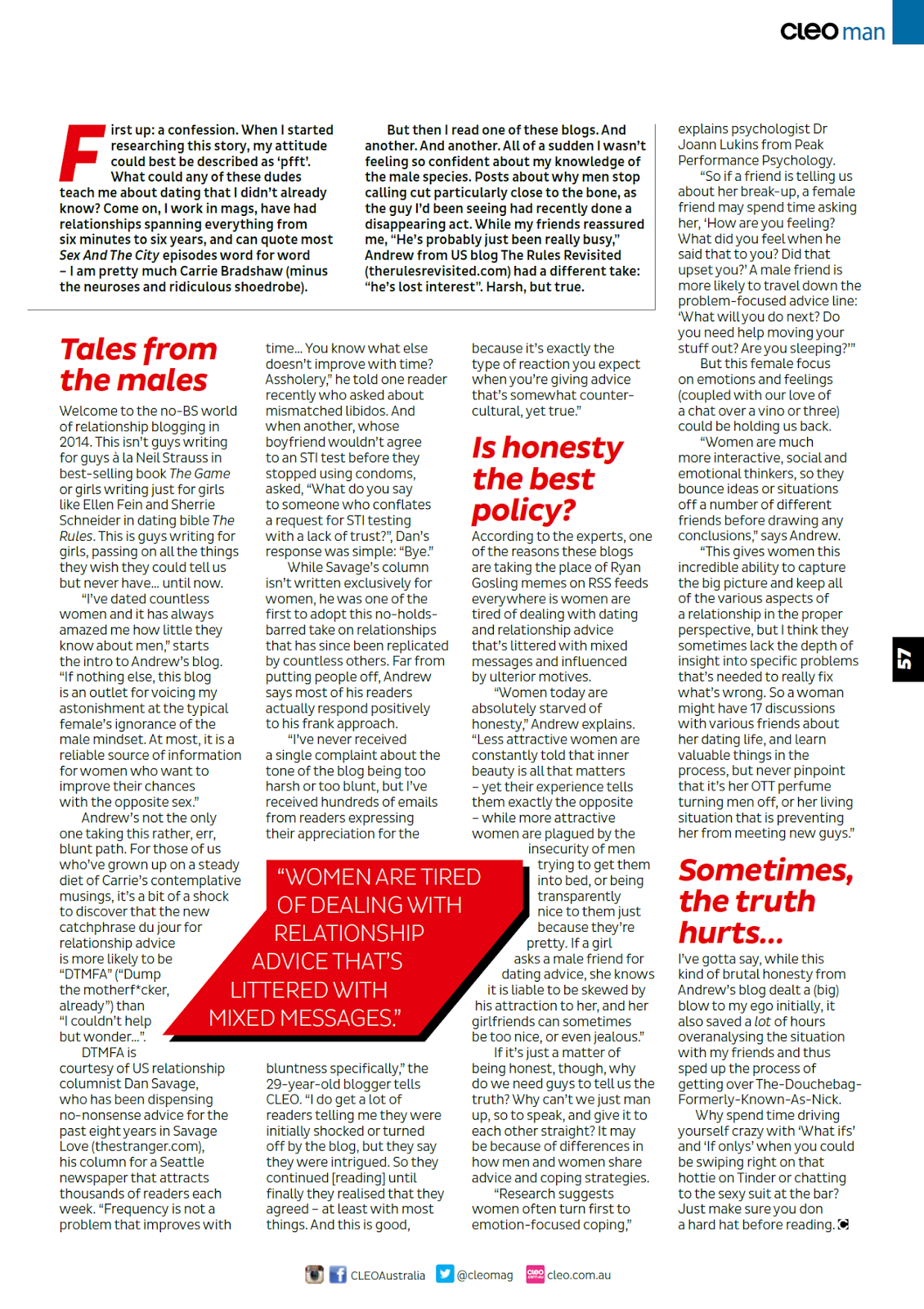
In the end, my answers were quoted considerably in the article, as was the post Men Don't Fall in Love the Same Way Women Do. The editor was kind enough to send me a hard copy of the magazine, as well as an electronic copy of the article, so I've included it in full as images in this post (you can click on the images to enlarge them, or open them in a new tab or window to zoom in and read the text).

Not all of the interview was quoted, of course, but as it touched on some interesting points about men and women, and gives a nice "meta" view of the blog, I thought it might be of general interest. The full text of the interview follows.
_____________________________

1. How did ‘The Rules Revisited’ come about?

I’d say The Rules Revisited was conceived out of the convergence of three factors in my life. The first was the process that I went through myself in learning how to attract women. This started soon after I graduated from college, and in many ways is still on-going; but it showed me that self-improvement is a very real possibility – even for someone like me, who at first felt utterly powerless with the opposite sex. The second was my love of writing and the need for a substantial way to exercise it. Initially I considered starting a blog for men, but most of the ideas that I found engaging and useful had already been pretty well articulated by others. The third factor was the recognition that, in spite of there being this vast network of men producing material to help each other improve their chances with women, there really wasn't anything out there for women trying to improve their chances with men. It felt a bit one-sided, especially because I knew from my own dating experience how badly the advice was needed. With that realization, the concept of the blog was obvious, and I immediately sat down to write the first few posts. I haven’t stopped since.

2. Your advice is quite blunt and to-the-point – what was the initial response like from readers?

It was very positive, actually. To this date, I've never received a single complaint about the tone of the blog being too harsh or too blunt; but I've received hundreds of e-mails from readers expressing their appreciation for the bluntness specifically. In hindsight this doesn't surprise me. Women today are absolutely starved of honesty. Less attractive women are constantly told that “inner beauty is all that matters” (yet their experience tells them exactly the opposite), while more attractive women are plagued by the insincerity of men trying to get them into bed, or being transparently nice to them just because they are pretty. If a girl asks a male friend for dating advice, she knows that it is liable to be skewed by his attraction to her; and her girlfriends can sometimes be too nice, or even jealous. The tone of the blog was never something premeditated; it is just the way I think and write. But I understand why it is appreciated.

(Right-click and choose "Open link in new tab," then you can zoom in on the text)
I do get a lot of readers telling me that they are initially shocked or turned-off by the blog; but they say that they were intrigued. So they continued… and continued… until finally they realized that they agreed – at least with most things. And this is good, because it is exactly the type of reaction you expect when you are giving advice that is somewhat counter-cultural, yet true. Of course, I have to assume that some readers never get passed the “shocked” phase; I just never hear from them because they close their browser and move on. But that is expected also. Not everyone has an attention span and an open mind.

Ultimately, I understand that my readers appreciate my blog because they can trust it. They’d rather read a blog that they disagree with occasionally but trust completely, than a book or website that is trying to sell them something – even if it sounds good every time.

3. Has that response changed at all over time? How so?

It hasn't really, no. The number of people giving feedback has increased dramatically, but the types of responses (and the relative percentages of each type) haven’t changed.

4. What have been some of your most popular topics/posts?

One of the most popular has definitely been The Importance of Silence After a Breakup. Even though I wrote it fairly recently, it has already accumulated the second highest amount of traffic, and has by far the highest number of comments, which are overwhelmingly positive. I am in the final stages of writing a book that expands considerably on this topic, and how to handle breaking up with a man in general.

The post with the highest number of hits is Men Don’t Fall In Love The Same Way Women Do. The comments aren't all positive, but it has the largest number of and +1s on Google by far. I suspect its popularity is partially driven by the number of girls searching the internet for “how men fall in love,” (which is the number one search term leading to my blog) and the absolute absence of other material trying to explain it. I am in the process of writing a better post on the same topic at the moment.

A few others that have been very popular are:
What Men Think of You Without Makeup (this gets shared a lot on beauty forums)
What Men Think About Older Women (fairly controversial, as judged by the comments)

Some of my best posts are the newer ones, which dig a little deeper:

5. Your blog tagline says that, in your experience, women understand very little about men and the male mindset. Why do you think this is?

Well, for starters, it definitely isn't just women who are confused about the male mindset; men are equally confused about the female mindset – I just happen to write for women. There is a notion floating around that it has “always been this way,” but I absolutely disagree. A hundred years ago in Western societies, men knew what women wanted and women knew what men wanted. Even if they weren't happy with the rules of the game, and even if the rules were wrong, everyone knew them and played by them. But all that has recently changed, because we've rejected the old script. We live in a hugely tumultuous time for male-female relations. Men and women are “equal” now, but no one knows what to do anymore to attract the opposite sex. In the absence of any authority telling us how to behave, both sexes hear the word “equal,” shrug their shoulders in confusion, and assume that it means “the same.” We conclude that men want from women the same things that women want from men, and we act accordingly. But it isn't true. Social evolution (let alone biological evolution, which I think plays a part) doesn't occur that quickly. Both sexes still want significantly different things, but no one is telling us this anymore. And even though there is some overlap in our desires, this actually makes things more confusing, because it just serves to further mask the differences. Both sexes are currently standing in the rubble of a social battlefield, each trying to give the other what it doesn't want – mainly because we just don’t know any better.

6. In your opinion, what are the main differences in how men and women give each other dating advice?

That is a great question, because there are enormous differences. One of the largest symptoms of this difference, as I explained before, is actually one of the reasons that I started The Rules Revisited, and that is the complete lack of dating advice available for women on the internet – or in the media in general, for that matter. In the last 15 years, men have generated thousands upon thousands of books, blogs, websites, videos, businesses, etc. – each picking apart a different aspect of attracting women: overcoming approach anxiety, being authentic in a woman’s presence, mastering one-night stands, attracting women online, and so on. The sheer volume is impressive, and actually a huge testament to how much the male world revolves around the pursuit of women. But when you search for similar books or websites for women, you find very few – and many of them are actually written by men.

In my experience, women tend to seek dating advice mostly from friends. For example, my female acquaintances often ask me for dating advice; and I know that girls discuss it amongst themselves all the time. They love discussing it. They love telling their friends about what “he” said or did, gauging their friends’ reactions, and comparing related stories. Such a discussion is an event, to be enjoyed in-and-of-itself, whereas for men it is brief and purely practical – if it occurs at all.

There obviously are some women turning to the internet for dating advice, otherwise The Rules Revisited wouldn't have an audience. Probably this number is increasing, as people in general become more familiar with the power of the internet, realizing what lies at their fingertips. But there is no question that women lag men significantly in their use of written and internet-based dating advice.

In any case, we can say that the female approach to dating advice tends to be more social and discursive, while the male approach tends to be more individual and analytic.

7. Why do you think men and women approach dating advice so differently?

The sexes approach dating advice differently because the sexes think differently. The male mind is more inclined towards the kind of obsessive focus one needs in order to scrutinize even the tiniest of social interactions and break it down into usable rules. This is what we know how to do best, so this is the kind of advice we know how to follow.

Women are much more interactive, social and emotional thinkers. So they do what they do best: they bounce ideas or situations off of a number of different friends before drawing any conclusions. They feel their way through their questions, focusing on their gut instincts more. I also suspect that they are much more in tune with their friends’ and family’s emotional reaction to their dating situation, which is something that many men would never even consider.

I think it is important to point out that both approaches have certain strengths, but also certain flaws. The masculine ability to analyze is impressive, but men can get too easily trapped in a single problem, losing sight of the forest for the trees. For example, a man might perfect his online dating profile to the point that he has cute girls messaging him daily, or learn exactly how to react when his girlfriend tests his honesty or courage, only to realize – years later – that he still doesn't know how to keep a girl interested for more than three months.

The female strategy, on the other hand, gives women this incredible ability to capture the big picture and keep all of the various aspects of a relationship in the proper perspective; but I think women sometimes lack the depth of insight into specific problems that is sometimes needed to fix what’s wrong. So a girl might have 17 discussions with various friends about her dating life – and learn valuable things in the process – but never pinpoint that it is her short hair that’s turning men off, or her living situation that is preventing her from meeting new guys.

To borrow from the adage: a man is liable to forget the forest for the trees, while a woman is liable to forget the trees for the forest.

8.  Do you read other dating/relationship blogs? If so, which ones?

I read HookingUpSmart.com, written and run by Susan Walsh, which I very highly recommend for both sexes. For men I very highly recommend the sections of AnimusEmpire.com that are dedicated to “Manliness” and “Dating.”

Tuesday, January 14, 2014

5 Ways That Men Misunderstand Women

We tend to operate under the assumption that the opposite sex's behavior in a given situations is always informed by a rational understanding of the relevant factors: what you want, what he wants, what really matters in a relationship, etc. But the truth is that there are many times where it is informed by a complete misunderstanding. So while the best way to understand male behavior is to become familiar with men's motivations and modes of thought, the second best way is to become familiar with men's motivations and misunderstandings - because it is unfortunately often that a man's behavior in dealing with women is rooted in misconception.

The following are five of the most common ways in which men misunderstand women, and some of the mistakes they make as a result.

1. Men don't know the difference between making a woman happy and attracting her. A lot of men believe that they will attract a woman by giving her what satisfies her in the moment, rather than doing what will demonstrate their character to her. Often these two things are in conflict. For example, a man will often tell a woman she looks beautiful, when the truth (which she knows) is that she is only looking decent. He will do this because he thinks that her momentary happiness is more important than her long-term ability to trust his opinion, and, by extension, him. Likewise, a man will often try to let a girl choose where to go for their date, because he wrongly believes that her enjoyment of the location is more important than her appreciation of his ability to be decisive and have a plan. These men don't realize that women are more interested in being with a man of character than frivolous things like always believing that they look pretty, or loving the restaurant where they enjoy a man's company. Men misunderstand this because they themselves are always seeking to be satisfied in the moment, and so they project that desire onto the women they date.

2. Men think women experience sex the same way they do. This might seem like a minor detail, as it only manifests itself during sex; however, it is actually central to a relationship, just as sex is central to a relationship. Men need an orgasm to really enjoy sex. It is nothing short of frustrating otherwise. A man who believes that a woman needs an orgasm in order to enjoy sex is misunderstanding something that is much bigger than his partner's desire to feel an orgasm. A man who thinks that his woman needs experience an orgasm to enjoy intercourse is far more likely to neglect the thing that she actually needs in order to enjoy sex: his integrity, openness, pleasure - and most importantly, his desire for her. I've had sex with a lot of women, and the ones who have really liked me could care less whether or not they have an orgasm. They are more than happy just to be fucked by a man that they feel lucky to be with. In fact, the reality is that the less a woman respects and is attracted to her man, the more she will "need" an orgasm to enjoy sex. But men project their own need for an orgasm onto their woman. They work too hard to get her off, and in the end, fail to satisfy her in the more important way: by enjoying her, and letting her be the object of his (as one reader called it) "hurricanes of desire." This misconception manifests itself in things like his performance of obsequious oral sex, his listening to you when you tell him to "come now" (rather than being authentic and coming when it happens naturally), or in general listening to how you tell him to fuck you. More severely, it shows up as performance anxiety.

[Before everyone starts jumping down my throat for this one: I am well-aware that women love having an orgasm during sex. But if you "need" an orgasm in order to enjoy sex, ask yourself whether you'd prefer to be ravaged deeply by your man without an orgasm, or be given an orgasm by a guy who goes down on you for so long that he goes limp and loses interest in fucking you. Of course you want both, but both aren't always possible; and the point is that, when they aren't, men often choose poorly between the two options.]

3. Men think that you know you are hot. Many men feel powerless in the presence of a beautiful woman. Actually, it is more accurate to say that many men feel powerless in the presence of any woman in proportion to how much more beautiful than him she is. This is particularly true in younger men, but some men never grow out of it. Much of this feeling of powerlessness is due to the assumption that the woman knows that she is beautiful, and that therefore, they stand no chance of having her. (The rest is due to what I will explain in point number 5, below.) The truth, of course, is that a woman's confidence is absolutely uncorrelated with looks. Many beautiful women feel wildly insecure. However, a lot of men don't realize this. They are so stunned by beauty that they cannot see past it. A man like this might be too intimidated to approach or pursue a woman that he perceives as being out of his league due to her looks alone, when the truth is that the girl may be wishing that he'd approach her.

4. Men think that you mean what you say. Men are literal creatures. Natural selection has weeded out those of us who didn't have a mind for focusing on the facts and the facts alone, and getting the job done. The result is that, while we excel at those things, we suck pretty hard at reading between the lines, interpreting emotions, or understanding what is left unsaid. And the more modern culture tries to tell us that men and women are the same, the harder it is for us to understand that women don't suck at this as much as we do. Many men, therefore, believe that women are equally literal. These men believe that women mean what they say, and say everything that they mean - but this is simply not true. I got an e-mail just the other day from a reader who broke up with her boyfriend, not because she didn't like him anymore, but because she was hoping he would fight for the relationship. She (understandably) wanted to feel desired by him, so she tested him by ending the relationship. I can guarantee you that the boyfriend believed that she ended the relationship because she wanted the relationship to end. But the truth is that she was ending the relationship specifically and exclusively because she did not want the relationship to end. I can give similar examples in which women have asked for things they didn't want in the hope that the man wouldn't give them to her, or others in which a woman has said things she didn't believe only to incite a reaction in a man (or another woman). The point is that, when a man responds to you, he is responding to what you've said or done under the assumption that it is immediately and directly motivated by what you want to happen.

5. Men think that women care just as much about physical attractiveness as men do. The fact that they believe this says a lot more about how important looks are to men than anything about how important looks are to women. It is projection through and through, and causes a lot of men to be insecure about their looks - almost as much as women are insecure about their looks, just without a valid reason. It also leads to men neglecting the important aspects of their character in order to learn how to dress perfectly, or spend all day in the gym. Women are left with a pool of jacked-up, perfectly-dressed, shaved-chested pussies from which to choose a husband, rather than confident and intelligent men of character who are a little rough around the edges. (Yes, I know this is an exaggeration, but the point is that you have fewer men to choose from.) If you've ever looked around and wondered "where are all the good men?" this is probably a big factor in answering your question.

You'll notice that all of these misconceptions are due to projection, encouraged by the notion that men and women are the same - which is not anywhere near as similar as people think it is to men and women being equal. Anyway, keep these things in mind next time a guy does something confusing - chances are one of these will explain why.


Related Posts
1. Misconceptions
2. Why Women Don't Know What Men Want
3. The Analogy Between Sex and Commitment

Tuesday, December 24, 2013

You Don't Need to Like Sports

I've traveled a lot. I've lived in Europe twice, spent months at a time in Africa and India, and have visited dozens of other countries in south and central America, the Middle East and Europe (no, I am not in the military). I don't say this to brag or show off, but to lend a little more weight to the observation inspiring this post. The time I've spent abroad has given me a fairly good grasp on the differences between American women and foreigners. This understanding, in turn, helps me to recognize the characteristics that are universally feminine, as opposed to those that are specific to the women in the United States, or any other culture.

One thing that is unique to the United States is how much American women watch sports. Perhaps I am noticing this more recently because it is the middle of the American Football season, but in any case the trend is unmistakable. Women in the United States have favorite teams, know the names of all the players, and watch every game. They cheer with excitement when there is a good play, swear at the referees when they make a bad call, have opinions about who will beat whom, and generally invest a good deal of their identity as a fan of their chosen team.

This doesn't really happen outside the United States. I am sure there are some places where women care about sports more than others, but I have yet to go anywhere outside the U.S. and find women out-shouting men at a bar where a "big game" is being shown on TV. In the U.S. it happens regularly, so it is clear that this is a cultural (rather than sexual) phenomenon.

Most sports are inherently masculine. They are physical, aggressive, strategic and competitive. Perhaps more importantly, "scoring" is characterized in most sports by the same kind of build-up and break-through that occurs in the male orgasm (it isn't a coincidence that men use the same term to refer to getting laid), and in other traditionally masculine pursuits, like hunting and scientific investigation. And while this doesn't mean that women can't or shouldn't participate in sports, or even thoroughly enjoy them, it does mean that any pressure a woman feels to watch or participate in them is most likely external and cultural, rather than internal and authentic.

More to the point here, liking sports will not make you more attractive to men. As I have pointed out before, trying to be one of the guys is a bad dating strategy. There is nothing lamer than that girl at the bar on game-day, wearing face-paint and a team jersey, yelling at the players or referees on the screen in an attempt to prove to the guys around her how much she knows about the game. It is almost the definition of trying too hard, and it is a huge turn-off. While taking an interest the things he likes (sports) is a demonstration of good-will, admiration, and maybe even loyalty, being as obsessed about hockey as he is will not make him want to bang you or date you; it will (at most) make him want to be your friend.

I occasionally pick up Cosmopolitan to see what kind of advice they are giving, and I read there once that men said they like a girl who loves sports. I don't doubt that men have said this, but that doesn't mean it is any truer than the female claim to like men who are able to cry during movies. While both are kind of nice ideas in theory, the behaviors of both sexes in choosing partners betray their real preferences. And yes, of course, there are girls who are epic sports fans and still get guys, but I can promise you that this is because they are hot or fun to be around - not because they are sports fans. 

So if you are American girl, and feel like you aren't fitting in because you don't know the name of your local basketball team's point guard, or if you find yourself tempted to mimic that one girl you know that has men swarming over her as she spouts football statistics, take a moment to recognize that (a) it isn't her love of sports that is attracting those men, and (b) if it isn't something you genuinely like, you shouldn't be doing it anyway.


Related Posts

Sunday, September 29, 2013

Why Men Are Capable of Commitment

I've pointed out some things about the male attitude towards relationships that - considered by themselves - might make women despair of the possibility of a real or lasting relationship (two posts that come to mind are Men and Sexual Variety and  Men Don't Have Commitment Problems). But they only represent part of the story... 

I remember a conversation that I had with an ex-girlfriend a few years ago about our fears in relationships. I told her that mine was to wake up one day, ten or twenty years into a marriage, and no longer want to be with my wife. Of course I'd only thought about the situation from the perspective of sexual attraction, and so had unsurprisingly developed the fear that I would grow bored or tired of her after she lost her beauty.

"Yeah, I see what you mean..." she agreed - but she continued, "I guess I've always just figured that the more time you spend with someone, the more you'll have invested in them. You'll have more shared experiences, more history - more memories. You'll know each other's habits, likes, dislikes, routines and quirks so much better than any new person's, that the temptation to leave won't really be that strong. You'd have to throw away everything and start again."

She was right. And I realized right then that my perspective on that hypothetical situation - and on relationships in general - was missing a huge piece of the puzzle. I was ignoring completely the phenomenon of attachment she described. I'd considered only lust and romantic love, the two early phases of relationships, and I'd lacked the experience or foresight to recognize that the situation I feared wasn't realistic.

More importantly, I realized that choosing someone to marry wasn't so much a matter of taking a gamble on the best girl possible as it was a choice of a girl to start to build a life with. In other words, the strength of the resulting relationship wasn't merely a function of the quality of the girl I would choose; much more important would be the life we'd live together - even if it wasn't perfect. By simply choosing to bind our lives together, we would be choosing to invest ourselves in each other; and before long, that investment would outweigh the greater sexual attraction of some hotter girl, or the excitement of sexual novelty.

Now, this isn't a particularly male phenomenon, but it is important for women to know that it isn't a particularly female phenomenon either. It happens to men too. So in the same way that I don't need to fear waking up twenty years from now and finding myself looking for a new wife, neither do you need to worry about your man doing it - assuming, of course, that you are both people of good-will, who are willing to work to maintain a good relationship. Even if he isn't aware of the phenomenon, it will affect him - just as it would have affected me even if I'd never had that conversation with my ex girlfriend.

The mistake I made in thinking about my future relationship is one that plagues young Americans' attitudes towards marriage. It is the reason that couples feel the need to live together before getting married, and stress out so much about choosing a partner. If these fears were rooted in reality, no relationship would succeed. There is always a hotter, richer or more-compatible partner out there; finding them isn't a prerequisite for a happy marriage, and you aren't going to renounce your vows just because you encounter them after marrying someone else. Your partner will always have the advantage of the time you've spent together and the relationship you've built.

It is also worth pointing out that this phenomenon is the main reason why you shouldn't linger in relationships that are stagnant or half-hearted. In doing so, you are investing yourself emotionally, and - despite the shortcomings of the relationship - that investment will make a break-up much more difficult.

In any case, I am writing this post because I was reminded of the whole concept a few hours ago, while listening to the lyrics of a new Dierks Bentley song, I Hold On, which is written to his wife. It's a great song, and one that I think is particularly poignant coming from a man:


If you can't watch the video, here are the words:
It's just an old beat up truck, some say that I should trade up
Now that I got some jangle in my pocket
But what they don’t understand is it's the miles that make a man
I wouldn’t trade that thing in for a rocket
What they don’t know is my dad and me, we drove her out to Tennessee
And she’s still here now he’s gone 
So I hold on... 
It's just an old beat up box, its rusty strings across the top
It probably don’t look like much to you
But these dents and scratches in the wood, yeah that’s what makes it sound so good
To me it's better than brand new
You see this here flat top guitar, has had my back in a million bars
Singing every country song 
So I hold on... 
To the things, I believe in
My faith, your love, our freedom
To the things I can count on
To keep me going strong
Yeah I hold on... I hold on... 
Like the stripes to the flag, like a boy to his dad
I cant change who I am, right or wrong
So I hold on... 
Yeah baby lookin' at you right now, there ain't never been no doubt
Without you I'd be nothing
So if you ever worry about... me walkin' out
Yeah let me tell you something...
I hold on...

Related Posts
1. The Downside of Cohabitation Before Marriage
2. We Have a Shared Responsibility
3. Why Rejection Is a Good Thing
4. The Male Sex Drive Always Recharges

Wednesday, August 28, 2013

If a Man Talks to You, He Likes You

I have made this point before, but only briefly; and as simple as the point is, it warrants further explanation.

If a man goes out of his way to interact with you, he is interested in you romantically or sexually - at least to some degree. A lot of women don’t realize this, because when they approach a man (for example, to ask directions in the street), they don’t do so with romantic or sexual intention. They wrongly project their own lack of intention onto the men who approach them. They think “When I approach a man, I don’t have romantic or sexual motives; so this guy asking me for directions has no ulterior motives.” But they are wrong.

If you are skeptical about this, consider that the same phenomenon is manifested in men. Men always “get the wrong idea” when a woman responds to their texts, or engages them in conversation in a bar, or doesn't spit on them and walk off when they ask her for directions. The truth may be that the girl is just being polite, or that she genuinely believes the guy just needs directions, but the man projects his own intentions onto her. He thinks “When I talk to a woman even for casual reasons, it is because I like her. This woman is talking to me, so she must like me.”

Yes, of course, there are exceptions to this rule. Sometimes a guy genuinely needs directions, or really is just talking to you to kill time at the bus station. But the point is that these exceptions are far rarer than you think. In fact, the exceptions are so rare that you are better off always assuming that men who approach you are interested than you are questioning it each time. In the rare instances that a man isn't interested, you have nothing to lose by assuming that he is; and the increased confidence you’ll have knowing that he is into you will help you to be your best self in his presence, which will attract him further.


Related Posts

Thursday, April 4, 2013

Men and "Friends With Benefits"

While explaining her relationship with a guy she is interested in, a reader who recently wrote to me for advice reminded me of the difference between the typical male and female approach to being "friends with benefits":
I guess we're friends with benefits because there's no commitment on both parts. I also made a conscious choice that it was only purely physical with what happened between us (only twice by the way). But I liked his company and the flowing conversations we had. I didn't put any pressure on him either. I had no illusions, in other words. I was, however, hoping that we could learn more about each other slowly and establish a good foundation before going to the next level. But again, I had no illusions.
The simple fact is that men almost never fall in love this way, despite what you saw in the fictional movie (emphasis on fictional), No Strings Attached. The woman quoted above might not have had any illusions about the fact that the relationship was purely sexual, but I suspect she did have some illusions about just how unlikely it was that her love interest would change his perspective on the relationship. If she hadn't, she wouldn't have wasted her time.

It has been my experience - both personal and vicarious - that the vast majority of women view a casual sexual relationship as a potential stepping stone towards a relationship. Men, on the other hand, see it as nothing more than what it sounds like: sex with no emotional ties, no commitment, nothing. If anything, men treat it as a step away from a committed relationship, because if they wanted more from a woman, they wouldn't settle for mere sex; they'd want her exclusivity also. (If this sounds familiar, it is probably because it is almost identical to the difference between the male and female perspectives on moving in together before marriage.)

Any man who is mildly observant of the opposite sex will have a hunch in the back of his mind that this kind of relationship is bound to explode eventually. But he isn't going to turn down all of the commitment-free sex he'll get in the meantime just because of some "feeling." Men don't trust feelings the way women do. Men are hyper-rational, literal creatures. If it is called "no-strings-attached" relationship, that's exactly how he treats it, no matter how much cuddling and hanging out is involved.

Furthermore, a man will often be willing to engage in a relationship like this with a woman who is below his league, in the same way that many people will have lower standards for the quality of the house they lease, as opposed to the one they eventually buy.

Yes, of course, I know, there are occasional exceptions. There are always exceptions. Once in a while, a long-term relationship or even a marriage can grow out of something that started as friends-with-benefits. But the point is that, when it comes to casual sexual relationships, the exceptions are so rare that you'll be far better off avoiding them completely than taking a gamble on even the most apparently promising ones.

So before you jump at the opportunity to "get closer" to the man you want by making things sexual, recognize that his willingness to engage in a casual sexual relationship with you is actually a step away from commitment, not a step towards it.

Friday, March 22, 2013

Your Love Life Is in Trouble If...

Your love life is in trouble if...

  • You minimize the time that you put into looking good because you believe that "only shallow men care about your appearance."
  • You tell yourself you have plenty of time to find a guy.
  • You over-analyze what you should text men and when.
  • You actually believe your friends when they tell you that you have "a Beyonce thing going on" or compare you to any other heavy-set-but-attractive female celebrity.
  • You behave differently depending on the kind of guy you are with (dating) at the time.
  • You blame the fact that you are single on "all men being assholes," the male "fear of commitment," or "all the good men being taken," instead of acknowledging the only real problem: yourself.
  • You reflexively criticize hot girls for being "ditsy" or "stupid" - even if they are.
  • You assume that a man means something else when he tells you he "isn't looking for anything serious right now."
  • You are trying to date a guy who is cheating on his wife or girlfriend with you.
  • You don't own high heels.
  • You don't have a gym membership.
  • You believe that you "just need to be patient" and soon you'll fall madly in love with a man who unexpectedly stumbles into your life, just like in the movies.
  • You don't think you can get more attractive than you are right now.
  • You believe that the best way to get more attention from the men who don't approach you is to instead approach them.
  • You are tall for a girl, and believe that slouching makes you more attractive because it takes the emphasis off your height.

Related Posts

Wednesday, March 20, 2013

What Men Think About Your Virginity

Imagine you are dating a guy who doesn't know that you are a virgin. Everything is going well until, one night, he starts to push things past the limits of your sexual comfort zone. After a quick battle in your conscience, you stop him and reluctantly tell him "I can't..." followed by an apologetic, blush-filled explanation about how you were raised, how hard it is to constantly disappoint men, and how difficult it is to live with the fear of being "found out" by your friends. He is a little bit surprised at the news initially, but he says that it isn't a big deal. He even seems sincere when he tells you how much he admires your decision and sometimes wishes that he'd stayed a virgin too. However, in the next few days, his contact and initiative plummet. Before long he stops talking to you altogether. You are confused. You understand that men want sex, but this guy seemed different...

Sound familiar?

Of course, there are many variations on this story. Maybe you wanted to sleep with him, but something made him suspicious, and he asked if you were a virgin before anything happened. Or maybe you made it clear that you really didn't want to stay a virgin, but that you just needed a little longer together before having sex. Or maybe you actually asked him to sleep with you, right then and there, because you were fed up with being a virgin and figured you might as well lose it with him as with the next guy. However it happened for you, the result was probably the same: he disappeared.

You've probably assumed that men act this way for one or more of the following reasons:
  1. They think it will be too much work to sleep with you,
  2. They are "weirded out" by the fact that you've never had sex,
  3. They don't want to "suffer" through your inexperience.
For some men, a combination of these things will play a role in their decision, but usually it will be a minor one. If you are hot enough, men won't give up very easily at all - particularly players, who know that women often say no at first, only to give in soon afterwards. No man is "weirded out" by the idea of virginity to the point that it would actually prevent him from enjoying sex. And although sex might not be as great with a virgin as with a more experienced girl, few if any men have so many women at their fingertips that they can afford to discriminate based solely on anticipated performance. There is something deeper at work.

The primary reason that most men disappear after learning you are a virgin is simple but often overlooked: men don't want the responsibility of taking your virginity. Rightly or wrongly, men assume that in proportion to how long you've remained a virgin, your experience losing it will be "a big deal," and something that you want to do within the context of a serious relationship - even if you tell them otherwise. Men aren't afraid of or "weirded out" by your virginity; they are wary of the expectations that will accompany taking it from you.

It should go without saying that the men who are going to be most turned off by expectations or responsibility are the ones who know, in the back of their minds (or the forefront), that there isn't potential for a relationship. If a man really likes you, your virginity will not be impediment to dating. He will not balk at the idea of waiting until you are in a committed relationship (or possibly longer) for sex. In this sense, your virginity can actually serve as a good filtering mechanism for avoiding men who aren't interested in anything serious.

There are limits to this phenomenon, however. Once inside a committed relationship, even a man with the best intentions is likely to be put off if his girlfriend insists on waiting until marriage for sex. The convenient reality in these cases, however, is that the few women who insist on waiting until marriage are probably most compatible with the few men who are also willing to wait until marriage. So if you really believe that prolonged virginity or abstinence until marriage is important, consider this belief a filtering mechanism - no man without similar beliefs will be willing to wait that long.

It is also worth pointing out that men will be somewhat less scrupulous about taking a younger girl's virginity. Because younger girls haven't been virgins for as long, men (even young men) will assume that the girls care less about giving it away. Although there isn't a strict age cutoff for this assumption, it falls somewhere between 20 and 22. Before 20, almost no guy will be surprised at a girl's virginity. After 22, almost all men will assume that a girl's virginity is intentional. Keep in mind that the average age at which American girls reportedly lose their virginity is 17.

Also keep in mind that being surprised that a girl is still a virgin is not the same as thinking that she is "weird" because of it. I considered writing a paragraph explaining the age at which men will think a woman is "weird" for still being a virgin (since I know that some women worry about this), but in the process of trying to pinpoint that age, I realize two things: (a) there really isn't one, and (b) you shouldn't care anyway.

To conclude: men who disappear after learning you are a virgin wouldn't have stuck around in the long run anyway, and they certainly don't disappear because they are lazy or feel awkward about your inexperience. They are simply unwilling to deal with the moral hangover or relationship pressure of taking you through such an "important" event in your life, then walking away afterwards. And they will avoid doing so even if it means foregoing easy or guaranteed-STD-free sex. So if a guy disappears on you after you tell him about your virginity, don't feel the need go and to lose it at the next opportunity; just be glad you dodged a bullet.


Related Posts
1. What Men Think About Your Sexual History
2. How to Date as a Virgin
3. How to Look Good During Sex
4. Never Tell a Guy When You'll Have Sex With Him

Thursday, March 14, 2013

Yeah, That's About Right


Hi Andrew,

I would like to start this email with a sincere compliment about how much I have enjoyed your blog over the past few months since I discovered it. You have given me so much food for thought, whether I agree with you or not, and challenge my opinions and perceptions of the male-female dynamic. I am thankful that you take the time to write this blog.  : )

I have a suggestion for one of your blog posts. I very frequently find that women are quite obtuse when it comes to knowing when a man is hitting on her. When I was younger, my father once said, "Nicole, if a man you don't know is talking to you for any reason, he is hitting on you."

When I share this piece of information with my females friends, they scoff. "NO! That's not true! What if he needed directions? Or help picking out a ripe cantaloupe at the market? Or the best bus to take to get downtown the fastest?" The list goes on and on. On the flip side, when I share my dad's advice with another guy and ask his opinion of it, their response is almost always, "Yeah, that's about right."

The reason I bring this up is because I think there are many women out there that may not be able to recognize when a man is hitting on them or trying to pick them up. Perhaps if women were more attuned to when they were being hit on, their success of flirting and engaging with men would be greater. If you agree, I have a feeling that a post about this would be very helpful to your female readers.

Thanks so much and keep up the good work!

Much love,
Nicole
____________________________________________

Nicole,

Yeah, that's about right.

Andrew


Related Posts
1. Misconceptions
2. "The Wong Kind of Attention"
3. Why Women Don't Know What Men Want
4. Why You Don't Get Approached by Men

Monday, March 4, 2013

Less Masculine = More Feminine

I pulled the following statement from the comments of the post The Analogy Between Confidence and Beauty:

So I had a revelation about a few weeks ago...and it pertains almost exactly to this post. I'm a confident 7, well-spoken girl but have always wondered why I'm having such issues with attracting the right type of guys when I have such a well-rounded personality. So I started to experiment with how I acted around guys. I became more feminine, I would act more sweet, talk less, be less witty or sarcastic and it was crazy how many more guys came flocking to me. It was kind of disheartening though that I had to become this demure thing to attract more guys. I felt like I was compromising myself, and at times not even being myself because I had to bite my tongue so much and watch what I said. I don't want to be a bobblehead airhead girl, but it seems as though that's what guys want. How do I attract the men I want without compromising myself?

I want to share my response, because I have had similar questions from other readers, and it is an important point for any woman trying to understand her feminine self in the modern world:

You only think of behaving in a more feminine manner as "compromising yourself" because you've been conditioned to think of your personal value in purely masculine terms. But why is it "compromising" to be MORE feminine? You are too fixated on the fact that you are being LESS masculine. Yes, you are LESS ambitious, LESS witty, LESS assertive; but why think of these changes in negative terms? What about the fact that you've become MORE receptive, or MORE radiant, sweetER, or MORE beautiful?
Men and women are two halves of a whole: one typically active (male) and one typically passive (female). But neither one is more important or better than the other, any more than an electrical plug and socket - which are typically referred to as "male" and "female" - are more or less important when it comes to conveying electricity.
It is only because "success" in our society is defined in masculine terms that you feel like you have reduced or compromised yourself as a person by this change. So instead of considering what you've subtracted or "repressed" by being LESS male, focus on what you've added or improved by being MORE female.

There is one more important point here: even though the "bobblehead airhead girl" gets good responses from men, this doesn't mean that she therefore represents the ideal of femininity that men seek. Men prefer her because there are elements of the "bobblehead" that they like: her carefree spirit, her flirtiness, her willingness to be led, her cheerfulness, etc. Her characteristic stupidity and lack of substance are things that men merely tolerate in order to experience the feminine qualities that they desire so deeply - that is, the qualities that men do not typically have in themselves and cannot get from masculine women.

If this seems unfair or counter-intuitive, consider that women behave similarly in their selection of men: they often tolerate insensitivity, excessive pride or stubbornness (i.e. they date "assholes") only because these qualities are unfortunately common in most of the men who have the masculine qualities that they want: strength, aggression, unshakable confidence, ambition, etc. - in other words, the qualities that women do not typically have in themselves and cannot get from feminine men.


Related Posts
1. Femininity, Authenticity and Compatibility
2. Are You Repressing Your Femininity?
3. Misconceptions

Saturday, February 23, 2013

Why You Can't Get the Men You Want

Most women who complain that they "don't get any attention from men" actually mean that they don't get attention from the men they want. And the simple advice for women in this situation (which I have seen on other blogs, and have occasionally given out myself) is sometimes appropriate: "you aren't hot enough to get the guys you want; lower your standards." However, in most cases, I think there is deeper phenomenon at work.

Women tend to be aware of and rate their looks fairly accurately. I know this because a lot of readers send me pictures saying "I think I am an X out of 10, can you tell me what I really am?" Although I always refuse to give them my numerical opinion (because all men think differently), their guesses are usually very close to what I would have ranked them.

So why would they set the bar so much higher than what they know they can get? Some might point out that their "delusion" is caused by their experiences getting men who are out of their league for sex and casual dating. And though I agree that this happens, it doesn't capture the whole picture. Women just aren't that easily deceived about their own physical attractiveness. It shouldn't be surprising, then, that the problem is primarily an internal one.

Each of us has an inherent knowledge of our own capabilities and dispositions. We know the inner workings of our own mind: how honest we are, how prone we are to mood swings, our insecurities and strengths, what we've experienced, what we still need to learn, the strength of our ambitions, etc. This translates into an excellent knowledge of our personal capabilities, our personal potential. We all know roughly what we could achieve, whether or not we have achieved it. Occasionally we modify this self-perception when we realize the extent of strengths we didn't know we had, or weaknesses that have greater implications than we'd imagined. But in general, we know ourselves well; we know what we are capable of becoming. This is true in all aspects of our lives: business, working out, academic learning - everywhere. It also applies to dating. Because we know ourselves, we also know roughly what we should be able to get when it comes to the opposite sex.

A statement that often accompanies women's complaints about not getting the men they want is something to the effect of "I know I am a catch. I have so much love to give a man. Why can't men see that??" This is a symptom of the above-described phenomenon: you know that you have the right "raw material" to attract the kind of man you want (in fact, "the kind of man you want" is partially defined by your self-knowledge), but you are confused about why it hasn't happened for you yet.

The reason for this is simple: your self-perception of your potential is roughly accurate, but you aren't living up to that potential. You aren't the person you know you can be. You have the capability, but you haven't used it. You have the potential, but you haven't fulfilled it. You know you can be a fun and exciting person to be around when you feel comfortable, but you haven't confronted your insecurity in social situations, so men don't realize this. You know you have a great figure, but you haven't learned yet to show it off by correcting your posture, so no one notices it. You know you have great hair, but you don't put the effort in to style it well, so it does you little good. You know you are pretty, but you haven't confronted your fear of looking a little awkward, and this has dramatically slowed your efforts at learning how to dress yourself well. Your are well aware of your inner feminine self and you instincts to nurture and love, but you suppress them (as you've been implicitly told to do by your parents or the culture around you) and men assume you are cold and boring. You know that you are an incredibly sexual person, but because of your strict conservative upbringing, you cloak it in "modesty" and men are turned off.

The reason women can't get what they think they deserve is that we (men and women alike) always peg our standards to what we know we can be, not to what we are, while members of the opposite sex judge us - understandably - only on what we are currently. They have no access to the inner workings of our mind; and even if they did, they would have no guarantee that we'd ever reach the potential this would reveal to them. So your discontent in dating boils down to the fact that you aren't living up to your own standards - yet. Incidentally, this also explains why most people have such an aversion to settling: our subconscious knowledge of what we "should" be able to get is achievable (if not currently accurate), so it seems defeatist to accept something less.

I've illustrated an example of this in the diagram below. A woman who is a 5.5 out of 10 has the potential to be a 7.5, so she "knows" that she can get men of that caliber (red arrows). She is constantly setting her sights on men who are in the 7-8 range (dark blue arrows), and she is constantly being rejected by them. She doesn't understand why, since she thinks these men are in her league, when the truth is that she could get into their league. Her situation isn't helped by the fact that a lot of the men she wants haven't met their full potential yet either, meaning that they - also wrongly - have their sights set on women of an even higher caliber (light blue arrows).

Rank out of Ten (Combined Looks and Appearance)

So the bad news is that you probably can't get the men that you think you can get. But the good news is that you probably can eventually get the men that you think you can get - assuming you are willing to work at it, and do. The biggest takeaway, though, is that if you aren't getting the men you want (but you think that they are in your league), your first move shouldn't be to lower your standards, it should be to self-improve.


Related Posts

Thursday, January 10, 2013

Misconceptions

The most recent post on Hooking Up Smart borrows a Venn diagram from a website called Doghouse Diaries. The diagram attempts to dispel a few myths about what men find attractive in women. While of course all men have different tastes, and projection is inevitable, I was still a little disappointed at what the author came up with.

Below is my take on the phenomenon he recognizes. You'll notice that I kept a couple of his points. I also used a list format so that the differences can be seen more clearly.


Related Posts

Thursday, August 16, 2012

How to Get "The Right Kind of Attention"

My model for understanding the way a woman acts and dresses has always been something like this: the more a woman dresses like a slut, the more attractive she is; but the more a woman acts like a slut, the less attractive she is. In other words, the most attractive women are those who dress like whores but act like good girls. Impossible, right? Probably. But it is the ideal nonetheless, just like a woman's ideal is a man who is extremely powerful and physically attractive, yet in touch with his emotions and sweet - which also does not exist.

In any case, I was out the other night and I ran into a girl I'd met a few weeks before at the same bar. We started talking, and somehow got onto the topic of how women dress...

"It's simple for a girl" she said. "If you want to pick up a guy to get laid, or to make out, you wear a short, tight skirt and low-cut cleavage. But if you want to meet a guy to date, you..."

"...wear something modest." I interrupted, somewhat smugly. "That's what every girl thinks and it's complete bullshit." I was about to explain to her that good guys and bad guys alike are both equally attracted to a woman's body, and that behaving modestly is far more important than dressing modestly, when she cut me off:

"Wait, I wasn't finished! That wasn't what I was going to say at all. I was going to say that you have to choose one or the other."

"One or the other?" I asked. "What do you mean?"

"I mean you either wear the short, tight skirt, or the plunging neckline - but not both."

I was silent. I literally paused for several seconds, thinking about what she said. I was still somewhat shocked by the fact that she didn't buy into the absurdly false cliche that a woman attracts good men by pretending that good men don't have sexual impulses; but I was also intrigued by the nuance of her idea. It was honest, and it bore the hallmark complexity of truth.

"Huh... That's really interesting." I said, pensively. "I actually spend entirely too much time thinking about these kinds of things, and haven't thought of that before. You might be on to something." I paused again for a few seconds. "I need to think about it more, but I like the idea regardless. I've always thought that women are more attractive the sluttier they dress and the more modestly they act, but I might have to re-consider that now."

The jury is still out. The girl won't return my calls either...


Related Posts
1. Sexy Versus Cute
2. "The Wrong Kind of Attention"
3. The Most Important Time to Dress Well
4. There Is Nothing Modest About Loose Jeans

Saturday, May 26, 2012

Why You Should Beware of Romantic Movies

Romantic movies, and romantic comedies in particular, are made to play into the supposed ideals of women, not to reflect the reality of relationships. If they did the latter, they wouldn't sell, because the public doesn't watch movies to see what they can experience in everyday life.

These movies, though made to reflect public opinion, in turn help to create or perpetuate the viewers' romantic ideals, and a deceptive cycle is formed. Very few people ever stop to ask themselves whether or not any of these fictions reflect real life. I know I didn't until well into my twenties, and I have acquaintances who clearly still have not.

Yes, Hugh Grant makes you woosy and increases your heart-rate; but how much of that is because he is a bumbling idiot and supplicating push-over who gives in to the courted woman's every wish; and how much of it is because of the romantic setting, the background music, the omission of anything less than perfect, and most importantly, the female audience's wishful thinking that they can have the best of both worlds - namely, a man who is strong enough that he isn't swayed by his emotions, but one who is swayed by his emotions so much that he can't control himself around a woman? This does not exist.

So be careful the next time you watch or read anything about a man or a woman in love - especially if you often find yourself looking for men like the ones you see in the movies. I do think there is a place for movies and novels in society, so I'll stop before this starts to sound too much like The Republic; but Plato wasn't entirely wrong to warn us of the pitfalls of fiction...