Showing posts with label how men think. Show all posts

Tuesday, September 1, 2015

The Problem with Denim and Leather

Several years ago, I got into a discussion about women's clothes with my girlfriend at the time and her friend. The friend mentioned that she had "kind of started to hate polo shirts on girls." I was a bit surprised, so I asked what was motivating her hatred. She replied that they were "just too masculine."

I found that interesting. I'd never even noticed polo shirts as being particularly attractive or unattractive, let alone masculine or feminine; but I could see where she was coming from. After all, some clothes (dresses for example) are more feminine, so it made sense that other types could be more masculine. From that point on, I started paying more attention to how sex-appropriate various types of clothes seemed.

Years later I started reading a website called Masculine Style, which does a great job of teaching men how to dress well. The author explains that the history and evolution of certain clothes is what makes them have the visual effect that they do, making them work (or not) for different men in different situations.

He explains, for example, that heavier knit sweaters are far more rugged and masculine-looking than a thin cashmere cardigan because they were designed for and traditionally used by dock workers and fishermen. Similarly, boat shoes were designed with soles that were soft enough to prevent scratching the decks of yachts, and therefore still hint at wealth and luxury in spite of their casualness. Sturdier materials like denim and leather have histories rooted in farming and manual labor, and so they carry connotations of their industrial origins – which brings me to my point…

For a couple years now, I've realized that I don't like when girls wear denim or leather. If the girl is good-looking, I will still be somewhat sexually attracted to her, but both the magnitude and type of attraction is significantly different than it would be if the same girl were dressed in lighter, softer materials. And following the train of thought that was inspired by my ex-girlfriend's friend and what I read on Masculine Style, I've started to wonder if my distaste is due to denim and leather being inherently unfeminine materials.

I mean think about it: denim and leather are rough, sturdy materials made to withstand the abuse of hard labor. They were made to protect rugged men doing rugged work. In the same way that we project onto guys who wear heavy-knit sweaters the masculinity of dock workers, it makes sense that we project onto women the connotations of wearing laborer's clothes – whether we do so consciously or unconsciously. And doing so casts a shadow over a woman's femininity. Asking a woman to look attractive in a biker jacket is kind of like asking a man to look attractive in lace.

Now, I realize that anytime you say (or even suggest) that something might be "objectively" masculine or feminine, people get defensive. If there is a scale along which masculinity or femininity can be quantified, people invariably start worrying about where along it they'll be placed. They are afraid of being judged.* But I am going to assume that my readers have learned to be comfortable with themselves, and throw the idea out there anyway – not so much because I am completely convinced by it as to field your opinions. So here is the concept:
Denim and leather (and perhaps other materials besides) are objectively masculine, at least to the same extent that materials like satin or lace are feminine. The current popularity of leather and denim in female fashion is a trend, piggybacked on the popularity of feminism, and it does not reflect the objective attractiveness of the materials themselves. While women can often look attractive in denim or leather, they do so in spite of the materials, not because of them.

Nope. Really.

I've been testing the idea recently by mentally separating the factors of my attraction each time I see a hot girl wearing one of these materials. Certainly when I think about a woman wearing any piece of clothing in either denim or leather, I can always imagine her being sexier in something less rugged. I've never liked jean or leather skirts on girls; and although it is much harder to look objectively at jean pants (because they are so entrenched in current fashion), I find normal cotton way more attractive.

When I suggest to my male friends that leather and denim are unattractive on women – which I've done several times – I rarely get an enthusiastic chorus of agreement. I get, "Yeah I guess I can sort of see what you mean" or "No, man, I love a girl in a jean skirt." But I am pretty sure that these statements ultimately boil down to "I am not observant enough to figure out what turns me on about a woman's wardrobe" and "I love a girl in a skirt."

Again, this isn't a statement about what women should or shouldn't wear (they're your clothes, do whatever the you want), it is merely a statement intended to spark thought about whether your choice of clothes is an authentic expression of your personal taste or the voice of popular culture.

Oh and just for the record, I am OK with polo shirts on girls.

---------------------------------------------------------------
*In this sense, modern Western culture (at least when it comes to gender) is like a school system without testing. Everyone is just kind of learning at their own rate without an objective measurement of anyone's performance. You can imagine how outraged people in such a system would be the first time you were to suggest that there will periodically be these things called “exams” by which students' comprehension will be evaluated. There would be huge resistance. But testing in schools isn't the end of the world. Yeah, there is pressure to perform to a certain level, and the students that do poorly have to acknowledge the fact that they aren't as “smart” as the other students. But it introduces a degree of accountability that cannot otherwise be motivated, and the school system is better off for it.


Related Posts
1. "Because of" Versus "In Spite Of"
2. Don't Wear Sneakers
3. Femininity, Authenticity, and Compatibility
4. There Is Nothing Modest About Loose Jeans
5. Be Careful About Wearing Large-Shouldered Tops
6. Where Is Feminism Taking Us?

Tuesday, August 18, 2015

Ugly Girls Don’t Exist

Every once in a while I get e-mails from girls who have clearly resigned themselves to a life of lovelessness because they think they are ugly. This post is for them.

I used to feel sorry for ugly girls. When you're a young guy who still feels completely in awe of beautiful women, it's easy to fall into thinking that the girls who don’t have a visual effect on you are incapable of enjoying the dating world. Female good looks were overwhelming to me at the time, so the girls without them mustn't have been able to get guys – or so my 22-year-old logic went, anyway.

This reasoning sustained some damage when I finally went out with some hot girls. Doing so made me realize that what my mom had been telling me for years was actually true: a girl's looks aren't everything. But this actually wasn't what put an end to my pity. That didn’t happen until I realized that, when you frame the situation correctly, there actually isn’t anyone to pity. Let me explain...

It's common knowledge that physical beauty in women consists mainly of signs of health, youth, and fertility. Wide hips are attractive because they are conducive to childbearing. Long, full, smooth hair is sexy because it shows that a woman has all the nutrients she needs to grow it. Big breasts are attractive because they emphasize a woman’s ability to feed her child. Tight skin and big eyes are attractive because they make a woman look young and therefore more capable of bearing healthy children.

This state of affairs isn’t a coincidence. It exists because, throughout human history, the men who happened to be attracted to signs of health, youth, and fertility were more likely to fuck healthy, young, and fertile women, and they were therefore more likely to pass on their fertility-attracted genetics to future generations. The dudes who happened to be attracted to some other set of traits in females ended up having sex with less-fertile women, and their genetics were never passed on – or at least, they were passed on less and less until they died out completely. Likewise, the infertile women (in other words, the unattractive women) – or the women attracted to impotent men – also failed to reproduce, and their genes were similarly drained from the gene pool.

Most of you have probably heard all of this before. What is interesting here isn’t so much the evolutionary narrative, it’s the corresponding implication: because the weakest and least-attractive genes died out long ago, and the strongest, healthiest, most attractive ones have persisted, the human race is getting perpetually more attractive.

Of course, you don't need the spiel on natural selection to realize this; just look at what we used to look like:

A Neanderthal Woman and Modern Woman
(Image from National Geographic)

Yes, that’s right, I am comparing you to cave women. But it is a legitimate comparison because it makes an important point: if you exist on the earth today, it is only because men, collectively, throughout human history, wanted to fuck you. The ones who didn’t died off millions of years ago, along with all of the “ugly” genes in both sexes. Everyone left is sexy.

It’s like the whole human race has been using Tinder for millions of years, and now we’re living in a world populated only by our matches. Except it’s even better because our matches didn’t just swipe us right because they were bored on the way to work; they actually voted for us by banging our ancestors – there’s no ambiguity about what they wanted. And sure, maybe you like some of your matches more than the others, and maybe some of your matches like others more than you; but there is no getting around the fact that your sexual attractiveness (or potential for it) was a prerequisite for your existence in the gene pool.


Don’t get me wrong, I am not saying that you are attractive just the way you are. It may well be that you need to lose some serious weight and learn how to dress well in order to make men realize that they want to bang you. But that is a good thing, because it means that you can lose some serious weight and learn how to dress well and men will realize that they want to bang you.

And of course, there will always be “least hot,” “hotter” and “hottest.” Our minds have evolved to care about that, but the interesting thing is that men’s penises have not. I’ve talked about this with many guy friends many times, and we all agree that, when we are horny, we are willing to fuck about 50 % of women under the age of 60. And this considers even the women who don’t make an effort – imagine how high that number would be if everyone did.

Neither am I saying that every woman has an inherent capability to lock down a top-shelf dude. There are a lot of things other than looks that matter in dating and relationships, and there is a lot more to life than getting sexual attention from men. But what I am saying is that every woman who thinks she’s “just ugly” or somehow “unfuckable” is flat-out wrong. You are on this earth today because you have the ability to give men a boner. End of story.

This is a pretty important point – important enough that I made it in one of my earliest posts a few years ago. I drew the conclusion then that no girl needs to be below a 5 on the 10-point scale. And I stand by that. To borrow from what I said there:
...the time and effort you put into your appearance will produce results. Do not worry if your gut tells you otherwise; your gut is informed by beauty pageants and "100 Hottest Women" lists, and a thousand other influences that both reinforce and reflect the notion that beauty is a matter of winning the genetic gene pool - i.e. a matter of 'haves' vs. 'have-nots.' This notion is bullshit...no girl needs to be less than a five on the ten scale...If you present yourself well and get in great shape, you will be above average. And for those of you that are naturally about average, the sky's your limit.
I realize this message probably doesn’t apply to most of my readers. If you are reading websites like this, you haven’t given up hope. You know or at least suspect that there are things you can do to improve the quality and quantity of attention you get from men. So this message isn’t necessarily for you. But you probably know other girls who have given up. Maybe you have a friend who thinks she’s inherently unattractive or that she’s destined to be single her whole life because men don't want to fuck her.

The next time that conversation comes up with her (or even if it doesn’t), remind her of what I've said here. Remind her that hope should never be lost. Better yet, remind her that hope should never be necessary. You don't need hope when you're a winner in the genetic Olympics; you just need motivation. And a damn good way for her to get motivated is to recognize the truth: that with a little effort, being sexually attractive is well within her reach.


Related Posts
1. Feminine Beauty Is Highly Controllable
2. You Can Control How Attractive You Are
3. Should You Focus on Your Looks or Personality More?

Tuesday, June 9, 2015

Your PhD Is His Eight-Pack

Everyone's talking about the whole "dadbod" thing, so it's been on my mind recently.

Before I say anything else, let me just make it clear that I resent having to reference something with such a retarded name. Modern American culture's tendency to come up with stupid names for stuff like this is almost as obnoxious as its ability to miss the point.

In any case, while on the surface the whole "dadbod" phenomenon looks like nothing more than a justification for men and women who want to be lazy about their appearance, I think there is something valuable in the idea, even if it lies a little beneath the surface. But in order to draw an important comparison to it, I first need to explain something else I've been thinking about recently, thanks to a recent podcast on Animus Empire and conversations with a couple girls I know...

These days, a lot of women out-perform men in the ostensible measures of "success." Whether this be with achievements in the workplace, academic degrees, financial earnings, or just the capability to make things happen, many women feel like they are better than men at their own game. And many women are.

But at the same time, a woman's physiology compels her to want to "marry up." In spite of the desire and ability to be successful by traditionally male standards, she also feels incapable of settling for a man who doesn't impress her with respect to those same standards.

Source: Snyder and Dillow, 2012

This is obviously problematic. When you as a woman are earning $100k + per year or have dual Bachelor's degrees and a Master's, it is going to be pretty tough feeling like you've found someone impressive, because the vast majority of men earn about $45k and drink their way through laughable degrees. I've met many girls in this situation – accomplished in all respects, but unhappy in their relationships and dissatisfied by their supposed success. (Perhaps unfulfilled is a better word, for reasons I explain in my new book.)

Most women don't intentionally choose this situation. They were raised in a culture that told them their personal worth was dictated by the position they could win in the office, or the degree they could earn in school. When they were too young to think for themselves and understand what their post-pubescent selves would want, they were pointed in the direction of traditionally masculine success, and told that they'd better work hard and marry their "equal" if they wanted to be happy in life. But anyone over the age of 30 knows that this is bullshit. Sure, no one wants to go back to 17th century and arranged marriages; but the idea that a woman can be happily married to a man who has no abilities in excess of her own is absurd. She might find a way to be content in that kind of marriage, sure, but content people take Zoloft.

This isn't something that only applies to women, by the way. Both sexes want spouses that are "better" than them; we just want the opposite sex to be better than us in very different and complimentary ways. Women typically want a man who is better than them when it comes to providing and protecting their family, while men typically want a woman who is better than them when it comes to raising children, creating a "home" (I mean this in the widest possible sense of the word) and keeping the family connected to the outside world. I discuss one small aspect of this dynamic in the post The Analogy Between Confidence and Beauty. If you haven't read yet, I suggest taking a minute to do so before finishing this one. The point is that women want men who are stable and capable ("confident"), while men want a woman who is fertile and a light in their life ("beautiful").

This is what your PhD or upper management position looks like.
Anyway that brings us to the "dadbod." As I said, at first glance, the claim that women like men with mediocre bodies looks like an excuse for men to be sloppy and for women to lower the standard of comparison for their own bodies. And for many people, this is exactly how the concept will be used, without further consideration. But for those of us who are willing to think and work, there is a lesson to take away from the "dadbod." After all, the article that started it all was only popular because it touched on an important yet controversial truth, namely, that women and men want different things in relationships. Both sexes want to be better at certain things than their partner, and both sexes want the other to be better than them in some ways. To some degree, it actually does makes sense for a woman to be "the pretty one." This doesn't excuse men from looking after themselves, but it does mean that men who think that they have to tone and sculpt themselves into a Greek God in order to get girls are missing something much more important than bodyfat.

As usual, the useful takeaway here is reached by flipping the comparison to the other side of the sexual divide. Most women struggle with the concept that men don't like them for their accomplishments. They see accomplished men and feel attracted, so they have a hard time understanding why that same standard doesn't apply to them too. At the same time, most women - even if they don't agree that "dadbods" are sexy - at least can identify with wanting to be the pretty one in the relationship and disliking feelings of competition with their own partner. By this point, you probably get what I am going to say: as a man, dating a woman who is highly accomplished in traditionally male arenas is a lot like being a woman and dating a man with a perfectly sculpted body. Or we could state it like this: guys feel the same way about dating women who are more accomplished than them as you feel about dating men who are sexier than you.

Now, by all means, the correct solution for a girl who feels inclined towards guys with "dadbods" is to hit the gym and learn how to present herself (so she can get guys without "dadbods"); just like a guy who feels tempted to date stupid girls should find his purpose in life and work his ass off (so he can feel confident dating smart and accomplished girls). The fact that the sexes want different things doesn't mean it is right for guys to stop working out any more than it means that it is right for women to intentionally dumb themselves down intellectually. As I've stated in a million different ways on this blog, the answer isn't a reduction of the other, it is an augmentation of the self.

No, the whole "dadbod" thing doesn't excuse laziness, but it does serve as a reminder (albeit an awkward one) that each sex is looking for reciprocal qualities in the other. So think twice before pouring several years into developing the very quality you are looking for in the opposite sex. You only have so much time and energy to spend in developing yourself - spend it wisely.


Related Posts
1. No, Your Intelligence Is Not Your Problem
2. Men Don't Care About Your Accomplishments
3. The Analogy Between Sex and Commitment
4. Human Energy Is Conserved

Tuesday, April 21, 2015

Book Release: Beyond the Breakup

After far longer than I ever expected it to take, my first book, Beyond the Breakup, is finally out. You can buy it in print format on the CreateSpace eStoreAmazon.com or any of the European Amazon sites. It is also available in electronic format on the Kindle Store (HTML format) or Google Play (PDF format).

As I've said previously (and I'm sure you can probably tell from the title and subtitle) the book is about understanding and handling breakups - specifically, the ones you didn't want to happen. For more detail about the content, I encourage you to take a look at the chapter list at the bottom of this post and read the book description just below the next paragraph.

As I've also pointed out previously, this book was originally intended to be a compilation of blog posts that I'd written about breakups and rejection; so if you are a frequent reader you'll definitely come across some familiar content. However, in the process of compiling the posts, I realized that a lot more needed to be said, and the book grew considerably. I'd estimate that the blog material counts for only 20% of the total content, so even readers who have read every post on this blog will find lots of new material - most of which I consider my best work to date.

Here is the description from the back of the cover:
"It might seem a bit backwards to write a relationship advice book that deals exclusively with breakups and rejection. It would be a lot more obvious to write a book that explains how to attract a man – or at least how to keep the one you already have. Better to give advice about how to start or maintain a relationship than how to deal with the end of one. 
"However, it has been my experience that, for most girls, a painful breakup or rejection actually is the beginning, not the end. It isn't the beginning of a relationship, obviously, but it is the beginning in the sense that it causes them to question for the first time their approach to dating, relationships, and the opposite sex in general. It is the beginning of their efforts to make a change. 
"This book is not written for women with a weak spirit. It isn't going to tell you how to mitigate the pain you feel in the wake of a breakup, and it isn't going to tell you that everything is going to be fine. And while it will tell you how to maximize your chances of getting your ex back, it isn't going to pretend that there are any 'tricks' to make that outcome likely. However, it will do something much more important: it will give you a strong insight into your ex's state of mind and male psychology in general. This will give you the foundation you need to navigate the breakup and – more importantly – propel yourself into honest and successful relationships with the men in your future." 
 – Andrew Aitken
Here are some of the book's stats:
Word Count: 56,000
Pages: 200
Print Format: Paperback
Print Size: 5.25 x 8 inches (13.3 x 20.3 cm)
Anyway, enjoy, and please let me know what you think, either in the comments here, the comments on Amazon, or by e-mail. As always, you can contact me at therulesrevisited@gmail.com.


Chapter List
Introduction
PART I – UNDERSTANDING WHAT HAPPENED
Men Don’t Fall in Love the Same Way Women Do
The Analogy between Sex and Commitment
Why This Always Happens to You
Changing Your Perspective
Why You Didn't See It Coming
Men Don’t Have “Commitment Problems”
The Difference between Liking You and Liking You Enough
Why Men “Fade Out”
You Weren't Dating Him in the First Place
The Small Things Didn't Matter Anyway
Why Your Ex (Who Dumped You) Is Still Contacting You
Your Ex and Guilt
Your Ex and Pride
Your Ex and Decisiveness
Interpreting His Emotions
What’s Going through His Mind 
PART II – HOW TO HANDLE THE BREAKUP 
The Importance of Silence after a Breakup
No, You Can't Be “Just Friends”
How to Know If You Should Cut Him Off
Why It's Never Too Late
Why You Should Tell Him That You Are Cutting Him Off
What to Say
Managing Your Expectations
When You Should Fight to Save Your Relationship
Exceptions to the Rule
How to Know If You Should Dump Him First
When He Cheats
The Anatomy of Missing Him 
PART III – FOLLOWING THROUGH WITH THE BREAKUP 
Making Him Jealous Doesn't Work
Seeing Him at Work
Keeping in Touch With His Friends and Family
Being Connected with Your Ex on Social Media
Returning His Things and Getting Yours Back
What to Do When He Contacts You
When He Says He Wants Another Chance
Reason and Distraction
Stop Sleeping with Your Ex to Prove He Likes You 
PART IV – MOVING ON AND REBUILDING
You Are Responsible for Your Own Romantic Happiness
Stop Letting Him Waste Your Time
Know Why You Want Him Back
Why Getting Him Back Won't Help
Why Getting Dumped Is a Good Thing
The Importance of Emotional Honesty
Dating Again
Putting the Breakup in Perspective
When You Can Contact Him Again
Reframing the Future 
A Final Word

Related Posts

Tuesday, April 7, 2015

Your Hand Can't Hide Your Ass

There's one thing some girls do that never fails to make me laugh. When they walk by a group of guys and suspect that the guys will check out her ass, they try to subtly drape their hand across their butt in an attempt to shield it from the guys' view. This is always funny because (a) it's never subtle and (b) it is absolutely ineffective. Although some girls might only be trying to "disrupt" the guys' view, rather than block it completely, it simply doesn't work. Whatever curve (or lack thereof) you might be successful in hiding on one side of your ass can just as easily be seen on the other. You'd have better luck trying to shade yourself from the sun with a broomstick.

But, as you might have guessed, I am not writing this just to remind your of your body proportions. No, there is something more important going on, and the attempt to hide your ass is just the symptom. By hiding your ass, you are either expressing insecurity about your body, or else you are showing your lack of comfort with male sexuality.

If you are trying to hide your ass because you don't like the way it looks, you are essentially saying "I am discontent with my body, so I am going to try to hide it." And I get that no one is completely content with their body; it's the hiding it part that is the problem. The alternative, of course, is to say "I am discontent with the way my ass looks, so I am going to do something to change it." By draping your hand across your butt, you are being dishonest rather than proactive. You are doing the same thing as the guy who, when asked by a girl what he does, tells her he "has his own company," when the truth is that he works at his dad's gas station for 50 hours a week and is making a weak-at-best attempt to start a website selling graphic t-shirts on the side. In the same way that he needs to start admitting what he really does with 95% of his time (and then doing something to change it if that makes him uncomfortable), you need to let men look at your ass for what it is, and then use the resulting discomfort as motivation for squats, lunges or dieting.

Granted, the guy who checks you out from behind probably isn't being completely honest either. If he were, he wouldn't wait until you passed to "steal" a look at your ass; he would do it while you are watching. Of course there is the practical consideration that a girl's ass can only be seen from behind, but this doesn't change the fact that most men are too scared or ashamed to express their sexual interest in a girl directly. Those guys probably liked your face or chest more than your ass, but checking those out would have required eye contact and revealing that they like you, which of course requires facing rejection. Anyway, just because most men are insincere in looking doesn't excuse you for being insincere in hiding. I am only saying so to point out that this isn't a gender-specific problem. 

Now, if, on the other hand, you are attempting to hide your ass in spite of being perfectly comfortable with the way it looks, there is only one explanation: you don't feel comfortable with male sexual desire. This might be because of its intensity, or because you don't really understand it* (perhaps because you have no experience with it), or it might be because your sister or friend is on the receiving end of it far more than you. Whatever the case, it makes you uneasy.

You might attempt to defend this uneasiness by saying that you "don't like being treated like a piece of meat," but this is just an example of clever semantics putting a negative spin on a phenomenon that is so natural that you couldn't - or more accurately, wouldn't - exist without it. Straight men who are unmotivated by an attractive female body are about as common as women who are unmotivated by the idea of commitment. Good luck finding them. You either need to get used to that idea, or get used to the idea of being single, because if you can't feel comfortable with the fact that a man feels sexually attracted to the curves of your body, you can't feel comfortable with men.

Let me be clear here: I am not trying to defend men who only care about a woman's looks (who, by the way don't exist - but this is the topic for another post), and I am not trying to defend rude or crass expressions of male physical desire, like cat-calling or groping. But I am trying to point out that it isn't normal or healthy for women to walk around constantly worried about whether or not men are looking at their asses. And it certainly isn't normal to awkwardly pretend that your limbs happen to be in conveniently "concealing" locations when they have no natural business being there.

So if you are one of the girls doing this, realize that men know what you are trying to do and it doesn't work. And if you want to dig a little deeper, recognize it as a sign of a psychological kink that you need to work on.

----------------------------------
*Many men have a similar discomfort with the reciprocal, which is female emotional desire.


Monday, March 2, 2015

Thoughts on "The Manosphere"

I suspect a good portion of the readers of this site have stumbled upon "The Manosphere" while browsing the internet for information about relationships – even if they haven't recognized it by that name. For those unfamiliar with it, The Manosphere is a very loose collection of blogs and websites written for men by men. They discuss male-related issues, with a heavy focus on the politics and social dynamics surrounding male-female interactions.

Perhaps more characteristic than the content itself (which can vary quite widely) is the underlying ideology, which champions self-improvement, the exposure of counter-cultural "red pill" truths about sexual dynamics, and a return to traditional gender roles for men and women. Sites like Return of Kings and Chateau Heartiste are typical of The Manosphere.

Recently, a reader asked whether I agreed with a post she'd read, claiming that women should read Manosphere websites (the post was written by a girl). By doing so, the post argued, women can learn a lot about men, and therefore more effectively attract the kind of man they want. What follows are my thoughts about this theory…

Let me start by explaining that I know about The Manosphere because I used to read it. I still do occasionally, as some of the blogs are still on my Blogger feed, and they often publish posts with titles that are hard to ignore, such as "6 Reasons Why Fat Women Are Defective."

In any case, the first thing you need to realize is that, in spite of the constant attempts to prove the contrary, The Manosphere is written by men who are bad with women. At least, it is written by men who have a history of being bad with women. I know this in part because being bad with women was how I discovered The Manosphere. But you don't need this "takes-one-to-know-one" perspective to see that posts titled "The Age of Flakes" or "How to Get Rid of Approach Anxiety" are written by guys (and of course, for guys) who have a lot of room for improvement.

Let me emphasize that I see nothing wrong with this. When a guy wakes up in his early twenties and realizes that he has crippling anxiety about talking to women, it is usually due to causes that were somewhat beyond his control - the way his parents raised him, for example. The fact that these guys are taking steps or even strides towards changing that fact is laudable. I am not mocking or pointing fingers here; I am just pointing out that the basic characteristic common to the authors of Manosphere sites is that they have a history of not getting the kind of reactions from women that they want, which leads to the more important point: Manosphere writers come from a place of discontent with respect to what women think about them. A small subset of them might have learned a handful of techniques that get them to a point where they feel proud of their success with women, and a select few beyond that might have genuinely overcome their underlying sense of inadequacy with respect to women. But the rest still feel this dissatisfaction, even if they don't recognize or admit it.

Now, there are two ways a man can react when he is disappointed with his success with women. The first is to recognize an inadequacy within, and work towards improving. The second is to blame that lack of success on women or circumstance, and give up. In The Manosphere, you'll find both. When I first discovered some Manosphere websites, I was looking for other men who had the first reaction; and I found enough of it to keep me interested for a while. But it was the realization that the majority of the writers were indulging in the second reaction that ultimately caused me to stop reading. In the same way that I eventually stopped appreciating Taylor Swift because I heard enough of her songs to realize that she has a major victim syndrome, I was turned off by The Manosphere's writers once I read enough to recognize what lies behind most of their complaints: dissatisfaction with themselves and the need for a scapegoat.

Let's look at an example to illustrate this: if a guy is approaching girls and they are rejecting him by turning immediately to look at their phones, there are two ways of explaining what is happening. The first is for the guy to admit that he is approaching these girls awkwardly, or that he is dressed poorly, or that something else is wrong. Then he can either work to improve or lower his expectations accordingly. The second way is to blame it on women or smartphones – or both. A nice way to confirm this opinion is to read (or write) an article claiming that "Women Who Own iPhones Lose The Ability To Love" and read all of the affirming responses in the article's comments section. Of course, the guy has to overlook the fact that the positive comments come from other men who've been similarly snubbed by girls, and are similarly looking for confirmation that it wasn't their fault. You, meanwhile, read such an article and are left wondering if maybe your phone is preventing you from attracting men. The reality, of course, is that your instinct to look at your phone all the time says much more about his timidity in approaching you than anything about your receptiveness.

I am not saying that all men in The Manosphere hate women. I am not even saying that any one of its writers hates women. But I am saying that The Manosphere is built on the tiny feelings of satisfaction that its thousands of readers – many of whom are normal guys who have a fairly healthy relationships with women – feel every time they can laugh or take a jab at what has caused them pain at some point in their past: women. I know because I've felt the temptation to do so myself, and I've seen the same tendency manifest itself as a wide spectrum of self-supporting-yet-delusional beliefs (held by men and women alike, and not necessarily related to dating). Men like reading The Manosphere for the same reason that women like songs that tell them weight isn't so important when it comes to attracting men: because it's easier than admitting that they're going to have to work harder.


I can absolutely see how a girl would be drawn in to The Manosphere. In a world of sappy, sugar-coated, "everything-is-going-to-be-all-right" dating advice, the stuff you read on The Manosphere stings just enough to be believable. You might even applaud yourself for pushing through your initial distaste for what you read in order to learn from the "harsh truth" beyond. But just because the truth is often harsh doesn't mean that harsh claims are necessarily true. Just because everyone else lies to you to make you feel good about yourself doesn't mean that the person who makes you feel bad about yourself isn't full of shit too. And as I explained above, there are good reasons to believe that a lot of The Manosphere is full of shit. What seems like a collection of articles written by men with absolutely no motivation to lie to you is actually a collection of articles written by men who feel shunned and mistreated by women in general (or at least have a history of feeling that way), and therefore have an underlying desire to believe that the playing field of sexual dynamics is tilted back in their favor. There is a reason why reading The Manosphere makes you feel like it kind of sucks to be a girl. What better way is there for a guy in his 30s to compensate for the feelings of sexual impotence he had in college (when he was surrounded by beautiful girls he couldn't get) than by inflating the importance of youth when it comes to female attractiveness? The assertions of The Manosphere are simply too convenient to be completely believable.

Yes, it is partially true that society has lost sight of what these guys call "red pill" truths; I am not denying that. But the very fact that they use metaphors from The Matrix should hint at the fact that many of them have issues with attracting women; and the almost singular focus on pointing out female shortcomings should suggest that maybe, just maybe, they hold their world-view because it conveniently puts them back into the place of power they feel so incapable of occupying. Ever notice how the most ardent modern-day Feminists are fat and ugly? The most vocal authors in The Manosphere are the masculine manifestation of exactly the same phenomenon: the phenomenon whereby people subconsciously choose beliefs that reassert their importance and agency in the world. The modern Feminist says "I am not good-looking enough to compete with Victoria's Secret models, so the standards of beauty they idealize must be inaccurate and unfair." The Manosphere writer says: "I am not getting the attention from women that I want; it must be because the girls in my country are selfish and entitled."

I don't want to paint the whole Manosphere in a bad light. From what I've read of his stuff, the guy who writes Chateau Heartiste seems pretty damn smart, and I admire Roosh's drive and bold individualism. There are definitely a lot of intelligent guys writing some very insightful stuff in The Manosphere, and there is a lot that both women and men can learn from reading it. The problem is just that there is a lot of bad mixed in with the good. And although it might be easy to identify the posts that are flagrantly wrong, even the sharpest readers will have trouble distinguishing the truth in the grayer areas.

So I am not going to tell you not to read The Manosphere. I've never liked the idea of censorship, and who the hell am I to tell you what to read anyway? But if you do choose to read The Manosphere, you need to recognize that you are walking through a minefield of ideas, where a lot of what you'll read is colored by the authors' need to feel sexually powerful. Yes, occasionally the complaints you read about women on those blogs will be honest and accurate expositions of things that women are doing wrong; but more often than not they will be frustration-fueled attempts to blame someone or something else for the fact that the author can't get the kind or quantity of girls he wants. That being said, being aware of the mindset behind what you read in The Manosphere should go a long way towards being able to distinguish the truth from the wishful thinking. So my advice is simple: keep this fact in mind, and read carefully.

One last note, especially for the men reading this: most of the good information contained in The Manosphere, and a lot more besides, minus all of the posturing and complaining, can be found on a website called Animus Empire. Women, of course, can find the good without the bad on blogs like this one.


Related Posts

Tuesday, January 20, 2015

Interpreting Male Compliments

When people change something about their appearance – their hairstyle, clothes, makeup, hair color, etc. – they often rely on the feedback that they get from others in deciding whether or not they themselves like the change. I hear people say all the time (after updating their look) “Yeah, I wasn’t so sure about it, but people seem to like it." Of course, this often goes unspoken, but in general people take others’ compliments at face value. This is the problem I want to address.

Let me start with a couple examples. A female coworker recently showed up at the office with short hair. Whereas previously it had been mid-back length, she’d cut it to be only a few inches long. It looked OK at best; but she looked significantly worse than she had with long hair. When she walked into our area of the office for the first time, the “feedback” started…
Guy 1: “Oh, wow you cut your hair – it looks great!”  
Guy 2: “Yeah, wow, looks good.” 
Guy 3: “You look much younger.”
(I didn’t contribute, because I’d run into her earlier in the day and after expressing my surprise at barely recognizing her, told her it looked “stylish” in an unenthusiastic tone.)

When she walked out of our area and out of earshot, we all looked at each other. Guy 1, who had previously always talked about how sexy this girl was, burst out immediately: “Maaann, it looks horrible! What did she do???” We all agreed.

Another time, a girl walked into the same area of our office wearing a new shirt, which was bright green. It drew attention, but it looked horrible. It didn't work with her complexion at all. Immediately, one guy – who is particularly attractive to most of the girls in the office – said “Nice shirt. Good color; green looks good on you.” I am sure she walked away thinking to herself “Wow, I guess green is my color.”

In the first example, obviously the intention behind the compliment was to make the cute girl feel good, or at least to avoid making her feel bad. This is fairly easy to recognize and understand. But something different is at work in the second example, and I've been recognizing it happening more and more in my daily life as I've come to realize what is going on: people respond positively to the things they notice, not to things that are positive. A person might see a friend and think “wow look at that new belt” because it really stands out, or “wow her hairstyle (or color) is completely different today.” But then, because it is so noticeable, they feel the need to acknowledge it. Once they've acknowledged it, the same phenomenon at work in the first example kicks in: they feel the need to make the person feel good about it, and an inaccurate compliment is the result. So in the end, “nice haircut” actually just means “I noticed your haircut.” And if you subscribe to the school of style that says "you should wear your clothes; your clothes shouldn't wear you," then you realize that this is more often a bad sign than a good one.

I've occasionally been given compliments like "you look good in grey." However, knowing what I do about wearing colors that compliment my complexion (I look OK in grey, but not great. I wear grey because it is an easy color to find in stores and doesn't look horrible on me), and recognizing that these compliments came from someone with the desire to make me feel good, I realize that what they really meant was "You look good," and "you wear a lot of grey." But the causal link between those two facts what purely in the eye of the beholder - or rather, the complimenter.

But the problem isn't only that people get inaccurate feedback when they wear or change things in extreme or otherwise noticeable ways. The problem is that when people change things in subtle-yet-powerful ways, they get no feedback whatsoever. The best changes more often than not draw no feedback, while the worst changes draw compliments. If you pay attention to others’ opinions, you’ll end up with a completely skewed opinion of what makes you look good.

The best compliments are those that are mistaken, or indefinite. I've had this happen to me several times. One time my receptionist told me “Andrew, you look great today! Did you change your hair?” I hadn't touched it. In fact, nothing was different about me that day except for my shirt. It happened to be one that I didn't normally wear, but which, in retrospect, perfectly complemented my complexion. Her compliment of my hair was actually a compliment of my shirt.

So pay attention when people give you general or indefinite compliments: “you look very… vibrant today,”  or “something looks different; I like it,” or “did you change your hair?” (even though you haven’t). If you reflect when you receive compliments like this, you can often decipher them to understand their source. And if you succeed, you can rely on your interpretation of that vague or mistaken compliment far more than you can rely on normal “compliments,” which are often little more than sugar-coated observations.


Related Posts

Wednesday, December 17, 2014

No, Your Intelligence Isn't the Problem

I get e-mails from girls all the time telling me that they are attractive, sweet, well-dressed, fun, etc. but can't seem to get the guys they want. They then point out that they are working on a PhD and conclude their question by asking whether or not their intelligence is intimidating men and therefore turning them off. I get similar questions about career success: "I am doing everything right but I am very highly paid - does that intimidate men?"

This is the equivalent of a guy pointing out that he is smart, tall, reasonably good-looking and successful in his job, but struggles to attract girls - then asking if it is because his muscles are too big. I mean, after all, maybe that's what is keeping the girls at bay, right?

If you are a rocket scientist, there is a chance that your academic prowess might be intimidating to an average guy, in the same way that a steroid-injected meat-head's muscles might be a a little much for the average girl. Yeah, sure, there is a risk that pouring too much of your energy into academics will turn guys off a bit, especially if it is done as a mask for your feelings of inadequacy with respect to other women. It's the same risk that a guy runs when he devotes the majority of his free time to getting jacked, especially when it is done as a mask for his feelings of inadequacy relative to other men. But the muscles themselves aren't the chief problem, and neither is your degree or your job.

It's way more likely the case that you are underestimating the importance of your weight, or that you cut your hair way too short, that your posture is horrible, that you talk like you want men to believe you're stupid, or that you don't realize how much your lack of boundaries is making men dismiss you. These are the kinds of things that actually turn men off, in the same way that low self-esteem and low intelligence are the kinds of things that actually turn women off (not coincidentally, these are common problems among meatheads).

The women who ask this question are always asking "why don't I get any attention from the men I want?" Their question is never "why do I get tons of sexual attention from men, but none stick around?" (some do ask this question, but they never then go on to blame it on their degree or job). If a woman were asking the latter question, I still wouldn't jump to the immediate conclusion that her degree or salary was the problem; I would look first to her personality. But if a girl isn't even getting sexual attention from the guys she is concerned about intimidating, I guarantee her hypothesis about her threatening intelligence is wrong. Why? Because there is a remote possibility that men will be intimidated or turned off by a woman's brains or job when they are considering her as a girlfriend or spouse, but there is no possibility that it will prevent at least some guys from trying to get in her pants. None whatsoever. Men go for the girls they are physically attracted to, then choose from those the ones they are personally attracted to. Only after that do they take into account things like brains and (much later) salary or professional success. You can't blame academic or financial intimidation on your inability to get a boyfriend or husband if you aren't at least getting sexual attention from the men you want; it'd be like blaming the power outage in your house on a government conspiracy or that neighbor you hate... during a raging thunder and lightening storm.

No, in all likelihood, your academic degree or high-paid position isn't the fundamental problem; but it is an very convenient scapegoat - and an ego-boosting one at that. It is a hell of a lot easier and more satisfying to blame big muscles or advanced degrees for your lack of success with the opposite sex than it is to find out (or admit) what's really wrong. And for women, what is really wrong almost always has something to do with your looks or personality, which, thankfully, are both very much controllable.


Related Posts
1. Men Don't Care About Your Accomplishments
2. The Importance of Personal Boundaries
3. Human Energy is Conserved
4. Are You Repressing Your Femininity?
5. What Men Think About Your Intelligence

Wednesday, October 29, 2014

"I'm Not Like Other Girls"

Dating and relationships are rife with cliche lines and expressions. People hear them in movies or on television, and then rehash them because they seem like the appropriate thing to say when the narrative of their relationship starts to vaguely resemble the script of their favorite romantic comedy. You know what I am talking about - things like "Let's just be friends," "I had a really great time tonight," "It's not you it's me," etc. But one of the most overused lines comes up when a man makes a sexual advance with a girl he just started seeing. Every guy knows the line I am talking about here:
"I can't do that... I'm... I'm not like other girls."
If girls had any idea how often guys hear that line, they'd cringe at the mere thought of using it. I cringe every time I hear it, just because I've heard it so many times before, and hate cliches. But most girls probably didn't realize how common it is, because it is always said in private, out of earshot of other girls. Now you know.

Of course, the irony is that, in the very act of saying she is different, the girl saying so is being exactly the opposite of different. Perhaps the greater irony still is that, from a guy's perspective, her saying so is actually a pretty good sign that she is about to say yes to sex. Some guys realize this more than others, but the ones that do know that the girls who really are different (in the sense that they don't have sex very quickly) don't feel the need to verbalize that fact in order to convince anyone.

Now, if you are a normal American girl, you've probably said this yourself at some point. And that's OK. I've said just as stupid and equally cliche shit to girls before. Most guys have, so I'm not pointing fingers. And actually, I'm not even accusing you of being like every other girl. For that matter, I'm not even saying that you shouldn't be like every other girl when it comes to sex. I am just pointing out that, if what you say is true, then you don't need to say it; and you actually undermine your credibility in the very act of doing so.

So if you really want to prove to a guy that you are different from other girls, just be different from other girls, and leave it at that.


Related Posts

Monday, October 20, 2014

Fat Women Look Hotter in Tight Clothes

I hear the following conversation regularly:
Guy 1: “Man, check out that girl in the yoga pants [or any tight article of clothing] over there.”
Guy 2: “Damn, she is hot. I love when girls wear yoga pants.”
Guy 1: “Yeah, me too… except fat girls, that is just disgusting.”
Guy 2: “Haha well yeah, not fat girls. That is just gross. They shouldn't be allowed to wear stuff like that.”
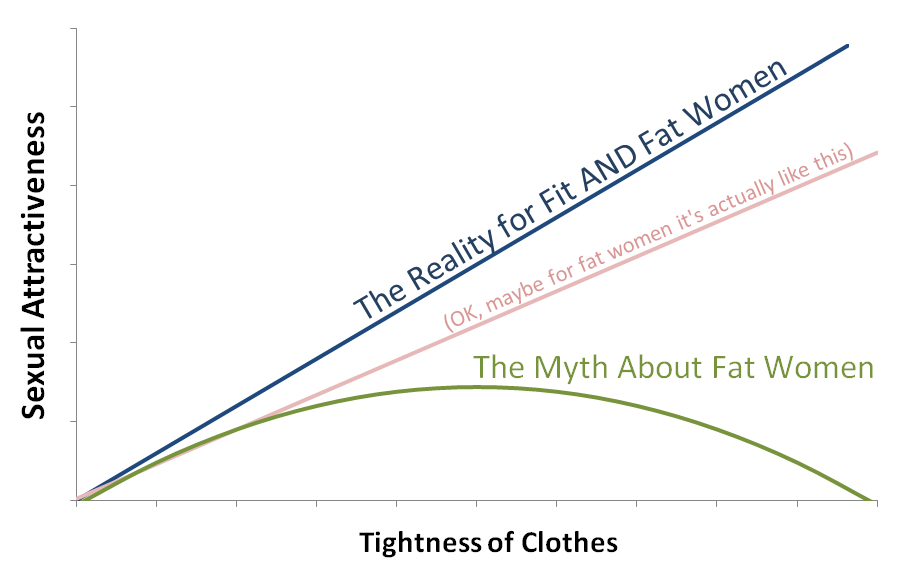
This line of thinking always bothers me. The implication is that, while tight clothes make fit women look more attractive, they make fat women look less attractive, and should therefore be avoided by any woman that is overweight. But this simply isn't true. Fat women, though unattractive, still look more attractive in tight clothes than they do in loose ones.

I know a lot of readers will initially disagree – men included. There was a time when I disagreed myself. In fact, I used to participate in the very kinds of conversation I am criticizing. But eventually I started paying attention to fat women rather than just dismissing them, and in doing so I realized that what we were saying wasn't true at all. What happened was that, on a few occasions when out with female friends or acquaintances, they started criticizing heavy-set girls for wearing tight clothes. They said things like “She shouldn't be wearing that, look at her stomach!” or "That girl needs to go home and lose 20 lbs before getting in a swimsuit like that!" But when I looked at the same girls they were criticizing, I found myself attracted to them, precisely because of their tight clothes. I had enough imagination to recognize that the very same girls in loose clothes would do absolutely nothing for me; but in a tight dress or yoga pants, I was checking them out.

Look, here is the thing: the female figure has evolved to be attractive to men, and it shines most when its natural curves can be seen. This holds true even when those natural curves are covered in fat; which makes sense, because (except in severe cases of obesity), the woman's proportions still exist. Loose clothes only serve to mask a woman’s figure. When a fat woman wears loose clothes, it makes her look like a mass of floating fabric. You not only still know that she is fat, but you also forget that she is a woman. True, a tight dress might show that a woman has a gut, but loose clothes don't hide it - they just hide her femininity.

Granted, there is probably a way in which an overweight woman can choose clothes very carefully in order to play down her weight while playing up her curves; but these clothes won't necessarily be loose. Anyway it is somewhat beside the point, which is that, on the whole, tight clothes still make fat women hotter, even if they don’t make fat women hot. You might be able to argue that fat women gain less attractiveness than fit women by wearing tight clothes - great, no problem; I am just saying that they don't lose it.

It's been too long since I illustrated anything on here, so let's do so with a plot:


If you still aren't convinced, it might be worth pointing out that the mistake I am accusing people of making is actually a very common one in human reasoning. It’s easy to think that something is a certain way (i.e. unattractive) because of something rather than in spite of something. In other words, it is very easy to believe that a fat woman is unattractive because of her tight clothes, when the reality is that she is unattractive in spite of the tight clothes. The tight clothes make a woman's BMI a little more evident, so people are more prone to make this logical leap; but that doesn't mean they are right in doing so.

Conversations like the one above happen because men like to indulge in the idea that fat women are unattractive. It makes them feel better about their own sexual attractiveness to look down on someone else’s. If they have to slip through a logical loophole in order to do so, they aren't going to lose sleep over it. And the girls who mock fat girls for wearing tight clothes usually just aren't secure enough with their own bodies to wear something that tight. They aren't mad at what you are wearing, they are mad because it reminds them of their own insecurities. Of course, it is easier to mock the fat-but-confident girl than it is to face up to your own body issues, so that is exactly what they do.

Anyway, fat and overweight ladies: don’t be shy about wearing tight stuff to the gym, bikinis on the beach or tight dresses to the club. You can ignore the guys and girls that claim you should cover up, because their complaints say a lot more about their self-confidence (or lack thereof) than anything about how you look in spandex. And yoga pants might not make you look like a supermodel, or even thin, but they still turn guys on more than your baggy jeans.


Related Posts

Friday, September 26, 2014

Nice Guys Don't Exist

Everyone adapts their behavior to the people around them, and in response to the situation at hand. We are nice to people we like and mean or bitchy to people we don’t. We are friendly and cheerful when things go well and short-tempered or depressed when they don’t. Yeah, sure, there are some people who are generally more disposed to (for example) mean or more egocentric behavior than others, just as there are some people who are more disposed to (for example) kind or generous behavior than others; but even they are more mean or kind to some people, and less egocentric or generous to others. And of course there are some people whose behavior is less affected by circumstance than others, but not to the point that it isn't affected at all – and not even to the point that it isn't affected significantly. We like to think of personality as static and constant, intrinsic to each person. But the reality is that personality is merely a name we give to a set of behaviors coming from an individual; and those behaviors are very much mood-driven, situational and dynamic.

This misconception plays into our perception of the opposite sex significantly. Consider how frequently you change your behavior towards the men in your life…

If I approach a girl in a bar awkwardly, and then speak to her in a low voice because I am nervous, she isn't going to be attracted, and isn't going to respond well. The fact that she is short with me, or excuses herself immediately to go to the bathroom doesn't mean that she is a "bitch;" it just means that I didn't attract her enough. The next guy who approaches her might approach her confidently and genuinely, and have her wrapped around his finger the rest of the night.

If I have a dead-end job and lack ambition, my girlfriend isn't going to respond to me in the same way as the guy she dates next (i.e. after she dumps me), who is intentional in his career and gainfully employed in a position he truly enjoys. I might tell my friends that she was “cold” or “distant” but they'll know as well as I will that her next boyfriend probably has none of the same problems. Or maybe she is the one complaining that he is cold and distant.

The same kind of girls that ignored me when I was young and lacked confidence now treat me entirely differently, because I am older and far more sure of myself. At twenty years old, it was tempting to view those girls as stuck-up or bitchy; but the reality is that they were probably acting like angels towards some 30-year-old who was much more attractive due to his age, maturity and position in life.

I am not saying all of this to make a point about women, but to make a point about men – because men work exactly the same way. It is easy to believe that a certain guy is an asshole because he dumps you without an explanation, or that another is an authentically nice guy because he treats you well. But I am telling you: those men behave in entirely different ways with different girls.

The guy who you think is a player because he hits on three other girls before taking you home, then never calls you the next day – I guarantee that he is genuine and respectful and serious with other girls he dates. I know this because I've been that guy plenty of times. Some women I treat well and with respect, and others I don’t. If I see a girl I'm attracted to and whom I respect, I change my game completely. My male friends do the same.

The guy who is a dismissive asshole to you is a babbling, nervous idiot with the girl he is crazy about, and the guy who is such a gentleman to you absolutely crushes the hopes of girls that he doesn't find attractive, or doesn't respect. Likewise, the guy who never calls you back isn't “flaky,” he just doesn't care that much about you. I am sure there is a girl out there who has complained that he was needy and contacted her too much. And I am equally sure that the guy you were dating who seems to have “commitment anxiety” has at some point in his life practically begged to be in a relationship with a girl.

The thing is, nice guys don’t exist. “Douchebags” don’t exist. The behaviors we describe with these terms are not innate and static characteristics of any given person; they are behaviors that change depending on the other person involved and the circumstances surrounding the interaction. Of course there are men out there who are more disposed to certain types of behavior than others; but the degree of attraction a man feels for you will affect his behavior towards you far more than anything intrinsic to his personality, and the degree of attraction he feels for you is significantly affected by the kind of behavior you'll accept from him.

So instead of complaining about the dearth of nice guys or the abundance of douchebags, start thinking about what you can do to make then men in your life treat you the way you want. Because that is what is going to make the difference – not finding some "perfect guy" with some supposed personality type. You don't find perfect men, you elicit perfection from men.


Related Posts

Friday, August 22, 2014

How to Set Up Your Friends

Most women I've met like the idea of setting up the single men in their lives with the single girls in their lives. In other words, they like match-making. Mothers seem to love this more than most, presumably because it puts them back in touch with the romantic spark that is often dead in their own relationships. Perpetually single girls love this too, probably because having influence over someone else’s love life is the next best thing to having control over your own. But normal girls like it too, and this is understandable because it is only human to want to have an influence on other people's lives (it is human to want to have influence in general). In the same way that it is empowering to know that you were the one who got your friend the job that was the springboard for her career, it is empowering to know that you introduced her to the guy that finally gave her confidence in her dating life, or even the guy that she eventually married.

Now, let me preface what I am about to say by pointing out that setups are usually a bad idea. In the vast majority of cases, the very fact that your friend needs help finding love is a good indication that your attempt to help is going to fail. This is because the problem is never one of "just not having met the right person yet." It always runs deeper. Maybe she is insecure, or too introverted, or overweight. Maybe she is trying to be masculine, or makes herself unapproachable. Whatever the case, her inability to take charge of her own romantic life isn't merely a matter of bad luck; it is a symptom of a deeper problem, which your attempt to introduce her to someone new isn't doing anything to solve. It's like giving another book to a child with a learning disability, and thinking "this time he'll get it." Exactly. It isn't going to happen.

So with that background, let's take a look at what most people do when they try to set up their friends (because this blog is for women I am going to use the example of a girl, but guys make the same mistake). Once a girl sees a potential match in her social circle, she goes to the girl and guy separately, and tells each of them that she knows "someone that they have to meet." She might tell each person a few things about the other, maybe show them some photos, and she gets them to agree to the setup. Then she arranges some kind of event at which the two people have the opportunity to meet each other. She's "really good at this" because she never lets either person know that the other one knows it's a set up. That way it won't feel forced or awkward. Perfect, right? Wrong.

The problem isn't that the person thinks that the other knows about the setup. The problem is that the person themselves knows they are being set up. And they knew this the very moment the girl told them there was "someone that they had to meet." This does two things: first, it generates expectations and makes both parties feel like they have to perform, which of course results in an encounter more awkward than a new graduate's first job interview. More importantly, however, and what I want to point out here, is that it destroys the single most important thing for someone who struggles with their dating life: autonomy.

Let's look at this from a the guy's perspective...

One of the hallmarks of masculinity is self-control: men want to be in control of their lives, and by extension, they want to be in control of their dating lives. A man will never feel good about himself if he can't initiate and perpetuate his own relationships. (Remember that his inability to do so is the reason his friends want to set him up in the first place.) By setting a guy up, you are essentially stepping in and putting training wheels on his bike - reminding him that he cannot handle himself. Yes, it might be true that he rides poorly (or not at all) without those training wheels; but by taking control of his dating life you are making him feel like a child, and he won't respect himself for any girl he "gets" with your help. He also won't respect any girl that he needs help to meet, because men know instinctively that women are attracted to men who don't need help: men who are in control and confident with their own capabilities. In other words, he knows he can get a better girl if he gets his shit together and deals with his lack of options himself.

You might argue that without some initial help, a guy (or girl) will never date anyone at all. To use the bike analogy, you might argue that, yes, a guy might not respect himself for using training wheels, but without training wheels he will never learn how to ride. But this argument assumes that his problem is balance. In real terms, your insistence on setting him up assumes that his problem is meeting girls. But as I pointed out at the beginning, this is never the case. His problem isn't one of balance, it is the fear of crashing. His problem isn't one of meeting girls, it is the fear of rejection; and setups do nothing to help him overcome that fear.

There is a feminine perspective on this too. When it comes to match-making, the feminine problem is that a girl will not respect a man who needed the help of a friend (i.e. you) to meet and attract her. This isn't only a matter of judging the man's courage, or the social abilities needed to make a connection with her. Women know that if a man is motivated enough, he will dig down and find that courage, and make something happen - or at least he will try. You want a man who desires you enough to push through a crowd to meet you, or takes some kind of initiative. At very least, you want a guy who does more than accept dates that are handed to him because his friends think he has no other options. A girl who finds herself in a relationship that started that way won't respect him, won't respect the relationship, and won't respect herself. So deep down, girls doesn't like being set up any more than guys do. They might like being single even less, but they'll be even less enthusiastic still about being dumped once their boyfriends wake up, and realize that they are only with those girls because they never had the balls to go for what they really wanted.

I am sure many readers know people who have had successful relationships after being set up, some of which might have even lead to marriage. My parents were set up, and they've been married more than 30 years. Maybe you were set up and are still with your boyfriend. And that's fine. But it doesn't mean that those cases are ideal or likely, or that they do anything to strengthen the inner core of the relationship.

So what do you do? How do you help facilitate a match that you think has potential? Well, you let both the guy and the girl ride without training wheels. You encourage them to take control of their own dating lives, and then you let them do so. This doesn't mean that you can't set them up, but it does mean that you can't tell either of them you are setting them up. Here is what you do: you invite them both to whatever event you've organized, then you sit back and see if they connect. Nothing more, nothing less. If he doesn't take the initiative on his own, nothing happens, and that's OK - or at least, it isn't something you can correct by stepping in and facilitating the connection any more than you already have.

Of course, it isn't always the case that the person you are trying to set up has any problems dating or attracting the opposite sex. Maybe they have plenty of options, and you just happen to know someone who would be a great match for them. But in these cases, you won't need to do anything other than introduce the two people anyway; they will be perfectly fine on their own if there is an attraction, so the strategy is the same: introduce, step back, and let it happen. Nothing more.


Related Posts
1. You Are Responsible For Your Own Romantic Happiness

Thursday, August 7, 2014

Bars Are a Bad Place to Meet Women

I've met the majority of the women I've dated in bars. There have been plenty of girls that I've met through friends or randomly in public, but in bars, the sheer density of attractive, young, single women is enormously greater than it is on the street or beach or office (or anywhere else); and my dating history reflects that. I've made the point previously that the higher concentration of the opposite sex in nightlife venues is a good thing, and I stand by what I said. But as I've gotten older and come to know myself better, I've recognized two serious disadvantages to meeting women in this way.

1. Randomness

The first thing I've realized is that I don't value the way that I meet women I meet in bars – that is, I don’t value the process itself. I was telling this recently to a girl that I know, and she suggested that it was because meeting girls in bars is "too random." I think this is the common supposition - namely, that because you don't have any history or connection with the people that you meet in bars, there is no foundation for a relationship, and so any attempt at one is doomed. But this isn't the problem. A strong foundation for a relationship is just as much a function of personal compatibility as it is a function of common history or connections. Meeting the opposite sex in a bar isn't unsuccessful for lack of foundation, and it isn't unsuccessful because it is random. It is unsuccessful precisely because it isn't random.

Randomness is actually what we all want, in the sense that we all want our "how we met" story to be unique and unexpected. The more random it is that you met someone to whom you find yourself deeply attracted, the more special it feels, because you know that you were incredibly lucky for it to happen. It's the same phenomenon that makes people appreciate life so much after a near-death experience. You value what you have because you know that you almost didn't have it. As absurd as most romantic comedies are, it says something about our ideals of romance that so many of them start with some permutation of a girl hitting a guy on a bike with her car - randomly - and then falling in love with him. Things are romantic at least partially because they are unexpected, that is, seemingly impossible or unreal. I probably don't need to explain to most women how un-romantic it is to receive flowers on Valentine's Day. It might be nice, and it might be better than never receiving flowers, but it isn't romantic because it is too predictable. It isn't random at all.

Being picked up in a bar also isn't random at all. In fact, it is exactly the opposite of random; it is boring because it is too mechanical, too planned. Guys know that they want to meet girls, they know where to find them, and they go there to do so. Girls know that they want to meet men, they know where they will be hit on, and they go there for that reason. The encounter might take place in an exciting, fast-paced and sexually-charged atmosphere, but that's just superficial ornamentation. Underneath, those meetings are absolutely bland, because they are absolutely intentional.

Yes, obviously, not everyone in a bar is there with the conscious intention of meeting the opposite sex, but the percentage of people who are is infinitely higher in nightlife environments than it is in, say, a shopping mall. And following the train of thought described above, we project that intention onto every person we meet in a nightlife environment, then down-rate the value of those encounters accordingly. I don't value the women I meet in bars because there is nothing special about the way we met.

2. Difficulty

The second thing I realized is that I don't value the effort I make to meet girls in bars. There isn't necessarily anything wrong with the girls themselves, but I don't respect my relationships with them because I didn't have to work very hard to make those relationships happen. Men are very keenly aware that things of low value are easy to obtain, and so we assume (and in most cases are right) that things that are easy to obtain are low in value. A man might have the best job in the world, but he'll never feel good about it as long as he knows that he only got it because his father pulled strings with his professional contacts to make it happen. The same mentality applies in dating.

It hasn't always been this way for me. In my early twenties, approaching a random girl in a bar and attracting her enough to get her phone number took balls and felt like a real accomplishment - because at the time, for me, it was. I was able to have genuine relationships with girls that I met in bars because I respected myself for meeting girls in bars. But I don't anymore, because it has become too easy, too boring. Without the challenges that my adolescent social anxiety used to pose, all I see in bars is a social scene hugely facilitated by dark lighting, loud music, commotion and alcohol. They’re still a great place to have fun and get laid, but they’re not the kind of place where I expect to find a relationship anymore.

Now, does this mean that bars are a bad place to meet guys, or that you should stop going out?

Not necessarily. Despite the fairly categorical nature of this post's title, what I am really saying here is that bars are a bad place for me to meet women at this point in my life. I am no relativist, but the reasons explained above don’t apply to every guy, and they don't apply in every situation. If you meet a guy tomorrow who is the way I was at 22, for whom it is a big deal to meet a girl in a bar, then this isn't going to be an issue at all. And even if the guy you meet in a bar is exactly like me in the sense that it isn't a challenge for him, there is still the possibility of something working out; it just means that you are getting off on the wrong foot. If there is a strong enough connection, "how you met" probably won't be enough to prevent or disrupt it.

There is also the chance that there will be some other coincidence that makes the encounter incredibly random, despite the environment – maybe you find out that you both come from the same town on the other side of the country, or that you have identical ancestry, or that you are both obsessed with the same nerdy sci-fi movie, even though you met in a nightclub. And as I explained in previous posts, you still have to consider the disadvantages posed by what I've explained above, along-side the low probability of getting off on the right foot somewhere less intentional, like a shopping mall or at work.

No, I am not saying that you shouldn't go to bars. I am saying that you should be cognizant of the fact that men – just like women – will not respect or value what comes too easily, whether it comes too easily because (a) it is too mechanical or (b) because it requires very little effort. The converse of this is that men will value their encounter with you in proportion to how (a) unlikely or (b) difficult it was. While this doesn't mean that you should lock yourself in a steel cage and only accept men who are willing to tear it down to get to you, it does mean that you should avoid situations in which every man has easy access to you.

Incidentally, this post could also have been written about online dating, or anything else that dramatically facilitates meeting the opposite sex. You might think of bars and online dating as completely different – even opposites – but they share the strong similarity of taking the difficulty out of approaching (and therefore, being approached by) the opposite sex. Even though it seems like an ideal situation on the surface, the reality is that, for many men and women, bars and online dating are shortcuts. And no one wants to know that they got something important to them by taking a shortcut. Even if online dating or going to bars isn't a shortcut for you, be aware that it might be a shortcut for the guy, and that he is liable to respect himself and the relationship less because of it.


Related Posts
1. Bars Are a Good Place to Meet Guys – Part 1
2. How "Hard to Get" Should You Play?
3. Don’t Initiate Contact
4. Why You Don’t Get Approached by Men