Showing posts with label what men want. Show all posts

Tuesday, September 15, 2015

Older Women Can Still Be Sexy

I recently spent a couple weeks in Europe. While there, I noticed something that genuinely surprised me: older European women are sexy. I found myself attracted to women over the age of 35 or even 45 much more frequently than I do in the U.S., where I almost never notice women over the age of 35. In Europe, it was a regular occurrence.

It didn't take me long to realize why. The difference is obvious. My attraction to these women could be almost completely attributed to the following factors:


This was kind of a revelation to me. I'd thought that wrinkles, loose skin, and thinning hair (the most obvious signs of aging) were the main factors reducing a woman's attractiveness. But this simply isn't true. Feeling my neck instinctively turn and my eyes involuntarily drawn to the hips of these European women as they walked by put an end to that idea. Perfect skin and perfect hair simply don't matter that much. My hormones were saying "YES" over and over again to women without either one.

This was a powerful realization for a couple reasons. The first was the simple satisfaction of realizing that it reinforces a couple points I've been making all along: that feminine beauty is highly controllable and that no women needs to be ugly.

But more importantly, it was powerful because it gave me hope. Yeah that sounds like exaggeration and maybe even a little gay, but it's true. I'd always had this background fear that after getting married and enjoying several years of physical attraction and great sex with my wife, she'd inevitably lose her physical beauty, I'd lose my physical attraction, and sexual fidelity would become a burden. A perpetually satisfying sexual relationship with an aging woman seemed impossible. And given that I never want to cheat on my future wife, that was a pretty disheartening belief. It essentially meant that I had to choose between having a family or a sex life.

I believed this was inevitable because I saw it happening all around me in the United States: the vast majority of women here become unattractive after 35. Physical attraction is by no means everything, but it's pretty damn important. So realizing that I could be legitimately attracted by women over 35 was a huge breath of fresh air. Sure, I'd always known it was possible for women to remain attractive as they age, but in the United States this is a rare exception, and seemingly impossible to predict. In Europe, however, it is the norm. And the fact that almost a whole continent of women can do it proves that it's totally achievable.

But here is the thing: European women don't just happen to wear heels and keep their hair long; it isn't a stroke of genetic luck or some fluke of cultural development. The decision to do those things is rooted in their mindset, in their beliefs. They do these things because as they age, European women continue to think of themselves as sexual beings. The wear dresses and stay in shape because they have zero doubt that they can still be very attractive to the opposite sex - and they are absolutely right.

In the United States, women either don't believe this, or they aren't motivated by American men to do this.* Probably it is some combination of these two factors, but I am skeptical about the importance of the latter, mainly because most European men are pussies, and they still manage to motivate their women to look sexy. Anyway, for the sake of not turning this post into a critique of cultures, I am limiting the discussion to the point about belief - or more specifically, American women's disbelief.

So let's get right to the point: that disbelief is unfounded, because you can totally look sexy to men well into your 50s. The exact same things that make you attractive to men in your 20s continue making you attractive well into your later years; there is no reason to abandon them.

Get rid of this idea that some clothes are "age-inappropriate," or that you have to somehow limit your wardrobe as you get older. The only clothes that are age-inappropriate are those that make women who aren't ready for sex look sexual. If anything, increased age should expand your wardrobe, since you'll be more confident, have stronger boundaries, and therefore be able to pull off sexier looks.

Nope, you don't need more makeup, and you don't need a boob job. Yes, believe it or not, your body is still sexy in spite of the wrinkles and grey hairs. Shit, I don't care if your hair is completely grey. If you are in good shape and you dress in a feminine, sexual manner, you are going to give men erections for a long, long time. The male need for Viagra says just as much about women's unwillingness to think of themselves as sexually desirable beings as it says about the impotence of their men.

Yeah it might be tough to see yourself getting older, especially in light of knowing how much men care about looks. I get that. But it is flat-out wrong and incredibly short-sighted to think that just because you are on a downward slope, the game is over.

Remember this as you age. And for those of you already well past your prime, recognize that it is never too late to reverse your thinking. You can still be sexy; you just need to make an effort and shed these puritanical American ideas. True, you'll be fighting your culture in doing so, and you'll have to learn to come to terms with looks of disapproval from the women who decided that it was acceptable to wear sneakers to the grocery store. But if your personal style is rooted in a firm belief about the kind of woman you want to be, you'll see those criticisms for what they are: comments from women motivated primarily by jealousy and the will to believe they don't have to work.

---------------------------------------
* Some people might argue that American women stop trying to be sexy because the ones who get married and have children foster a culture that prioritizes raising children over being sexually attractive. This might be true, but it misses the point. The error lies not in American women's efforts to be good mothers, but in their belief that this somehow precludes being sexy. There is no reason why women can't do both, as evidenced by European women, who are also great mothers. In fact, this is a topic for another post, but I would argue that you actually can't be a great mother without continuing to think of yourself as a sexual being.


Related Posts
1. Female Game for Women in Their 30s
2. The Advantage of Dating After 30
3. Some Older Women Are Smart
4. What Men Think About Older Women

Tuesday, September 1, 2015

The Problem with Denim and Leather

Several years ago, I got into a discussion about women's clothes with my girlfriend at the time and her friend. The friend mentioned that she had "kind of started to hate polo shirts on girls." I was a bit surprised, so I asked what was motivating her hatred. She replied that they were "just too masculine."

I found that interesting. I'd never even noticed polo shirts as being particularly attractive or unattractive, let alone masculine or feminine; but I could see where she was coming from. After all, some clothes (dresses for example) are more feminine, so it made sense that other types could be more masculine. From that point on, I started paying more attention to how sex-appropriate various types of clothes seemed.

Years later I started reading a website called Masculine Style, which does a great job of teaching men how to dress well. The author explains that the history and evolution of certain clothes is what makes them have the visual effect that they do, making them work (or not) for different men in different situations.

He explains, for example, that heavier knit sweaters are far more rugged and masculine-looking than a thin cashmere cardigan because they were designed for and traditionally used by dock workers and fishermen. Similarly, boat shoes were designed with soles that were soft enough to prevent scratching the decks of yachts, and therefore still hint at wealth and luxury in spite of their casualness. Sturdier materials like denim and leather have histories rooted in farming and manual labor, and so they carry connotations of their industrial origins – which brings me to my point…

For a couple years now, I've realized that I don't like when girls wear denim or leather. If the girl is good-looking, I will still be somewhat sexually attracted to her, but both the magnitude and type of attraction is significantly different than it would be if the same girl were dressed in lighter, softer materials. And following the train of thought that was inspired by my ex-girlfriend's friend and what I read on Masculine Style, I've started to wonder if my distaste is due to denim and leather being inherently unfeminine materials.

I mean think about it: denim and leather are rough, sturdy materials made to withstand the abuse of hard labor. They were made to protect rugged men doing rugged work. In the same way that we project onto guys who wear heavy-knit sweaters the masculinity of dock workers, it makes sense that we project onto women the connotations of wearing laborer's clothes – whether we do so consciously or unconsciously. And doing so casts a shadow over a woman's femininity. Asking a woman to look attractive in a biker jacket is kind of like asking a man to look attractive in lace.

Now, I realize that anytime you say (or even suggest) that something might be "objectively" masculine or feminine, people get defensive. If there is a scale along which masculinity or femininity can be quantified, people invariably start worrying about where along it they'll be placed. They are afraid of being judged.* But I am going to assume that my readers have learned to be comfortable with themselves, and throw the idea out there anyway – not so much because I am completely convinced by it as to field your opinions. So here is the concept:
Denim and leather (and perhaps other materials besides) are objectively masculine, at least to the same extent that materials like satin or lace are feminine. The current popularity of leather and denim in female fashion is a trend, piggybacked on the popularity of feminism, and it does not reflect the objective attractiveness of the materials themselves. While women can often look attractive in denim or leather, they do so in spite of the materials, not because of them.

Nope. Really.

I've been testing the idea recently by mentally separating the factors of my attraction each time I see a hot girl wearing one of these materials. Certainly when I think about a woman wearing any piece of clothing in either denim or leather, I can always imagine her being sexier in something less rugged. I've never liked jean or leather skirts on girls; and although it is much harder to look objectively at jean pants (because they are so entrenched in current fashion), I find normal cotton way more attractive.

When I suggest to my male friends that leather and denim are unattractive on women – which I've done several times – I rarely get an enthusiastic chorus of agreement. I get, "Yeah I guess I can sort of see what you mean" or "No, man, I love a girl in a jean skirt." But I am pretty sure that these statements ultimately boil down to "I am not observant enough to figure out what turns me on about a woman's wardrobe" and "I love a girl in a skirt."

Again, this isn't a statement about what women should or shouldn't wear (they're your clothes, do whatever the you want), it is merely a statement intended to spark thought about whether your choice of clothes is an authentic expression of your personal taste or the voice of popular culture.

Oh and just for the record, I am OK with polo shirts on girls.

---------------------------------------------------------------
*In this sense, modern Western culture (at least when it comes to gender) is like a school system without testing. Everyone is just kind of learning at their own rate without an objective measurement of anyone's performance. You can imagine how outraged people in such a system would be the first time you were to suggest that there will periodically be these things called “exams” by which students' comprehension will be evaluated. There would be huge resistance. But testing in schools isn't the end of the world. Yeah, there is pressure to perform to a certain level, and the students that do poorly have to acknowledge the fact that they aren't as “smart” as the other students. But it introduces a degree of accountability that cannot otherwise be motivated, and the school system is better off for it.


Related Posts
1. "Because of" Versus "In Spite Of"
2. Don't Wear Sneakers
3. Femininity, Authenticity, and Compatibility
4. There Is Nothing Modest About Loose Jeans
5. Be Careful About Wearing Large-Shouldered Tops
6. Where Is Feminism Taking Us?

Tuesday, August 25, 2015

Amy Young

I haven't come across many online dating advice resources for women that I consider valuable. You might have noticed that (until today) I didn't follow anyone on Twitter, and you probably notice that I don't have links to other websites anywhere on here. This is because most other dating advice resources for women basically suck. They either give advice that feeds people's need to feel like there are easy solutions, don't say anything insightful, or their authors are clearly more interested in their personal success than putting out quality content. I don't want to undermine my readers' trust for my content by recommending them.

Well, today I stumbled upon* an impressive exception. Her name is Amy Young and she has a YouTube channel and a blog. I haven't watched all of her videos or read all of her articles, but I've seen more than enough to recognize three things that set her apart:
  1. She's smart. Why this matters is kind of self-explanatory, but I am going to spell it out anyway: it means that she gets down the crux of your issues with men and dating, and she explains them clearly. (And to anticipate the comments: yes, in spite of what you may have inserted between the lines of my posts on the topic, intelligence in women is attractive.)
  2. She's genuine. She isn't dishing out advice from the "I do everything right and that's why you should listen to me" perspective like many supposed dating gurus. It comes much more from a place of "Yeah, I fucked this up too, but I see now where I went wrong; don't make the same mistake I did." And her advice is all the more trustworthy because of it.
  3. She's not a complainer. This is by far what sold me the most. People who don't complain are rare. Very, very, rare. And this is all the more true when it comes to talking about the behavior of the opposite sex. Aside from a couple tongue-in-cheek comments, her content is 100% devoid of the hackneyed, indulgent, "girls are good, guys are bad," victim-type undertones that pervade so much of the dating advice out there for women. That absence is a hallmark of someone with strong boundaries, and it demonstrates the kind of mindset you need to attract a quality guy. This is the kind of girl you want to be taking advice from.
Yeah, OK, she starts her videos by saying shit in an weird voice, and she puts gay music in the background of her videos. But you're girls so you probably like that stuff anyway.

I posted some videos below, but go check her out:

https://www.youtube.com/channel/UCxbz8CzmZFjgKHJ3sbUoa1g
(link to her YouTube channel)

http://www.amyyoungcoaching.com/
(link to her website)

Here's one video that I kept saying "Holy shit, that is so true" to:

How to Reveal A Guy's True Intentions

Here is one that most girls need to hear:

What if All the "Good Guys" are Taken?

And in the vein of my last post (again, so true):

Dudes Lovin Lady Bodies 101

Enjoy.

--------------------------------
* Or, to be more accurate, I was recommended her channel by YouTube's apparently effective content match-up algorithms.

Monday, March 2, 2015

Thoughts on "The Manosphere"

I suspect a good portion of the readers of this site have stumbled upon "The Manosphere" while browsing the internet for information about relationships – even if they haven't recognized it by that name. For those unfamiliar with it, The Manosphere is a very loose collection of blogs and websites written for men by men. They discuss male-related issues, with a heavy focus on the politics and social dynamics surrounding male-female interactions.

Perhaps more characteristic than the content itself (which can vary quite widely) is the underlying ideology, which champions self-improvement, the exposure of counter-cultural "red pill" truths about sexual dynamics, and a return to traditional gender roles for men and women. Sites like Return of Kings and Chateau Heartiste are typical of The Manosphere.

Recently, a reader asked whether I agreed with a post she'd read, claiming that women should read Manosphere websites (the post was written by a girl). By doing so, the post argued, women can learn a lot about men, and therefore more effectively attract the kind of man they want. What follows are my thoughts about this theory…

Let me start by explaining that I know about The Manosphere because I used to read it. I still do occasionally, as some of the blogs are still on my Blogger feed, and they often publish posts with titles that are hard to ignore, such as "6 Reasons Why Fat Women Are Defective."

In any case, the first thing you need to realize is that, in spite of the constant attempts to prove the contrary, The Manosphere is written by men who are bad with women. At least, it is written by men who have a history of being bad with women. I know this in part because being bad with women was how I discovered The Manosphere. But you don't need this "takes-one-to-know-one" perspective to see that posts titled "The Age of Flakes" or "How to Get Rid of Approach Anxiety" are written by guys (and of course, for guys) who have a lot of room for improvement.

Let me emphasize that I see nothing wrong with this. When a guy wakes up in his early twenties and realizes that he has crippling anxiety about talking to women, it is usually due to causes that were somewhat beyond his control - the way his parents raised him, for example. The fact that these guys are taking steps or even strides towards changing that fact is laudable. I am not mocking or pointing fingers here; I am just pointing out that the basic characteristic common to the authors of Manosphere sites is that they have a history of not getting the kind of reactions from women that they want, which leads to the more important point: Manosphere writers come from a place of discontent with respect to what women think about them. A small subset of them might have learned a handful of techniques that get them to a point where they feel proud of their success with women, and a select few beyond that might have genuinely overcome their underlying sense of inadequacy with respect to women. But the rest still feel this dissatisfaction, even if they don't recognize or admit it.

Now, there are two ways a man can react when he is disappointed with his success with women. The first is to recognize an inadequacy within, and work towards improving. The second is to blame that lack of success on women or circumstance, and give up. In The Manosphere, you'll find both. When I first discovered some Manosphere websites, I was looking for other men who had the first reaction; and I found enough of it to keep me interested for a while. But it was the realization that the majority of the writers were indulging in the second reaction that ultimately caused me to stop reading. In the same way that I eventually stopped appreciating Taylor Swift because I heard enough of her songs to realize that she has a major victim syndrome, I was turned off by The Manosphere's writers once I read enough to recognize what lies behind most of their complaints: dissatisfaction with themselves and the need for a scapegoat.

Let's look at an example to illustrate this: if a guy is approaching girls and they are rejecting him by turning immediately to look at their phones, there are two ways of explaining what is happening. The first is for the guy to admit that he is approaching these girls awkwardly, or that he is dressed poorly, or that something else is wrong. Then he can either work to improve or lower his expectations accordingly. The second way is to blame it on women or smartphones – or both. A nice way to confirm this opinion is to read (or write) an article claiming that "Women Who Own iPhones Lose The Ability To Love" and read all of the affirming responses in the article's comments section. Of course, the guy has to overlook the fact that the positive comments come from other men who've been similarly snubbed by girls, and are similarly looking for confirmation that it wasn't their fault. You, meanwhile, read such an article and are left wondering if maybe your phone is preventing you from attracting men. The reality, of course, is that your instinct to look at your phone all the time says much more about his timidity in approaching you than anything about your receptiveness.

I am not saying that all men in The Manosphere hate women. I am not even saying that any one of its writers hates women. But I am saying that The Manosphere is built on the tiny feelings of satisfaction that its thousands of readers – many of whom are normal guys who have a fairly healthy relationships with women – feel every time they can laugh or take a jab at what has caused them pain at some point in their past: women. I know because I've felt the temptation to do so myself, and I've seen the same tendency manifest itself as a wide spectrum of self-supporting-yet-delusional beliefs (held by men and women alike, and not necessarily related to dating). Men like reading The Manosphere for the same reason that women like songs that tell them weight isn't so important when it comes to attracting men: because it's easier than admitting that they're going to have to work harder.


I can absolutely see how a girl would be drawn in to The Manosphere. In a world of sappy, sugar-coated, "everything-is-going-to-be-all-right" dating advice, the stuff you read on The Manosphere stings just enough to be believable. You might even applaud yourself for pushing through your initial distaste for what you read in order to learn from the "harsh truth" beyond. But just because the truth is often harsh doesn't mean that harsh claims are necessarily true. Just because everyone else lies to you to make you feel good about yourself doesn't mean that the person who makes you feel bad about yourself isn't full of shit too. And as I explained above, there are good reasons to believe that a lot of The Manosphere is full of shit. What seems like a collection of articles written by men with absolutely no motivation to lie to you is actually a collection of articles written by men who feel shunned and mistreated by women in general (or at least have a history of feeling that way), and therefore have an underlying desire to believe that the playing field of sexual dynamics is tilted back in their favor. There is a reason why reading The Manosphere makes you feel like it kind of sucks to be a girl. What better way is there for a guy in his 30s to compensate for the feelings of sexual impotence he had in college (when he was surrounded by beautiful girls he couldn't get) than by inflating the importance of youth when it comes to female attractiveness? The assertions of The Manosphere are simply too convenient to be completely believable.

Yes, it is partially true that society has lost sight of what these guys call "red pill" truths; I am not denying that. But the very fact that they use metaphors from The Matrix should hint at the fact that many of them have issues with attracting women; and the almost singular focus on pointing out female shortcomings should suggest that maybe, just maybe, they hold their world-view because it conveniently puts them back into the place of power they feel so incapable of occupying. Ever notice how the most ardent modern-day Feminists are fat and ugly? The most vocal authors in The Manosphere are the masculine manifestation of exactly the same phenomenon: the phenomenon whereby people subconsciously choose beliefs that reassert their importance and agency in the world. The modern Feminist says "I am not good-looking enough to compete with Victoria's Secret models, so the standards of beauty they idealize must be inaccurate and unfair." The Manosphere writer says: "I am not getting the attention from women that I want; it must be because the girls in my country are selfish and entitled."

I don't want to paint the whole Manosphere in a bad light. From what I've read of his stuff, the guy who writes Chateau Heartiste seems pretty damn smart, and I admire Roosh's drive and bold individualism. There are definitely a lot of intelligent guys writing some very insightful stuff in The Manosphere, and there is a lot that both women and men can learn from reading it. The problem is just that there is a lot of bad mixed in with the good. And although it might be easy to identify the posts that are flagrantly wrong, even the sharpest readers will have trouble distinguishing the truth in the grayer areas.

So I am not going to tell you not to read The Manosphere. I've never liked the idea of censorship, and who the hell am I to tell you what to read anyway? But if you do choose to read The Manosphere, you need to recognize that you are walking through a minefield of ideas, where a lot of what you'll read is colored by the authors' need to feel sexually powerful. Yes, occasionally the complaints you read about women on those blogs will be honest and accurate expositions of things that women are doing wrong; but more often than not they will be frustration-fueled attempts to blame someone or something else for the fact that the author can't get the kind or quantity of girls he wants. That being said, being aware of the mindset behind what you read in The Manosphere should go a long way towards being able to distinguish the truth from the wishful thinking. So my advice is simple: keep this fact in mind, and read carefully.

One last note, especially for the men reading this: most of the good information contained in The Manosphere, and a lot more besides, minus all of the posturing and complaining, can be found on a website called Animus Empire. Women, of course, can find the good without the bad on blogs like this one.


Related Posts

Wednesday, December 17, 2014

No, Your Intelligence Isn't the Problem

I get e-mails from girls all the time telling me that they are attractive, sweet, well-dressed, fun, etc. but can't seem to get the guys they want. They then point out that they are working on a PhD and conclude their question by asking whether or not their intelligence is intimidating men and therefore turning them off. I get similar questions about career success: "I am doing everything right but I am very highly paid - does that intimidate men?"

This is the equivalent of a guy pointing out that he is smart, tall, reasonably good-looking and successful in his job, but struggles to attract girls - then asking if it is because his muscles are too big. I mean, after all, maybe that's what is keeping the girls at bay, right?

If you are a rocket scientist, there is a chance that your academic prowess might be intimidating to an average guy, in the same way that a steroid-injected meat-head's muscles might be a a little much for the average girl. Yeah, sure, there is a risk that pouring too much of your energy into academics will turn guys off a bit, especially if it is done as a mask for your feelings of inadequacy with respect to other women. It's the same risk that a guy runs when he devotes the majority of his free time to getting jacked, especially when it is done as a mask for his feelings of inadequacy relative to other men. But the muscles themselves aren't the chief problem, and neither is your degree or your job.

It's way more likely the case that you are underestimating the importance of your weight, or that you cut your hair way too short, that your posture is horrible, that you talk like you want men to believe you're stupid, or that you don't realize how much your lack of boundaries is making men dismiss you. These are the kinds of things that actually turn men off, in the same way that low self-esteem and low intelligence are the kinds of things that actually turn women off (not coincidentally, these are common problems among meatheads).

The women who ask this question are always asking "why don't I get any attention from the men I want?" Their question is never "why do I get tons of sexual attention from men, but none stick around?" (some do ask this question, but they never then go on to blame it on their degree or job). If a woman were asking the latter question, I still wouldn't jump to the immediate conclusion that her degree or salary was the problem; I would look first to her personality. But if a girl isn't even getting sexual attention from the guys she is concerned about intimidating, I guarantee her hypothesis about her threatening intelligence is wrong. Why? Because there is a remote possibility that men will be intimidated or turned off by a woman's brains or job when they are considering her as a girlfriend or spouse, but there is no possibility that it will prevent at least some guys from trying to get in her pants. None whatsoever. Men go for the girls they are physically attracted to, then choose from those the ones they are personally attracted to. Only after that do they take into account things like brains and (much later) salary or professional success. You can't blame academic or financial intimidation on your inability to get a boyfriend or husband if you aren't at least getting sexual attention from the men you want; it'd be like blaming the power outage in your house on a government conspiracy or that neighbor you hate... during a raging thunder and lightening storm.

No, in all likelihood, your academic degree or high-paid position isn't the fundamental problem; but it is an very convenient scapegoat - and an ego-boosting one at that. It is a hell of a lot easier and more satisfying to blame big muscles or advanced degrees for your lack of success with the opposite sex than it is to find out (or admit) what's really wrong. And for women, what is really wrong almost always has something to do with your looks or personality, which, thankfully, are both very much controllable.


Related Posts
1. Men Don't Care About Your Accomplishments
2. The Importance of Personal Boundaries
3. Human Energy is Conserved
4. Are You Repressing Your Femininity?
5. What Men Think About Your Intelligence

Thursday, August 7, 2014

Bars Are a Bad Place to Meet Women

I've met the majority of the women I've dated in bars. There have been plenty of girls that I've met through friends or randomly in public, but in bars, the sheer density of attractive, young, single women is enormously greater than it is on the street or beach or office (or anywhere else); and my dating history reflects that. I've made the point previously that the higher concentration of the opposite sex in nightlife venues is a good thing, and I stand by what I said. But as I've gotten older and come to know myself better, I've recognized two serious disadvantages to meeting women in this way.

1. Randomness

The first thing I've realized is that I don't value the way that I meet women I meet in bars – that is, I don’t value the process itself. I was telling this recently to a girl that I know, and she suggested that it was because meeting girls in bars is "too random." I think this is the common supposition - namely, that because you don't have any history or connection with the people that you meet in bars, there is no foundation for a relationship, and so any attempt at one is doomed. But this isn't the problem. A strong foundation for a relationship is just as much a function of personal compatibility as it is a function of common history or connections. Meeting the opposite sex in a bar isn't unsuccessful for lack of foundation, and it isn't unsuccessful because it is random. It is unsuccessful precisely because it isn't random.

Randomness is actually what we all want, in the sense that we all want our "how we met" story to be unique and unexpected. The more random it is that you met someone to whom you find yourself deeply attracted, the more special it feels, because you know that you were incredibly lucky for it to happen. It's the same phenomenon that makes people appreciate life so much after a near-death experience. You value what you have because you know that you almost didn't have it. As absurd as most romantic comedies are, it says something about our ideals of romance that so many of them start with some permutation of a girl hitting a guy on a bike with her car - randomly - and then falling in love with him. Things are romantic at least partially because they are unexpected, that is, seemingly impossible or unreal. I probably don't need to explain to most women how un-romantic it is to receive flowers on Valentine's Day. It might be nice, and it might be better than never receiving flowers, but it isn't romantic because it is too predictable. It isn't random at all.

Being picked up in a bar also isn't random at all. In fact, it is exactly the opposite of random; it is boring because it is too mechanical, too planned. Guys know that they want to meet girls, they know where to find them, and they go there to do so. Girls know that they want to meet men, they know where they will be hit on, and they go there for that reason. The encounter might take place in an exciting, fast-paced and sexually-charged atmosphere, but that's just superficial ornamentation. Underneath, those meetings are absolutely bland, because they are absolutely intentional.

Yes, obviously, not everyone in a bar is there with the conscious intention of meeting the opposite sex, but the percentage of people who are is infinitely higher in nightlife environments than it is in, say, a shopping mall. And following the train of thought described above, we project that intention onto every person we meet in a nightlife environment, then down-rate the value of those encounters accordingly. I don't value the women I meet in bars because there is nothing special about the way we met.

2. Difficulty

The second thing I realized is that I don't value the effort I make to meet girls in bars. There isn't necessarily anything wrong with the girls themselves, but I don't respect my relationships with them because I didn't have to work very hard to make those relationships happen. Men are very keenly aware that things of low value are easy to obtain, and so we assume (and in most cases are right) that things that are easy to obtain are low in value. A man might have the best job in the world, but he'll never feel good about it as long as he knows that he only got it because his father pulled strings with his professional contacts to make it happen. The same mentality applies in dating.

It hasn't always been this way for me. In my early twenties, approaching a random girl in a bar and attracting her enough to get her phone number took balls and felt like a real accomplishment - because at the time, for me, it was. I was able to have genuine relationships with girls that I met in bars because I respected myself for meeting girls in bars. But I don't anymore, because it has become too easy, too boring. Without the challenges that my adolescent social anxiety used to pose, all I see in bars is a social scene hugely facilitated by dark lighting, loud music, commotion and alcohol. They’re still a great place to have fun and get laid, but they’re not the kind of place where I expect to find a relationship anymore.

Now, does this mean that bars are a bad place to meet guys, or that you should stop going out?

Not necessarily. Despite the fairly categorical nature of this post's title, what I am really saying here is that bars are a bad place for me to meet women at this point in my life. I am no relativist, but the reasons explained above don’t apply to every guy, and they don't apply in every situation. If you meet a guy tomorrow who is the way I was at 22, for whom it is a big deal to meet a girl in a bar, then this isn't going to be an issue at all. And even if the guy you meet in a bar is exactly like me in the sense that it isn't a challenge for him, there is still the possibility of something working out; it just means that you are getting off on the wrong foot. If there is a strong enough connection, "how you met" probably won't be enough to prevent or disrupt it.

There is also the chance that there will be some other coincidence that makes the encounter incredibly random, despite the environment – maybe you find out that you both come from the same town on the other side of the country, or that you have identical ancestry, or that you are both obsessed with the same nerdy sci-fi movie, even though you met in a nightclub. And as I explained in previous posts, you still have to consider the disadvantages posed by what I've explained above, along-side the low probability of getting off on the right foot somewhere less intentional, like a shopping mall or at work.

No, I am not saying that you shouldn't go to bars. I am saying that you should be cognizant of the fact that men – just like women – will not respect or value what comes too easily, whether it comes too easily because (a) it is too mechanical or (b) because it requires very little effort. The converse of this is that men will value their encounter with you in proportion to how (a) unlikely or (b) difficult it was. While this doesn't mean that you should lock yourself in a steel cage and only accept men who are willing to tear it down to get to you, it does mean that you should avoid situations in which every man has easy access to you.

Incidentally, this post could also have been written about online dating, or anything else that dramatically facilitates meeting the opposite sex. You might think of bars and online dating as completely different – even opposites – but they share the strong similarity of taking the difficulty out of approaching (and therefore, being approached by) the opposite sex. Even though it seems like an ideal situation on the surface, the reality is that, for many men and women, bars and online dating are shortcuts. And no one wants to know that they got something important to them by taking a shortcut. Even if online dating or going to bars isn't a shortcut for you, be aware that it might be a shortcut for the guy, and that he is liable to respect himself and the relationship less because of it.


Related Posts
1. Bars Are a Good Place to Meet Guys – Part 1
2. How "Hard to Get" Should You Play?
3. Don’t Initiate Contact
4. Why You Don’t Get Approached by Men

Sunday, April 20, 2014

How to Date as a Virgin

I didn't kiss a girl until I was 20 years old. Although that doesn't seem very odd to me in retrospect, it definitely made me feel awkward at the time. From about the age of 16 on, I vividly remember being paranoid of admitting to my friends that I'd never kissed a girl. The fear was so severe that I used to rehearse in my mind how I would equivocate if I were ever asked about it.

I was much less ashamed about being a virgin, because virginity was something I actively believed in at the time. Not having kissed a girl, on the other hand, was just a product of my inability to attract the kind of girl I wanted to kiss. But anyway, the point is that I know how much pressure a girl (or woman) can feel to live up to what she sees as the socially acceptable level of sexual experience for someone her age. And even though my beliefs have changed a lot since then, I can also identify with the belief that sex should be saved for marriage, or at least for some significant level of feeling or commitment.

There is no doubt in my mind that female virgins feel this pressure. One of the most common questions I get from readers is "what will he think if he finds out that I am a virgin?" I've already written a post answering this question, but I also want to discuss the best way to go about dating as a virgin. And I will do that by answering the next four most common questions that I receive from girls about virginity, namely:

  1. Should you tell the guys you date that you are a virgin?
  2. When should you tell guys you are dating that you are a virgin?
  3. How should you tell guys you are dating that you are a virgin?
  4. How do you know when to give your virginity to a guy?

I'll address each question separately. But first, I want to take a moment to highlight what is perhaps the important thing...

One of the biggest problems virgins face is that they don't know why they want to be virgins. Their parents told them not to sleep around, and it seemed like a good idea for a while, but it isn't something they've ever decided for themselves - or if they did at some point, they're now starting to doubt that decision. Meanwhile, the social pressure to do otherwise is starting to increase, as is their hormonal drive - both of which they were warned against by their parents. The result is an internal conflict that makes both paths seem "wrong" and incredibly difficult to reconcile.

Let me be clear: I am not going to tell you that virginity is right or wrong, and I am not going to tell you whether or not you should stay a virgin. That is a normative decision, and not mine to make for you. I will say that Western society has undeniably pushed the normal marriage age beyond the years at which are bodies are prime for sex and children (few people will dispute this). And while this doesn't mean that you should or shouldn't have sex, it does mean that if you want to stay a virgin until marriage, it's going to be tough.

Without having a clear idea in your mind about the circumstances in which you want to lose your virginity, there is no way that you are going to be able to resist the social and biological pressure to have sex; and as I will explain, neither is there any way that you will be confident in your dating life. So the first thing you need to do in order to start dating successfully as a virgin is to decide when or under what circumstances you want to stop dating as a virgin.

With that said, let's get into the questions...

1. Should you tell the guys you are date that you are a virgin?

This seems like a simple "yes" or "no" question, but it isn't. The very fact that you feel the need to ask it betrays a problem much deeper than your confusion about whether or not to tell a guy that you've never had sex before. The problem is that you are treating your virginity like something that you have to admit, which is another way of saying that you are treating it like something that you need to hide. So the far more important question is "why do I feel ashamed of my virginity?"

Usually, the answer is that you aren't sure of your reasons for being a virgin to begin with. If you were really sure of your life decisions, you wouldn't be worried about what the guys you date think of them. You'd (rightly) disqualify guys who disapproved of your virginity because their disapproval betrays their incompatibility with you.

Once you are comfortable with your decision, you won't need me to tell you the answer to your original question, which is that, yes, you should tell him you are a virgin, but only if the topic comes up naturally. And this brings us to the second question...

2.  When should you tell guys you are dating that you are a virgin?

Telling a guy that you are a virgin should be no different than telling him who you voted for in the presidential elections, or whether or not you believe in god, or any other potentially divisive fact about yourself. You wouldn't feel a need to "confess" to him that you voted for Ron Paul on your first date; but you'd tell him if he asked - or if your political views came up in the course of conversation. Virginity, politics, religion, etc. - these are the kinds of things that you eventually need to know about each other because they reveal a person's values; but we don't immediately discuss them because a person's values aren't the only important thing about them. If you skipped the conversation about favorite movies, or family, or personal interests, you'd be missing a big piece of the picture. Likewise, if you only talked about how much you both love that one comedian, and never brought up those topics that make you a little nervous to discuss, you'd be missing out on important information about the other person.

Topics like politics and virginity make you nervous because they can be divisive, and you are afraid of losing him if you learn that each other have clashing values (e.g. if he doesn't value virginity, but you do). But by guarding this information about yourself, you are missing out. Not only will being open about yourself allow you to find a compatible man, it will be attractive because it will show that you are confident about who you are and how you choose to live your life. You need to be comfortable with the idea of losing a guy before you can be open enough to attract him. In fact, often when a man seems turned off by a girls virginity, it isn't her virginity that is the problem; it's her insecurity.

Since having confidence in your life decisions is more easily said than done, it can help to know that most guys won't think you are weird for being a virgin; and if a guy is put off by it, it is because he wasn't that into you to begin with.

3.  How should you tell guys you are dating that you are a virgin?

In order to answer this question, we need to look more closely at what I mean by the topic "coming up naturally." This could happen fairly directly - for example, over dinner on a first date, if he is bold enough to bring up sex and the conversation takes a natural path towards sexual experience. But more than likely, it will happen when you are in bed together and you shut him down when tries to take things to a sexual level. The first few times this happens, he will probably just attribute it to you not being ready for sex. But eventually, he is going to start wondering and he will probably ask you about it. At that point, here is a good way to navigate the conversation that is likely to follow:
You: "No, that's going too far, we need to slow down."
Him: "Really? I mean, we've been through this several times, and we've been dating for three months now... Are you... are you a virgin?"
You: "Yeah"
Him: "I thought so."
You: "Yeah, I mean, getting close to having sex makes me a little uncomfortable, just because I've never had sex before, so I am not surprised that you noticed."
Him: "Wow, so you've never had sex before?"
You: "Haha nope."
Him: "Haha never?!? That's crazy - why not?"
You: "[insert your personal reasoning here and - if it is true- explain that you aren't opposed to having sex with the right guy]"
Him: "Yeah well I respect that" [Note: Almost every guy will say this. Yes, as you suspect, it's at least half bullshit. If he really respected, it, he'd still be a virgin himself. He says this to make you feel better about the situation, which he probably suspects is a little awkward for you.]
You: "So, umm... can we continue making out now? I was kind of enjoying that..."
Otherwise the conversation could come up somewhat randomly - say, while you are sitting on the couch together watching TV. If he brings up something related to sex, for example, the conversation might require you to point out that you are a virgin. In that case, go ahead and do so. I'll use a "tough" example. Assume that you are 23 and he is 24:
Him: "Haha today at work me and the guys were talking about sex, and this one guy, Paul - actually you know him, you met him at Jessica's party - anyway, he's kind of a ladies' man, but somehow it came up that he didn't lose his virginity until he was 23!"
You: "Wow, that's pretty late..." [your heart starts beating a little faster, sensing that the question might come up any moment now. The gears in your head start spinning, thinking about how you can avoid it. Try to ignore both reactions.]
Him: "Yeah, I couldn't believe it. I mean, I am pretty tame when it comes to sleeping with girls, and I lost mine when I was 19. Actually, I even thought that was late..." [your nerves kick in even more, knowing that he considers 19 "late." But this is also where you choose to engage the topic, in spite of your fear.]
You: "19 isn't that late, but 23 definitely is later than normal... Haha you don't know this about me, but I am actually still a virgin."
Him: "Wait, what - really? You're kidding. You're 23; how are you still a virgin??"
You: "Well, see... in my teens I was super horny and I didn't want STDs or a baby before getting married, so I had my doctor sew up my vagina."
Him: "Haha WTF?!?"
You: "I'm kidding! No, ok, I mean, I don't know, I guess most of the guys that have been interested in sex were clearly only interested in sex. I am not waiting for Mr. Perfect, but I am too proud to let a guy bang me when I know he is just going to take off afterwards. I mean come on... So yeah, my criteria are a little higher than most girls' and it just hasn't happened yet."
Him: "I guess that makes sense. I really respect that."
You: "Good. So anyway, what else happened today at work?"
The point is that, even if it feels like a big deal and you are nervous, just "jump in" and tell him. Even if he reacts as if it's a big deal, your reaction will set the tone more than his. No matter what he says, maintain a tone of voice that says "yeah, I am a virgin... So?" Also, if you need the motivation to "jump in," know that it's better to be the one to say it first (as in the example above) than to only "admit" it after he pries it out of you. This looks insecure, and as we discussed earlier: insecure < virgin.

4. How do you know when to give your virginity to a guy?

This is another question that betrays somewhat of the wrong attitude. If you have to ask it, it suggests that you don't know why you are a virgin. If you knew why you are a virgin, you would also know under what circumstances you are willing to stop being a virgin. The two go hand in hand. If you don't want to have sex until you fall in love, then have sex once you fall in love. If you don't want to have sex until marriage, then have sex after you get married. If you don't want to have sex until X happens, have sex only after X happens. Not having had sex until X happens might be a little counter-cultural, but it beats the hell out of losing your virginity before X happens and living with the knowledge that a culture bullied you into it.

It isn't complicated. In fact, it is too simple to be the real issue behind the question. The danger, and the real reason girls ask the question, is that after several months or years of holding on to a principle (whether that be meeting an ideal lover or a moral code), you become frustrated at your inability to meet the criteria you set out for yourself. Maybe you haven't met the kind of guy you're willing to give your virginity to, or maybe you haven't gotten married yet. When this happens, the temptation is to either 
(a) blame that inability on the fact that you are a virgin, or
(b) convince yourself that your requirements for sex were exaggerated, and then sleep with the next guy who comes along to prove to yourself that you really believe it. 
Both are weak attempts to hide from the truth, which is that you failed to reach the situation in which you'd be comfortable having sex. That failure might not have been your fault, but it is the disappointing reality nonetheless, and this is where questions about "how do you know when..." creep in. So my advice is this: don't compromise your ideal; figure out what you have to do to live up to that ideal, and start working towards it. Rise to the challenge. Yes, there is such a thing as having unrealistic expectations, and you should give some thought to this, but be careful of falling into situation (b), above.


Related Posts
1. What Men Think About Your Virginity
2. What Men Think About Your Sexual History
3. Never Tell a Guy When You'll Have Sex With Him

Sunday, March 9, 2014

The Economics of Sex

A reader recently posted a link to a video that captures, in extremely clear terms, a phenomenon that has been implicit (and at times, explicit) in everything I write on this blog. It is a video that discusses sexual economics, and more importantly, their implications for dating and relationships. Here it is:


I cannot recommend this video highly enough. Especially for anyone encountering this blog or its ideas for the first time, it gives an important insight into one of the biggest differences between men and women in dating and relationships (I believe bigger ones exist, but this is a great starting point for discovering them). Even regular readers can benefit by watching this video, because it articulates clearly and concisely ideas that are well-worth solidifying in your mind; and hearing them in such clear and concise terms will do exactly that.


With that said, I do want to point out two minor disagreements I have with the video, though I only feel the need to do so because I agree so completely with the rest:

(a) I think the video focuses too much on the pill as the source of the disparity between supply and demand, rather than on certain philosophical undercurrents in Western society, or mans' access to pornography - both of which are at least as responsible (if not more so) for the phenomena the video describes.

(b) It suggests that "affirming desirability" is a sexual motivation for women, but not for men (1:28). This is simply untrue. Yes, men bang women because an orgasm feels better in a vagina than in their hand; but a big part of that "better feeling" is actually pride: it is either the satisfaction of the woman's affirmation, or the affirmation from their guy friends upon sharing the story with them. I do, however, agree with their point that women tend to be motivated by the intimacy of sex more than men; and as I've suggested before, I also think that feeling desired is a greater sexual motivation for women than it is for men.* So I don't think this criticism detracts from the video's larger point that men and women have different motivations for sex.

To give credit where credit is due, the video was made by the Austin Institute for The Study of Family and Culture. I don't know anything more about their organization than what they have written on their "About Us" page, but I also don't care. I am just glad someone made the video.

________________________
* I don't think this is because women are more emotionally needy than men (as one might infer). I am convinced that it is because men are more desirous of carnal sexual pleasure. So as a woman, there is simply more sexual desire to be received.


Related Posts
1. The Analogy Between Sex and Commitment
2. Women Get to Play Out of Their League
3. Men and Sexual Variety
4. 5 Ways Men Misunderstand Women

Sunday, January 26, 2014

5 Winter Fashions Men Like

Most men are familiar with the "75 degree rule," which refers to the fact that, in Spring, women seem to come out from their Winter hibernation once the temperature rises above 75 degrees Fahrenheit (for those of you not burdened by an archaic system of scientific units, that is 24 degrees Celsius). Spring comes, and hot girls are suddenly out everywhere wearing shorts, dresses, small t-shirts and skirts. When I first heard of the rule, I remember speculating that perhaps girls weren't actually indoors any more than men during the winter; it was just that we noticed them less when it was cold because they were all bundled up in clothes that hid their beauty.

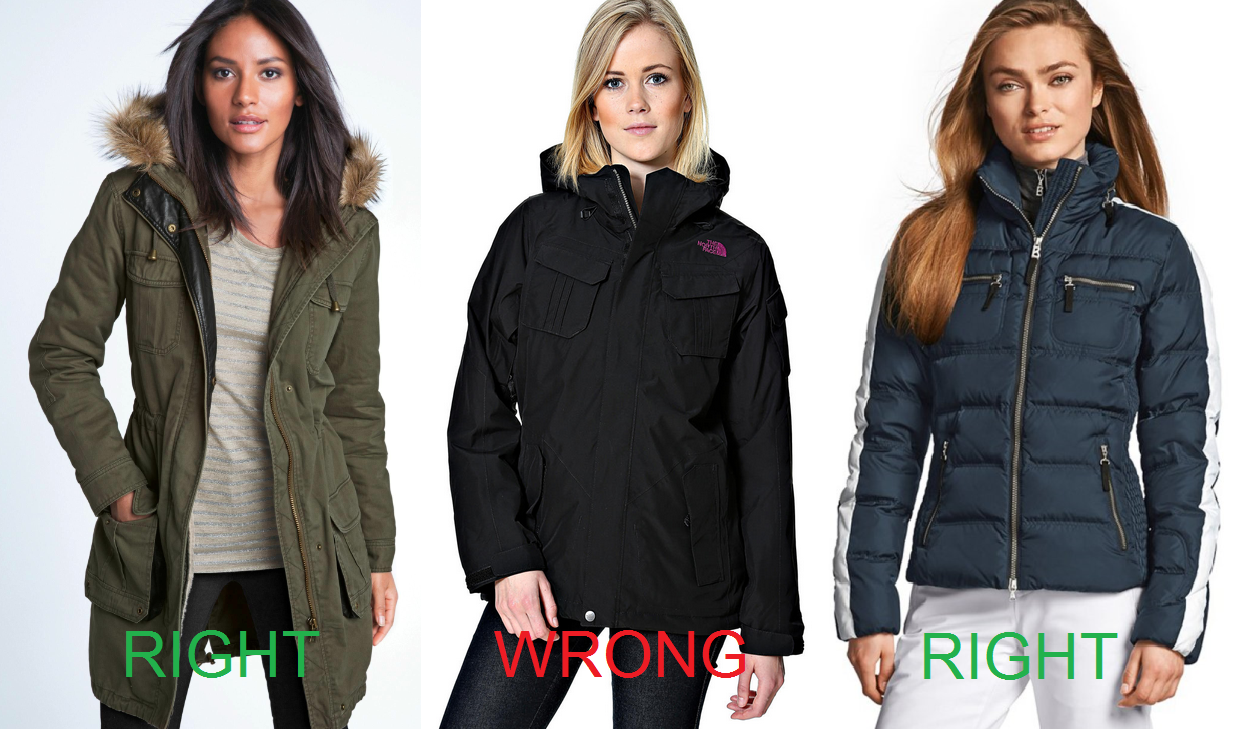
I still stand by my speculation, because the simple truth is that the feminine figure is more attractive when it isn't concealed  (yes, even if the woman is overweight), and the more delicate and feminine parts of a woman's body - like her neck, jawline and breasts - add nothing to her attractiveness when they are covered by a jacket or scarf. So female winter fashion is all about minimizing the effect of the extra material. To this end, the fit of your winter clothes is more important than anything else. The more your clothes follow the natural lines of your figure, the better. This doesn't mean that you always need to wear tight clothes, but it does mean that the bulky jacket your mom bought for you last year probably makes you look like a man. Three tight layers are far better than one heavy layer.

Anyway, here are five female winter fashions/considerations that will make men find you more attractive in winter. There are obviously plenty of other ways to look attractive in cold weather, but these are good starting points:

1. A Jacket That Fits You. For the purposes of looking good in cold weather, nothing is more important than the fit of your jacket. Men should be able to see your curves when you are wearing your jacket. This means that it should follow the curves of your waist and hips. It also means having sleeves that don't add bulk to your arms. And then there are the general aesthetics related to having as few wrinkles as possible from excess material. Most popular clothes stores design and cut their clothes for "average" people, which in the United States, means fat people. So for many girls, getting a jacket that fits will mean having to buy something that is more expensive, or else having a cheaper jacket altered by a tailor. A draw-string at the waist can also help to achieve this effect.


2. Fur-Trimmed Hooded Jackets. I've often told my guy friends how much I like these, and they always agree. The fur is extremely soft, warm and playful = feminine; and if you choose the color to properly complement your complexion, it can be extremely attractive visually as well. Popular fashion seems to have caught on to this in the last year or so, and more girls are wearing them. Because of this, you might not stand out as much by wearing one, but it also means that it is much easier to find them in stores. Besides, "looking like every other girl" is only problematic when every other girl looks bad. Here is an example:


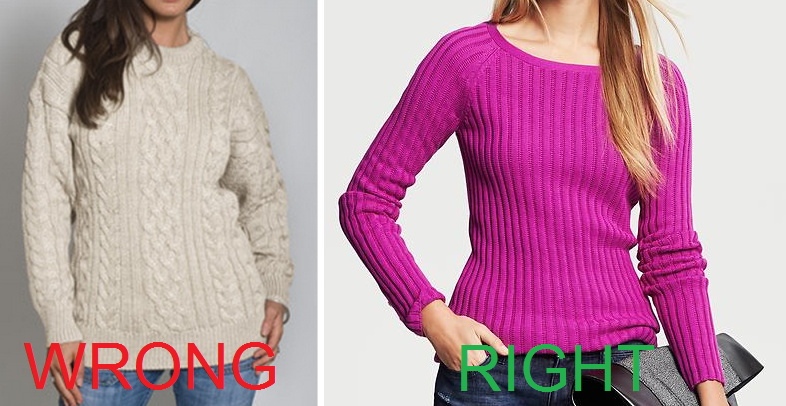
3. Tight Sweaters. A tight sweater embraces everything I said above about the importance of wearing well-fitted clothes. There is something both sexual and nurturing about a woman wearing a tight sweater. It is sexual for the obvious reason that it shows off her figure, but it is nurturing because it gives her an air of warmth and comfort. (Note: We left turtle-neck sweaters in the 90s for a reason: they are hideous on both sexes. Never wear one.)


4. Tall, Heeled Boots. Uggs are great if you want to look like a little girl; but if you want to attract guys over the age of 15, you will need to embrace a more mature look. Tall, heeled boots are sexy. They achieve all of the effects of attractive posture that you get from high heels, and their height draws attention to your thighs and waist. Heels are more important than height, but if heels aren't possible, tall boots without heels are still better than most other shoes - probably warmer too. All three of the examples below are great.


5. Leggings. Because they contain no vital organs, your limbs are the parts of your body least prone to the effects of cold weather; so most women are capable of going outdoors in leggings, even in the middle of winter. This is good, because they are sexy as hell. They make every woman's legs and ass look 10 - 20 % better than normal, and because they are so popular and reveal no skin, no one thinks they look slutty. Yes, they are hotter than a pair of tight jeans - probably because cotton can never conform to your body as well as synthetic, stretchy materials. And no, you don't need to be thin for them to make you look better. Black is obviously the most versatile color, but designs and patterns can work too, as long as they aren't overly obnoxious (e.g. cartoon characters or logos). Wear two or three pairs if it's too cold.

If any of these looks seem like they "aren't you" it is probably only because you haven't tried them yet.


Related Posts
1. The Most Important Time to Dress Well
2. Appearance Checklists
3. How to Make Any Outfit Better
4. Don't Wear Sneakers
5. Sexy Versus Cute

Tuesday, December 24, 2013

You Don't Need to Like Sports

I've traveled a lot. I've lived in Europe twice, spent months at a time in Africa and India, and have visited dozens of other countries in south and central America, the Middle East and Europe (no, I am not in the military). I don't say this to brag or show off, but to lend a little more weight to the observation inspiring this post. The time I've spent abroad has given me a fairly good grasp on the differences between American women and foreigners. This understanding, in turn, helps me to recognize the characteristics that are universally feminine, as opposed to those that are specific to the women in the United States, or any other culture.

One thing that is unique to the United States is how much American women watch sports. Perhaps I am noticing this more recently because it is the middle of the American Football season, but in any case the trend is unmistakable. Women in the United States have favorite teams, know the names of all the players, and watch every game. They cheer with excitement when there is a good play, swear at the referees when they make a bad call, have opinions about who will beat whom, and generally invest a good deal of their identity as a fan of their chosen team.

This doesn't really happen outside the United States. I am sure there are some places where women care about sports more than others, but I have yet to go anywhere outside the U.S. and find women out-shouting men at a bar where a "big game" is being shown on TV. In the U.S. it happens regularly, so it is clear that this is a cultural (rather than sexual) phenomenon.

Most sports are inherently masculine. They are physical, aggressive, strategic and competitive. Perhaps more importantly, "scoring" is characterized in most sports by the same kind of build-up and break-through that occurs in the male orgasm (it isn't a coincidence that men use the same term to refer to getting laid), and in other traditionally masculine pursuits, like hunting and scientific investigation. And while this doesn't mean that women can't or shouldn't participate in sports, or even thoroughly enjoy them, it does mean that any pressure a woman feels to watch or participate in them is most likely external and cultural, rather than internal and authentic.

More to the point here, liking sports will not make you more attractive to men. As I have pointed out before, trying to be one of the guys is a bad dating strategy. There is nothing lamer than that girl at the bar on game-day, wearing face-paint and a team jersey, yelling at the players or referees on the screen in an attempt to prove to the guys around her how much she knows about the game. It is almost the definition of trying too hard, and it is a huge turn-off. While taking an interest the things he likes (sports) is a demonstration of good-will, admiration, and maybe even loyalty, being as obsessed about hockey as he is will not make him want to bang you or date you; it will (at most) make him want to be your friend.

I occasionally pick up Cosmopolitan to see what kind of advice they are giving, and I read there once that men said they like a girl who loves sports. I don't doubt that men have said this, but that doesn't mean it is any truer than the female claim to like men who are able to cry during movies. While both are kind of nice ideas in theory, the behaviors of both sexes in choosing partners betray their real preferences. And yes, of course, there are girls who are epic sports fans and still get guys, but I can promise you that this is because they are hot or fun to be around - not because they are sports fans

So if you are American girl, and feel like you aren't fitting in because you don't know the name of your local basketball team's point guard, or if you find yourself tempted to mimic that one girl you know that has men swarming over her as she spouts football statistics, take a moment to recognize that (a) it isn't her love of sports that is attracting those men, and (b) if it isn't something you genuinely like, you shouldn't be doing it anyway.


Related Posts

Thursday, July 18, 2013

The Importance of Personal Boundaries

A lot of girls have e-mailed me asking for my opinion of the book Why Men Love Bitches. I'd heard of the book a couple times outside of the blog as well, so about six months ago, after a handful of these requests, I decided to get a copy to see what it was all about. My conclusion was that the book is saying something true, but also saying it poorly.

The truth is that men are attracted to bitches, but we don't love them because they are bitches; we just love women that happen to be bitches. In other words, men are attracted to bitches for a quality other than their bitchiness - a quality that any woman (bitch or not) can have. A similar thing is true of women who like "assholes." They only like those men because they are also strong, or confident, or powerful. They don't like them because they are assholes, they like them in spite of their being assholes.

The book Why Men Love Bitches doesn't make this distinction strongly enough for my taste. It skirts around a point that many women desperately need to hear without ever directly addressing it. It plays on an attention-grabbing title, at the expense of clearly telling women the crucial point - namely, that being a bitch, in-and-of-itself, is actually very unattractive to men. My worry is that some women read the book and start being bitchy in an attempt to attract men, just like many men try to be assholes to attract women. Both strategies are dangerous because they are often partially successful, despite missing the real point.

In any case, this criticism obviously begs the question: what are “bitchy” girls doing right? If women like men who are assholes, not because they are assholes, but because they are confident or strong in some other way, then what is the analogous quality in "bitches" that attracts men? And the answer is simple: bitchy women have strong personal boundaries.

Personal boundaries are the limits at which you "draw the line" and prevent other people from infringing on your personal world, that is, your personal rights and emotions - essentially, they are the limits of "what you will put up with." Boundaries apply in both big and small matters, and in all areas of your life: romantic, practical, physical, emotional, spiritual. Some people draw their boundaries quite close to themselves, allowing others to infringe upon their personal world dramatically, without resistance. Others draw expansive boundaries, protecting even their smallest and least significant rights and emotions relentlessly. Balancing between these two extremes is critical. But before saying more about how they play into male-female dynamics, I want to illustrate the concept with a few examples...

Example 1 – A woman is riding a busy train. There is one seat available, but a businessman is using it for his laptop bag while he works intently on his computer. The woman wants to sit down, and certainly has a right to the seat, but she will handle the situation differently depending on the strength of her boundaries. If they are very strong, she will walk up to the man and ask him politely to move his bag so that she can sit down. If she has medium boundaries, she might walk into his field of view, a little tentatively, hoping that he will take the initiative to move his bag himself – but standing if he doesn't. If she has weak boundaries, she will be too nervous about upsetting him, and will tell herself "I can just stand, it isn't that far," which is exactly what she will do.

Example 2 – A woman is asked out by a man who doesn't show up for a date, and doesn't apologize. If the woman has strong boundaries, she won’t hesitate to delete his contact information, and tell him when he calls back three days later that he can go fuck himself. If the woman has medium boundaries, she will probably keep his contact info and ask him what happened, but ultimately agree to another date – despite being under-impressed with his excuse. If she has weak boundaries, the woman will probably just pretend nothing happened, assume that she must have misunderstood the plans, and maybe even apologize for the text she sent that night asking what happened (which he never answered).

Example 3 – A girl walking down the street is asked to contribute to an organization or charity whose ideals she does not believe in. The person asking for donations is enthusiastic and persistent. If the girl has strong boundaries she will say "no" immediately, ignore the second request, and maybe even snap back "I said no!" if asked a third time. If the girl has medium boundaries she is likely to apologize and makes an excuse about not having any money on her, in order to avoid donating and compromising her beliefs. A girl with weak boundaries will first try to avoid the person asking for money altogether; but once she is asked, she will immediately give in, and actually donate a generous amount because she sees on the list that other people have done the same.

Example 4 – A girl is throwing a neon-themed party, and wants to invite a guy she has a crush on. The idea of the party is that anyone who attends has to wear all neon, and the girl knows that if she lets one person come in normal clothes, others will too, and the theme will be spoiled. Upon inviting the guy she likes, he tells her that he'd like to come, but he has nothing neon to wear, and that he has no time between now and the party to buy something. A girl with weak boundaries will immediately tell the guy that it isn't a strict requirement, and that he should just come anyway. A woman with medium boundaries won't bend on the requirement, but she might offer to help him find some neon clothes. A woman with strong boundaries will smile, maybe throw in a wink or a nudge, and tell the guy that if he really wants to come, he will find a way to get something neon (she isn't going to let him ruin the party just because she likes him).

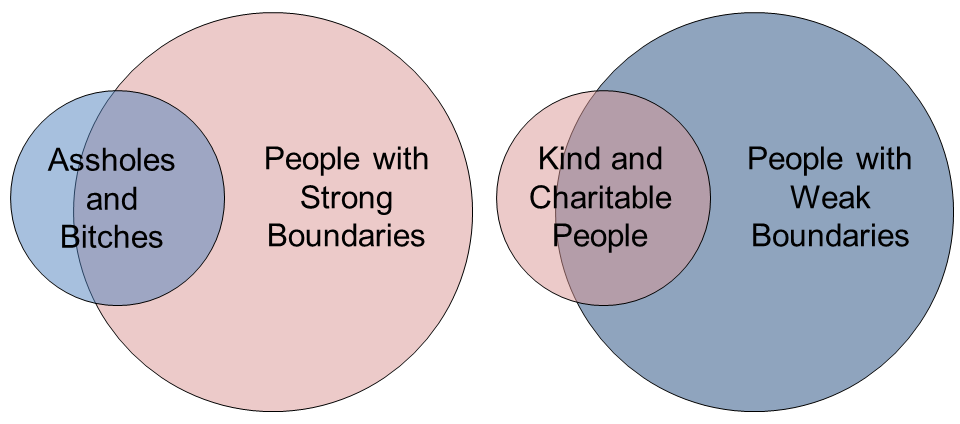
Often people with weak boundaries are thought of as kind or charitable, and a lot of people with strong boundaries are perceived as assholes and bitches, but these labels are inaccurate. It is perfectly possible to have strong personal boundaries without being an asshole (best illustrated in example 1, where the woman is firm, but polite), just as it is perfectly possible to have weak personal boundaries without being kind or charitable (best illustrated in example 3, where the girl gives to charity, but not for altruistic motives). Assholes and bitches are just a subset of the group of people with strong boundaries, just as kind and charitable people are just a subset of the group of people with weak boundaries.

This can be illustrated quite simply with a Venn diagram. There is some overlap between the groups, but there are plenty of people with strong boundaries outside the set of assholes, just as there are plenty of people with weak boundaries outside the set of kind people. Neither group completely encompasses the other.

Perhaps the primary way in which we judge another person's value (and I mean primary both in the sense of "main" and in the sense of chronologically first) is by evaluating what they appear to think about themselves. We do this by observing their confidence, their posture, their grooming, the way they dress, and most importantly, the way they interact with others. We form an opinion of their self-esteem and bearing.

We do this because - unless we know them extremely well - we are privy only to a limited amount of information about their capabilities, talents, and weaknesses (i.e. the things that actually define their value); so we are forced to make a second-hand judgment, an inference. But in general, this judgment is reasonably accurate, because people usually know their own strengths and weaknesses almost perfectly. This self-knowledge usually informs their level of confidence, such that the way that they carry themselves usually reflects their strengths and weaknesses reasonably well.*

Now, healthy boundaries are a sign of confidence, of someone who respects themselves, of someone who knows their own self-worth. Weak boundaries, on the other hand, are a sign of insecurity and low self-esteem. The woman who asks the man on the train for a seat knows that she is just as good as he is, and just as deserving of the seat, so she has no inhibitions about asking (or even telling) him to move his bag. The woman who lets her date get away with not showing up thinks he is the best she can do (i.e. thinks she is below his league). She is afraid to cut him off because she doesn't want to lose him. The girl who can't say no to a donation request, and then gives more than she wanted, has such a poor self-image that she puts even a random charity worker's opinion above her own money and principles. And the girl who tells her crush not to come to the party out-of-costume does so easily because her sense of self-worth is not contingent on one man's willingness to attend a party – or even on how much he likes her.

I am saying all of this is to make a very simple but crucial point: when a man encounters a woman who has strong boundaries, he knows that she values and respects herself, and he therefore makes the reasonable inference that she is a woman of good character. Assuming she meets his minimum criteria for physical attractiveness, his attraction for her – and I am talking about the long-term kind, the kind that makes men fall in love – will skyrocket.

The opposite is also true. When a man meets a woman who lets him (or others) walk all over her boundaries, or even define them, he concludes that she doesn't respect herself, and therefore, that she must not be someone worthy of respect. Even if she is beautiful, his attraction for her will soon plummet.

In my experience, women tend to have weaker rather than stronger boundaries. My guess is that this is true because, from a young age, their boundaries are often handled by the males in their lives – a protective father or brother, suitors who believe they need to be “gentlemen,” male colleagues who suppress their sexual attraction in the office, etc. Surrounded by this behavior, women have relatively less practice than men (on average) maintaining their personal boundaries, defending their personal space, rights and emotions. As a result, they aren't as comfortable confronting someone on the train about moving his bag, or telling those who mistreat them to go fuck themselves.

It has also been my experience that the more attractive a girl is, the more likely she will be to have weak boundaries. This is a little counter-intuitive, and definitely a generalization, but I think I understand why it is the case. From a young age, beautiful women are surrounded by men who are constantly demurring, constantly meeting their needs, and giving them whatever space or compliments they need. Some women like this still manage to develop strong boundaries, and they are the ones that men would kill to be with. But most do not, because they've never had to "fight" for anything. When a woman like this comes across a man who is confident and attractive, she invariably gets banged, walked all over, then dumped. And it is largely because she doesn't show the men in her life that she is someone of value. If she were to maintain strong personal boundaries, men would see that she respected herself, and would want to trace that confidence to its root by getting to know her.

Do not underestimate the importance of this post. For what I suspect is the majority of my readers, it is probably the most important one I've written. I get e-mails all the time from beautiful women (they attach pictures), telling me that they are doing "everything right," but that they still can't land a man. Other women e-mail me asking how they can really "hook" a guy, how they can make him look past the sex, how they can get him to fall in love. They can attract the men they want, they just can't seem to keep to them. This post is fundamental to answering both questions.

For the girls doing “everything right”…
If you read through the posts on this blog, you will notice that many of them – some of which are linked in the Related Posts section, below – advocate the maintenance of strong boundaries in specific situations; but boundaries are not something that you can apply to your life only in a piece-wise fashion. This is transparent. Even if a girl doesn't fuck on the first date, a guy will know that she has poor boundaries when she accepts a date after he’s admitted that he isn't looking for anything serious. Likewise, a girl who doesn't initiate contact still betrays her weak boundaries if she replies immediately to every text a guy writes her. Doing only the things I've posted about on this blog will only get you a fraction of the way to the correct disposition. This post is meant to explain the underlying principle, so that you really can apply it in everything.

For the girls who can attract but can’t keep a man…
Boundaries are fundamental to getting past the initial attraction phase with a man. Looks only get you in the door. As I have said before, while appearances are essential in getting a guy to approach or getting him to ask you out, they are nowhere near enough to get a guy to commit for the long term. Strong boundaries are a primary and therefore critical indicator of a woman's deep, inner worth – the kind of woman that men are not only willing to commit to, but actually want to commit to. There are plenty of women out there who are attractive, but there are very few who have the substance to go with it. Sound, healthy boundaries set a woman apart from the crowd instantly.

So, yes, "men love bitches," in the sense that they love women with strong personal boundaries; but they do not love bitches because they are mean, manipulative, under-handed or have harsh personalities. Men love bitches because their personal boundaries are rooted in a self-respect that tells him more than anything else about their character and inner-value; and it is only with this kind of woman that men want to settle down.

___________________
* While of course there are plenty of exceptions, they are normally short-lived. In the long run, people who are over- or under-confident almost always run into circumstances that serve to correct their distorted self-image. Some good examples are the delusional American Idol contestants who are finally told by the judges (on public television) how much they suck. Similarly, a person who has no self-esteem will eventually find a talent or social niche, and realize that they really aren’t as dumb or awkward as they thought.


Related Posts
1. The Importance of Silence After a Breakup
2. Don't Try to Be One of The Guys
3. Never Tell a Guy When You'll Have Sex With Him
4. No, You Can't Be "Just Friends"
5. Men That Like You Will Explain Themselves
6. Men and "Friends with Benefits"
7. The Downside to Cohabitation Before Marriage