Showing posts with label masculinity. Show all posts

Tuesday, September 1, 2015

The Problem with Denim and Leather

Several years ago, I got into a discussion about women's clothes with my girlfriend at the time and her friend. The friend mentioned that she had "kind of started to hate polo shirts on girls." I was a bit surprised, so I asked what was motivating her hatred. She replied that they were "just too masculine."

I found that interesting. I'd never even noticed polo shirts as being particularly attractive or unattractive, let alone masculine or feminine; but I could see where she was coming from. After all, some clothes (dresses for example) are more feminine, so it made sense that other types could be more masculine. From that point on, I started paying more attention to how sex-appropriate various types of clothes seemed.

Years later I started reading a website called Masculine Style, which does a great job of teaching men how to dress well. The author explains that the history and evolution of certain clothes is what makes them have the visual effect that they do, making them work (or not) for different men in different situations.

He explains, for example, that heavier knit sweaters are far more rugged and masculine-looking than a thin cashmere cardigan because they were designed for and traditionally used by dock workers and fishermen. Similarly, boat shoes were designed with soles that were soft enough to prevent scratching the decks of yachts, and therefore still hint at wealth and luxury in spite of their casualness. Sturdier materials like denim and leather have histories rooted in farming and manual labor, and so they carry connotations of their industrial origins – which brings me to my point…

For a couple years now, I've realized that I don't like when girls wear denim or leather. If the girl is good-looking, I will still be somewhat sexually attracted to her, but both the magnitude and type of attraction is significantly different than it would be if the same girl were dressed in lighter, softer materials. And following the train of thought that was inspired by my ex-girlfriend's friend and what I read on Masculine Style, I've started to wonder if my distaste is due to denim and leather being inherently unfeminine materials.

I mean think about it: denim and leather are rough, sturdy materials made to withstand the abuse of hard labor. They were made to protect rugged men doing rugged work. In the same way that we project onto guys who wear heavy-knit sweaters the masculinity of dock workers, it makes sense that we project onto women the connotations of wearing laborer's clothes – whether we do so consciously or unconsciously. And doing so casts a shadow over a woman's femininity. Asking a woman to look attractive in a biker jacket is kind of like asking a man to look attractive in lace.

Now, I realize that anytime you say (or even suggest) that something might be "objectively" masculine or feminine, people get defensive. If there is a scale along which masculinity or femininity can be quantified, people invariably start worrying about where along it they'll be placed. They are afraid of being judged.* But I am going to assume that my readers have learned to be comfortable with themselves, and throw the idea out there anyway – not so much because I am completely convinced by it as to field your opinions. So here is the concept:
Denim and leather (and perhaps other materials besides) are objectively masculine, at least to the same extent that materials like satin or lace are feminine. The current popularity of leather and denim in female fashion is a trend, piggybacked on the popularity of feminism, and it does not reflect the objective attractiveness of the materials themselves. While women can often look attractive in denim or leather, they do so in spite of the materials, not because of them.

Nope. Really.

I've been testing the idea recently by mentally separating the factors of my attraction each time I see a hot girl wearing one of these materials. Certainly when I think about a woman wearing any piece of clothing in either denim or leather, I can always imagine her being sexier in something less rugged. I've never liked jean or leather skirts on girls; and although it is much harder to look objectively at jean pants (because they are so entrenched in current fashion), I find normal cotton way more attractive.

When I suggest to my male friends that leather and denim are unattractive on women – which I've done several times – I rarely get an enthusiastic chorus of agreement. I get, "Yeah I guess I can sort of see what you mean" or "No, man, I love a girl in a jean skirt." But I am pretty sure that these statements ultimately boil down to "I am not observant enough to figure out what turns me on about a woman's wardrobe" and "I love a girl in a skirt."

Again, this isn't a statement about what women should or shouldn't wear (they're your clothes, do whatever the you want), it is merely a statement intended to spark thought about whether your choice of clothes is an authentic expression of your personal taste or the voice of popular culture.

Oh and just for the record, I am OK with polo shirts on girls.

---------------------------------------------------------------
*In this sense, modern Western culture (at least when it comes to gender) is like a school system without testing. Everyone is just kind of learning at their own rate without an objective measurement of anyone's performance. You can imagine how outraged people in such a system would be the first time you were to suggest that there will periodically be these things called “exams” by which students' comprehension will be evaluated. There would be huge resistance. But testing in schools isn't the end of the world. Yeah, there is pressure to perform to a certain level, and the students that do poorly have to acknowledge the fact that they aren't as “smart” as the other students. But it introduces a degree of accountability that cannot otherwise be motivated, and the school system is better off for it.


Related Posts
1. "Because of" Versus "In Spite Of"
2. Don't Wear Sneakers
3. Femininity, Authenticity, and Compatibility
4. There Is Nothing Modest About Loose Jeans
5. Be Careful About Wearing Large-Shouldered Tops
6. Where Is Feminism Taking Us?

Friday, August 22, 2014

How to Set Up Your Friends

Most women I've met like the idea of setting up the single men in their lives with the single girls in their lives. In other words, they like match-making. Mothers seem to love this more than most, presumably because it puts them back in touch with the romantic spark that is often dead in their own relationships. Perpetually single girls love this too, probably because having influence over someone else’s love life is the next best thing to having control over your own. But normal girls like it too, and this is understandable because it is only human to want to have an influence on other people's lives (it is human to want to have influence in general). In the same way that it is empowering to know that you were the one who got your friend the job that was the springboard for her career, it is empowering to know that you introduced her to the guy that finally gave her confidence in her dating life, or even the guy that she eventually married.

Now, let me preface what I am about to say by pointing out that setups are usually a bad idea. In the vast majority of cases, the very fact that your friend needs help finding love is a good indication that your attempt to help is going to fail. This is because the problem is never one of "just not having met the right person yet." It always runs deeper. Maybe she is insecure, or too introverted, or overweight. Maybe she is trying to be masculine, or makes herself unapproachable. Whatever the case, her inability to take charge of her own romantic life isn't merely a matter of bad luck; it is a symptom of a deeper problem, which your attempt to introduce her to someone new isn't doing anything to solve. It's like giving another book to a child with a learning disability, and thinking "this time he'll get it." Exactly. It isn't going to happen.

So with that background, let's take a look at what most people do when they try to set up their friends (because this blog is for women I am going to use the example of a girl, but guys make the same mistake). Once a girl sees a potential match in her social circle, she goes to the girl and guy separately, and tells each of them that she knows "someone that they have to meet." She might tell each person a few things about the other, maybe show them some photos, and she gets them to agree to the setup. Then she arranges some kind of event at which the two people have the opportunity to meet each other. She's "really good at this" because she never lets either person know that the other one knows it's a set up. That way it won't feel forced or awkward. Perfect, right? Wrong.

The problem isn't that the person thinks that the other knows about the setup. The problem is that the person themselves knows they are being set up. And they knew this the very moment the girl told them there was "someone that they had to meet." This does two things: first, it generates expectations and makes both parties feel like they have to perform, which of course results in an encounter more awkward than a new graduate's first job interview. More importantly, however, and what I want to point out here, is that it destroys the single most important thing for someone who struggles with their dating life: autonomy.

Let's look at this from a the guy's perspective...

One of the hallmarks of masculinity is self-control: men want to be in control of their lives, and by extension, they want to be in control of their dating lives. A man will never feel good about himself if he can't initiate and perpetuate his own relationships. (Remember that his inability to do so is the reason his friends want to set him up in the first place.) By setting a guy up, you are essentially stepping in and putting training wheels on his bike - reminding him that he cannot handle himself. Yes, it might be true that he rides poorly (or not at all) without those training wheels; but by taking control of his dating life you are making him feel like a child, and he won't respect himself for any girl he "gets" with your help. He also won't respect any girl that he needs help to meet, because men know instinctively that women are attracted to men who don't need help: men who are in control and confident with their own capabilities. In other words, he knows he can get a better girl if he gets his shit together and deals with his lack of options himself.

You might argue that without some initial help, a guy (or girl) will never date anyone at all. To use the bike analogy, you might argue that, yes, a guy might not respect himself for using training wheels, but without training wheels he will never learn how to ride. But this argument assumes that his problem is balance. In real terms, your insistence on setting him up assumes that his problem is meeting girls. But as I pointed out at the beginning, this is never the case. His problem isn't one of balance, it is the fear of crashing. His problem isn't one of meeting girls, it is the fear of rejection; and setups do nothing to help him overcome that fear.

There is a feminine perspective on this too. When it comes to match-making, the feminine problem is that a girl will not respect a man who needed the help of a friend (i.e. you) to meet and attract her. This isn't only a matter of judging the man's courage, or the social abilities needed to make a connection with her. Women know that if a man is motivated enough, he will dig down and find that courage, and make something happen - or at least he will try. You want a man who desires you enough to push through a crowd to meet you, or takes some kind of initiative. At very least, you want a guy who does more than accept dates that are handed to him because his friends think he has no other options. A girl who finds herself in a relationship that started that way won't respect him, won't respect the relationship, and won't respect herself. So deep down, girls doesn't like being set up any more than guys do. They might like being single even less, but they'll be even less enthusiastic still about being dumped once their boyfriends wake up, and realize that they are only with those girls because they never had the balls to go for what they really wanted.

I am sure many readers know people who have had successful relationships after being set up, some of which might have even lead to marriage. My parents were set up, and they've been married more than 30 years. Maybe you were set up and are still with your boyfriend. And that's fine. But it doesn't mean that those cases are ideal or likely, or that they do anything to strengthen the inner core of the relationship.

So what do you do? How do you help facilitate a match that you think has potential? Well, you let both the guy and the girl ride without training wheels. You encourage them to take control of their own dating lives, and then you let them do so. This doesn't mean that you can't set them up, but it does mean that you can't tell either of them you are setting them up. Here is what you do: you invite them both to whatever event you've organized, then you sit back and see if they connect. Nothing more, nothing less. If he doesn't take the initiative on his own, nothing happens, and that's OK - or at least, it isn't something you can correct by stepping in and facilitating the connection any more than you already have.

Of course, it isn't always the case that the person you are trying to set up has any problems dating or attracting the opposite sex. Maybe they have plenty of options, and you just happen to know someone who would be a great match for them. But in these cases, you won't need to do anything other than introduce the two people anyway; they will be perfectly fine on their own if there is an attraction, so the strategy is the same: introduce, step back, and let it happen. Nothing more.


Related Posts
1. You Are Responsible For Your Own Romantic Happiness

Tuesday, January 14, 2014

5 Ways That Men Misunderstand Women

We tend to operate under the assumption that the opposite sex's behavior in a given situations is always informed by a rational understanding of the relevant factors: what you want, what he wants, what really matters in a relationship, etc. But the truth is that there are many times where it is informed by a complete misunderstanding. So while the best way to understand male behavior is to become familiar with men's motivations and modes of thought, the second best way is to become familiar with men's motivations and misunderstandings - because it is unfortunately often that a man's behavior in dealing with women is rooted in misconception.

The following are five of the most common ways in which men misunderstand women, and some of the mistakes they make as a result.

1. Men don't know the difference between making a woman happy and attracting her. A lot of men believe that they will attract a woman by giving her what satisfies her in the moment, rather than doing what will demonstrate their character to her. Often these two things are in conflict. For example, a man will often tell a woman she looks beautiful, when the truth (which she knows) is that she is only looking decent. He will do this because he thinks that her momentary happiness is more important than her long-term ability to trust his opinion, and, by extension, him. Likewise, a man will often try to let a girl choose where to go for their date, because he wrongly believes that her enjoyment of the location is more important than her appreciation of his ability to be decisive and have a plan. These men don't realize that women are more interested in being with a man of character than frivolous things like always believing that they look pretty, or loving the restaurant where they enjoy a man's company. Men misunderstand this because they themselves are always seeking to be satisfied in the moment, and so they project that desire onto the women they date.

2. Men think women experience sex the same way they do. This might seem like a minor detail, as it only manifests itself during sex; however, it is actually central to a relationship, just as sex is central to a relationship. Men need an orgasm to really enjoy sex. It is nothing short of frustrating otherwise. A man who believes that a woman needs an orgasm in order to enjoy sex is misunderstanding something that is much bigger than his partner's desire to feel an orgasm. A man who thinks that his woman needs experience an orgasm to enjoy intercourse is far more likely to neglect the thing that she actually needs in order to enjoy sex: his integrity, openness, pleasure - and most importantly, his desire for her. I've had sex with a lot of women, and the ones who have really liked me could care less whether or not they have an orgasm. They are more than happy just to be fucked by a man that they feel lucky to be with. In fact, the reality is that the less a woman respects and is attracted to her man, the more she will "need" an orgasm to enjoy sex. But men project their own need for an orgasm onto their woman. They work too hard to get her off, and in the end, fail to satisfy her in the more important way: by enjoying her, and letting her be the object of his (as one reader called it) "hurricanes of desire." This misconception manifests itself in things like his performance of obsequious oral sex, his listening to you when you tell him to "come now" (rather than being authentic and coming when it happens naturally), or in general listening to how you tell him to fuck you. More severely, it shows up as performance anxiety.

[Before everyone starts jumping down my throat for this one: I am well-aware that women love having an orgasm during sex. But if you "need" an orgasm in order to enjoy sex, ask yourself whether you'd prefer to be ravaged deeply by your man without an orgasm, or be given an orgasm by a guy who goes down on you for so long that he goes limp and loses interest in fucking you. Of course you want both, but both aren't always possible; and the point is that, when they aren't, men often choose poorly between the two options.]

3. Men think that you know you are hot. Many men feel powerless in the presence of a beautiful woman. Actually, it is more accurate to say that many men feel powerless in the presence of any woman in proportion to how much more beautiful than him she is. This is particularly true in younger men, but some men never grow out of it. Much of this feeling of powerlessness is due to the assumption that the woman knows that she is beautiful, and that therefore, they stand no chance of having her. (The rest is due to what I will explain in point number 5, below.) The truth, of course, is that a woman's confidence is absolutely uncorrelated with looks. Many beautiful women feel wildly insecure. However, a lot of men don't realize this. They are so stunned by beauty that they cannot see past it. A man like this might be too intimidated to approach or pursue a woman that he perceives as being out of his league due to her looks alone, when the truth is that the girl may be wishing that he'd approach her.

4. Men think that you mean what you say. Men are literal creatures. Natural selection has weeded out those of us who didn't have a mind for focusing on the facts and the facts alone, and getting the job done. The result is that, while we excel at those things, we suck pretty hard at reading between the lines, interpreting emotions, or understanding what is left unsaid. And the more modern culture tries to tell us that men and women are the same, the harder it is for us to understand that women don't suck at this as much as we do. Many men, therefore, believe that women are equally literal. These men believe that women mean what they say, and say everything that they mean - but this is simply not true. I got an e-mail just the other day from a reader who broke up with her boyfriend, not because she didn't like him anymore, but because she was hoping he would fight for the relationship. She (understandably) wanted to feel desired by him, so she tested him by ending the relationship. I can guarantee you that the boyfriend believed that she ended the relationship because she wanted the relationship to end. But the truth is that she was ending the relationship specifically and exclusively because she did not want the relationship to end. I can give similar examples in which women have asked for things they didn't want in the hope that the man wouldn't give them to her, or others in which a woman has said things she didn't believe only to incite a reaction in a man (or another woman). The point is that, when a man responds to you, he is responding to what you've said or done under the assumption that it is immediately and directly motivated by what you want to happen.

5. Men think that women care just as much about physical attractiveness as men do. The fact that they believe this says a lot more about how important looks are to men than anything about how important looks are to women. It is projection through and through, and causes a lot of men to be insecure about their looks - almost as much as women are insecure about their looks, just without a valid reason. It also leads to men neglecting the important aspects of their character in order to learn how to dress perfectly, or spend all day in the gym. Women are left with a pool of jacked-up, perfectly-dressed, shaved-chested pussies from which to choose a husband, rather than confident and intelligent men of character who are a little rough around the edges. (Yes, I know this is an exaggeration, but the point is that you have fewer men to choose from.) If you've ever looked around and wondered "where are all the good men?" this is probably a big factor in answering your question.

You'll notice that all of these misconceptions are due to projection, encouraged by the notion that men and women are the same - which is not anywhere near as similar as people think it is to men and women being equal. Anyway, keep these things in mind next time a guy does something confusing - chances are one of these will explain why.


Related Posts
1. Misconceptions
2. Why Women Don't Know What Men Want
3. The Analogy Between Sex and Commitment

Tuesday, December 24, 2013

You Don't Need to Like Sports

I've traveled a lot. I've lived in Europe twice, spent months at a time in Africa and India, and have visited dozens of other countries in south and central America, the Middle East and Europe (no, I am not in the military). I don't say this to brag or show off, but to lend a little more weight to the observation inspiring this post. The time I've spent abroad has given me a fairly good grasp on the differences between American women and foreigners. This understanding, in turn, helps me to recognize the characteristics that are universally feminine, as opposed to those that are specific to the women in the United States, or any other culture.

One thing that is unique to the United States is how much American women watch sports. Perhaps I am noticing this more recently because it is the middle of the American Football season, but in any case the trend is unmistakable. Women in the United States have favorite teams, know the names of all the players, and watch every game. They cheer with excitement when there is a good play, swear at the referees when they make a bad call, have opinions about who will beat whom, and generally invest a good deal of their identity as a fan of their chosen team.

This doesn't really happen outside the United States. I am sure there are some places where women care about sports more than others, but I have yet to go anywhere outside the U.S. and find women out-shouting men at a bar where a "big game" is being shown on TV. In the U.S. it happens regularly, so it is clear that this is a cultural (rather than sexual) phenomenon.

Most sports are inherently masculine. They are physical, aggressive, strategic and competitive. Perhaps more importantly, "scoring" is characterized in most sports by the same kind of build-up and break-through that occurs in the male orgasm (it isn't a coincidence that men use the same term to refer to getting laid), and in other traditionally masculine pursuits, like hunting and scientific investigation. And while this doesn't mean that women can't or shouldn't participate in sports, or even thoroughly enjoy them, it does mean that any pressure a woman feels to watch or participate in them is most likely external and cultural, rather than internal and authentic.

More to the point here, liking sports will not make you more attractive to men. As I have pointed out before, trying to be one of the guys is a bad dating strategy. There is nothing lamer than that girl at the bar on game-day, wearing face-paint and a team jersey, yelling at the players or referees on the screen in an attempt to prove to the guys around her how much she knows about the game. It is almost the definition of trying too hard, and it is a huge turn-off. While taking an interest the things he likes (sports) is a demonstration of good-will, admiration, and maybe even loyalty, being as obsessed about hockey as he is will not make him want to bang you or date you; it will (at most) make him want to be your friend.

I occasionally pick up Cosmopolitan to see what kind of advice they are giving, and I read there once that men said they like a girl who loves sports. I don't doubt that men have said this, but that doesn't mean it is any truer than the female claim to like men who are able to cry during movies. While both are kind of nice ideas in theory, the behaviors of both sexes in choosing partners betray their real preferences. And yes, of course, there are girls who are epic sports fans and still get guys, but I can promise you that this is because they are hot or fun to be around - not because they are sports fans

So if you are American girl, and feel like you aren't fitting in because you don't know the name of your local basketball team's point guard, or if you find yourself tempted to mimic that one girl you know that has men swarming over her as she spouts football statistics, take a moment to recognize that (a) it isn't her love of sports that is attracting those men, and (b) if it isn't something you genuinely like, you shouldn't be doing it anyway.


Related Posts

Monday, March 4, 2013

Less Masculine = More Feminine

I pulled the following statement from the comments of the post The Analogy Between Confidence and Beauty:

So I had a revelation about a few weeks ago...and it pertains almost exactly to this post. I'm a confident 7, well-spoken girl but have always wondered why I'm having such issues with attracting the right type of guys when I have such a well-rounded personality. So I started to experiment with how I acted around guys. I became more feminine, I would act more sweet, talk less, be less witty or sarcastic and it was crazy how many more guys came flocking to me. It was kind of disheartening though that I had to become this demure thing to attract more guys. I felt like I was compromising myself, and at times not even being myself because I had to bite my tongue so much and watch what I said. I don't want to be a bobblehead airhead girl, but it seems as though that's what guys want. How do I attract the men I want without compromising myself?

I want to share my response, because I have had similar questions from other readers, and it is an important point for any woman trying to understand her feminine self in the modern world:

You only think of behaving in a more feminine manner as "compromising yourself" because you've been conditioned to think of your personal value in purely masculine terms. But why is it "compromising" to be MORE feminine? You are too fixated on the fact that you are being LESS masculine. Yes, you are LESS ambitious, LESS witty, LESS assertive; but why think of these changes in negative terms? What about the fact that you've become MORE receptive, or MORE radiant, sweetER, or MORE beautiful?
Men and women are two halves of a whole: one typically active (male) and one typically passive (female). But neither one is more important or better than the other, any more than an electrical plug and socket - which are typically referred to as "male" and "female" - are more or less important when it comes to conveying electricity.
It is only because "success" in our society is defined in masculine terms that you feel like you have reduced or compromised yourself as a person by this change. So instead of considering what you've subtracted or "repressed" by being LESS male, focus on what you've added or improved by being MORE female.

There is one more important point here: even though the "bobblehead airhead girl" gets good responses from men, this doesn't mean that she therefore represents the ideal of femininity that men seek. Men prefer her because there are elements of the "bobblehead" that they like: her carefree spirit, her flirtiness, her willingness to be led, her cheerfulness, etc. Her characteristic stupidity and lack of substance are things that men merely tolerate in order to experience the feminine qualities that they desire so deeply - that is, the qualities that men do not typically have in themselves and cannot get from masculine women.

If this seems unfair or counter-intuitive, consider that women behave similarly in their selection of men: they often tolerate insensitivity, excessive pride or stubbornness (i.e. they date "assholes") only because these qualities are unfortunately common in most of the men who have the masculine qualities that they want: strength, aggression, unshakable confidence, ambition, etc. - in other words, the qualities that women do not typically have in themselves and cannot get from feminine men.


Related Posts
1. Femininity, Authenticity and Compatibility
2. Are You Repressing Your Femininity?
3. Misconceptions

Monday, February 11, 2013

What Men Think About Valentine's Day

The average guy doesn't like Valentine's day. Aside from the obvious fact that the holiday is driven by marketing hype much more than by the honest needs of relationships, men dislike Valentine's day because it places pressure on them to express their feelings in unnatural and effeminate ways, and often to a degree they feel unprepared for.

On Valentines's day, men are expected to show their undying love for their woman by following a script prescribed by Hallmark or Flowers.com, and promoted by Hollywood: flowers, fine dining, exuberant cards, rose petals, teddy bears, etc. If a man doesn't follow this script, he suffers the consequence of disrupting the relationship. But if he does follow it, he feels like an emasculated pushover, forced by social pressures into expressing feelings that he may or may not have in ways that would never have occurred to him naturally. Either way, he loses.

Not every man understands his own distaste for the holiday. Maybe a man's aversion to Valentine's day is manifested as nothing other than a small feeling of annoyance in the back of his mind as he tries to pick the least-gay card off the shelf in CVS (from among thousands of cards designed for women, by women). But this annoyance is rooted in the fact that he feels forced into expressing himself in unmanly ways.

A man demonstrates his love for you regularly in ways that aren't as ostentatious as a large bouquet of roses, but run deeper for their lack of overt exhibition: he commits to you willingly, he suppresses his desire to be with other women, he avoids reminding you of that desire, he attends to your emotional needs without complaint, he holds you and protects you, etc.

In addition, men are skeptical of Valentine's day because they know it is (at least partially) motivated by a woman's need to demonstrate to her friends how much she is loved - sometimes more so than it is motivated by a true need for the visible symbols of that love. Again, while most men might not recognize this consciously, it is implicit in their thought that the Valentine's day traditions seem overdone and excessive - because they are excessive if all that drives them is the woman's need for visible expressions of love.

I am not saying that no man likes to express his love through a card or flowers, or that men don't enjoy romantic dates. Some probably do. And I am not saying that there is no need for visible signs of affection in relationships, because there is. They have a time and a place (especially if the man and woman both express their love through gifts). What I am saying is that when a man doesn't get to choose that time and place, and when his hand is forced by the social pressures of a vacuous holiday, his masculine decisiveness and authority are called into question, and he resents it.

So this year I suggest you do three things to help your man through the awkwardness of Valentine's Day:
  1. De-emphasize Valentine's Day by dismissing it openly to him as a marketing ploy. Say something like "Valentine's Day is such a farce; if there weren't decorations in the grocery store and commercials on TV, no one would even remember it after five years. It's purely driven by marketing." (Do not tell him not to get you anything, as this might give him the idea that you don't like receiving gifts.)
  2. Get him something small. The biggest pressure on Valentine's Day comes from the "culture" within the relationship to make a big deal out of it. By only getting him something small (like a card or dressing up in lingerie), you take a lot of the pressure off him the next year.
  3. Curb whatever desire you have to show off on Valentine's Day. Aside from fact that your single female coworkers will probably murder you when you receive roses and a huge teddy bear at the office, recognize that a truly confident woman who is secure in her relationship doesn't need the external affirmation of her peers' jealousy.
  4. Recognize the existing expressions of his love for you, as described above. This will help you to realize that you don't need chocolates on some arbitrary day in February. (If there aren't any common expressions of love in your relationship, you probably shouldn't be together.)
Before you complain that taking the pressure off a man on Valentine's Day makes it "too easy for him," consider this: by stepping back and letting a man do that to which he is naturally inclined, you adopt the same attitude that you do when you don't initiate contact with a man, or when you cut off a guy that breaks up with you: you are stepping back and accepting what happens, even if it isn't what you expected and hoped for. Just like you gain nothing by artificially perpetuating a relationship by constantly contacting a guy who doesn't like you very enough, so too do you discern a man's true feelings for you by taking off the pressure and letting his actions on Valentine's Day (or at other times) reflect his true feelings for you. Don't deceive yourself by reveling in a forced sign of his affection.

If your man refuses to celebrate Valentine's Day, but you don't agree with him that it is ridiculous, your best bet is to employ the tactics of the author's wife in this post:
http://masculine-style.com/you-know-shes-a-keeper-when/


Related Posts
1. What Men Think About Being Called "Cute"
2. Never Tell a Guy When You'll Have Sex With Him
3. Who Is This Girl?
4. The Analogy Between Confidence and Beauty

Sunday, January 13, 2013

What Men Think About Your Intelligence

A reader recently commented on the post Men Don't Care About Your Accomplishments.
I am a highly intelligent woman, though not a genius by any means. However, men my age tell me that intelligence is not a turn-on for them. They say that as long as a woman is "reasonably intelligent" that is what they need... This makes me think that I might be possibly too cerebral to attract men... I laugh but I'm not bubbly and I never dumb myself down for men.
Someone rightly pointed out that part of what put men off was my desire to correct things they said that were inaccurate or participate in verbal sparring (I appreciate a good debate). I've reigned that in with good results but I want a man who actually likes my intelligence.
Is this a matter of men liking different things? Does my intelligence make no difference at all? Or is it a matter of combining my intelligence with enough social leverage to not make it my main feature?
This isn't the first time this question has shown up in the comments of this blog - or in my e-mail. I have also discussed the topic at length with my sisters, their friends, and a couple of the girls I've dated. And judging from their absolute disbelief at what I've told them, there is some news to be shared here...

No woman wants to date a weak man. In fact, a man's attractiveness to women hinges on her perception of his personal strength. A man could manifest his strength in many ways: he could be financially powerful (rich), physically powerful (tall or strong), socially powerful (confident), intellectually powerful (smart or witty), morally powerful (good), politically powerful (highly positioned), etc.; but unless you respect and admire him for his strength, however it is manifested, you will not be attracted to him. Even the best-looking man in the world will be rejected by women once they realize he is weak.

Men know that their role in a relationship is to be the more powerful one, and to use their power to protect and provide for their woman and children. If you subscribe to evolutionary biology's take on history, you will recognize this as a result of the fact that women have long been the physically weaker sex, and traditionally they have needed a male to protect and provide for them and their offspring. But reasons aside, the fact remains that men want to be the stronger mate in relationships. It gives us a feeling of importance to take care of our woman and children - it gives us purpose.

Women also prefer this state of affairs, as is evidenced by the fact that women routinely choose more powerful men as their partners. Women want a man who can hold his own among other men, who is impressive to them, and whom they admire for his strength.

Now, one of the most important signs of a man's power is his intelligence. It is the most pervasive expression of power because it touches every aspect of a man's life and facilitates all other expressions of power. For example, an heir to a large inheritance has financial power, but without the savvy to invest it wisely, that power will be squandered. A man might be physically strong, but unless he knows how to fight technically, he will be beaten soundly by much smaller, weaker opponents (the martial arts demonstrate this). Or a man might have all the social confidence in the world, but unless he is smart and discerning enough to know how and when to wield it, he will alienate those around him.

Intellectual strength is also instrumental in developing other strengths or powers. A man who is smart enough to understand the biological mechanisms behind dieting is going to be a much more effective in his workouts than the stereotypical dumb jock. He will see faster and better results, and will end up being physically stronger (all else being equal). Or a man who is sharp enough to observe and understand social dynamics will eventually gain more leverage over social situations than will a stupid but naturally confident person; his presence will become more commanding. Or again - more simply - smart men are more successful at their jobs and make more money than unintelligent ones.

One of the most common comments on the post Men Don't Care About Your Accomplishments, is the suggestion that men are are "threatened" or "intimidated" by smart, accomplished and intelligent women. When a woman is smarter than a man in a relationship, it isn't necessarily "intimidating" or "threatening," but it does rob him of a large portion of the power he feels that he needs in order to fulfill his role in the relationship - that is, in order to protect and provide for his woman and children. Note that it isn't his absolute power that is important here, but his power relative to hers. He needs to feel both powerful himself and needed by her in the relationship, both needs being intimately linked.

If this doesn't make sense, consider the same point by analogy: a man needs to feel admired and respected in a relationship in the same way that a woman needs to feel adored and desired. A woman's traditional role is to be the mother of the couple's children, and in order to fulfill that role she needs to be beautiful and radiant enough to attract her man - to make him want her sexually. A man who feels powerless in a relationship is like a woman who feels undesired in a relationship.

Alternatively, imagine how it would feel to date a man who was far more physically attractive than you. I don't mean more attractive "for a man;" I mean more attractive absolutely. Imagine he is tall, incredibly handsome, has the perfect physique and dresses impeccably. You, on the other hand, are slightly out of shape, have aged faster, aren't the best looking woman in the world, don't really do the whole "make up thing" well, and can never seem to pull off "stylish." Now imagine walking into a party on this man's arm. Heads turn from every direction as you walk in, but to take in his beauty - not yours. You are barely noticed. This is how a man of inferior intelligence (read: weakness) can feel in the presence of a woman who is much smarter than him. And this probably goes a long way towards illustrating how the feeling isn't "threatening" or "intimidating" so much as demoralizing - which is worse.

All of this is background to making the point that men want to be smarter than their woman, and they want this not because they are proud or misogynist, but in order to feel a sense of purpose. They aren't afraid of or threatened by smarter women, but their woman's intelligence can prevent them from having the advantage of power that makes them feel masculine and garners their woman's admiration.

Most women will admit that they don't actually want to be smarter than their man. While it might initially be an affront to hear that men want to be smarter than the women they date, you actually have the corollary desire. You want to be smart, and you understandably want to be given credit for your intelligence; but you know that intellectual ability plays heavily into a man's strength, and you want your man to be powerful - not only so that he can protect and provide for you, but also because you cannot be attracted to a man you don't admire and respect.

There are two caveats to this generalization:
  1. Men will feel the need to be more intelligent than their woman in proportion to how masculine they are, because this dictates how much need they feel the need to fill a traditionally masculine role in relationships. It is also true that women will feel the need for their man to be more powerful than themselves in proportion to how feminine they are.
  2. As mentioned above, there are different types of power. While intelligence is undeniably important, what ultimately matters is that the man and woman both value the same manifestation(s) of power and that the man has the advantage in that regard - whether or not this includes intelligence specifically. So, for example, maybe he and she both care most about physical power. Even though she is smarter, she will still respect and admire him for his height and physical strength; and he will be proud to fill the role as the one who is physically stronger in the relationship. In most instances, couples will put various levels of value on some combination of the different manifestations of power rather than all of it on one of them. But in the majority of relationships, intellect will play a large role.
One final and important point: intelligence is still undoubtedly a positive trait in women, so long as it does not undermine the man's strength by exceeding his. One of my favorite qualities of my most recent ex-girlfriend was her willingness and ability to talk for hours about our observations, ideas, and experiences related to a vast variety of subjects. She was always curious and often pensive. She was probably the smartest girl I have ever dated, and it might not be a coincidence that she was my most serious girlfriend.

So to conclude: a woman's intelligence is undoubtedly an attractive quality, but it has the negative side-effect of undermining a man's ability to feel powerful, and a woman's ability to admire him. The moral? Seek out men that are smarter than you, or at least, men that you still admire greatly in spite of their lesser intelligence. Keep at an arm's length any man whose overall abilities you start to question. Be cognizant of his feelings of strength in the relationship, always making sure that he feels - or rather, knows - that he is more powerful than you. And finally, smarter-than-average women: rest assured that your intelligence is not a negative in the dating world. While it is true that unintelligent men might be turned off by their own relative inability, your intelligence will be highly valued by the men you find most attractive - that is, the smartest ones.


Related Posts
1. No, Your Intelligence Isn't the Problem
2. Men Care About How You Talk
3. Men Don't Care About Your Accomplishments
4. The Analogy Between Confidence and Beauty

Wednesday, June 13, 2012

"The Difference Between" and "The Difference Among"

Many people’s understanding of the differences between the sexes is plauged by a single misconception, namely, that the difference between the sexes is greater than the difference among either of the sexes. This misconception can severely limit your chances with men, so it is worth acknowledging and correcting.

We are all familiar with the stereotypes of the sexes’ various capabilities or character traits: men are physically stronger than women; women are more intuitive than men; men are more independent than women; women are better at multi-tasking than men; etc. Few of us would dispute that these stereotypes are accurate.

Yet all of us have seen instances that disagree with these stereotypes in varying degrees. I’ve met a few women that could easily kick my ass and plenty that can beat me in sports; we’ve all encountered incredibly effeminate men, or women who are domineering and independent.

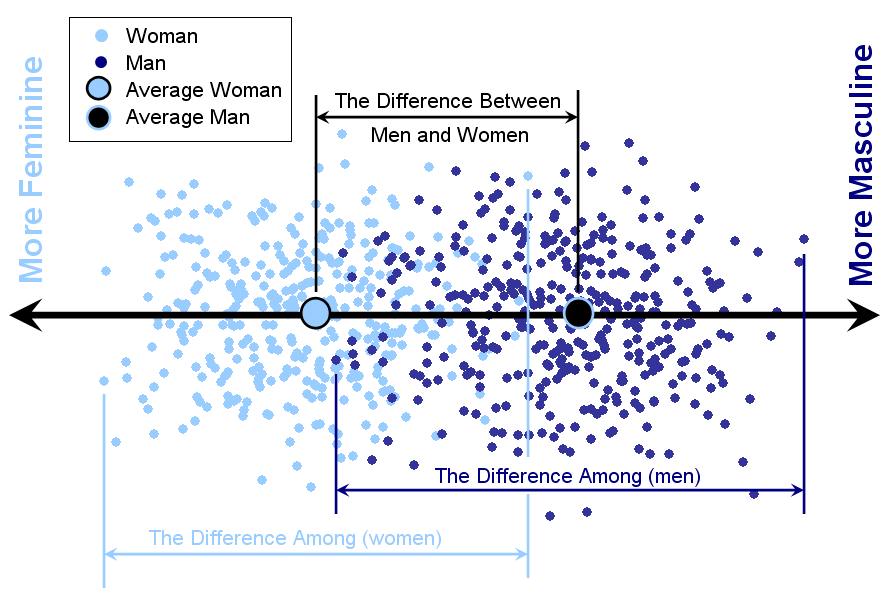
If you plotted each man or woman’s “rank” with respect to a given character trait on a linear scale, you would see a large amount of dispersion or “scatter” in the data. For example, a plot on the intuition scale might look something like this (each point represents a single man or woman):
(Note that the vertical dispersion of the data is just used to better-illustrate the horizontal dispersion)

Similar plots could be made for all kinds of characteristics:
  • Height
  • Physical strength
  • Sex drive
  • Risk aversion
  • Sexual promiscuity
  • Independence
  • etc.
On this blog I make a lot of statements about men and women, about masculinity and femininity, and about the effects of these dispositions on male-female relationships. Understanding these differences is important – critical, even – in learning how to dispose oneself towards the opposite sex. But it is equally important to keep in mind that these differences are only the differences between the averages. Not all men and women will conform to these stereotypes, and it would be a mistake to insist that because some do not, they are not “real men” or “real women,” or to ignore them in your attempts to attract the opposite sex. Be aware of this while reading this blog and others.

For example, I might make a statement like "Men desire sex more than women," and this is perfectly true when you look at the average man and the average woman. But it is just as important to recognize that you may encounter men that are less sexually driven than most women you know, or women who are hornier than any guy you’ve ever met. More importantly, you may not conform to the female stereotype yourself, which would probably mean that you would benefit from looking for a guy who doesn’t conform to the male stereotype (in that respect) either.

The following plot illustrates how a random group of men or women might fall on a masculine-feminine scale – which can be thought of as the combination of a large number of character traits.

Notice that the difference between men and women with respect to the masculinity-femininity scale is actually smaller than the male or female variance on the same scale. Again, the difference among men or women is larger than the difference between them. If you ignore this fact, one of the following could result:

(a) By only paying attention to the stereotypical male, you might miss out on a type of guy that is more appropriate for you than the stereotype – a better match.

(b) In the course of trying try too hard to conform to the stereotype of femininity, you could deny your naturalinclinations. Although your natural self may not attract as many men as your stereotyped self, it may attract more of the kind of men you are interested in. (Though be careful not to confuse your natural inclinations with social pressure – for example, the pressure to succeed in your job.)

So while you are thinking about or reading about the differences between the sexes, remember that, in most respects, the difference among is greater than the difference between; and this in turn means that the guy best for you or most attractive to you may be somewhere closer to the limits of the “scatter” rather than the average when it comes to a particular personality or physical trait.


Related Posts
1. Femininity, Authenticity and Compatibility
2. Men and Sexual Variety
3. The Analogy Between Confidence and Beauty
4. The Analogy Between Sexual and Emotional Support

Monday, June 4, 2012

What Men Think About Being Called "Cute"

A reader recently asked what men think about being called "cute."

I have a very poignant memory of the first time I heard a girl call a guy "cute." It was when I was about 11 years old. My friends and I were out in the playground during recess, and urgently needed to confirm a recent rumor that one of the girls in our class "liked" one of our friends. So of course we went as a group to confront her and her friends to investigate. I forget if the girl in question made the comment, or if it was one of her friends speaking on her behalf, but the salient response was that she thought our friend was "cute."

I was instantly repulsed by the word. I remember thinking it sounded condescending and inappropriate – or, as my sophisticated 11-year old mind phrased it, "like he was a little bunny or something." I remember immediately questioning her use of the word, and making it clear to her that I hated it. Seventeen years later, my opinions haven't changed much, although they have been dulled somewhat by the word's increasingly common use.

Anyway, that was a long way of saying that I think the primal instinct in a man is to dislike or even hate being called "cute," or more specifically, we hate what "cute" implies. Men want to be admired, not adored, and this adjective doesn't exactly reinforce a man's confidence in a woman's admiration. A woman calling a man "cute" is similar to a man calling a woman "nice," which sharply undercuts your understanding that he adores you, or could adore you - or at the very least, that he sees you as a woman who could be adored. It relegates you to the realm of "mildly attractive," in the same way that "cute" relegates a man to the realm of "noted but ignored." Granted, this is not always what a woman means, since "cute" has gradually come to carry more and more weight as a typical descriptor for "attractive." But it is ambiguous at best to men, and still does very little to connote admiration.

This should also explain why "handsome" is a poor substitute for "cute." If you want to please a man verbally, I suggest trying to express your appreciation for his strengths. Next time he makes a good observation, trying telling him (assuming you really think so) "you are so smart, I would never have thought of that..." Or if you admire his confidence and leadership abilities, tell him (when the occasion arises) how much you love watching his friends stop and listen when he speaks. If you love his physical strength, tell him how you love feeling weak or small in his arms the next time he holds you. Or if you love his confidence, tell him how you wish you could confront people with the same ease that he does.

These kinds of compliments highlight his masculine strengths and your admiration of them, rather than downplay his physical attractiveness, which is about all you accomplish with "cute."

Saturday, May 12, 2012

Men Don't Care About Your Accomplishments

A woman can brag endlessly about how much money she makes, the deals shes has closed, the celebrities she's rubbed elbows with, or the awards she's won: none of it matters to men. This might seem harsh, and it is perhaps slightly hyperbolic; after all, it is fairly interesting to know that a girl is successful at her job, or that she works with someone famous - and an award is always impressive. But none of these things translate into sexual or romantic attraction.

I am sure there are some women who grew up understanding otherwise. Or perhaps, having been dealt mediocre looks and a poor figure, others decided that they would pour their energy into their academic degrees or career rather than their beauty, and then proceeded (not without help) to dupe themselves into believing that men would like them for it. Unfortunately, this isn't the case, as many 30-something single career-women are currently realizing - the hard way.

I used to date a girl (older than me) who would always tell me about how she had just balanced some multi-million dollar budget, or how she was in the throes of closing an important project. And it was undeniably impressive that she reported directly to the CFO of the biggest hospital in the city. By all common standards she was successful. But every time she brought up work I got bored.

Women who try to attract men by being successful are like men who try to attract women by being sweet or gentle. While being sweet won't necessarily ruin a man's chances with women (in some cases it will), neither will it draw her in. Likewise, although a woman's business or academic success won't usually turn a man off (in some cases it will), neither will it attract him. Both of these misconceptions are examples of the sexes projecting their own desires onto the other. It is women, not men, who find career success attractive, because it demonstrates drive, focus, strength, initiative - masculine qualities. Likewise it is men, not women, who find gentleness attractive, because it is a symptom of openness, receptiveness, nuturing ability - feminine qualities. I got bored when the girl I was dating talked about work in the same way that women get turned off when a man starts smothering them with flowers and gifts, or constantly apologizes unnesessarily.

This isn't to say that women shouldn't earn PhDs, or become CEOs, or generally strive to achieve traditionally masculine goals. Whether or not women "should" do something is a separate question entirely from what will happen if they do. There are plenty of reasons that a woman might want to win an award or get a promotion; I am merely pointing out that she would be foolish to do so in an attempt to attract men.

Thursday, February 16, 2012

Don't Try to Be One of The Guys

TIME and TIME again I meet girls that try to set themselves apart from other women by identifying with men, hanging out with men and professing to be OK with all the fucked up stuff guys do to girls. This takes many forms. Here are some of the more common examples:

  • Having only or mostly guy friends
  • Claiming that "girls are too bitchy and emotional, guys are just easier to get along with"
  • Laughing at stories about guys treating girls like shit
  • Scoffing at girls that get upset or "overreact" when a guy breaks up with them
  • Being proud of the ability to drink a lot, or to drink strong liquor
  • Pretending to be OK with just hooking up or just having sex with a guy
  • Being proud of her one night stands, and telling stories about them openly
  • Not making demands of a potential boyfriend because "it's no big deal"

Yes, these things do get positive responses from men. However, in the same sense that any attention is not necessarily good attention (a lesson many men need to learn), any attraction is not necessarily romantic or even sexual attraction. The men that laugh at these comments or encourage your drinking feel the same kind of attraction for you that they feel for their buddies: casual, asexual, platonic camaraderie. If this sounds like the kind of attention you want from men, keep it up.

To put the phenomenon in perspective, consider a guy that tries to attract you by constantly identifying with you, hanging out only with girls, and professing to like the things girls like or do. I have witnessed a lot of men who do exactly this. For example,

  • Talking with girls about how "guys can be such assholes" (implying, of course, that he is different - which is probably true enough, but really beside the point)
  • Being the shoulder for the girl to cry on when the guy she actually likes rejects her
  • Admitting that he likes sentimental movies and even that cries sometimes because he is sensitive
  • Pretending he likes the same music as a girl, even if it is gay
  • Pretending that he cares more about her personality than her appearance - or at least (because it is at least conceivable that some men do care less for looks than personality), pretending he cares less about looks than he really does

All of this behaviour - in both men and women - is rooted in projection but ultimately is caused by a failure to differentiate between romantic and platonic affection. When you act like a man and constantly try to identify with him, you will attract him no more than the actions that I've just described attract you.

As obvious as it is, I think it bears repeating that men are attracted to women, not men. While they might complain about a girl who is "too emotional" or "a prude," there are ways of correcting feminine faults without reverting to masculine behavior.