Showing posts with label rejection. Show all posts

Tuesday, April 21, 2015

Book Release: Beyond the Breakup

After far longer than I ever expected it to take, my first book, Beyond the Breakup, is finally out. You can buy it in print format on the CreateSpace eStoreAmazon.com or any of the European Amazon sites. It is also available in electronic format on the Kindle Store (HTML format) or Google Play (PDF format).

As I've said previously (and I'm sure you can probably tell from the title and subtitle) the book is about understanding and handling breakups - specifically, the ones you didn't want to happen. For more detail about the content, I encourage you to take a look at the chapter list at the bottom of this post and read the book description just below the next paragraph.

As I've also pointed out previously, this book was originally intended to be a compilation of blog posts that I'd written about breakups and rejection; so if you are a frequent reader you'll definitely come across some familiar content. However, in the process of compiling the posts, I realized that a lot more needed to be said, and the book grew considerably. I'd estimate that the blog material counts for only 20% of the total content, so even readers who have read every post on this blog will find lots of new material - most of which I consider my best work to date.

Here is the description from the back of the cover:
"It might seem a bit backwards to write a relationship advice book that deals exclusively with breakups and rejection. It would be a lot more obvious to write a book that explains how to attract a man – or at least how to keep the one you already have. Better to give advice about how to start or maintain a relationship than how to deal with the end of one. 
"However, it has been my experience that, for most girls, a painful breakup or rejection actually is the beginning, not the end. It isn't the beginning of a relationship, obviously, but it is the beginning in the sense that it causes them to question for the first time their approach to dating, relationships, and the opposite sex in general. It is the beginning of their efforts to make a change. 
"This book is not written for women with a weak spirit. It isn't going to tell you how to mitigate the pain you feel in the wake of a breakup, and it isn't going to tell you that everything is going to be fine. And while it will tell you how to maximize your chances of getting your ex back, it isn't going to pretend that there are any 'tricks' to make that outcome likely. However, it will do something much more important: it will give you a strong insight into your ex's state of mind and male psychology in general. This will give you the foundation you need to navigate the breakup and – more importantly – propel yourself into honest and successful relationships with the men in your future." 
 – Andrew Aitken
Here are some of the book's stats:
Word Count: 56,000
Pages: 200
Print Format: Paperback
Print Size: 5.25 x 8 inches (13.3 x 20.3 cm)
Anyway, enjoy, and please let me know what you think, either in the comments here, the comments on Amazon, or by e-mail. As always, you can contact me at therulesrevisited@gmail.com.


Chapter List
Introduction
PART I – UNDERSTANDING WHAT HAPPENED
Men Don’t Fall in Love the Same Way Women Do
The Analogy between Sex and Commitment
Why This Always Happens to You
Changing Your Perspective
Why You Didn't See It Coming
Men Don’t Have “Commitment Problems”
The Difference between Liking You and Liking You Enough
Why Men “Fade Out”
You Weren't Dating Him in the First Place
The Small Things Didn't Matter Anyway
Why Your Ex (Who Dumped You) Is Still Contacting You
Your Ex and Guilt
Your Ex and Pride
Your Ex and Decisiveness
Interpreting His Emotions
What’s Going through His Mind 
PART II – HOW TO HANDLE THE BREAKUP 
The Importance of Silence after a Breakup
No, You Can't Be “Just Friends”
How to Know If You Should Cut Him Off
Why It's Never Too Late
Why You Should Tell Him That You Are Cutting Him Off
What to Say
Managing Your Expectations
When You Should Fight to Save Your Relationship
Exceptions to the Rule
How to Know If You Should Dump Him First
When He Cheats
The Anatomy of Missing Him 
PART III – FOLLOWING THROUGH WITH THE BREAKUP 
Making Him Jealous Doesn't Work
Seeing Him at Work
Keeping in Touch With His Friends and Family
Being Connected with Your Ex on Social Media
Returning His Things and Getting Yours Back
What to Do When He Contacts You
When He Says He Wants Another Chance
Reason and Distraction
Stop Sleeping with Your Ex to Prove He Likes You 
PART IV – MOVING ON AND REBUILDING
You Are Responsible for Your Own Romantic Happiness
Stop Letting Him Waste Your Time
Know Why You Want Him Back
Why Getting Him Back Won't Help
Why Getting Dumped Is a Good Thing
The Importance of Emotional Honesty
Dating Again
Putting the Breakup in Perspective
When You Can Contact Him Again
Reframing the Future 
A Final Word

Related Posts

Monday, February 24, 2014

6 Ways Men Mask Their Indifference

Whenever you are dating or seeing a guy, and there is some kind of external impediment to a normal relationship (or to the normal progress of a relationship), be skeptical of what "feels" true. By external impediment, I mean some factor outside the relationship that is making things between you difficult or impossible. You can scan the headings below to get an idea of what I mean. A man's affection in these situations will sometimes feel very much like the real thing, when the truth is that he is only allowing himself to fully express his feelings - or even slightly exaggerate them - because he knows that he is engaging in an impossible (or terminal) relationship. In other words, he will indulge in the relationship because he knows that he has an "out," and commitment will never be demanded of him.

Some men will do this in a manipulative way: they will consciously acknowledge to themselves that the relationship is a dead end, but act like everything is fine in order to continue in a fun or exciting or comfortable situation. More commonly, however, men will simply enjoy the relationship or the interaction with you, and will sub-consciously allow themselves to be more free with their affections or emotions or compliments, because they know in the back of their mind that they will never be forced to prove them by committing to you.

This isn't always the case, and your intuition is probably a strong guide in judging whether it applies in your case; but that intuition will be stronger still after understanding that this kind of behavior is a possibility, and recognizing the following ways in which this phenomenon can manifest itself:

1. Long Distance
This is probably the most common one. When a man is in another city or country, the pressure is off. He might not be cheating, but he is automatically expected to see you less, call you less, and generally be less involved in your life. Even though there is no impediment to him calling frequently, as he would if he were living down the street, it isn't expected of him. I've never been in a long distance relationship, but a few times I've kept in touch (for several months) with girls that I've met while traveling, so I know what this freedom feels like, and how low-investment those relationships are. The fact is that, if you are in different cities, you aren't on his mind anywhere near as much as you would be otherwise. When you are in the same place as a man, you occupy his thoughts frequently because there is always a possibility that you will be able to see each other soon. He is constantly entertaining this possibility in his mind, weighing it against other options. Even if you don't see each other as much as you'd like, he is still forced to think about that possibility (and therefore you) far more often. You are much more immediate to him. But when you are dating long-distance, there is no possibility to be together, and he mentally "shelves" you - that is, he makes you less of a priority in his life - because he knows that physical intimacy is not possible (and I don't only mean sexual intimacy). So a man in a long-distance relationship can put in far less effort to maintain the same level of commitment from you.

2. Technology
By technology I mean cell phones, text messaging, e-mail, etc. While these might seem to be facilitators of a relationship (as they make communication easier), they can often be exactly the opposite. Technology diminishes the amount of personal interaction that we have when we communicate, and, perhaps more importantly, allows us to multi-task. A guy can chat with you online every day, sometimes for hours, but because he is bored at work, while you are thinking "He texts me all the time even though he is busy at work." One time a girl thought I was falling in love with her because I called her almost every day for a couple weeks while I was driving home from work. The reality was that I just enjoyed talking to her and flirting, and I had nothing else to do during my commute. By the time I realized how much she'd read into it, it was too late. In extreme instances, a guy could be texting you from another woman's bed. Even if he doesn't multi-task like this, and uses his free time to contact you via chat or phone or video, it is less valuable than it is if you see him in person. If a guy spends an hour with you on video-chatting, for example, he only needs to be in front of his computer (or these days, his smartphone) in order to do it. In order to spend time with you in person, he would have to shower and get changed, travel to be with you, allow extra time for uncertainties like traffic or a change of plans, and then commute back. That one hour would be effectively two or three by the end of it. So interpret anything less than in-person one-on-one time with the caution it deserves.

3. His Relationship
Married men who are cheating on their wives, or guys who flirt with you even though they have a girlfriend, will never have to demonstrate how willing they are to commit to you. They can always hide behind their inability to leave their current woman. Judging from the e-mails I get, it is fairly common for men in marriages to profess their love to a mistress, but simultaneously claim that their hands are tied: "I would do anything for you, you know that - but I have a family; I can't just leave them." Getting involved with married men is a bad idea for many reasons, but this is an important one. He can continue to have the benefits of a secret relationship, always blaming his lack of intimacy on the fact that he is married and has and family, when the truth is that he wouldn't enter a serious relationship with you even if he were single. More commonly, a guy with a girlfriend might flirt with you and get your hopes up, when the reality is that he wouldn't want to be your boyfriend even if he were single; and it is precisely the knowledge that he can't be your boyfriend that gives him the liberty to engage in flirting with you. 

4. Your Relationship
You might be dating a guy that you are only semi-enthusiastic about, or thinking about breaking up with. Or perhaps you are married but unhappy. And there is a hot, single guy in your life that gives you a lot of attention. In fact, you are sure that if you weren't tied up, he'd be all over you. Think again. Men often allow themselves to enjoy the flirting, the sexual tension, the affirmation of your attraction and all the other makings of a courtship when they know that there is no pressure on them to follow through. They might not be attracted to you enough to make a move, but they will allow themselves to engage in the fun parts of the exchange because they know they will never have to. This is essentially the same mechanism as described in the previous point, except that it is a little more risky for the man, in the sense that he isn't in control of whether or not you end the relationship that is "preventing" something from happening between you and him.

5. Academic Degrees or Careers
I am sure some readers have been told "I love you, but I can't get engaged now; I need to graduate first." This might be true, but evaluate that statement with a heavy degree of cynicism. He could truly feel the need to get a piece of paper before making a commitment, or he could be uncertain about making a commitment to you at all and using his education as an excuse. Are you willing to wait until he graduates only to find out that he actually isn't as serious about you as you thought, or that he wants to "spend some time on his own" before he can commit to a future with you? The same kind of thing can be said about getting a promotion at work, or achieving financial stability (whatever that means), or buying a house. It all has potential to be bullshit.

6. Religious or Cultural Differences
Maybe your guy has told you that he "can't marry a non-Indian girl" (and you are American) or "I can't marry a non-Jewish girl" (and you are Catholic). While both of these might be perfectly true, men will often acknowledge their cultural or religious limitations and still continue to date you. I know plenty of guys who have done this, and the women simply hold on, thinking that maybe he will change his mind. Especially when it comes to culture and religion, you should take these men at their word: the relationship is a dead end. While there are a few Romeo and Juliet stories in the world, they tend to be played out only when both parties have little else in life to lose, not by people with comfortable lives and limitations imposed by cultures or creeds that they don't actually engage in or practice anyway. If you are trying (for example) to get a Hindu Indian doctor from a wealthy family to marry you, when you are a dark-skinned Muslim without an advanced degree, and his family has "expectations" about who he will marry, you are fighting a a losing battle against unreasonable prejudice: give up and cut your losses.


Related Posts
1. Men Don't Have Commitment Problems
2. The Analogy Between Sex and Commitment
3. The Dynamics of Dating Shy Men
4. Don't Let a Guy Waste Your Most Eligible Years

Wednesday, November 27, 2013

How "Hard to Get" Should You Play?

Every woman has been advised at one time or another that she can increase her attractiveness to a man by showing him less interest, that is, by playing "hard to get." Most people don't disagree with this advice, at least not completely; they understand that there is a psychological mechanism by which people tend to want what they can't have. But there is plenty of disagreement about the degree to which this tactic should be applied. A lot of girls obsess over how to strike a balance between "too easy" and "too hard to get." They analyze text messages, scrutinize their response times, stress out about when is the right time to sleep with a guy, or wonder if they will lose their chance with a guy off by not making a move themselves.

The reality is that there isn't any strict rule about how "hard to get" you need to play. Or rather, it varies for each girl and in each situation. Some girls need to apply it more than others. There are girls that immediately cling to any interested guy that meets their minimum requirements, and these girls could benefit quite a bit by showing some self-restraint. On the other end of the spectrum, there are girls with colder dispositions that would dissuade even the most persistent men by playing any harder-to-get than they already do. How hard-to-get you should play also depends on the guy in each situation. More persistent men will push through a higher amount of resistance, while those with a lot of options or lower degree of interest in a girl will be more easily deterred. You could drive yourself crazy trying to figure out where exactly along each spectrum you and he lie, and how to calibrate your behavior accordingly.

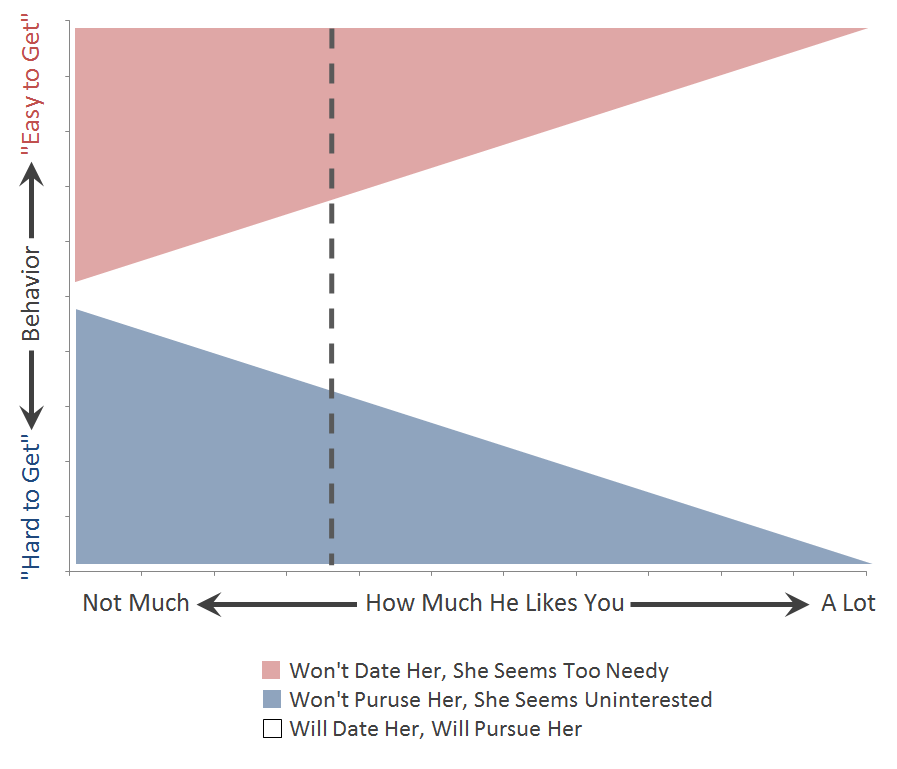
The good news, and the main point I want to make here, is that you really shouldn't over-think this. If a guy is interested in you, there is a wide margin between the behaviors that will make him think of you as "needy" and "uninterested." It will be incredibly difficult to change his interest in you by small things like agreeing too readily to a date, or being too enthusiastic in your texts. As long as you are agreeing to go out with him and not acting bored when you spend time together, you are showing more than enough interest to avoid discouraging the average guy. And as long as you aren't asking him out all the time, or initiating contact with him regularly, you aren't going to appear needy enough to turn him off.

Now, if a guy isn't that interested in you, the thresholds for "needy" and "uninterested" will be closer together, and smaller "mistakes" might cause him to change his mind about you. The girls that obsess over their behavior or the content of their text messages are usually dealing with a guy like this. In fact, his nonchalance about the relationship is usually what drives this hyper-awareness in the first place. The mistake these girls make is to think that their behavior that is responsible for the guy's decision to stop seeing them. While this is true in the limited sense that their behavior triggers the guy's decision, the reality is that his lack of interest was making it next to impossible not to trigger that decision.

Think about it this way: if a guy can be turned off just because you use the wrong adjective in a text, or sleep with him a couple dates too late or soon, or do some other small thing "wrong," then there isn't enough attraction there to sustain a relationship anyway. It was a losing battle from the outset. If the guy doesn't like you enough that you can behave naturally, then he doesn't like you enough for a relationship to last. There is no way you can perpetually guard every word and action around him, or control every emotional impulse forever; at some point you need to be able to relax and be yourself, and he needs to like what he sees when you do so. If you are in a situation where you are stressing out about what to do or say around a guy, your problem isn't your inability to know how to act, or your inability to calibrate your behavior, it is your inability to be comfortable with rejection.

This phenomenon can be illustrated with a simple plot, as shown below. The whole point is that it isn't worth spending your time in a dating situation that falls to the left of the dotted line. If you do, there won't be enough leeway between "needy" and "uninterested" behavior to allow you to be yourself in the relationship. In order to avoid the (red or blue) "no date" zones, you'll have to be constantly guarding your behavior in the same obsessed way that you are right now, as you attempt to get into or hold on to the relationship that is causing you so much stress. Where exactly the dotted line falls is something you need to decide for yourself; but you need to recognize that a limit exists. Until you do, you are going to give yourself a lot of grey hairs - and have nothing to show for it in the end.


Incidentally, guys make the same mistake all the time in their attempt to attract girls. It is particularly evident when you watch guys trying to figure out how to approach and pick girls up. If you could see how obsessively men try to figure out the right thing to say to a girl, or the best way (or time) to approach her, you would know exactly what I mean.* Men are constantly over-analyzing these things. What many men don't realize, is that if they need to force their behavior into a tiny, perfect mold in order to attract a girl, then they aren't going to be able to hold onto her for very long. The act can't be maintained forever; eventually they will need to relax and behave naturally, at which point the tailored personality that attracted her will disappear, and so will she.

In light of all of this, the goal - for men and women - should be to work at self-improvement slowly and steadily - in the long-term, but to relax and be themselves with the opposite sex in the moment. So if you are finding yourself constantly calculating your next "move" in a relationship, or watching your words too much, recognize that you are probably fighting a losing battle. Take a deep breath, relax, and focus instead on making yourself vulnerable to the possibility of rejection. Remember, sometimes it is a good thing.

______________________________________
* In fact, you can see this if you just do a Google search for "pick up artist" or "approach anxiety" and read the uncountable number of websites, blogs and books that have been written in an effort to perfect these things. In fact, I am convinced that men freak out about this stuff way more than women do. Perhaps this is because the pressure is on us to make the first move, but the obsession is still there.


Related Posts
1. Self-Improvement Takes Time
2. On Being a "Typical" Girl
3. Get Used to Rejection
4. Living Vulnerably
5. Don't Initiate Contact

Saturday, September 7, 2013

On Being a "Typical" Girl

I always cringe when I hear girls talk about a situation with a guy they like (or are dating), and they end with something like “…of course I am over-analyzing the situation, like a typical girl.” On the most recent occasion, which prompted me to write this post, a girl that I know was causally sleeping with a guy who would sometimes be affectionate and boyfriend-like, but at other times would seem completely disinterested. She explained this to me, and ended her narrative with the line I quoted above.

There are three things that bother me about this comment whenever I hear it. The first is that it is an expression of voluntary ignorance. It can be roughly translated to mean:
"Something feels wrong about my relationship, but the right thing for me to do is sit back and ignore my feeling of discontent. Silence and time will make me realize that there really is no problem – aside my own anxious and emotionally-driven behavior."
However, the glaringly obvious reality in these situations is that there is a very legitimate problem that needs to be addressed – or at least admitted. In most instances, the problem is that the guy is less interested in the girl than she wants him to be. The guy's behavior betrays this in subtle (and sometimes not-so-subtle) ways, the perception of which the girl is trying to sweep under the carpet. The action of categorically blaming "typical" female tendencies is actually just a psychological reflex or excuse, designed to postpone the inevitable pain that will come with rejection.

The second problem is a more serious one: by calling herself a "typical girl," with negative connotations, a woman is categorically insulting her own sex. The obvious implication is “women are all idiots because we stress out about men too much, are overly-emotional, and can't think reasonably about our relationships.” Not only is this not true (see below), but it is self-deprecating. Talking badly about yourself – let alone your whole sex – is always a bad policy. It is never necessary, and it demonstrates a lack of confidence that is hugely unattractive. Even if being a “typical girl” were obviously a bad thing, voluntarily drawing attention to it (or any associated behavior) would be a bad move.

The third problem, which is the most serious, is that a women who dismisses her feelings by calling herself a "typical girl" has no confidence in her emotions. Of course, it doesn't help that when a woman voices her feelings about a problem in a relationship, men will often tell her that she needs to “chill out,” or “stop being so emotional,” or even that she should “stop being such a girl.” But listening to and agreeing with a man who says this kind of thing – especially one with a vested interest in winning the argument or discussion – is nothing short of spineless. You have feelings, and your feelings tell you that something is wrong. They are legitimate feelings; you have them for a reason. Yet the second someone tells you that you need to stop being so emotional (and sometimes even without being prompted), you immediately doubt everything you feel, apparently convinced that there is something wrong with you for feeling the way you do. And then you actually verbalize that conviction, going as far as to insult your whole sex by blaming it on your womanhood. It is the ultimate expression of self-doubt.

Imagine if men did the equivalent. Imagine if your boyfriend came to you with a logical and well-expressed concern about the way things were going in the relationship. Then imagine if you, in response, flared up with emotion and screamed at him, telling him that he was being too logical and needed to feel more – that he needed to stop thinking so much. Maybe you would throw something at him while screaming this, just to add emphasis. He would stop and think for a moment, then agree, and then say something like “Yeah… yeah, I mean… I guess you’re right. I guess I am just being a typical guy... I really need to stop rationalizing everything.” Then he’d walk away - a bit puzzled, but ultimately convinced, and wondering how he could go about becoming more emotional.

Yeah, exactly – it would be absurd.

But this is precisely what goes on when a woman calls into question her primary tool for navigating relationships - that is, her intuition and emotions. A man is more rationally-focused, more logical in his approach to relationships; but this doesn't make him more right. We live in a world where Reason and Logic are increasingly championed as the only legitimate sources of knowledge. A few hundred years ago, this was chiefly a western error, one that we now refer to as “The Enlightenment.” But the influence of that movement is slowly propagating across the world, and destroying in its wake all confidence in emotional and intuitive knowledge – women’s strengths. In fact, it wouldn't be an exaggeration to say that The Enlightenment induced Feminism, which could only thrive in a society that managed to convince itself that there was something inherently better about the masculine ways of operating in the world and understanding it - in other words, doing so via logic and reason rather via intuition and feeling.

I guess what I am getting at here is that the modern philosophical trends aren't on a woman’s side when her feelings about a relationship are called into question – but that doesn't mean that those feelings are wrong. Likewise, a man who only wants to continue having sex with you isn't exactly going to affirm the emotions telling you that something is off; but that in no way undermines their legitimacy. Just because outside sources are telling you that your feelings are whimsical doesn't mean that you should second-guess yourself.

The next time you feel something inside of you sink at the attitude of a guy's text-message, don’t doubt that feeling just because he asks you “what’s wrong?” and you struggle to pinpoint it. Believe your feelings. Have confidence in your intuition. Similarly, the next time you feel undesired because your boyfriend is spending more time with his friends than he's spending with you, don’t call that feeling into question just because he coldly and “logically” argues that he would be a bad friend if he spent less time with them. Trust your emotions. You wouldn't feel bad about the situation if there was nothing wrong about it. (For example, in this situation the problem is probably that you want a man who loves you enough that he is at least tempted to ignore his friends for you, which he clearly is not.)

So to conclude: be vulnerable in acknowledging the reality of your relationships. Even if you struggle with this, stop talking down on your own sex by stereotyping your reluctance to face the truth as “typical.” Most importantly, stop undermining the legitimacy of your feelings by backing down every time they are questioned, or even mistrusting them yourself. Don't be shy about using your emotions and intuition to navigate your relationships; they are legitimate sources of knowledge, and they are your unique strengths as a woman: be proud of them.


Related Posts
1. Never Tell a Man Why He Shouldn't Want to Date You
2. Get Used to Rejection
3. The "Three Mistake Minimum" Rule on Dates
4. Femininity, Authenticity and Compatibility

Tuesday, April 9, 2013

Why Men "Fade Out"

Women sometimes complain about men "fading out" - that is, slowing and then ceasing contact after dating for a little while, or else just stopping it abruptly. The alternative, of course, is for the guy to call the girl and tell her directly (in these words or others) "I am not interested in seeing you again. I had fun with you but I can tell it won't work out so I don't want to continue dating."

No guy wants to make that call, so instead, many men simply stop communicating with the girl altogether. I understand that there are a lot of bad feelings mixed up in the experience of slowly realizing that the guy isn't interested, so I want to explain why men do this, try to excuse it slightly, and offer a way of handling it.*

The reasons men "fade out" are simple:
  1. It is easier than being direct with you (for him). He doesn't have to fumble through a difficult conversation in which he tries to balance the harsh truth about his feelings for you with an explanation that doesn't hurt your feelings too much. Not only is striking this balance difficult, but there are also implications if he fails to do so - damage to your ego if he is too blunt and ambiguity if he isn't sufficiently forthcoming.
  2. It is easier than being direct with you (for you). You don't want to hear the harsh truth any more than he wants to deliver it. True, you might want closure more than you want to avoid the pain of knowing he doesn't want to see you again; but the hit to the ego you receive when a guy fades out slowly is less severe than if he calls you up and says abruptly: "I don't think you are good enough for me" (which is what being dumped amounts to).
  3. It would be presumptuous to assume that you wanted to continue the relationship. This is the reason that I think women understand least. Sometimes a man feels like he doesn't have the right to announce his decision to stop seeing you, because he doesn't feel justified in making the implied assumption that you wanted to see him again. Sure, in some instances he might suspect that you do; but he never knows for sure. If there is enough ambiguity about your interest in him, it can very easily prevent him from being direct with you about his decision to stop seeing you.
  4. It still conveys the message. While in the short term you might be confused by his lack of contact, he knows that after a few months of silence there won't be any ambiguity about his lack of interest. In the long term, he isn't sacrificing clarity by forgoing the direct phone call.
Girls that have been faced with the need to dump a guy know exactly what I am talking about. In fact, this isn't a singularly male phenomenon, except in the sense that men - due to their promiscuity - tend to be the ones breaking things off more frequently than women.

So how do you handle the situation if a man starts to "fade out" on you? Well, I suggest you start by recognizing that your chief annoyance is the temporary ambiguity - with the emphasis on temporary (see #4 above). From there you have two options:
  1. Let the ambiguity dissipate by his continued lack of contact. This is usually difficult in proportion to how disappointed you are that he stopped wanting to see you; but a confident and vulnerable woman does not get very invested in the early stages of a relationship, and anyway is not interested perpetuating things with men who aren't interested (enough) in her.
  2. Remove the ambiguity by calling him. Whether you do it because you are impatient or because you are annoyed that he isn't being direct with you, you can always call him to ask for closure. While technically speaking this is initiating contact, it isn't problematic because you aren't trying to preserve the relationship anymore. I suggest saying something along the lines of "Hey, [name], I know things didn't work out between us, and I can live with that; but I just wanted to actually hear it from you and know what changed in your mind." You will be putting him on the spot here, so don't expect much in terms of an explanation, but at least you will get confirmation that he is no longer interested.
_____________________________

* Note that I am only talking here about "fading out" after early dating. If this happens after a long time together, or in an exclusive relationship, the reasons and obligations on the man's part are different entirely.


Related Posts

Tuesday, February 26, 2013

The Importance of Silence After a Break Up

If you've been reading this blog for any time now, you are familiar with the idea of cutting off a man after he breaks up with you. I want to explain a little more systematically the reasons why this is important. Keep in mind that by "break up" I mean any situation in which a man makes it clear that he is no longer interested in pursuing a sexual or romantic relationship with you: not calling after he gets your number, fading out after sex or a few dates, or explicitly ending a long term relationship. In any of these situations, cutting him off completely will accomplish five things:

  1. It will show him that you are a woman of high value. It will demonstrate that you are a woman who isn't desperate or needy - a woman who can live without him (because you can). Men find this attractive in a woman. Although this demonstration is unlikely to increase his attraction for you enough to make him change his decision, you will avoid confirming him in his decision by showing him that you are needy, pathetic and desperate - all of which are obvious symptoms of being below his league.
  2. It will show him what he is missing by way of contrast. By forcing him to experience life with you, and then suddenly without you (in other words, before and after the break up), you will emphasize whatever feelings he has as a result of his decision. First he has you, then he doesn't. The starker that contrast is, the more he will feel your absence, and the more likely it is that he will miss you and want you back. Again, it is unlikely that this effect will be enough to make him change his mind, but in some instances it will be. (Note: it is also possible that cutting him off will show him how much he doesn't miss you, but if this is this case then there is nothing you can gain by contacting him anyway - it is unquestionably over.)
  3. It will force him to think about his options seriously. As long you stay in touch with him, he will know that he can have you back at any moment, and he will feel no urgency to reverse his decision. By staying in touch with him, you effectively give him a "safety net." Even if he doubts his decision, he will have nothing forcing him to act one way or the other. He will simply go about his life, waiting until his “feelings about you become clear” (which they never will). 
  4. It will empower you. Although you have no control over his decision to break up with you or stop dating you, you can control what happens as a result of that decision. In fact, you are the sole person capable of "enforcing" the consequences of his decision. By hanging on and hoping to get him back, you give him all of the power. But if you force him to live with the consequences of his decision (i.e. making him live without you when he says "it's over"), you exercise your agency, your power. You seize what little control you can in the interaction. Although this probably won't change the outcome of the situation, it will go a long way towards bolstering your ego and self-esteem in the face of his rejection. You will transform yourself from someone who is pathetic and dejected in light of inevitable circumstances, into a person who exercises influence on the outcome of her situation - and her ex's situation. The added benefit (as explained in the other points of this post) is that by doing so you don't even sacrifice any of the likelihood that he will take you back - in fact, if anything, you increase it. 
  5. It will make him doubt his future options. This is probably the most important mechanism at work in your attempt to get him back, and it will be powerful in proportion to the length of the relationship with you that he is ending. If you stay in touch with him in an attempt to salvage things, you will confirm his belief that he can find someone better (which is his implicit motive for dumping you). The longer you stay in touch with him after the break up, the more he will think "Hmm... if she wants me so badly, girls who are hotter and sweeter will probably like me enough to date me too. Why would I take her back when I know I could do better?” While he might not be so calculating as to have this thought explicitly, I absolutely guarantee you that this thought passes through his subconscious and has a profound influence on his thinking about the break up. And it will occur to him even if you aren't making an active effort to get him back, but "just" texting or calling each other from time to time. He knows you wouldn't stay in touch unless you were interested in getting back together - he knows being "just friends" isn't workable. But, if you cut him off, he won’t know whether or not he just threw away the best girl he could get, and that doubt is priceless in making him consider coming back to you.
-----------------------------------------
If you liked this post, you'll definitely like my book, Beyond the Breakup, in which I add a 6th point that I overlooked when writing this post originally. I also explain a lot more about the practical side of cutting a guy off - what to say, when is "too late," and what to do if he gets back in touch.


Monday, December 3, 2012

Why Do You Want Him Back?

I get a lot of e-mails from women who are desperate to win back a guy that has slowly stopped contacting them, or explicitly broken up with them, or refused to engage in an exclusive relationship. They want to know what they can do to "make him want me again." Rather than giving them advice about what will hook him and pull him back in, I point out something to put the situation in perspective...

When a man rejects a woman, her desire to get him back usually consists of two parts:
(a) her desire to be with a man she really values and is attracted to, and
(b) her desire to prove that, deep down, he actually does want her.
In my experience, women are often (if not usually) motivated more by (b) than they are by (a). That is, they want to regain their pride more than they actually want to be with the guy in question. I've had a number of women even tell me (after taking a moment to think about it) that the guy they want back so badly is nothing like the man they imagine themselves marrying. In some cases, they admit that they probably would have ended things with him if he hadn't done it first - or even that they can see themselves ending things sometime down the road if he takes her back. Their authentic desire to be with him is rarely the motivating factor for wanting him back - even if it still plays a small part.

So before you drive yourself crazy trying to salvage a newly-ended relationship, think for a moment about your motivations: do you really want to be with him, or are you just trying to fix your wounded pride? Because your pride will naturally heal over time. But forcing yourself back into a relationship that he chose to end once already is a good recipe for having him end it again, which will just scar your ego further.

By acknowledging your real motivations, you will make it easier to come to terms with the breakup and be able to move on as quickly as possible.

-------------------------------------
If you liked this post, you'll definitely like my book, Beyond the Breakup, which says a lot more about understanding your mindset and your ex's in the wake of a breakup.


Related Posts
1. Why Rejection Is a Good Thing
2. Get Used to Rejection
3. Don't Initiate Contact
4. Know Why You Are Dating

Tuesday, November 13, 2012

How to Reject a Guy at a Bar - Part 2

[Continued from How to Reject a Guy at a Bar - Part 1]

The worst rejections men endure are the ones that are surrounded by rudeness. Men know that not all women will like them; this is expected. If it weren't, approaching girls would be easy. It is only because we know there is the possibility of rejection that most men get nervous and find approaching girls difficult. Being rejected rudely adds insult to injury. So if you are worried about rejecting a guy but preserving his ego, your two goals should be politeness and sincerity.

Most men know long before you say it explicitly that you are rejecting them. We may not be as intuitive as women, but we know attraction when we see it, and we recognize its absence with equal certainty. Your lack of enthusiasm in responding, the inattention of your eyes, your closed body language - all of these things convey the subconscious (and sometimes conscious) message that you don't particularly want to be interacting with us.

So in most cases, men know what's about to happen. What matters is that you show him that you don't think he is worthless just because you don't want to spend your night talking to him. Giving this impression depends on the tone of your voice, your body language and your facial expressions; but it will primarily be conveyed through your smile and your eyes:

  • Smile - If a smile doesn't come naturally, try to remember the fact that a man with enough balls to approach you essentially just told you that he thought you were beautiful (even if he just wanted sex, he still thinks this). Let this thought simmer in your mind for a moment before making your move to leave him. It should be enough fuel for a smile of gratitude, if nothing else.
  • Eyes - With your eyes, do not try to look apologetic or sad. This would be insincere. Instead, make sure to make eye contact with him. You shouldn't hold his eye contact in a lingering way, which would signal your desire to talk to him again; but neither should you let it be fleeting. Look him in the eye when you tell him that you are leaving. This is a sign of respect, which is something you should have for any well-intentioned man who makes an effort to meet you. Again, remember that he overcame his nerves, or at least was a confident enough person not to have them, and you will feel respect for him; then the eye contact will come naturally.

It is important to note that you do not need an interruption from a friend in order to make an exit. When girls "cockblock" for their friends it is crass and rude (if your friend does this against your will, you should still be able to smile and make eye contact as she drags you away). You don't need this. Instead, you can simply take the next natural lull in a conversation and say "Well, I am going to go find/talk to/dance with my friends. It was nice talking with you. Have a good night." Then walk away.

Do not say "I need to..." Instead say "I am going to..." By telling him what you are going to do, you remove any hint of an excuse from your language: you are telling him what you've decided, not blaming it on something else. Again, this is part of being sincere. It is a little more abrupt, but if it is said politely, with eye contact and a smile, it is better than lying to him about why you "can't" talk to him anymore. It will also save you from his wishful thinking that you would have stayed if you could have - which might result in him showing up again later.

If you struggle with the "walk away" part, it is probably because you don't have the appropriate momentum for your exit. It might seem harsh to walk off suddenly after standing there for a while talking to him. This is easily overcome. As you sense that you want to leave, start to collect your things, or get your money out to pay for your drink, or get down or up from your seat, etc. Do these things without stopping the conversation. He will see this and therefore be primed for your exit, which in turn will make it less awkward for you. It will also help you commit to leaving so that you don't falter and give in if he tries to convince you to stay.

As for men who are extremely rude or inappropriate in their approach, or guys that grope you: just walk away. You owe them nothing, least of all respect.


Related Posts

Monday, November 12, 2012

How to Reject a Guy at a Bar - Part 1

I recently wrote a post about rejecting men, but a reader (in fact, the author of an interesting blog about women's fashion) recently asked a more specific question: "What is the best way to reject a guy at a bar, as to lessen the blow to his ego?"

Before I get into how to lessen the blow to his ego, consider the following:
  1. Recognize that you like being hit on. A lot of girls that say they don't want to be hit on, when what they actually mean is that (a) they don't like having to reject guys they aren't interested in, or (b) they don't want guys to expect them to dance or kiss or go home with them. The actual act of being hit itself on is a pure ego boost, and I've never met a woman who doesn't enjoy this part of it. By acknowledging this fact, you will be better-able to recognize when you are encouraging men's approaches for the sake of your own ego, as opposed to doing so out of genuine interest in him.
  2. Don't worry about his feelings too much. While everyone has an obligation to be polite, you definitely don't owe him your attraction, and you don't need to baby him. If he can't handle rejection, he needs to learn how to. Consider your rejection a test of his manliness, and try not to worry about his feelings too much.
  3. Stop the interaction early if you realize you aren't interested in him. The less time you spend talking to someone, the less surprising it is when you end the conversation. But if you are trapped in the conversation (in a group setting, for example), you can...
  4. Steer the conversation away from personal topics. Focus instead on talking about superficial things, like what is happening around you, how busy the bar is, the lighting, etc. When you don't like a guy, think of your conversation like a hole you find yourself in: the less depth there is, the easier it will be to get out. Steering a conversation involves withholding your feedback on the things you want to avoid discussing (you should actually stay silent or give one-word answers) and then picking out things from his comments that you want to talk about, and playing them up - or else introducing your own topics.
  5. If he bought your drink and you accepted, you do owe it to him to stay until your drink is finished, unless he is inappropriate in some severe way (touching you, for example). You don't need to stay until he finishes his, but don't slurp yours down either. A polite exit will sound like this: "Well I enjoyed talking with you, but I need to go find/talk to/dance with my friends now. Thank you for the drink. I hope you enjoy your night." It is important not to start or end these statements by thanking him for the drink, since this will place too much emphasis on the fact that he paid for it, which could make you sound like you are just fishing for free alcohol, and piss him off. But if you are polite and he is upset that you leave, that is his problem, not yours.
  6. If you are a nice person, you don't need to worry too much. That is to say, if you are actually concerned about how to reject a guy kindly, you are probably already doing it as kindly as you will be able to. Focus most of your efforts on #2.
So with that backdrop, here is the practical answer...


Related Posts

Friday, November 2, 2012

What It Is Like to Be Rejected by Girls

[Note: Although I edited this post later, I wrote the vast majority of it after coming back from a bar on the night described, hence the use of the present tense.]

I am fuming right now. Furious. I feel like shit. I just walked in the door after a night out...

The evening started on a high note. I felt great before I went out. I slept well last night, got a lot done today, had a good workout this afternoon, was dressed well and was generally in a good mood. When I got to the bar there was a good crowd and a bunch of cute girls. I started the night by having a beer with my friend John and telling him a few things I've learned about approaching girls. He was just dumped by his girlfriend of three years, so I hoped he could use the pointers to meet someone new. Soon we started looking for girls we wanted to talk to. That is when the rejections started.

Every guy has "on" nights and "off" nights - this was definitely an off night. Only one girl I talked to the entire evening wanted to keep talking to me, and she wasn't attractive. The first group I tried to start a conversation with immediate turned their backs on me, and didn't even acknowledge what I said to them - despite the fact that it was clearly audible. Another girl entertained a conversation with me for a few minutes while my friend talked to hers, and then just walked away without even saying "excuse me," or "nice talking to you," - or even "bye." Another girl, when I tried to get her attention, literally shook her head "no" and turned away without saying a word. She didn't even listen to what I was trying to say to her. Time and time again I was shut down. It was humiliating.

I should mention that I normally have good success when I approach women. I know how to start and carry a casual conversation tactfully, and most women find me attractive. My lack of success wasn't a matter of me being awkward or arrogant. I was doing the same kind of things I do on the nights when I walk out of the bar with phone numbers from the hottest girl there. There certainly are things a man can do to improve his chances with women, but there is also an element of chance. You can't predict when a girl has had a bad day, or only likes black guys, or already has a boyfriend. Sometimes it works out, other times it doesn't; sometimes she likes you, sometimes she doesn't. By some coincidence, tonight was a long series of "doesn't"s.

As the night progressed, my humiliation grew, and then grew into anger. Towards the end I found myself wanting to lash out at these women, to retaliate for the pain they'd inflicted with the effortless and unfeeling turn of a shoulder, or the shake of their head. Like a 5th grader, I wanted to tell them I didn't give a fuck because they were ugly and I didn't want to talk to them anyway; but it wasn't true. I wanted to tell them I didn't care because I already had three numbers that night; but it wasn't true. I wanted my personal sense of worth and value to be completely independent of their response to my approach; but it wasn't. I wanted to not care, but I did.

As a man, the greatest desire I feel is for women. When I can't attract them, I feel worthless, impotent, emasculated. With each rejection, my sense of value was partially sucked out of me and trampled on the floor. And I had to stand there and pretend it didn't phase me, all the while trying to decide if it was worth pushing through the awkwardness and humiliation to see if there is a way to salvage the conversation (and my pride), or if I should just give up, excuse myself and walk away - defeated. Externally I maintained the same expression and held myself poised and upright; but inside, I was crushed. These girls' actions spoke volumes: "I do not value you enough even to entertain a conversation with you." I felt like shit.

I usually have the capacity to endure two or three rejections in a night - maybe more if they are spread out and interlaced with successes. But tonight the rejections piled on the rejections, and there was no recovering. At the end of the night I left the bar feeling dejected and angry.

Not all guys react this way to rejection; others might get embarrassed or saddened rather than angry. But even if the type of reaction is different, the degree will be equally severe. So the next time a guy brushes past you in a bar without noticing you, or doesn't call after getting your number, or stares at the girl next to you without so much as a glance in your direction - take a step back and remember that men have to endure rejection too, even though it takes a different form. It might be tempting to believe that "men have it easy" because we get to choose who we approach and when; but the truth is that women have just as much power in their ability to refuse a man's approach, as we have in our ability to initiate. And it hurts no less for a man to be told he isn't worth a girl's time than it does for you to be told (through a man's words, actions, or lack thereof) that you aren't worth his.


Related Posts

Sunday, September 16, 2012

How to Turn a Guy Down for Sex

Imagine that you go out to dinner on a first date with a guy you met recently. You go to a nice but fairly laid-back restaurant and you really hit it off, almost instantly. The conversation is fluid, he is witty and interesting and he seems genuinely interested in what you have to say. Afterwards you decide to get a drink at a bar down the street from the restaurant. One drink turns into three or four, and as you leave the bar he pulls you to the side of the sidewalk and kisses you. Unlike other guys you've gone on first dates with he is decisive, confident and not awkward.

You walk back to his place together and he invites you in. It is still fairly early, so you accept, but you both agree that it is "just for a little while." You are impressed because his place is really nice - well decorated, but decidedly manly; he has good taste. He kisses you again and you start making out on his couch. You are comfortable with him, and he seems comfortable holding you - you fit well together. Soon his hands move from touching your face to holding your waist and caressing your breasts through your shirt. Before long his hand is down your pants. You are a little drunk so you don't stop him - after all, it feels good, and you are really comfortable with him. But then he starts to unbutton your shirt.

You don't want to have sex with him on the first date, so you know you should stop him; but it is hard to say no - not because you want to have sex with him so badly (though you are actually starting to), but because it seems inappropriate or even unfair to stop him. You don't want to disappoint him and ruin the night, especially when it is just to follow some "rule" your mom taught you. So what do you do? How do you stop him without ruining the end of the date? By the time you've considered what the most tactful way of stopping him would be, he's finished taking off your shirt and bra. Your nipples are in his mouth when you realize that he's actually already unbuttoned your jeans...

----------------------------------------------

I agree that stopping the guy at this point is going to piss him off. There is no question that your suspicion is right in that regard - in fact it will probably piss him off more than you realize.  So what should you do now, and when should you have stopped him? There was never a time when it seemed appropriate.

In this situation, you should stop him right away. Better late than never. The annoyance you'll cause him and even the bad feelings you'll stamp on the first date - while important - are less important than not being slutty. True, he will lose some respect for you due to your lack of tact and because you led him on, but he would lose more respect for you if you slept with him on the first date.

The answer to the larger question is a little more complicated. For starters, you shouldn't have had four drinks at the bar (you could have nursed two instead). And then you shouldn't have gone inside with him when you got back to his place. And then you shouldn't have let him put his hand down your pants. And then you shouldn't have let him unbutton your shirt. And then you shouldn't have let him take off your bra. And then you shouldn't... etc. I am not saying you should be a prude, but I am saying that you should be a prude on the first date. With each thing you allow him to do, he feels closer to sex and you cause him more chagrin by then stopping him.

On a first date, I recommend not going in his place. You can have the four drinks at the bar if you can walk home or take public transportation, but otherwise the drinks offer too easy an excuse for needing to go inside to "sober up." If you do go in with him, it isn't the end of the world if you make out. You aren't giving the average American guy mixed signals by making out with him and then saying no to sex. The best stopping point is when he goes to put his hand down your pants or when he goes to take off your clothes - whichever one comes first. All you need to do to stop him is this: without interrupting the kissing, gently grab his hand and guide it away from your pants or shirt, to some other place on your body. Then continue making out as if nothing happened. It is a strong but subtle message. If he tries again, you just repeat the motion. If he tries a third time, you pull back and say "I don't want to do that yet." or something similar. Saying "yet" or "tonight" is key, because it hints that it will happen sometime in the future, and this will entice him (though be careful not to tell him when you'll do it).

Tuesday, July 24, 2012

No, You Can't Be "Just Friends"

I've lost count of the times girls have tried being "just friends" with me after I've called off the relationship. It's happened after one-night stands, it's happened after dating girls for a few weeks, it even happened after having a serious girlfriend. And I know this isn't only something I've experienced. Girls try this with guys all the time. It is a final grasp at the remnants of the commitment that they worked so hard for. I am sure some guys try it with girls that dump them too, but in general I think women struggle with cutting ties more than men. It is a struggle that is analogous in some ways to a man's reluctance to make ties with a woman.

Whatever the case, "just being friends" is simply not a viable way of relating to a man or woman you've been emotionally or sexually intimate with. The severed emotional ties between you will prevent you from relating to each other in platonic ways for a long time to come - perhaps forever. This is something that we all know instinctively, whether or not we admit it to ourselves in the face of a failed relationship. Trying to be "friends" is a recently-dumped female's way of saying "I am not ready to let go." However, in some occasions, the male ending the relationship will suggest it. If this happens to you, know that this is a male's way of saying one (or all) of a few different things:
  1. "I'm over the relationship but I like getting laid a lot, and it will be a lot of work to get that kind of steady pussy elsewhere. Let's keep having sex but without the commitment. We'll call it 'being friends.'"
  2. "I don't want to be in a relationship with you anymore. I don't expect that being 'just friends' will actually work, but I know this break up won't be easy for you, so I am suggesting being friends in an attempt to soften the blow."
  3. "I am on the fence about our relationship, but I am too much of a pussy to break up with you completely, even though I know nothing productive or emotionally healthy can come from staying in touch."
It definitely does not mean this:
Let's have a completely platonic relationship in which we ignore the feelings we had for one another, and even the ones we still have. I'll talk casually to you about the girls I'm dating or sleeping with, because the fact that we are "just friends" means that it won't hurt you at all to hear how replaceable you are, and how much I've moved on in such a short time. 
We won't need to worry about the temptation to have sex with each other, because once we become friends, any sexual attraction that existed will die instantly. Once we are "friends" we will immediately start seeing each other like ugly, wrinkled old men and women.
Oh, and also, most importantly: the "just friends" thing will be especially workable because my future girlfriend or wife will be overjoyed that I am still great friends with an ex. Women never get jealous of one another - you and she will probably be close friends someday.
It just doesn't work that way. So if a guy dumps you and says "let's just be friends," or suggests that you stay in touch, recognize that what he really means is one of the three numbered statements above, or some combination of the three. If, after being dumped, you find yourself tempted to convince your ex to be "just friends" or to "stay in touch" (because he still "means a lot to you"), acknowledge the fact that you really just want to hold on to some fraction of what once was, even if it is nothing like a real relationship and will actually hurt you in the long run. Be strong and cut him off.

-------------------------------------
If you liked this post, you'll definitely like my book, Beyond the Breakup, which explains everything you need to know about dealing with you ex: what he's thinking, what is motivating him to stay friends with you, how to maximize your chances of getting him back, and how to focus on your future if that doesn't happen.


Related Posts
1. When Your Ex Contacts You...
2. Men and "Friends with Benefits"
3. Why Do You Want Him Back?

Friday, June 1, 2012

Get Used to Rejection

If a man isn't getting rejected by women regularly, he will probably never find one that satisfies him. Because all women have different taste, men need to approach a large number of women that they find attractive in order to find one that reciprocates that attraction. This requires serious balls, thick skin, and persistence. I think most women appreciate this fact.

In general, a man has to get rejected many more times than a woman in order to succeed at dating. When a girl complains about a guy who stops returning her calls, my first instinct is to tell her "You think that's bad? I was rejected more times in the last month than you've been rejected in your entire life. Try being a dude for a week, then come back and complain to me." However, I don't, because I realize that the rejections a man endures - although no less damaging to his pride - are easier to bear in light of the knowledge that he can approach more women in order to find a new girl. A woman has less direct control over new dating opportunities. Although she can improve her chances by making herself more attractive, she can't just approach men at will without being seen as crazy or desperate. She has to wait until another man (that she likes) approaches her. Though she faces fewer rejections, she also faces fewer opportunities, so the rejections she does endure have more impact.

While women typically get rejected when a man walks away after an initial encounter or date, men typically get rejected when they approach. A woman has to have the courage to let the man walk away, while a man has to have the balls to approach in the first place. While men have to become confident enough to approach without knowing how a woman will respond, women have to become confident enough to let a man act according to his true feelings for her, without knowing whether he will stay with her or leave.

So although the nature of rejection is different for the two sexes, it is equally necessary for both. A man gains nothing from staying on his side of the street when a beautiful woman passes on the other; a woman gains nothing from perpetuating a relationship in which she constantly initiates. A man needs to initiate with the possibility of being rejected, and a woman has to let the man initiate, with the possibility of being rejected (i.e. the possibility that he will not initiate). Both sexes have to take risk and face rejection if they ultimately want success.

All of this is to make the point that rejection, while difficult for both sexes, is a necessary part of the dating landscape. You can't avoid it, so get used to it. As I've said before, if you aren't getting rejected, it probably means you aren't dating up to your potential. You are the only one responsible for your dating success. And like in all other aspects of life, you can increase that success by taking risks, enduring rejections, picking yourself back up and trying again.


Related Posts
1. Why Rejection Is a Good Thing
2. Why Do You Want Him Back?
3. How To Ask For Feedback From A Guy

Wednesday, February 22, 2012

Don't Talk Yourself Up

I've been on a number of first dates, or early dates anyway, during which the girl essentially tried convincing me that she was hot shit. This hasn't typically been outright bragging. In fact, I think in all instances that I can recall, the girl has ostensibly just been telling me about her dating history or personal experiences. But her narrative has been laced with comments about how she is usually the one to end relationships, or how she goes on a lot of first dates, or how she just can't seem to find someone that is intelligent but confident, extroverted but thoughtful, good looking but humble, etc. - all of which imply that she has options with men and is generally amazing. Other girls have talked almost immediately and incessantly about how much they've traveled, or their multiple degrees, or their great jobs. Their underlying message is "See? I am a great catch; you should want to date me." They are talking themselves up.

This doesn't annoy me or turn me off from a girl. As I said, it is usually stated very casually and comes across as factual rather than arrogant or cocky. I've never thought "Wow, this girl is full of herself," or decided that I shouldn't hang out with her again because of it. In most instances I've just listened, and quitely acknowledged that the girl was trying to put her best foot forward. Yet in most cases, after getting to know her, I've been the one to end the relationship and she's been the one trying to hold on. And she's looked stupid because, after coming in with such an obvious "look how great I am" speech, she's been the one to walk away unwanted. When pride comes before the fall it makes you look stupid, even if it isn't your pride that causes the fall.

So next time you are on a first date and trying to impress, consider the following:

1. If you talk yourself up, you are likely to look foolish to the guys that you are most interested in impressing. If you are attracted to them, chances are that they will also turn out to be/do/have the things that you consider "impressive." After initially showing off, you may gradually start to realize that the guy you were showing off for is actually in the same league as you, if not one higher. The frame will flip. Your game will actually work against you, because you will end up looking pathetic for bragging about what (to him) isn't such a big deal.

2. A man will be infinitely more impressed by a girl that reveals herself gradually and naturally, than he will be by one that plays all of her best cards at the outset. Behaving this way is attractive because it demonstrates not only humility, but also security and depth of personality. As a man gradually and naturally learns about your strengths (for example, when they come up in the natural course of conversation, or when he asks you about them), he will get the subtle yet strong impression that you are "bottomless," and that you feel no need to impress him. He will be drawn into your depth and attracted by your confidence.

Saturday, December 24, 2011

Self-Improvement Takes Time

I've been getting a lot of e-mails from girls asking for urgent advice about how to act around a particular guy, or how to interpret his behavior. Others express concern about the difficulty inherent in striking a balance between extremes (for example, between "hard to get" and needy, or prudish and slutty). And while I do usually have suggestions relevant to the specific situation, more often than not these kinds of questions are an indication that the girl is missing the big picture - that she is splitting hairs, and placing too much importance on one particular thing, when the truth is that no single thing matters completely.

If you find yourself worried about the wording of a particular text, or fretting over which earrings to wear, or generally wondering how you should behave towards a particular guy in a particular situation, take a big step back and realize two things:

1. If he is really into you, you will have to make significant mistakes to make him change his mind. While there are always ways to make him like you more, your baseline should be to simply continue doing what you are doing and making gradual improvements. By "significant mistakes" I mean things like revealing that you are actually addicted to coke or gaining 30 pounds.

2. If he isn't that into you, no single small change you make is really going to attract him. A new set of clothes or "hard to get" attitude will not make the difference. You will need to revolutionize yourself to really hook him, and it is impossible to do this overnight. Instead, admit that he is a lost cause, and spend the energy that you would have spent on him on improving your appearance and personality. Then, by the next time a guy of that caliber comes along, hopefully you will have improved enough to make him stick around.

I am not saying that little things don't matter - they do; collectively, they matter a lot. But no single one will make or break a guy's attraction to you, and improvements to each one take time to implement and become natural to you. You need to be patient. But if you continue to make a steady effort, there is no question that the quality of guys you attract will improve.

Wednesday, November 30, 2011

How To Ask For Feedback From A Guy

In another post I advocated asking for feedback from a guy that breaks up with you. Here is how to go about doing it and what to say:

DISCLAIMER: This approach only works with men that have already demonstrated some degree of a sincere interest in you - guys that have shown good will towards you by taking you out, sharing a real conversation, being genuinely affectionate, etc. A guy that you had a one night stand with does not count. A guy that flirts with you all the time, was texting with you a bunch but then stopped and never took you out does not count. A guy that you only meet up with in bars or clubs does not count. You can only expect an honest answer from a guy that has already demonstrated honesty towards you in some form or another.

Wait long enough to make sure he isn't going to pursue you anymore. This will vary depending on the relationship, so you will have to gauge it yourself. There isn't a magic number of days or weeks after you hear from him last. In fact, you may even still be in touch with him regularly if you haven't made him initiate contact or haven't cut him off yet. You just need to be honest with yourself. This is most easily done by thinking: "if he was acting towards my friend the way he is acting towards me now, would I think he'd stopped pursuing her?" If the answer is yes, you're good to proceed.

Contact him. Yes, this is technically "initiating contact," but it is OK when you have already given up on the idea of a relationship with him (so make sure you really have - go back and repeat the step above if needed). The best methods of contacting him are as follows:
  1. Text - This avoids awkwardness and allows you to lead him into the conversation gradually. See below. Also gives him time to think about what he will say.
  2. Internet Chat - Basically the same as texting. Good for the same reasons.
  3. E-mail - Use e-mail only if he is a conscientious/polite guy and you know he will answer, since e-mails are very easily ignored. If he will answer, e-mail has the advantage that it allows him time to really reflect.
  4. Phone - Not a great option since he is likely to avoid your call or give you hasty answers. Not recommended.
  5. In-Person - It is almost certain that you won't be able to get him to invest the time it would take for this (though it is a little more likely after long-term relationships). It is also awkward for both parties and forces rushed and therefore inaccurate responses. Not recommended.
I will assume for the rest of these points that you are using text, chat or e-mail. If the latter, you need to condense this "conversation" into written paragraphs. Try to keep it short, but make sure you convey the main points that I lay out below, with the exception of the lead-in.

Lead him into the conversation. Although guys will ultimately be willing to give you advice if you really want it, they will be extremely hesitant until you assure them that it is important to you and that you can handle whatever you tell them, no matter how harsh. Otherwise they will be worried about offending you. If it's been a while since you've been in touch, you will also need to make sure he realizes that this isn't an attempt to get another date or  re-initiate contact for relationship purposes. So you need to start with a message that (a) gets his attention and (b) communicates your openness. Prefacing a question by asking permission always indicates gravity and raises intrigue. So I see the conversation going something like this:

YOU: "Hey, can I ask you something?"
[If you don't get an answer try following up with "It quick, but important." Quick is the key word here.]

HIM: "Hey, yeah OK, what's up?"

YOU: "I'd like to get an outsider's view of what I am doing wrong with guys. I know its a weird thing to ask, but I feel like you would be pretty objective." [Note: not "your view" and not "what I did wrong with you"]

HIM: [probably no response, but if he gives you a negative answer, continue anyway with the following...]

YOU: "I need someone to be really honest with me. It's probably about time I heard it. You seem like a safe learning experience."

YOU: "And I swear I can take it. I only want the complete truth."

[Then you should throw out at least one example of something he would be unwilling to tell you for fear of crushing your ego. This will make him more comfortable with being honest, though it assumes that you are ready to accept whatever he throws out there.]

YOU: "Do I need to work out more? Maybe lighten up a little bit?"

HIM: [At this point he should give you some kind of response. Probably it will be positive. If you get nothing or a negative answer, be persistent: reiterate your need for the advice and that you can handle whatever he tells you.]

Encourage the conversation. If he gives you only one reason, try to elicit more with comments like "was there anything else?" followed by suggestions that you suspect may have influenced his decision, as well as a couple you don't. For example "are you sure I wasn't looking as good as than the night you met me?" or "was I too serious for a first date?" or "is it because I am not young enough?"

Don't belabor any single point. You really just need an overview, so don't try to dig for too much detail. Once you get the general idea of what he didn't like, move on. For example, if he says you weren't dressed well or wore too much makeup, don't ask what look he would have preferred or what would have been the perfect amount.

Don't object to anything. By asking for his unabashed advice, you are in no position to argue. And really, you shouldn't want to - you are merely collecting facts about his opinion. You can process them later. And while I would dissuade you from dismissing any of them, it won't get you anywhere to convince him that they aren't true.

Push past Mr. Nice Guy. If he starts giving you the typical bullshit about "we just didn't click" or "I didn't feel chemistry" it is only because he is not convinced you can handle an honest answer. So respond to those comments with reassurance that you can handle it, and tell him that you need concrete responses. Try this:

HIM: "I don't know, I just didn't feel it."

YOU: "Mike, I am not saying my feelings won't be hurt, but I need to hear the truth so that I can improve. I need to know the concrete things that were off. There must have been something."

[and if that doesn't work]

"Even if a lack of chemistry was the underlying reason, can you tell me some other way I could improve? I know I am not perfect." [Then throw in a few "tough" examples like you did at the outset, and assume that his answer is the real truth, not "chemistry" - because it is. Chemistry is just the cumulative effect of many small things; it isn't magic.]

Give him time to think about it. If he is still hesitating, and you've tried reassuring him that you can handle it, ask if he'd like some time to think about it. Be persistent about following up. Ask him if he needs "a few days," and then get in touch again in a few days.

Tuesday, October 4, 2011

Ask For Feedback If A Guy Breaks Up With You

I dated a girl not too long ago that was clueless about how to deal with guys. She was incredibly sweet and very attractive, but not very discerning and highly emotional. Although I think she acknowledged my insufficient interest pretty early on, we stayed in touch for a little while because she wasn't fully convinced I didn't like her. As she realized more and more that we weren't going to start dating, she started confiding in me about a couple of guys that she met and went on dates with. Whether or not this was her attempt at making me jealous, I really couldn't say for sure, but I don't think it was. Anyway, I gave her advice, she largely ignored it, and before long those guys stopped talking to her. In frustration, she texted me one day - something along the lines of "OK so tell me what I did wrong with you. Apparently I need to learn a thing or two about guys, because nothing is working out for me right now."

I hesitated because I know the truth can sometimes be tough to stomach, but she insisted and seemed sincere about wanting to know. So I thought about it for a minute, then proceeded to tell her (nicely) that she shouldn't have slept with me on the first date, that she probably shouldn't have hit on me to begin with, and some of the other things she did wrong or I thought were impediments to taking things further. I should mention that this girl was not a slut, was very highly educated, and was well-off. I think she had been quite sheltered growing up and didn't have very much experience with men, so she was honestly confused about why guys were losing interest.

While we stopped talking soon after that exchange, I was exteremly impressed that she asked. She walked away wiser than she was before she met me, and she had herself to thank for that, because she had the guts to ask for real criticism. She is the only girl that has ever done this with me, even though I would have constructive things to tell the vast majority of the ones that didn't. I recently applied this lesson in my own life when a girl that stopped responding to my calls and texts. She explained without hesitating, and her answer was a real eye-opener for me.

Most guys will be more than willing to give you this kind of feedback, especially if you are candid and legitimately curious when you ask (as opposed to bitter or defensive). Guys have a knack for being very clear and direct, and if they liked you enough to go on a date or two, it is unlikely that they will be mean or abrasive with their answer. If they beat around the bush or ignore you, it probably means that they decided you weren't attractive enough; but if they were willing to go on an initial date or two, there is probably something else you could improve. As long as you have the guts to ask, and the objectivity to consider his answer, you can learn a lot from this kind of feedback.