Showing posts with label relationship. Show all posts

Saturday, January 30, 2016

Your Ex's Birthday Doesn't Matter

One question I receive from readers frequently goes something like this:
"My boyfriend broke up with me because of X, Y or Z reason. It has been tough, but I've been following your advice, and I haven't contacted him at all since it happened. He texted me a couple times asking how I am, but I didn't reply. The thing is, his birthday is next week. It is OK to send him a message to say 'happy birthday'? I don't want him to think I am rude."
The answer is definitively, absolutely, always, without a question "no."

I don't care that you've decided to "remain friends" or how close you still are. I don't care if he got you a huge present last year and you "feel the need to return the gesture." I don't care if you say "but we just broke up a couple days ago," or that "I always do that kind of thing for people I care about, and I still care about him." And I definitely don't care if you "just think it would be kind of mean not to."

Don't do it.

All of the above are rationalizations - mere excuses for remaining in contact with him, for trying to re-initiate something or seeing if he'll take the opportunity to re-initiate something given the chance. He isn't your boyfriend anymore, and as I explain in my book, he really isn't a friend or acquaintance anymore either. He is an ex, you're single, and as long as you are keeping strings attached to him you aren't attaching new strings to someone else.


Related Posts
1. Book Release: Beyond the Breakup
2. No, You Can't Be "Just Friends"
3. Stop Having Sex to Prove He Likes You

Tuesday, May 19, 2015

You Shouldn't Want a Boyfriend

The other day, a girl I've been seeing casually for a long time told me that she "really needs to find a boyfriend." I've known several single girls who have communicated this to me in one way or another, and they haven't only been hinting at the fact that they wanted me to be that boyfriend; they've also been expressing an honest desire. Some have suggested it through their behavior or by talking around it; but a few, like this girl, have said it explicitly.

The problem with wanting a boyfriend is that it isn't wanting a husband. Yes, of course, for some girls, saying "I need a boyfriend" is just an abbreviated way of saying that they want to meet a guy who they can date and who will eventually propose; but I wouldn't be writing this post if that applied in every case. Some girls only mean that they are tired of being lonely - that they just want companionship and to feel loved again. They might have some minimal requirements for the boyfriend, but the point is that those requirements fall significantly short of the ones they have for their future spouse.

If your end-game is getting a boyfriend, you aren't going to be filtering the men you date for their long-term compatibility. You'll get into relationships that you could have known from the outset would be terminal (if you'd stopped for a moment to think about it), and you'll end up wasting your time. So be honest with yourself about what you want in a man - maybe even write it down - and don't give in to the temptation of temporary companionship and affection.


Related Posts
1. Know Why You Are Dating
2. Don't Let a Guy Waste Your Most Eligible Years
3. Why Men Are Capable of Commitment
4. How "Hard to Get" Should You Play?
5. Men and "Friends with Benefits"

Tuesday, April 21, 2015

Book Release: Beyond the Breakup

After far longer than I ever expected it to take, my first book, Beyond the Breakup, is finally out. You can buy it in print format on the CreateSpace eStore, Amazon.com or any of the European Amazon sites. It is also available in electronic format on the Kindle Store (HTML format) or Google Play (PDF format).

As I've said previously (and I'm sure you can probably tell from the title and subtitle) the book is about understanding and handling breakups - specifically, the ones you didn't want to happen. For more detail about the content, I encourage you to take a look at the chapter list at the bottom of this post and read the book description just below the next paragraph.

As I've also pointed out previously, this book was originally intended to be a compilation of blog posts that I'd written about breakups and rejection; so if you are a frequent reader you'll definitely come across some familiar content. However, in the process of compiling the posts, I realized that a lot more needed to be said, and the book grew considerably. I'd estimate that the blog material counts for only 20% of the total content, so even readers who have read every post on this blog will find lots of new material - most of which I consider my best work to date.

Here is the description from the back of the cover:
"It might seem a bit backwards to write a relationship advice book that deals exclusively with breakups and rejection. It would be a lot more obvious to write a book that explains how to attract a man – or at least how to keep the one you already have. Better to give advice about how to start or maintain a relationship than how to deal with the end of one. 
"However, it has been my experience that, for most girls, a painful breakup or rejection actually is the beginning, not the end. It isn't the beginning of a relationship, obviously, but it is the beginning in the sense that it causes them to question for the first time their approach to dating, relationships, and the opposite sex in general. It is the beginning of their efforts to make a change. 
"This book is not written for women with a weak spirit. It isn't going to tell you how to mitigate the pain you feel in the wake of a breakup, and it isn't going to tell you that everything is going to be fine. And while it will tell you how to maximize your chances of getting your ex back, it isn't going to pretend that there are any 'tricks' to make that outcome likely. However, it will do something much more important: it will give you a strong insight into your ex's state of mind and male psychology in general. This will give you the foundation you need to navigate the breakup and – more importantly – propel yourself into honest and successful relationships with the men in your future." 
 – Andrew Aitken
Here are some of the book's stats:
Word Count: 56,000
Pages: 200
Print Format: Paperback
Print Size: 5.25 x 8 inches (13.3 x 20.3 cm)
Anyway, enjoy, and please let me know what you think, either in the comments here, the comments on Amazon, or by e-mail. As always, you can contact me at therulesrevisited@gmail.com.


Chapter List
Introduction
PART I – UNDERSTANDING WHAT HAPPENED
Men Don’t Fall in Love the Same Way Women Do
The Analogy between Sex and Commitment
Why This Always Happens to You
Changing Your Perspective
Why You Didn't See It Coming
Men Don’t Have “Commitment Problems”
The Difference between Liking You and Liking You Enough
Why Men “Fade Out”
You Weren't Dating Him in the First Place
The Small Things Didn't Matter Anyway
Why Your Ex (Who Dumped You) Is Still Contacting You
Your Ex and Guilt
Your Ex and Pride
Your Ex and Decisiveness
Interpreting His Emotions
What’s Going through His Mind 
PART II – HOW TO HANDLE THE BREAKUP 
The Importance of Silence after a Breakup
No, You Can't Be “Just Friends”
How to Know If You Should Cut Him Off
Why It's Never Too Late
Why You Should Tell Him That You Are Cutting Him Off
What to Say
Managing Your Expectations
When You Should Fight to Save Your Relationship
Exceptions to the Rule
How to Know If You Should Dump Him First
When He Cheats
The Anatomy of Missing Him 
PART III – FOLLOWING THROUGH WITH THE BREAKUP 
Making Him Jealous Doesn't Work
Seeing Him at Work
Keeping in Touch With His Friends and Family
Being Connected with Your Ex on Social Media
Returning His Things and Getting Yours Back
What to Do When He Contacts You
When He Says He Wants Another Chance
Reason and Distraction
Stop Sleeping with Your Ex to Prove He Likes You 
PART IV – MOVING ON AND REBUILDING
You Are Responsible for Your Own Romantic Happiness
Stop Letting Him Waste Your Time
Know Why You Want Him Back
Why Getting Him Back Won't Help
Why Getting Dumped Is a Good Thing
The Importance of Emotional Honesty
Dating Again
Putting the Breakup in Perspective
When You Can Contact Him Again
Reframing the Future 
A Final Word

Related Posts

Friday, August 22, 2014

How to Set Up Your Friends

Most women I've met like the idea of setting up the single men in their lives with the single girls in their lives. In other words, they like match-making. Mothers seem to love this more than most, presumably because it puts them back in touch with the romantic spark that is often dead in their own relationships. Perpetually single girls love this too, probably because having influence over someone else’s love life is the next best thing to having control over your own. But normal girls like it too, and this is understandable because it is only human to want to have an influence on other people's lives (it is human to want to have influence in general). In the same way that it is empowering to know that you were the one who got your friend the job that was the springboard for her career, it is empowering to know that you introduced her to the guy that finally gave her confidence in her dating life, or even the guy that she eventually married.

Now, let me preface what I am about to say by pointing out that setups are usually a bad idea. In the vast majority of cases, the very fact that your friend needs help finding love is a good indication that your attempt to help is going to fail. This is because the problem is never one of "just not having met the right person yet." It always runs deeper. Maybe she is insecure, or too introverted, or overweight. Maybe she is trying to be masculine, or makes herself unapproachable. Whatever the case, her inability to take charge of her own romantic life isn't merely a matter of bad luck; it is a symptom of a deeper problem, which your attempt to introduce her to someone new isn't doing anything to solve. It's like giving another book to a child with a learning disability, and thinking "this time he'll get it." Exactly. It isn't going to happen.

So with that background, let's take a look at what most people do when they try to set up their friends (because this blog is for women I am going to use the example of a girl, but guys make the same mistake). Once a girl sees a potential match in her social circle, she goes to the girl and guy separately, and tells each of them that she knows "someone that they have to meet." She might tell each person a few things about the other, maybe show them some photos, and she gets them to agree to the setup. Then she arranges some kind of event at which the two people have the opportunity to meet each other. She's "really good at this" because she never lets either person know that the other one knows it's a set up. That way it won't feel forced or awkward. Perfect, right? Wrong.

The problem isn't that the person thinks that the other knows about the setup. The problem is that the person themselves knows they are being set up. And they knew this the very moment the girl told them there was "someone that they had to meet." This does two things: first, it generates expectations and makes both parties feel like they have to perform, which of course results in an encounter more awkward than a new graduate's first job interview. More importantly, however, and what I want to point out here, is that it destroys the single most important thing for someone who struggles with their dating life: autonomy.

Let's look at this from a the guy's perspective...

One of the hallmarks of masculinity is self-control: men want to be in control of their lives, and by extension, they want to be in control of their dating lives. A man will never feel good about himself if he can't initiate and perpetuate his own relationships. (Remember that his inability to do so is the reason his friends want to set him up in the first place.) By setting a guy up, you are essentially stepping in and putting training wheels on his bike - reminding him that he cannot handle himself. Yes, it might be true that he rides poorly (or not at all) without those training wheels; but by taking control of his dating life you are making him feel like a child, and he won't respect himself for any girl he "gets" with your help. He also won't respect any girl that he needs help to meet, because men know instinctively that women are attracted to men who don't need help: men who are in control and confident with their own capabilities. In other words, he knows he can get a better girl if he gets his shit together and deals with his lack of options himself.

You might argue that without some initial help, a guy (or girl) will never date anyone at all. To use the bike analogy, you might argue that, yes, a guy might not respect himself for using training wheels, but without training wheels he will never learn how to ride. But this argument assumes that his problem is balance. In real terms, your insistence on setting him up assumes that his problem is meeting girls. But as I pointed out at the beginning, this is never the case. His problem isn't one of balance, it is the fear of crashing. His problem isn't one of meeting girls, it is the fear of rejection; and setups do nothing to help him overcome that fear.

There is a feminine perspective on this too. When it comes to match-making, the feminine problem is that a girl will not respect a man who needed the help of a friend (i.e. you) to meet and attract her. This isn't only a matter of judging the man's courage, or the social abilities needed to make a connection with her. Women know that if a man is motivated enough, he will dig down and find that courage, and make something happen - or at least he will try. You want a man who desires you enough to push through a crowd to meet you, or takes some kind of initiative. At very least, you want a guy who does more than accept dates that are handed to him because his friends think he has no other options. A girl who finds herself in a relationship that started that way won't respect him, won't respect the relationship, and won't respect herself. So deep down, girls doesn't like being set up any more than guys do. They might like being single even less, but they'll be even less enthusiastic still about being dumped once their boyfriends wake up, and realize that they are only with those girls because they never had the balls to go for what they really wanted.

I am sure many readers know people who have had successful relationships after being set up, some of which might have even lead to marriage. My parents were set up, and they've been married more than 30 years. Maybe you were set up and are still with your boyfriend. And that's fine. But it doesn't mean that those cases are ideal or likely, or that they do anything to strengthen the inner core of the relationship.

So what do you do? How do you help facilitate a match that you think has potential? Well, you let both the guy and the girl ride without training wheels. You encourage them to take control of their own dating lives, and then you let them do so. This doesn't mean that you can't set them up, but it does mean that you can't tell either of them you are setting them up. Here is what you do: you invite them both to whatever event you've organized, then you sit back and see if they connect. Nothing more, nothing less. If he doesn't take the initiative on his own, nothing happens, and that's OK - or at least, it isn't something you can correct by stepping in and facilitating the connection any more than you already have.

Of course, it isn't always the case that the person you are trying to set up has any problems dating or attracting the opposite sex. Maybe they have plenty of options, and you just happen to know someone who would be a great match for them. But in these cases, you won't need to do anything other than introduce the two people anyway; they will be perfectly fine on their own if there is an attraction, so the strategy is the same: introduce, step back, and let it happen. Nothing more.


Related Posts
1. You Are Responsible For Your Own Romantic Happiness

Sunday, March 9, 2014

The Economics of Sex

A reader recently posted a link to a video that captures, in extremely clear terms, a phenomenon that has been implicit (and at times, explicit) in everything I write on this blog. It is a video that discusses sexual economics, and more importantly, their implications for dating and relationships. Here it is:


I cannot recommend this video highly enough. Especially for anyone encountering this blog or its ideas for the first time, it gives an important insight into one of the biggest differences between men and women in dating and relationships (I believe bigger ones exist, but this is a great starting point for discovering them). Even regular readers can benefit by watching this video, because it articulates clearly and concisely ideas that are well-worth solidifying in your mind; and hearing them in such clear and concise terms will do exactly that.


With that said, I do want to point out two minor disagreements I have with the video, though I only feel the need to do so because I agree so completely with the rest:

(a) I think the video focuses too much on the pill as the source of the disparity between supply and demand, rather than on certain philosophical undercurrents in Western society, or mans' access to pornography - both of which are at least as responsible (if not more so) for the phenomena the video describes.

(b) It suggests that "affirming desirability" is a sexual motivation for women, but not for men (1:28). This is simply untrue. Yes, men bang women because an orgasm feels better in a vagina than in their hand; but a big part of that "better feeling" is actually pride: it is either the satisfaction of the woman's affirmation, or the affirmation from their guy friends upon sharing the story with them. I do, however, agree with their point that women tend to be motivated by the intimacy of sex more than men; and as I've suggested before, I also think that feeling desired is a greater sexual motivation for women than it is for men.* So I don't think this criticism detracts from the video's larger point that men and women have different motivations for sex.

To give credit where credit is due, the video was made by the Austin Institute for The Study of Family and Culture. I don't know anything more about their organization than what they have written on their "About Us" page, but I also don't care. I am just glad someone made the video.

________________________
* I don't think this is because women are more emotionally needy than men (as one might infer). I am convinced that it is because men are more desirous of carnal sexual pleasure. So as a woman, there is simply more sexual desire to be received.


Related Posts
1. The Analogy Between Sex and Commitment
2. Women Get to Play Out of Their League
3. Men and Sexual Variety
4. 5 Ways Men Misunderstand Women

Monday, February 24, 2014

6 Ways Men Mask Their Indifference

Whenever you are dating or seeing a guy, and there is some kind of external impediment to a normal relationship (or to the normal progress of a relationship), be skeptical of what "feels" true. By external impediment, I mean some factor outside the relationship that is making things between you difficult or impossible. You can scan the headings below to get an idea of what I mean. A man's affection in these situations will sometimes feel very much like the real thing, when the truth is that he is only allowing himself to fully express his feelings - or even slightly exaggerate them - because he knows that he is engaging in an impossible (or terminal) relationship. In other words, he will indulge in the relationship because he knows that he has an "out," and commitment will never be demanded of him.

Some men will do this in a manipulative way: they will consciously acknowledge to themselves that the relationship is a dead end, but act like everything is fine in order to continue in a fun or exciting or comfortable situation. More commonly, however, men will simply enjoy the relationship or the interaction with you, and will sub-consciously allow themselves to be more free with their affections or emotions or compliments, because they know in the back of their mind that they will never be forced to prove them by committing to you.

This isn't always the case, and your intuition is probably a strong guide in judging whether it applies in your case; but that intuition will be stronger still after understanding that this kind of behavior is a possibility, and recognizing the following ways in which this phenomenon can manifest itself:

1. Long Distance
This is probably the most common one. When a man is in another city or country, the pressure is off. He might not be cheating, but he is automatically expected to see you less, call you less, and generally be less involved in your life. Even though there is no impediment to him calling frequently, as he would if he were living down the street, it isn't expected of him. I've never been in a long distance relationship, but a few times I've kept in touch (for several months) with girls that I've met while traveling, so I know what this freedom feels like, and how low-investment those relationships are. The fact is that, if you are in different cities, you aren't on his mind anywhere near as much as you would be otherwise. When you are in the same place as a man, you occupy his thoughts frequently because there is always a possibility that you will be able to see each other soon. He is constantly entertaining this possibility in his mind, weighing it against other options. Even if you don't see each other as much as you'd like, he is still forced to think about that possibility (and therefore you) far more often. You are much more immediate to him. But when you are dating long-distance, there is no possibility to be together, and he mentally "shelves" you - that is, he makes you less of a priority in his life - because he knows that physical intimacy is not possible (and I don't only mean sexual intimacy). So a man in a long-distance relationship can put in far less effort to maintain the same level of commitment from you.

2. Technology
By technology I mean cell phones, text messaging, e-mail, etc. While these might seem to be facilitators of a relationship (as they make communication easier), they can often be exactly the opposite. Technology diminishes the amount of personal interaction that we have when we communicate, and, perhaps more importantly, allows us to multi-task. A guy can chat with you online every day, sometimes for hours, but because he is bored at work, while you are thinking "He texts me all the time even though he is busy at work." One time a girl thought I was falling in love with her because I called her almost every day for a couple weeks while I was driving home from work. The reality was that I just enjoyed talking to her and flirting, and I had nothing else to do during my commute. By the time I realized how much she'd read into it, it was too late. In extreme instances, a guy could be texting you from another woman's bed. Even if he doesn't multi-task like this, and uses his free time to contact you via chat or phone or video, it is less valuable than it is if you see him in person. If a guy spends an hour with you on video-chatting, for example, he only needs to be in front of his computer (or these days, his smartphone) in order to do it. In order to spend time with you in person, he would have to shower and get changed, travel to be with you, allow extra time for uncertainties like traffic or a change of plans, and then commute back. That one hour would be effectively two or three by the end of it. So interpret anything less than in-person one-on-one time with the caution it deserves.

3. His Relationship
Married men who are cheating on their wives, or guys who flirt with you even though they have a girlfriend, will never have to demonstrate how willing they are to commit to you. They can always hide behind their inability to leave their current woman. Judging from the e-mails I get, it is fairly common for men in marriages to profess their love to a mistress, but simultaneously claim that their hands are tied: "I would do anything for you, you know that - but I have a family; I can't just leave them." Getting involved with married men is a bad idea for many reasons, but this is an important one. He can continue to have the benefits of a secret relationship, always blaming his lack of intimacy on the fact that he is married and has and family, when the truth is that he wouldn't enter a serious relationship with you even if he were single. More commonly, a guy with a girlfriend might flirt with you and get your hopes up, when the reality is that he wouldn't want to be your boyfriend even if he were single; and it is precisely the knowledge that he can't be your boyfriend that gives him the liberty to engage in flirting with you. 

4. Your Relationship
You might be dating a guy that you are only semi-enthusiastic about, or thinking about breaking up with. Or perhaps you are married but unhappy. And there is a hot, single guy in your life that gives you a lot of attention. In fact, you are sure that if you weren't tied up, he'd be all over you. Think again. Men often allow themselves to enjoy the flirting, the sexual tension, the affirmation of your attraction and all the other makings of a courtship when they know that there is no pressure on them to follow through. They might not be attracted to you enough to make a move, but they will allow themselves to engage in the fun parts of the exchange because they know they will never have to. This is essentially the same mechanism as described in the previous point, except that it is a little more risky for the man, in the sense that he isn't in control of whether or not you end the relationship that is "preventing" something from happening between you and him.

5. Academic Degrees or Careers
I am sure some readers have been told "I love you, but I can't get engaged now; I need to graduate first." This might be true, but evaluate that statement with a heavy degree of cynicism. He could truly feel the need to get a piece of paper before making a commitment, or he could be uncertain about making a commitment to you at all and using his education as an excuse. Are you willing to wait until he graduates only to find out that he actually isn't as serious about you as you thought, or that he wants to "spend some time on his own" before he can commit to a future with you? The same kind of thing can be said about getting a promotion at work, or achieving financial stability (whatever that means), or buying a house. It all has potential to be bullshit.

6. Religious or Cultural Differences
Maybe your guy has told you that he "can't marry a non-Indian girl" (and you are American) or "I can't marry a non-Jewish girl" (and you are Catholic). While both of these might be perfectly true, men will often acknowledge their cultural or religious limitations and still continue to date you. I know plenty of guys who have done this, and the women simply hold on, thinking that maybe he will change his mind. Especially when it comes to culture and religion, you should take these men at their word: the relationship is a dead end. While there are a few Romeo and Juliet stories in the world, they tend to be played out only when both parties have little else in life to lose, not by people with comfortable lives and limitations imposed by cultures or creeds that they don't actually engage in or practice anyway. If you are trying (for example) to get a Hindu Indian doctor from a wealthy family to marry you, when you are a dark-skinned Muslim without an advanced degree, and his family has "expectations" about who he will marry, you are fighting a a losing battle against unreasonable prejudice: give up and cut your losses.


Related Posts
1. Men Don't Have Commitment Problems
2. The Analogy Between Sex and Commitment
3. The Dynamics of Dating Shy Men
4. Don't Let a Guy Waste Your Most Eligible Years

Thursday, January 30, 2014

Stop Having Sex to Prove He Likes You

I've dated several women who knew that I'd lost interest in a relationship with them long before we stopped having sex. In fact, a couple of times they knew it even before I realized it myself. In retrospect, I see that these girls continued having sex with me for one reason and one reason only: to continue feeling my sexual desire.

Some girls might have done this because they mistakenly believed that male sexual desire is something important or hard to come by; but the girls I am referring to were mostly old enough or smart enough to know better. They wanted to experience my sexual desire because they needed the minimal affirmation it offered in order to feel good about themselves - or at least, in order to avoid feeling bad about themselves after realizing that the end was in sight.

I would call this situation pitiable, but ultimately pity is a wasted emotion, because it doesn't give enough credit to the agency of its object. So if you are still sleeping with a man who isn't as serious about you as you want him to be, I am not going to pity you, and I am not going to blame him. You and only you have the ability to change the situation.

You will only change the situation by demanding more in your relationships, and you will only demand more in your relationships if you believe that you deserve more in your relationships. And by a convenient loophole in human psychology, you will actually start believing that you deserve more in your relationships if you start acting like you deserve more in your relationships. So suck up the rejection and walk away.


Related Posts
1. Self-Improvement Takes Time
2. You Are Responsible for Your Own Romantic Happiness
3. Why Rejection Is a Good Thing

Saturday, September 7, 2013

On Being a "Typical" Girl

I always cringe when I hear girls talk about a situation with a guy they like (or are dating), and they end with something like “…of course I am over-analyzing the situation, like a typical girl.” On the most recent occasion, which prompted me to write this post, a girl that I know was causally sleeping with a guy who would sometimes be affectionate and boyfriend-like, but at other times would seem completely disinterested. She explained this to me, and ended her narrative with the line I quoted above.

There are three things that bother me about this comment whenever I hear it. The first is that it is an expression of voluntary ignorance. It can be roughly translated to mean:
"Something feels wrong about my relationship, but the right thing for me to do is sit back and ignore my feeling of discontent. Silence and time will make me realize that there really is no problem – aside my own anxious and emotionally-driven behavior."
However, the glaringly obvious reality in these situations is that there is a very legitimate problem that needs to be addressed – or at least admitted. In most instances, the problem is that the guy is less interested in the girl than she wants him to be. The guy's behavior betrays this in subtle (and sometimes not-so-subtle) ways, the perception of which the girl is trying to sweep under the carpet. The action of categorically blaming "typical" female tendencies is actually just a psychological reflex or excuse, designed to postpone the inevitable pain that will come with rejection.

The second problem is a more serious one: by calling herself a "typical girl," with negative connotations, a woman is categorically insulting her own sex. The obvious implication is “women are all idiots because we stress out about men too much, are overly-emotional, and can't think reasonably about our relationships.” Not only is this not true (see below), but it is self-deprecating. Talking badly about yourself – let alone your whole sex – is always a bad policy. It is never necessary, and it demonstrates a lack of confidence that is hugely unattractive. Even if being a “typical girl” were obviously a bad thing, voluntarily drawing attention to it (or any associated behavior) would be a bad move.

The third problem, which is the most serious, is that a women who dismisses her feelings by calling herself a "typical girl" has no confidence in her emotions. Of course, it doesn't help that when a woman voices her feelings about a problem in a relationship, men will often tell her that she needs to “chill out,” or “stop being so emotional,” or even that she should “stop being such a girl.” But listening to and agreeing with a man who says this kind of thing – especially one with a vested interest in winning the argument or discussion – is nothing short of spineless. You have feelings, and your feelings tell you that something is wrong. They are legitimate feelings; you have them for a reason. Yet the second someone tells you that you need to stop being so emotional (and sometimes even without being prompted), you immediately doubt everything you feel, apparently convinced that there is something wrong with you for feeling the way you do. And then you actually verbalize that conviction, going as far as to insult your whole sex by blaming it on your womanhood. It is the ultimate expression of self-doubt.

Imagine if men did the equivalent. Imagine if your boyfriend came to you with a logical and well-expressed concern about the way things were going in the relationship. Then imagine if you, in response, flared up with emotion and screamed at him, telling him that he was being too logical and needed to feel more – that he needed to stop thinking so much. Maybe you would throw something at him while screaming this, just to add emphasis. He would stop and think for a moment, then agree, and then say something like “Yeah… yeah, I mean… I guess you’re right. I guess I am just being a typical guy... I really need to stop rationalizing everything.” Then he’d walk away - a bit puzzled, but ultimately convinced, and wondering how he could go about becoming more emotional.

Yeah, exactly – it would be absurd.

But this is precisely what goes on when a woman calls into question her primary tool for navigating relationships - that is, her intuition and emotions. A man is more rationally-focused, more logical in his approach to relationships; but this doesn't make him more right. We live in a world where Reason and Logic are increasingly championed as the only legitimate sources of knowledge. A few hundred years ago, this was chiefly a western error, one that we now refer to as “The Enlightenment.” But the influence of that movement is slowly propagating across the world, and destroying in its wake all confidence in emotional and intuitive knowledge – women’s strengths. In fact, it wouldn't be an exaggeration to say that The Enlightenment induced Feminism, which could only thrive in a society that managed to convince itself that there was something inherently better about the masculine ways of operating in the world and understanding it - in other words, doing so via logic and reason rather via intuition and feeling.

I guess what I am getting at here is that the modern philosophical trends aren't on a woman’s side when her feelings about a relationship are called into question – but that doesn't mean that those feelings are wrong. Likewise, a man who only wants to continue having sex with you isn't exactly going to affirm the emotions telling you that something is off; but that in no way undermines their legitimacy. Just because outside sources are telling you that your feelings are whimsical doesn't mean that you should second-guess yourself.

The next time you feel something inside of you sink at the attitude of a guy's text-message, don’t doubt that feeling just because he asks you “what’s wrong?” and you struggle to pinpoint it. Believe your feelings. Have confidence in your intuition. Similarly, the next time you feel undesired because your boyfriend is spending more time with his friends than he's spending with you, don’t call that feeling into question just because he coldly and “logically” argues that he would be a bad friend if he spent less time with them. Trust your emotions. You wouldn't feel bad about the situation if there was nothing wrong about it. (For example, in this situation the problem is probably that you want a man who loves you enough that he is at least tempted to ignore his friends for you, which he clearly is not.)

So to conclude: be vulnerable in acknowledging the reality of your relationships. Even if you struggle with this, stop talking down on your own sex by stereotyping your reluctance to face the truth as “typical.” Most importantly, stop undermining the legitimacy of your feelings by backing down every time they are questioned, or even mistrusting them yourself. Don't be shy about using your emotions and intuition to navigate your relationships; they are legitimate sources of knowledge, and they are your unique strengths as a woman: be proud of them.


Related Posts
1. Never Tell a Man Why He Shouldn't Want to Date You
2. Get Used to Rejection
3. The "Three Mistake Minimum" Rule on Dates
4. Femininity, Authenticity and Compatibility

Thursday, July 18, 2013

The Importance of Personal Boundaries

A lot of girls have e-mailed me asking for my opinion of the book Why Men Love Bitches. I'd heard of the book a couple times outside of the blog as well, so about six months ago, after a handful of these requests, I decided to get a copy to see what it was all about. My conclusion was that the book is saying something true, but also saying it poorly.

The truth is that men are attracted to bitches, but we don't love them because they are bitches; we just love women that happen to be bitches. In other words, men are attracted to bitches for a quality other than their bitchiness - a quality that any woman (bitch or not) can have. A similar thing is true of women who like "assholes." They only like those men because they are also strong, or confident, or powerful. They don't like them because they are assholes, they like them in spite of their being assholes.

The book Why Men Love Bitches doesn't make this distinction strongly enough for my taste. It skirts around a point that many women desperately need to hear without ever directly addressing it. It plays on an attention-grabbing title, at the expense of clearly telling women the crucial point - namely, that being a bitch, in-and-of-itself, is actually very unattractive to men. My worry is that some women read the book and start being bitchy in an attempt to attract men, just like many men try to be assholes to attract women. Both strategies are dangerous because they are often partially successful, despite missing the real point.

In any case, this criticism obviously begs the question: what are “bitchy” girls doing right? If women like men who are assholes, not because they are assholes, but because they are confident or strong in some other way, then what is the analogous quality in "bitches" that attracts men? And the answer is simple: bitchy women have strong personal boundaries.

Personal boundaries are the limits at which you "draw the line" and prevent other people from infringing on your personal world, that is, your personal rights and emotions - essentially, they are the limits of "what you will put up with." Boundaries apply in both big and small matters, and in all areas of your life: romantic, practical, physical, emotional, spiritual. Some people draw their boundaries quite close to themselves, allowing others to infringe upon their personal world dramatically, without resistance. Others draw expansive boundaries, protecting even their smallest and least significant rights and emotions relentlessly. Balancing between these two extremes is critical. But before saying more about how they play into male-female dynamics, I want to illustrate the concept with a few examples...

Example 1 – A woman is riding a busy train. There is one seat available, but a businessman is using it for his laptop bag while he works intently on his computer. The woman wants to sit down, and certainly has a right to the seat, but she will handle the situation differently depending on the strength of her boundaries. If they are very strong, she will walk up to the man and ask him politely to move his bag so that she can sit down. If she has medium boundaries, she might walk into his field of view, a little tentatively, hoping that he will take the initiative to move his bag himself – but standing if he doesn't. If she has weak boundaries, she will be too nervous about upsetting him, and will tell herself "I can just stand, it isn't that far," which is exactly what she will do.

Example 2 – A woman is asked out by a man who doesn't show up for a date, and doesn't apologize. If the woman has strong boundaries, she won’t hesitate to delete his contact information, and tell him when he calls back three days later that he can go fuck himself. If the woman has medium boundaries, she will probably keep his contact info and ask him what happened, but ultimately agree to another date – despite being under-impressed with his excuse. If she has weak boundaries, the woman will probably just pretend nothing happened, assume that she must have misunderstood the plans, and maybe even apologize for the text she sent that night asking what happened (which he never answered).

Example 3 – A girl walking down the street is asked to contribute to an organization or charity whose ideals she does not believe in. The person asking for donations is enthusiastic and persistent. If the girl has strong boundaries she will say "no" immediately, ignore the second request, and maybe even snap back "I said no!" if asked a third time. If the girl has medium boundaries she is likely to apologize and makes an excuse about not having any money on her, in order to avoid donating and compromising her beliefs. A girl with weak boundaries will first try to avoid the person asking for money altogether; but once she is asked, she will immediately give in, and actually donate a generous amount because she sees on the list that other people have done the same.

Example 4 – A girl is throwing a neon-themed party, and wants to invite a guy she has a crush on. The idea of the party is that anyone who attends has to wear all neon, and the girl knows that if she lets one person come in normal clothes, others will too, and the theme will be spoiled. Upon inviting the guy she likes, he tells her that he'd like to come, but he has nothing neon to wear, and that he has no time between now and the party to buy something. A girl with weak boundaries will immediately tell the guy that it isn't a strict requirement, and that he should just come anyway. A woman with medium boundaries won't bend on the requirement, but she might offer to help him find some neon clothes. A woman with strong boundaries will smile, maybe throw in a wink or a nudge, and tell the guy that if he really wants to come, he will find a way to get something neon (she isn't going to let him ruin the party just because she likes him).

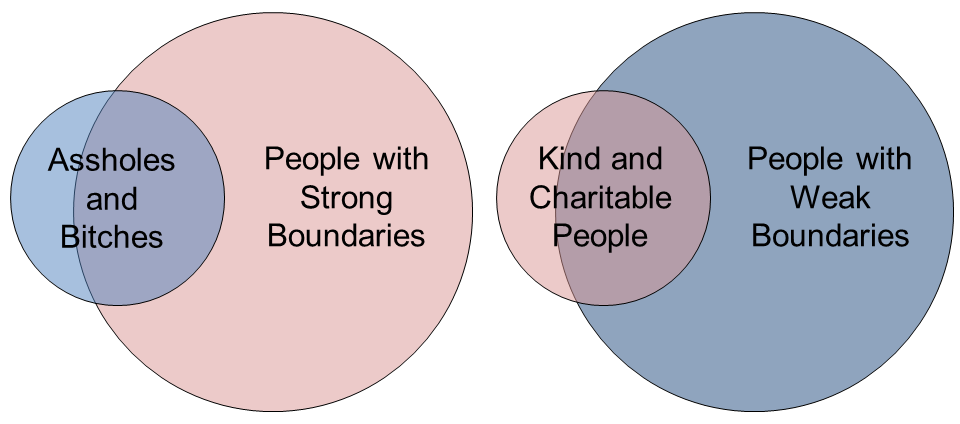
Often people with weak boundaries are thought of as kind or charitable, and a lot of people with strong boundaries are perceived as assholes and bitches, but these labels are inaccurate. It is perfectly possible to have strong personal boundaries without being an asshole (best illustrated in example 1, where the woman is firm, but polite), just as it is perfectly possible to have weak personal boundaries without being kind or charitable (best illustrated in example 3, where the girl gives to charity, but not for altruistic motives). Assholes and bitches are just a subset of the group of people with strong boundaries, just as kind and charitable people are just a subset of the group of people with weak boundaries.

This can be illustrated quite simply with a Venn diagram. There is some overlap between the groups, but there are plenty of people with strong boundaries outside the set of assholes, just as there are plenty of people with weak boundaries outside the set of kind people. Neither group completely encompasses the other.

Perhaps the primary way in which we judge another person's value (and I mean primary both in the sense of "main" and in the sense of chronologically first) is by evaluating what they appear to think about themselves. We do this by observing their confidence, their posture, their grooming, the way they dress, and most importantly, the way they interact with others. We form an opinion of their self-esteem and bearing.

We do this because - unless we know them extremely well - we are privy only to a limited amount of information about their capabilities, talents, and weaknesses (i.e. the things that actually define their value); so we are forced to make a second-hand judgment, an inference. But in general, this judgment is reasonably accurate, because people usually know their own strengths and weaknesses almost perfectly. This self-knowledge usually informs their level of confidence, such that the way that they carry themselves usually reflects their strengths and weaknesses reasonably well.*

Now, healthy boundaries are a sign of confidence, of someone who respects themselves, of someone who knows their own self-worth. Weak boundaries, on the other hand, are a sign of insecurity and low self-esteem. The woman who asks the man on the train for a seat knows that she is just as good as he is, and just as deserving of the seat, so she has no inhibitions about asking (or even telling) him to move his bag. The woman who lets her date get away with not showing up thinks he is the best she can do (i.e. thinks she is below his league). She is afraid to cut him off because she doesn't want to lose him. The girl who can't say no to a donation request, and then gives more than she wanted, has such a poor self-image that she puts even a random charity worker's opinion above her own money and principles. And the girl who tells her crush not to come to the party out-of-costume does so easily because her sense of self-worth is not contingent on one man's willingness to attend a party – or even on how much he likes her.

I am saying all of this is to make a very simple but crucial point: when a man encounters a woman who has strong boundaries, he knows that she values and respects herself, and he therefore makes the reasonable inference that she is a woman of good character. Assuming she meets his minimum criteria for physical attractiveness, his attraction for her – and I am talking about the long-term kind, the kind that makes men fall in love – will skyrocket.

The opposite is also true. When a man meets a woman who lets him (or others) walk all over her boundaries, or even define them, he concludes that she doesn't respect herself, and therefore, that she must not be someone worthy of respect. Even if she is beautiful, his attraction for her will soon plummet.

In my experience, women tend to have weaker rather than stronger boundaries. My guess is that this is true because, from a young age, their boundaries are often handled by the males in their lives – a protective father or brother, suitors who believe they need to be “gentlemen,” male colleagues who suppress their sexual attraction in the office, etc. Surrounded by this behavior, women have relatively less practice than men (on average) maintaining their personal boundaries, defending their personal space, rights and emotions. As a result, they aren't as comfortable confronting someone on the train about moving his bag, or telling those who mistreat them to go fuck themselves.

It has also been my experience that the more attractive a girl is, the more likely she will be to have weak boundaries. This is a little counter-intuitive, and definitely a generalization, but I think I understand why it is the case. From a young age, beautiful women are surrounded by men who are constantly demurring, constantly meeting their needs, and giving them whatever space or compliments they need. Some women like this still manage to develop strong boundaries, and they are the ones that men would kill to be with. But most do not, because they've never had to "fight" for anything. When a woman like this comes across a man who is confident and attractive, she invariably gets banged, walked all over, then dumped. And it is largely because she doesn't show the men in her life that she is someone of value. If she were to maintain strong personal boundaries, men would see that she respected herself, and would want to trace that confidence to its root by getting to know her.

Do not underestimate the importance of this post. For what I suspect is the majority of my readers, it is probably the most important one I've written. I get e-mails all the time from beautiful women (they attach pictures), telling me that they are doing "everything right," but that they still can't land a man. Other women e-mail me asking how they can really "hook" a guy, how they can make him look past the sex, how they can get him to fall in love. They can attract the men they want, they just can't seem to keep to them. This post is fundamental to answering both questions.

For the girls doing “everything right”…
If you read through the posts on this blog, you will notice that many of them – some of which are linked in the Related Posts section, below – advocate the maintenance of strong boundaries in specific situations; but boundaries are not something that you can apply to your life only in a piece-wise fashion. This is transparent. Even if a girl doesn't fuck on the first date, a guy will know that she has poor boundaries when she accepts a date after he’s admitted that he isn't looking for anything serious. Likewise, a girl who doesn't initiate contact still betrays her weak boundaries if she replies immediately to every text a guy writes her. Doing only the things I've posted about on this blog will only get you a fraction of the way to the correct disposition. This post is meant to explain the underlying principle, so that you really can apply it in everything.

For the girls who can attract but can’t keep a man…
Boundaries are fundamental to getting past the initial attraction phase with a man. Looks only get you in the door. As I have said before, while appearances are essential in getting a guy to approach or getting him to ask you out, they are nowhere near enough to get a guy to commit for the long term. Strong boundaries are a primary and therefore critical indicator of a woman's deep, inner worth – the kind of woman that men are not only willing to commit to, but actually want to commit to. There are plenty of women out there who are attractive, but there are very few who have the substance to go with it. Sound, healthy boundaries set a woman apart from the crowd instantly.

So, yes, "men love bitches," in the sense that they love women with strong personal boundaries; but they do not love bitches because they are mean, manipulative, under-handed or have harsh personalities. Men love bitches because their personal boundaries are rooted in a self-respect that tells him more than anything else about their character and inner-value; and it is only with this kind of woman that men want to settle down.

___________________
* While of course there are plenty of exceptions, they are normally short-lived. In the long run, people who are over- or under-confident almost always run into circumstances that serve to correct their distorted self-image. Some good examples are the delusional American Idol contestants who are finally told by the judges (on public television) how much they suck. Similarly, a person who has no self-esteem will eventually find a talent or social niche, and realize that they really aren’t as dumb or awkward as they thought.


Related Posts
1. The Importance of Silence After a Breakup
2. Don't Try to Be One of The Guys
3. Never Tell a Guy When You'll Have Sex With Him
4. No, You Can't Be "Just Friends"
5. Men That Like You Will Explain Themselves
6. Men and "Friends with Benefits"
7. The Downside to Cohabitation Before Marriage

Tuesday, July 9, 2013

Do You Really Want Dating to Be Easier?

Dating isn't easy. In fact, for anyone with romantic ambitions, it is extremely difficult. There was a time where dating options were far more limited by religion, geography, social class, and family pressure. But these days, dating options are virtually limitless, and ideals about romance are pegged to ridiculous standards, both of which make it hard for people to settle down. When you consider this in light of the fact that people have such varied tastes, it isn't hard to see why it is so difficult to fall mutually in love.

The greatest victories in sports are the ones that follow a difficult comeback. We appreciate them because they are born out of unlikely circumstances, and are the result of a tremendous effort. I remember watching basketball games when I was a kid, and actually liking it when my favorite team was down by a large margin. The way I saw it, the deficit was just potential for a big comeback - maybe an unprecedented comeback, a game people would talk about for decades. While I knew that I might be witnessing a blowout, I also knew that I might be watching sports history in the making. I also knew that I wouldn't be anywhere near as excited if my team won by a large margin - it would just be too easy that way.

When you get frustrated at your lack of success with the opposite sex, stop for a moment and recognize that the same principle applies in your dating life.  If finding a boyfriend or husband were easy, you wouldn't care much for your relationships. Every man would be replaceable, just as you would be to every man. The more you improve yourself in order to find love, or the more years you spend maturing before you can recognize it, the more unique your story will be, and the more you will value the man who marks its end.


Related Posts
1. Why Rejection Is a Good Thing
2. Self-Improvement Takes Time
3. Why Do You Want Him Back?
4. Know Why You Are Dating

Tuesday, June 18, 2013

Why Getting Him Back Won't Help

I need to give some advice that doesn't fall strictly into the category of "here is what you don't realize about men" (or what men like) - not because I want to change the theme of the blog, but because the misunderstanding it corrects is rampant in young relationships, and hopefully pointing it out will free some mental space in the minds of young women so they can instead focus more on their misconceptions about what men want, or other more-important things.

I have answered dozens if not hundreds of e-mails asking for advice about how to correct a relationship after a break-up or a break-up attempt. They usually sound something like this:
My boyfriend and I have been together for over three and a half years. About two weeks ago, he told me he was questioning the relationship and thinks he wants to break up. He told me that he dislikes X, Y and Z about the relationship and thinks they are signs that we'd both be better off with someone else.
We talked about it, and eventually he changed his mind, because we were both more open and honest with each other. We ended agreeing to give it another shot, and to do X, Y and Z differently. So we're still together.
I am glad we worked things out, but now I feel like he has all the power. It's like I got "almost-dumped." I'm not completely happy with the situation but I am also unsure about how to proceed. What should I do??
In other situations, one person breaks up with the other, and then (by either party's initiative) the couple gets back together, thinking that "this time it will be better." In either case, the important characteristic is that the relationship reaches or nears its end, only to make what seems to be a thankful recovery.

The main problem in these situations normally isn't that one person can't follow through with the promise to change X, Y or Z (though this too is very frequently true, and a close secondary problem). The main problem, and what most people fail to recognize, is that when a relationship nears or reaches a failure point, its limits are defined.

Prior to such an episode, each party could believe - and usually at least hoped - that the relationship was strong enough to sustain limitless difficulties. Neither party knew how much it would take to break the other's feelings or commitment. But a break-up (or near-break-up) changes that irreversibly. Suddenly one partner knows that the other's commitment has real limits. What was once "a love that knew no bounds" and apparently bottomless, is shown to be of finite dept - maybe even shallow. So the disappointment comes, not because the relationship is broken, but because it is shown to be breakable.


There is an additional aspect of this phenomenon that makes it all the more condemning. While each partner previously compared their other dating options to something of unknown and conceivably infinite strength (i.e. their existing relationship), a doubt-forming episode will mean that they now compare their options to something they know to be finite, and perhaps even weak. Both the man and woman will convince themselves far more easily that things could be perfect with someone else, because their optimism about dating, stripped of its previous object, needs a new outlet. So in addition to seeming weaker in-and-of itself, the existing relationship will now be compared to inflated alternatives.


I have a very good guy friend who has been married for six years. His wife recently asked him for a divorce. He confided in me recently that this is actually the second time it's happened; two years into the marriage she did the same thing. At the time, he refused the divorce. He wanted to try to make it work, so they talked it through and she agreed. He essentially convinced her to "work on the relationship" and try to make the best of it.

Four years later, she's done the same thing, and this time, he isn't fighting it - because now he recognizes what I am saying here. Those four years, he admitted to me recently, were always spent in doubt of her feelings and fidelity, caused by the simple fact that she voiced her discontent. The relationship was ostensibly maintained, but the reality was that it had already been undermined by her attempt to end it; and my friend proceeded to waste four years trying to salvage what he essentially knew was dead after two.

Granted, there are some instances in which a break-up or fight doesn't reveal a relationship's depth, just as there are situations in which you might be willing to live with the limitations that such an episode often does reveal. The point here isn't to imply that all break-ups or fights are premonitions of ultimate failure, but to point out that if you find yourself disappointed in spite of having "saved" your relationship from a bad episode, it is almost certainly because that episode showed you that your relationship is more fragile than you'd hoped. So before you spend all kinds of emotional energy trying to get your boyfriend back or resisting a break-up, ask yourself whether just having him (or just having him back) is actually enough to satisfy you.

-------------------------------------
If you liked this post, you'll definitely like my book, Beyond the Breakup. In fact, this post has been included as one of the chapters, along with others that explain how to react when your ex tries to contact you, how to understand his motives for doing so, and much more.


Related Posts
1. Why Do You Want Him Back?
2. Why Rejection Is a Good Thing
3. Get Used to Rejection

Thursday, April 4, 2013

Men and "Friends With Benefits"

While explaining her relationship with a guy she is interested in, a reader who recently wrote to me for advice reminded me of the difference between the typical male and female approach to being "friends with benefits":
I guess we're friends with benefits because there's no commitment on both parts. I also made a conscious choice that it was only purely physical with what happened between us (only twice by the way). But I liked his company and the flowing conversations we had. I didn't put any pressure on him either. I had no illusions, in other words. I was, however, hoping that we could learn more about each other slowly and establish a good foundation before going to the next level. But again, I had no illusions.
The simple fact is that men almost never fall in love this way, despite what you saw in the fictional movie (emphasis on fictional), No Strings Attached. The woman quoted above might not have had any illusions about the fact that the relationship was purely sexual, but I suspect she did have some illusions about just how unlikely it was that her love interest would change his perspective on the relationship. If she hadn't, she wouldn't have wasted her time.

It has been my experience - both personal and vicarious - that the vast majority of women view a casual sexual relationship as a potential stepping stone towards a relationship. Men, on the other hand, see it as nothing more than what it sounds like: sex with no emotional ties, no commitment, nothing. If anything, men treat it as a step away from a committed relationship, because if they wanted more from a woman, they wouldn't settle for mere sex; they'd want her exclusivity also. (If this sounds familiar, it is probably because it is almost identical to the difference between the male and female perspectives on moving in together before marriage.)

Any man who is mildly observant of the opposite sex will have a hunch in the back of his mind that this kind of relationship is bound to explode eventually. But he isn't going to turn down all of the commitment-free sex he'll get in the meantime just because of some "feeling." Men don't trust feelings the way women do. Men are hyper-rational, literal creatures. If it is called "no-strings-attached" relationship, that's exactly how he treats it, no matter how much cuddling and hanging out is involved.

Furthermore, a man will often be willing to engage in a relationship like this with a woman who is below his league, in the same way that many people will have lower standards for the quality of the house they lease, as opposed to the one they eventually buy.

Yes, of course, I know, there are occasional exceptions. There are always exceptions. Once in a while, a long-term relationship or even a marriage can grow out of something that started as friends-with-benefits. But the point is that, when it comes to casual sexual relationships, the exceptions are so rare that you'll be far better off avoiding them completely than taking a gamble on even the most apparently promising ones.

So before you jump at the opportunity to "get closer" to the man you want by making things sexual, recognize that his willingness to engage in a casual sexual relationship with you is actually a step away from commitment, not a step towards it.

Wednesday, March 20, 2013

What Men Think About Your Virginity

Imagine you are dating a guy who doesn't know that you are a virgin. Everything is going well until, one night, he starts to push things past the limits of your sexual comfort zone. After a quick battle in your conscience, you stop him and reluctantly tell him "I can't..." followed by an apologetic, blush-filled explanation about how you were raised, how hard it is to constantly disappoint men, and how difficult it is to live with the fear of being "found out" by your friends. He is a little bit surprised at the news initially, but he says that it isn't a big deal. He even seems sincere when he tells you how much he admires your decision and sometimes wishes that he'd stayed a virgin too. However, in the next few days, his contact and initiative plummet. Before long he stops talking to you altogether. You are confused. You understand that men want sex, but this guy seemed different...

Sound familiar?

Of course, there are many variations on this story. Maybe you wanted to sleep with him, but something made him suspicious, and he asked if you were a virgin before anything happened. Or maybe you made it clear that you really didn't want to stay a virgin, but that you just needed a little longer together before having sex. Or maybe you actually asked him to sleep with you, right then and there, because you were fed up with being a virgin and figured you might as well lose it with him as with the next guy. However it happened for you, the result was probably the same: he disappeared.

You've probably assumed that men act this way for one or more of the following reasons:
  1. They think it will be too much work to sleep with you,
  2. They are "weirded out" by the fact that you've never had sex,
  3. They don't want to "suffer" through your inexperience.
For some men, a combination of these things will play a role in their decision, but usually it will be a minor one. If you are hot enough, men won't give up very easily at all - particularly players, who know that women often say no at first, only to give in soon afterwards. No man is "weirded out" by the idea of virginity to the point that it would actually prevent him from enjoying sex. And although sex might not be as great with a virgin as with a more experienced girl, few if any men have so many women at their fingertips that they can afford to discriminate based solely on anticipated performance. There is something deeper at work.

The primary reason that most men disappear after learning you are a virgin is simple but often overlooked: men don't want the responsibility of taking your virginity. Rightly or wrongly, men assume that in proportion to how long you've remained a virgin, your experience losing it will be "a big deal," and something that you want to do within the context of a serious relationship - even if you tell them otherwise. Men aren't afraid of or "weirded out" by your virginity; they are wary of the expectations that will accompany taking it from you.

It should go without saying that the men who are going to be most turned off by expectations or responsibility are the ones who know, in the back of their minds (or the forefront), that there isn't potential for a relationship. If a man really likes you, your virginity will not be impediment to dating. He will not balk at the idea of waiting until you are in a committed relationship (or possibly longer) for sex. In this sense, your virginity can actually serve as a good filtering mechanism for avoiding men who aren't interested in anything serious.

There are limits to this phenomenon, however. Once inside a committed relationship, even a man with the best intentions is likely to be put off if his girlfriend insists on waiting until marriage for sex. The convenient reality in these cases, however, is that the few women who insist on waiting until marriage are probably most compatible with the few men who are also willing to wait until marriage. So if you really believe that prolonged virginity or abstinence until marriage is important, consider this belief a filtering mechanism - no man without similar beliefs will be willing to wait that long.

It is also worth pointing out that men will be somewhat less scrupulous about taking a younger girl's virginity. Because younger girls haven't been virgins for as long, men (even young men) will assume that the girls care less about giving it away. Although there isn't a strict age cutoff for this assumption, it falls somewhere between 20 and 22. Before 20, almost no guy will be surprised at a girl's virginity. After 22, almost all men will assume that a girl's virginity is intentional. Keep in mind that the average age at which American girls reportedly lose their virginity is 17.

Also keep in mind that being surprised that a girl is still a virgin is not the same as thinking that she is "weird" because of it. I considered writing a paragraph explaining the age at which men will think a woman is "weird" for still being a virgin (since I know that some women worry about this), but in the process of trying to pinpoint that age, I realize two things: (a) there really isn't one, and (b) you shouldn't care anyway.

To conclude: men who disappear after learning you are a virgin wouldn't have stuck around in the long run anyway, and they certainly don't disappear because they are lazy or feel awkward about your inexperience. They are simply unwilling to deal with the moral hangover or relationship pressure of taking you through such an "important" event in your life, then walking away afterwards. And they will avoid doing so even if it means foregoing easy or guaranteed-STD-free sex. So if a guy disappears on you after you tell him about your virginity, don't feel the need go and to lose it at the next opportunity; just be glad you dodged a bullet.


Related Posts
1. What Men Think About Your Sexual History
2. How to Date as a Virgin
3. How to Look Good During Sex
4. Never Tell a Guy When You'll Have Sex With Him

Wednesday, January 30, 2013

When Your Ex Contacts You...

Hello there Andrew,

I reached out to you about three months ago regarding a man that had recently left me after three years. Well you will be happy to know that I have been dating and self-improving like its my job ;). Your keen advice had a major impact on the manner in which I handled the rejection.

So, my ex-boyfriend sent me a text message last week. It was one of those "Hey, thinking about you, just want to say Hi, how are you?" kind of text messages. Not wanting to sound bitter or unhappy, I gave him a three-word reply. He asked another question and I again gave him a very short reply. He stopped texting after that brief interaction.

Part of me is wondering if that was his attempt to hang out with me again and if he was testing the waters with a text message?

I gave him very uninterested answers which he caught onto quickly. Odds are he will not be trying to contact me anymore but I would really like to see him so that I can show-off a little bit. If my motives are not wanting to get back together but reminding him what he gave up, am I exempt from the "cutting him off rule"? Can I contact him in a few weeks to meet up somewhere casual?

Thank you for reading this!! ;)

Brooke
______________________________________________

Brooke,

Wow. This is the perfect example of how you are supposed to handle a man who contacts you after he breaks up with you. So many women would have gotten back in touch with him before he popped up again, or responded to his text with much more than three words. But you played it perfectly - I am impressed.

By the way, wasn't it so much sweeter getting that text after three months of silence than it would have been if you'd been in contact all along? There is absolutely no ambiguity about the fact that he contacted you for the sole reason that he was thinking about you, wondering how you were, and maybe even questioning whether or not he made the right decision in ending the relationship. The clarity of that fact is beautiful.

Now, in terms of showing him what he's missing, I'd be careful about asking him to hang out with you. True, you might sit there and tell him that everything is going fine (i.e. without him) - and it might even be true, as it is in your case. But he could easily misinterpret the fact that you wanted to spend time with him after only three months. After six months or a year, your desire to meet him would be more obviously a case of platonic curiosity about what he's been up to since you last talked. But after only three months, the fact that you made time to see him might outweigh the indifference you demonstrate in a face-to-face setting. So I suggest sidelining that idea for a few months (though I'm willing to bet that by then you won't care what he thinks; you'll probably just be genuinely curious to see what he's been doing).

The more important point, however, is that your silence already speaks volumes - especially because you never once broke it. Your replies, and in particular their brief and unmoved, matter-of-fact tone also communicated to him how much you've moved on. If you hadn't replied at all, he would have assumed that you were so upset or heartbroken that you couldn't bring yourself to talk to him (which would have been a fine way to handle the situation if this had been the case). And if you'd replied with more enthusiasm or tried to engage him in conversation, he would have assumed that you were still in love with him and trying to get him back. In either case, his ego would have swelled, even in spite of any feelings of sympathy or guilt he had. But your brief replies were at once so casual and indifferent that you can be sure his ego was kept in check, probably even deflated. Moreover, he was acutely reminded of his decision to walk away from a confident woman who respects herself and now has a promising future.

As I said, I am impressed. I hope things continue to go well for you.

Good luck,
Andrew
______________________________________________

Update: I had another e-mail from Brooke shortly after the one above, telling me that her ex contacted her again the next day, this time on Facebook, and said "ugh, just read through our log of messages, it takes me back. miss you [pet name]. hope you are well, I miss you a lot! im sure you dont want to hear that but its true..." She did not indicate whether or not she would reply, but it was clear that she viewed this - rightly - as a personal victory (not a victory over him) rather than an opportunity to get back together with him.

Men make mistakes. It is up to you to help them realize it by showing what life is like without you.

-------------------------------------
If you liked this post, you'll definitely like my book, Beyond the Breakup. In fact, this post has been improved and significantly expanded as one of the chapters, and I explain some important attitudes to foster when you engage him. Most importantly, I give examples of what you can say to him, tailored for various situations.


Related Posts
1. Why Rejection Is a Good Thing
2. No, You Can't Be "Just Friends"
3. Cut Him Off

Friday, January 25, 2013

The Dynamics of Dating Shy Men

A post I made about why women shouldn't take the initiative in relationships evoked some questions about how to deal with shy men - after all, shy men don't chase women, and are unlikely to initiate anything. If a girl doesn't approach or initiate contact with a shy man, nothing will happen. This is true, but handling this situation isn't as simple as you might think...

The first thing to do when you find yourself attracted to a shy man is to question your feelings for him. In other words, ask yourself "Am I attracted in spite of or because of his shyness?"

  • If you like him because of his shyness, ask yourself further: why do you find shyness attractive in a man? Is that feeling authentic? Do you like his shyness only because you feel like you can't get a confident man? Do you not mind being more socially powerful than him? Women who are attracted to shy men are sometimes manifesting their need to feel dominance over a man (e.g. because they had an absent or abusive father). Other times they run to shy men after being rejected by a confident one (an "Asshole").
  • If you like him in spite of his shyness, ask yourself further: could you respect a shy man? Would you admire him? In 10 years, will you still find it attractive? This is important because you need to know if his shyness will ultimately be an impediment to a serious relationship. If you know - deep down - that you could never be with a man who doesn't have the balls to pursue you, then you shouldn't waste your time with him (or waste his time with you).

If you answer these questions sincerely and still want to date him, you then face the problem of making it happen - or rather, making him make it happen.

I used to be shy. My little brother is shy (with girls). A very close friend of mine is extremely shy, and I know plenty of other guys that are shy. For me it is a familiar mindset. Shy guys, almost by definition, do not have the balls to initiate and pursue women. They fall outside of the predator-prey model for sexual interactions that is assumed in the "don't initiate contact" rule. So it is acceptable for you to initiate with a shy guy. But there are a couple caveats...

The problem with male shyness is that it wears off in specific situations. A shy man may never become courageous enough to approach women in general, but he can eventually grow comfortable with a girlfriend or wife. As the fear of the unknown dissipates with increased familiarity, a shy man's confidence in his interactions with you will rise. His masculine instincts will kick in, and in some cases you can end up with a man that acts towards you the same way that a confident man would have acted from the outset.

So, if you do choose to initiate, do so only during the early stages of dating, that is, until he builds his confidence and comfort around you. Once this happens, you will need to gradually assume a less assertive (more traditionally female) role, because he will then be more liable to get bored with you, wonder if he could do better, consider his other options (the perception of which his newly-found confidence will likely inflate), fool around, etc.

The second caveat is that even a shy man has pride. Though he knows his own limitations (as prescribed by his shyness), he also knows what a typical man is "supposed to do." So he recognizes, too, when you are doing it for him. This will offend him if you flaunt it, or if it is evident due simply to the social magnitude of the task you've assumed (for example, if you take his hand and lead him through a crowd). That offense will reflect negatively on you and the relationship. So be careful about how much (and which) initiative you take. Unfortunately there is no quantifiable or simple rule here, as his threshold for embarrassment will vary in proportion to his shyness and his pride, which are different in every man.

So how do you initiate? Well, for starters, in the early stages, you will need to give him blatant signs of your interest. Aside from their innate male tendency to overlook anything that isn't spelled out in black and white, shy men will by default doubt any sign of your affection. The reason for this is that shy men are more concerned with avoiding the social catastrophe of asking you out and failing than they are of getting you. This is what prevents them from taking the initiative in the first place. If they have even the slightest doubt about your intentions they will hold back. So whatever you would normally do to indicate your interest to a confident man, double or triple it for a shy man (in proportion to his shyness):

  • If you would touch him lightly on the arm for 1.5 seconds, hold the contact for 4 or 5 seconds. 
  • If you would hold eye contact with a confident man for 2 seconds to show him that you are interested, hold a shy man's gaze for 3 or 4 seconds, or do it repeated times. 
  • If you would normally drop a single verbal hint that you'd like to hang out sometime, do it three times before expecting anything from a shy man.
  • If you would normally expect a kiss on the second date from a confident man, wait until at least fifth or sixth to be kissed by a shy man - and in fact, you should probably just make this move yourself.

While I don't suggest that you overtly ask out a shy guy on an "official" date (this would too flagrantly undermine what he knows to be his role as described above), I do suggest that you suggest and then ask him to hang out under casual pretenses. Of course, he will question this over and over in his mind, wondering whether you were asking him to hang out just to be friends, or if you wanted something more. So show him that you want something more - ask repeatedly.

In general, you will need to carry the relationship up until the point that it is "official." When it has been established (or is otherwise clear) that the two of you are together, then you should start reducing your initiative and letting him take the reins. As I said, he will probably start to do this on his own anyway, so rather than forcing it, just be cognizant of the transition. Comments like "Oh, I thought you were going drive/get the tickets/plan the trip/[insert other traditionally masculine roles here]" can help in priming his confidence if it seems to be lagging and it bothers you.

Dating a shy man takes a lot of initial investment for an uncertain outcome. You will probably get frustrated at his lack of response to your initiatives. The biggest problem is that it won't be clear to you whether or not his unresponsiveness is a product of his shyness or his lack of interest in you - because it could be either one. Shy men have taste and standards too. His persistent willingness to hang out with you might be stem from a real interest, but it also might be a manifestation of his unfulfilled desire for female attention; he could just enjoy dabbling in the idea of a relationship but at the same time not like you enough to want anything serious with you. Unfortunately there is no easy way to discern his true intentions without putting yourself on the line over and over again, and seeing how he responds. This can be humiliating, frustrating, even infuriating, and it can ultimately still end in failure. (If nothing else, this will give you good insight into what it is like to be a man.)

While all of this sounds like it might be too difficult to deal with - and many women will come to that conclusion - it is worth pointing out that if you can navigate through the difficult aspects of attracting and dating a shy man, he is likely to be completely faithful to you. Due to the lack of female attention he has attracted or received, he is like an emotional spring that you will release. If you are looking for an abundance of devotion, he has it to give.

So, in conclusion, if you are interested in a shy man, start by questioning that feeling. If his shyness is not a deal-breaker for you, you can initiate, but you need to be careful about striking a balance between sending strong enough signals and not offending his masculine pride. It is a difficult tightrope to walk, but the consolation is that these men rarely receive attention from women, and have a lot of love and devotion to give you.


Related Posts
1. The More Confident He Is, The Less He Likes You
2. Don't Initiate Contact
3. Learn How to Be Social