Showing posts with label dating. Show all posts

Tuesday, May 19, 2015

You Shouldn't Want a Boyfriend

The other day, a girl I've been seeing casually for a long time told me that she "really needs to find a boyfriend." I've known several single girls who have communicated this to me in one way or another, and they haven't only been hinting at the fact that they wanted me to be that boyfriend; they've also been expressing an honest desire. Some have suggested it through their behavior or by talking around it; but a few, like this girl, have said it explicitly.

The problem with wanting a boyfriend is that it isn't wanting a husband. Yes, of course, for some girls, saying "I need a boyfriend" is just an abbreviated way of saying that they want to meet a guy who they can date and who will eventually propose; but I wouldn't be writing this post if that applied in every case. Some girls only mean that they are tired of being lonely - that they just want companionship and to feel loved again. They might have some minimal requirements for the boyfriend, but the point is that those requirements fall significantly short of the ones they have for their future spouse.

If your end-game is getting a boyfriend, you aren't going to be filtering the men you date for their long-term compatibility. You'll get into relationships that you could have known from the outset would be terminal (if you'd stopped for a moment to think about it), and you'll end up wasting your time. So be honest with yourself about what you want in a man - maybe even write it down - and don't give in to the temptation of temporary companionship and affection.


Related Posts
1. Know Why You Are Dating
2. Don't Let a Guy Waste Your Most Eligible Years
3. Why Men Are Capable of Commitment
4. How "Hard to Get" Should You Play?
5. Men and "Friends with Benefits"

Friday, September 26, 2014

Nice Guys Don't Exist

Everyone adapts their behavior to the people around them, and in response to the situation at hand. We are nice to people we like and mean or bitchy to people we don’t. We are friendly and cheerful when things go well and short-tempered or depressed when they don’t. Yeah, sure, there are some people who are generally more disposed to (for example) mean or more egocentric behavior than others, just as there are some people who are more disposed to (for example) kind or generous behavior than others; but even they are more mean or kind to some people, and less egocentric or generous to others. And of course there are some people whose behavior is less affected by circumstance than others, but not to the point that it isn't affected at all – and not even to the point that it isn't affected significantly. We like to think of personality as static and constant, intrinsic to each person. But the reality is that personality is merely a name we give to a set of behaviors coming from an individual; and those behaviors are very much mood-driven, situational and dynamic.

This misconception plays into our perception of the opposite sex significantly. Consider how frequently you change your behavior towards the men in your life…

If I approach a girl in a bar awkwardly, and then speak to her in a low voice because I am nervous, she isn't going to be attracted, and isn't going to respond well. The fact that she is short with me, or excuses herself immediately to go to the bathroom doesn't mean that she is a "bitch;" it just means that I didn't attract her enough. The next guy who approaches her might approach her confidently and genuinely, and have her wrapped around his finger the rest of the night.

If I have a dead-end job and lack ambition, my girlfriend isn't going to respond to me in the same way as the guy she dates next (i.e. after she dumps me), who is intentional in his career and gainfully employed in a position he truly enjoys. I might tell my friends that she was “cold” or “distant” but they'll know as well as I will that her next boyfriend probably has none of the same problems. Or maybe she is the one complaining that he is cold and distant.

The same kind of girls that ignored me when I was young and lacked confidence now treat me entirely differently, because I am older and far more sure of myself. At twenty years old, it was tempting to view those girls as stuck-up or bitchy; but the reality is that they were probably acting like angels towards some 30-year-old who was much more attractive due to his age, maturity and position in life.

I am not saying all of this to make a point about women, but to make a point about men – because men work exactly the same way. It is easy to believe that a certain guy is an asshole because he dumps you without an explanation, or that another is an authentically nice guy because he treats you well. But I am telling you: those men behave in entirely different ways with different girls.

The guy who you think is a player because he hits on three other girls before taking you home, then never calls you the next day – I guarantee that he is genuine and respectful and serious with other girls he dates. I know this because I've been that guy plenty of times. Some women I treat well and with respect, and others I don’t. If I see a girl I'm attracted to and whom I respect, I change my game completely. My male friends do the same.

The guy who is a dismissive asshole to you is a babbling, nervous idiot with the girl he is crazy about, and the guy who is such a gentleman to you absolutely crushes the hopes of girls that he doesn't find attractive, or doesn't respect. Likewise, the guy who never calls you back isn't “flaky,” he just doesn't care that much about you. I am sure there is a girl out there who has complained that he was needy and contacted her too much. And I am equally sure that the guy you were dating who seems to have “commitment anxiety” has at some point in his life practically begged to be in a relationship with a girl.

The thing is, nice guys don’t exist. “Douchebags” don’t exist. The behaviors we describe with these terms are not innate and static characteristics of any given person; they are behaviors that change depending on the other person involved and the circumstances surrounding the interaction. Of course there are men out there who are more disposed to certain types of behavior than others; but the degree of attraction a man feels for you will affect his behavior towards you far more than anything intrinsic to his personality, and the degree of attraction he feels for you is significantly affected by the kind of behavior you'll accept from him.

So instead of complaining about the dearth of nice guys or the abundance of douchebags, start thinking about what you can do to make then men in your life treat you the way you want. Because that is what is going to make the difference – not finding some "perfect guy" with some supposed personality type. You don't find perfect men, you elicit perfection from men.


Related Posts

Friday, August 22, 2014

How to Set Up Your Friends

Most women I've met like the idea of setting up the single men in their lives with the single girls in their lives. In other words, they like match-making. Mothers seem to love this more than most, presumably because it puts them back in touch with the romantic spark that is often dead in their own relationships. Perpetually single girls love this too, probably because having influence over someone else’s love life is the next best thing to having control over your own. But normal girls like it too, and this is understandable because it is only human to want to have an influence on other people's lives (it is human to want to have influence in general). In the same way that it is empowering to know that you were the one who got your friend the job that was the springboard for her career, it is empowering to know that you introduced her to the guy that finally gave her confidence in her dating life, or even the guy that she eventually married.

Now, let me preface what I am about to say by pointing out that setups are usually a bad idea. In the vast majority of cases, the very fact that your friend needs help finding love is a good indication that your attempt to help is going to fail. This is because the problem is never one of "just not having met the right person yet." It always runs deeper. Maybe she is insecure, or too introverted, or overweight. Maybe she is trying to be masculine, or makes herself unapproachable. Whatever the case, her inability to take charge of her own romantic life isn't merely a matter of bad luck; it is a symptom of a deeper problem, which your attempt to introduce her to someone new isn't doing anything to solve. It's like giving another book to a child with a learning disability, and thinking "this time he'll get it." Exactly. It isn't going to happen.

So with that background, let's take a look at what most people do when they try to set up their friends (because this blog is for women I am going to use the example of a girl, but guys make the same mistake). Once a girl sees a potential match in her social circle, she goes to the girl and guy separately, and tells each of them that she knows "someone that they have to meet." She might tell each person a few things about the other, maybe show them some photos, and she gets them to agree to the setup. Then she arranges some kind of event at which the two people have the opportunity to meet each other. She's "really good at this" because she never lets either person know that the other one knows it's a set up. That way it won't feel forced or awkward. Perfect, right? Wrong.

The problem isn't that the person thinks that the other knows about the setup. The problem is that the person themselves knows they are being set up. And they knew this the very moment the girl told them there was "someone that they had to meet." This does two things: first, it generates expectations and makes both parties feel like they have to perform, which of course results in an encounter more awkward than a new graduate's first job interview. More importantly, however, and what I want to point out here, is that it destroys the single most important thing for someone who struggles with their dating life: autonomy.

Let's look at this from a the guy's perspective...

One of the hallmarks of masculinity is self-control: men want to be in control of their lives, and by extension, they want to be in control of their dating lives. A man will never feel good about himself if he can't initiate and perpetuate his own relationships. (Remember that his inability to do so is the reason his friends want to set him up in the first place.) By setting a guy up, you are essentially stepping in and putting training wheels on his bike - reminding him that he cannot handle himself. Yes, it might be true that he rides poorly (or not at all) without those training wheels; but by taking control of his dating life you are making him feel like a child, and he won't respect himself for any girl he "gets" with your help. He also won't respect any girl that he needs help to meet, because men know instinctively that women are attracted to men who don't need help: men who are in control and confident with their own capabilities. In other words, he knows he can get a better girl if he gets his shit together and deals with his lack of options himself.

You might argue that without some initial help, a guy (or girl) will never date anyone at all. To use the bike analogy, you might argue that, yes, a guy might not respect himself for using training wheels, but without training wheels he will never learn how to ride. But this argument assumes that his problem is balance. In real terms, your insistence on setting him up assumes that his problem is meeting girls. But as I pointed out at the beginning, this is never the case. His problem isn't one of balance, it is the fear of crashing. His problem isn't one of meeting girls, it is the fear of rejection; and setups do nothing to help him overcome that fear.

There is a feminine perspective on this too. When it comes to match-making, the feminine problem is that a girl will not respect a man who needed the help of a friend (i.e. you) to meet and attract her. This isn't only a matter of judging the man's courage, or the social abilities needed to make a connection with her. Women know that if a man is motivated enough, he will dig down and find that courage, and make something happen - or at least he will try. You want a man who desires you enough to push through a crowd to meet you, or takes some kind of initiative. At very least, you want a guy who does more than accept dates that are handed to him because his friends think he has no other options. A girl who finds herself in a relationship that started that way won't respect him, won't respect the relationship, and won't respect herself. So deep down, girls doesn't like being set up any more than guys do. They might like being single even less, but they'll be even less enthusiastic still about being dumped once their boyfriends wake up, and realize that they are only with those girls because they never had the balls to go for what they really wanted.

I am sure many readers know people who have had successful relationships after being set up, some of which might have even lead to marriage. My parents were set up, and they've been married more than 30 years. Maybe you were set up and are still with your boyfriend. And that's fine. But it doesn't mean that those cases are ideal or likely, or that they do anything to strengthen the inner core of the relationship.

So what do you do? How do you help facilitate a match that you think has potential? Well, you let both the guy and the girl ride without training wheels. You encourage them to take control of their own dating lives, and then you let them do so. This doesn't mean that you can't set them up, but it does mean that you can't tell either of them you are setting them up. Here is what you do: you invite them both to whatever event you've organized, then you sit back and see if they connect. Nothing more, nothing less. If he doesn't take the initiative on his own, nothing happens, and that's OK - or at least, it isn't something you can correct by stepping in and facilitating the connection any more than you already have.

Of course, it isn't always the case that the person you are trying to set up has any problems dating or attracting the opposite sex. Maybe they have plenty of options, and you just happen to know someone who would be a great match for them. But in these cases, you won't need to do anything other than introduce the two people anyway; they will be perfectly fine on their own if there is an attraction, so the strategy is the same: introduce, step back, and let it happen. Nothing more.


Related Posts
1. You Are Responsible For Your Own Romantic Happiness

Sunday, April 20, 2014

How to Date as a Virgin

I didn't kiss a girl until I was 20 years old. Although that doesn't seem very odd to me in retrospect, it definitely made me feel awkward at the time. From about the age of 16 on, I vividly remember being paranoid of admitting to my friends that I'd never kissed a girl. The fear was so severe that I used to rehearse in my mind how I would equivocate if I were ever asked about it.

I was much less ashamed about being a virgin, because virginity was something I actively believed in at the time. Not having kissed a girl, on the other hand, was just a product of my inability to attract the kind of girl I wanted to kiss. But anyway, the point is that I know how much pressure a girl (or woman) can feel to live up to what she sees as the socially acceptable level of sexual experience for someone her age. And even though my beliefs have changed a lot since then, I can also identify with the belief that sex should be saved for marriage, or at least for some significant level of feeling or commitment.

There is no doubt in my mind that female virgins feel this pressure. One of the most common questions I get from readers is "what will he think if he finds out that I am a virgin?" I've already written a post answering this question, but I also want to discuss the best way to go about dating as a virgin. And I will do that by answering the next four most common questions that I receive from girls about virginity, namely:

  1. Should you tell the guys you date that you are a virgin?
  2. When should you tell guys you are dating that you are a virgin?
  3. How should you tell guys you are dating that you are a virgin?
  4. How do you know when to give your virginity to a guy?

I'll address each question separately. But first, I want to take a moment to highlight what is perhaps the important thing...

One of the biggest problems virgins face is that they don't know why they want to be virgins. Their parents told them not to sleep around, and it seemed like a good idea for a while, but it isn't something they've ever decided for themselves - or if they did at some point, they're now starting to doubt that decision. Meanwhile, the social pressure to do otherwise is starting to increase, as is their hormonal drive - both of which they were warned against by their parents. The result is an internal conflict that makes both paths seem "wrong" and incredibly difficult to reconcile.

Let me be clear: I am not going to tell you that virginity is right or wrong, and I am not going to tell you whether or not you should stay a virgin. That is a normative decision, and not mine to make for you. I will say that Western society has undeniably pushed the normal marriage age beyond the years at which are bodies are prime for sex and children (few people will dispute this). And while this doesn't mean that you should or shouldn't have sex, it does mean that if you want to stay a virgin until marriage, it's going to be tough.

Without having a clear idea in your mind about the circumstances in which you want to lose your virginity, there is no way that you are going to be able to resist the social and biological pressure to have sex; and as I will explain, neither is there any way that you will be confident in your dating life. So the first thing you need to do in order to start dating successfully as a virgin is to decide when or under what circumstances you want to stop dating as a virgin.

With that said, let's get into the questions...

1. Should you tell the guys you are date that you are a virgin?

This seems like a simple "yes" or "no" question, but it isn't. The very fact that you feel the need to ask it betrays a problem much deeper than your confusion about whether or not to tell a guy that you've never had sex before. The problem is that you are treating your virginity like something that you have to admit, which is another way of saying that you are treating it like something that you need to hide. So the far more important question is "why do I feel ashamed of my virginity?"

Usually, the answer is that you aren't sure of your reasons for being a virgin to begin with. If you were really sure of your life decisions, you wouldn't be worried about what the guys you date think of them. You'd (rightly) disqualify guys who disapproved of your virginity because their disapproval betrays their incompatibility with you.

Once you are comfortable with your decision, you won't need me to tell you the answer to your original question, which is that, yes, you should tell him you are a virgin, but only if the topic comes up naturally. And this brings us to the second question...

2.  When should you tell guys you are dating that you are a virgin?

Telling a guy that you are a virgin should be no different than telling him who you voted for in the presidential elections, or whether or not you believe in god, or any other potentially divisive fact about yourself. You wouldn't feel a need to "confess" to him that you voted for Ron Paul on your first date; but you'd tell him if he asked - or if your political views came up in the course of conversation. Virginity, politics, religion, etc. - these are the kinds of things that you eventually need to know about each other because they reveal a person's values; but we don't immediately discuss them because a person's values aren't the only important thing about them. If you skipped the conversation about favorite movies, or family, or personal interests, you'd be missing a big piece of the picture. Likewise, if you only talked about how much you both love that one comedian, and never brought up those topics that make you a little nervous to discuss, you'd be missing out on important information about the other person.

Topics like politics and virginity make you nervous because they can be divisive, and you are afraid of losing him if you learn that each other have clashing values (e.g. if he doesn't value virginity, but you do). But by guarding this information about yourself, you are missing out. Not only will being open about yourself allow you to find a compatible man, it will be attractive because it will show that you are confident about who you are and how you choose to live your life. You need to be comfortable with the idea of losing a guy before you can be open enough to attract him. In fact, often when a man seems turned off by a girls virginity, it isn't her virginity that is the problem; it's her insecurity.

Since having confidence in your life decisions is more easily said than done, it can help to know that most guys won't think you are weird for being a virgin; and if a guy is put off by it, it is because he wasn't that into you to begin with.

3.  How should you tell guys you are dating that you are a virgin?

In order to answer this question, we need to look more closely at what I mean by the topic "coming up naturally." This could happen fairly directly - for example, over dinner on a first date, if he is bold enough to bring up sex and the conversation takes a natural path towards sexual experience. But more than likely, it will happen when you are in bed together and you shut him down when tries to take things to a sexual level. The first few times this happens, he will probably just attribute it to you not being ready for sex. But eventually, he is going to start wondering and he will probably ask you about it. At that point, here is a good way to navigate the conversation that is likely to follow:
You: "No, that's going too far, we need to slow down."
Him: "Really? I mean, we've been through this several times, and we've been dating for three months now... Are you... are you a virgin?"
You: "Yeah"
Him: "I thought so."
You: "Yeah, I mean, getting close to having sex makes me a little uncomfortable, just because I've never had sex before, so I am not surprised that you noticed."
Him: "Wow, so you've never had sex before?"
You: "Haha nope."
Him: "Haha never?!? That's crazy - why not?"
You: "[insert your personal reasoning here and - if it is true- explain that you aren't opposed to having sex with the right guy]"
Him: "Yeah well I respect that" [Note: Almost every guy will say this. Yes, as you suspect, it's at least half bullshit. If he really respected, it, he'd still be a virgin himself. He says this to make you feel better about the situation, which he probably suspects is a little awkward for you.]
You: "So, umm... can we continue making out now? I was kind of enjoying that..."
Otherwise the conversation could come up somewhat randomly - say, while you are sitting on the couch together watching TV. If he brings up something related to sex, for example, the conversation might require you to point out that you are a virgin. In that case, go ahead and do so. I'll use a "tough" example. Assume that you are 23 and he is 24:
Him: "Haha today at work me and the guys were talking about sex, and this one guy, Paul - actually you know him, you met him at Jessica's party - anyway, he's kind of a ladies' man, but somehow it came up that he didn't lose his virginity until he was 23!"
You: "Wow, that's pretty late..." [your heart starts beating a little faster, sensing that the question might come up any moment now. The gears in your head start spinning, thinking about how you can avoid it. Try to ignore both reactions.]
Him: "Yeah, I couldn't believe it. I mean, I am pretty tame when it comes to sleeping with girls, and I lost mine when I was 19. Actually, I even thought that was late..." [your nerves kick in even more, knowing that he considers 19 "late." But this is also where you choose to engage the topic, in spite of your fear.]
You: "19 isn't that late, but 23 definitely is later than normal... Haha you don't know this about me, but I am actually still a virgin."
Him: "Wait, what - really? You're kidding. You're 23; how are you still a virgin??"
You: "Well, see... in my teens I was super horny and I didn't want STDs or a baby before getting married, so I had my doctor sew up my vagina."
Him: "Haha WTF?!?"
You: "I'm kidding! No, ok, I mean, I don't know, I guess most of the guys that have been interested in sex were clearly only interested in sex. I am not waiting for Mr. Perfect, but I am too proud to let a guy bang me when I know he is just going to take off afterwards. I mean come on... So yeah, my criteria are a little higher than most girls' and it just hasn't happened yet."
Him: "I guess that makes sense. I really respect that."
You: "Good. So anyway, what else happened today at work?"
The point is that, even if it feels like a big deal and you are nervous, just "jump in" and tell him. Even if he reacts as if it's a big deal, your reaction will set the tone more than his. No matter what he says, maintain a tone of voice that says "yeah, I am a virgin... So?" Also, if you need the motivation to "jump in," know that it's better to be the one to say it first (as in the example above) than to only "admit" it after he pries it out of you. This looks insecure, and as we discussed earlier: insecure < virgin.

4. How do you know when to give your virginity to a guy?

This is another question that betrays somewhat of the wrong attitude. If you have to ask it, it suggests that you don't know why you are a virgin. If you knew why you are a virgin, you would also know under what circumstances you are willing to stop being a virgin. The two go hand in hand. If you don't want to have sex until you fall in love, then have sex once you fall in love. If you don't want to have sex until marriage, then have sex after you get married. If you don't want to have sex until X happens, have sex only after X happens. Not having had sex until X happens might be a little counter-cultural, but it beats the hell out of losing your virginity before X happens and living with the knowledge that a culture bullied you into it.

It isn't complicated. In fact, it is too simple to be the real issue behind the question. The danger, and the real reason girls ask the question, is that after several months or years of holding on to a principle (whether that be meeting an ideal lover or a moral code), you become frustrated at your inability to meet the criteria you set out for yourself. Maybe you haven't met the kind of guy you're willing to give your virginity to, or maybe you haven't gotten married yet. When this happens, the temptation is to either 
(a) blame that inability on the fact that you are a virgin, or
(b) convince yourself that your requirements for sex were exaggerated, and then sleep with the next guy who comes along to prove to yourself that you really believe it. 
Both are weak attempts to hide from the truth, which is that you failed to reach the situation in which you'd be comfortable having sex. That failure might not have been your fault, but it is the disappointing reality nonetheless, and this is where questions about "how do you know when..." creep in. So my advice is this: don't compromise your ideal; figure out what you have to do to live up to that ideal, and start working towards it. Rise to the challenge. Yes, there is such a thing as having unrealistic expectations, and you should give some thought to this, but be careful of falling into situation (b), above.


Related Posts
1. What Men Think About Your Virginity
2. What Men Think About Your Sexual History
3. Never Tell a Guy When You'll Have Sex With Him

Monday, February 24, 2014

6 Ways Men Mask Their Indifference

Whenever you are dating or seeing a guy, and there is some kind of external impediment to a normal relationship (or to the normal progress of a relationship), be skeptical of what "feels" true. By external impediment, I mean some factor outside the relationship that is making things between you difficult or impossible. You can scan the headings below to get an idea of what I mean. A man's affection in these situations will sometimes feel very much like the real thing, when the truth is that he is only allowing himself to fully express his feelings - or even slightly exaggerate them - because he knows that he is engaging in an impossible (or terminal) relationship. In other words, he will indulge in the relationship because he knows that he has an "out," and commitment will never be demanded of him.

Some men will do this in a manipulative way: they will consciously acknowledge to themselves that the relationship is a dead end, but act like everything is fine in order to continue in a fun or exciting or comfortable situation. More commonly, however, men will simply enjoy the relationship or the interaction with you, and will sub-consciously allow themselves to be more free with their affections or emotions or compliments, because they know in the back of their mind that they will never be forced to prove them by committing to you.

This isn't always the case, and your intuition is probably a strong guide in judging whether it applies in your case; but that intuition will be stronger still after understanding that this kind of behavior is a possibility, and recognizing the following ways in which this phenomenon can manifest itself:

1. Long Distance
This is probably the most common one. When a man is in another city or country, the pressure is off. He might not be cheating, but he is automatically expected to see you less, call you less, and generally be less involved in your life. Even though there is no impediment to him calling frequently, as he would if he were living down the street, it isn't expected of him. I've never been in a long distance relationship, but a few times I've kept in touch (for several months) with girls that I've met while traveling, so I know what this freedom feels like, and how low-investment those relationships are. The fact is that, if you are in different cities, you aren't on his mind anywhere near as much as you would be otherwise. When you are in the same place as a man, you occupy his thoughts frequently because there is always a possibility that you will be able to see each other soon. He is constantly entertaining this possibility in his mind, weighing it against other options. Even if you don't see each other as much as you'd like, he is still forced to think about that possibility (and therefore you) far more often. You are much more immediate to him. But when you are dating long-distance, there is no possibility to be together, and he mentally "shelves" you - that is, he makes you less of a priority in his life - because he knows that physical intimacy is not possible (and I don't only mean sexual intimacy). So a man in a long-distance relationship can put in far less effort to maintain the same level of commitment from you.

2. Technology
By technology I mean cell phones, text messaging, e-mail, etc. While these might seem to be facilitators of a relationship (as they make communication easier), they can often be exactly the opposite. Technology diminishes the amount of personal interaction that we have when we communicate, and, perhaps more importantly, allows us to multi-task. A guy can chat with you online every day, sometimes for hours, but because he is bored at work, while you are thinking "He texts me all the time even though he is busy at work." One time a girl thought I was falling in love with her because I called her almost every day for a couple weeks while I was driving home from work. The reality was that I just enjoyed talking to her and flirting, and I had nothing else to do during my commute. By the time I realized how much she'd read into it, it was too late. In extreme instances, a guy could be texting you from another woman's bed. Even if he doesn't multi-task like this, and uses his free time to contact you via chat or phone or video, it is less valuable than it is if you see him in person. If a guy spends an hour with you on video-chatting, for example, he only needs to be in front of his computer (or these days, his smartphone) in order to do it. In order to spend time with you in person, he would have to shower and get changed, travel to be with you, allow extra time for uncertainties like traffic or a change of plans, and then commute back. That one hour would be effectively two or three by the end of it. So interpret anything less than in-person one-on-one time with the caution it deserves.

3. His Relationship
Married men who are cheating on their wives, or guys who flirt with you even though they have a girlfriend, will never have to demonstrate how willing they are to commit to you. They can always hide behind their inability to leave their current woman. Judging from the e-mails I get, it is fairly common for men in marriages to profess their love to a mistress, but simultaneously claim that their hands are tied: "I would do anything for you, you know that - but I have a family; I can't just leave them." Getting involved with married men is a bad idea for many reasons, but this is an important one. He can continue to have the benefits of a secret relationship, always blaming his lack of intimacy on the fact that he is married and has and family, when the truth is that he wouldn't enter a serious relationship with you even if he were single. More commonly, a guy with a girlfriend might flirt with you and get your hopes up, when the reality is that he wouldn't want to be your boyfriend even if he were single; and it is precisely the knowledge that he can't be your boyfriend that gives him the liberty to engage in flirting with you. 

4. Your Relationship
You might be dating a guy that you are only semi-enthusiastic about, or thinking about breaking up with. Or perhaps you are married but unhappy. And there is a hot, single guy in your life that gives you a lot of attention. In fact, you are sure that if you weren't tied up, he'd be all over you. Think again. Men often allow themselves to enjoy the flirting, the sexual tension, the affirmation of your attraction and all the other makings of a courtship when they know that there is no pressure on them to follow through. They might not be attracted to you enough to make a move, but they will allow themselves to engage in the fun parts of the exchange because they know they will never have to. This is essentially the same mechanism as described in the previous point, except that it is a little more risky for the man, in the sense that he isn't in control of whether or not you end the relationship that is "preventing" something from happening between you and him.

5. Academic Degrees or Careers
I am sure some readers have been told "I love you, but I can't get engaged now; I need to graduate first." This might be true, but evaluate that statement with a heavy degree of cynicism. He could truly feel the need to get a piece of paper before making a commitment, or he could be uncertain about making a commitment to you at all and using his education as an excuse. Are you willing to wait until he graduates only to find out that he actually isn't as serious about you as you thought, or that he wants to "spend some time on his own" before he can commit to a future with you? The same kind of thing can be said about getting a promotion at work, or achieving financial stability (whatever that means), or buying a house. It all has potential to be bullshit.

6. Religious or Cultural Differences
Maybe your guy has told you that he "can't marry a non-Indian girl" (and you are American) or "I can't marry a non-Jewish girl" (and you are Catholic). While both of these might be perfectly true, men will often acknowledge their cultural or religious limitations and still continue to date you. I know plenty of guys who have done this, and the women simply hold on, thinking that maybe he will change his mind. Especially when it comes to culture and religion, you should take these men at their word: the relationship is a dead end. While there are a few Romeo and Juliet stories in the world, they tend to be played out only when both parties have little else in life to lose, not by people with comfortable lives and limitations imposed by cultures or creeds that they don't actually engage in or practice anyway. If you are trying (for example) to get a Hindu Indian doctor from a wealthy family to marry you, when you are a dark-skinned Muslim without an advanced degree, and his family has "expectations" about who he will marry, you are fighting a a losing battle against unreasonable prejudice: give up and cut your losses.


Related Posts
1. Men Don't Have Commitment Problems
2. The Analogy Between Sex and Commitment
3. The Dynamics of Dating Shy Men
4. Don't Let a Guy Waste Your Most Eligible Years

Thursday, January 30, 2014

Stop Having Sex to Prove He Likes You

I've dated several women who knew that I'd lost interest in a relationship with them long before we stopped having sex. In fact, a couple of times they knew it even before I realized it myself. In retrospect, I see that these girls continued having sex with me for one reason and one reason only: to continue feeling my sexual desire.

Some girls might have done this because they mistakenly believed that male sexual desire is something important or hard to come by; but the girls I am referring to were mostly old enough or smart enough to know better. They wanted to experience my sexual desire because they needed the minimal affirmation it offered in order to feel good about themselves - or at least, in order to avoid feeling bad about themselves after realizing that the end was in sight.

I would call this situation pitiable, but ultimately pity is a wasted emotion, because it doesn't give enough credit to the agency of its object. So if you are still sleeping with a man who isn't as serious about you as you want him to be, I am not going to pity you, and I am not going to blame him. You and only you have the ability to change the situation.

You will only change the situation by demanding more in your relationships, and you will only demand more in your relationships if you believe that you deserve more in your relationships. And by a convenient loophole in human psychology, you will actually start believing that you deserve more in your relationships if you start acting like you deserve more in your relationships. So suck up the rejection and walk away.


Related Posts
1. Self-Improvement Takes Time
2. You Are Responsible for Your Own Romantic Happiness
3. Why Rejection Is a Good Thing

Wednesday, November 27, 2013

How "Hard to Get" Should You Play?

Every woman has been advised at one time or another that she can increase her attractiveness to a man by showing him less interest, that is, by playing "hard to get." Most people don't disagree with this advice, at least not completely; they understand that there is a psychological mechanism by which people tend to want what they can't have. But there is plenty of disagreement about the degree to which this tactic should be applied. A lot of girls obsess over how to strike a balance between "too easy" and "too hard to get." They analyze text messages, scrutinize their response times, stress out about when is the right time to sleep with a guy, or wonder if they will lose their chance with a guy off by not making a move themselves.

The reality is that there isn't any strict rule about how "hard to get" you need to play. Or rather, it varies for each girl and in each situation. Some girls need to apply it more than others. There are girls that immediately cling to any interested guy that meets their minimum requirements, and these girls could benefit quite a bit by showing some self-restraint. On the other end of the spectrum, there are girls with colder dispositions that would dissuade even the most persistent men by playing any harder-to-get than they already do. How hard-to-get you should play also depends on the guy in each situation. More persistent men will push through a higher amount of resistance, while those with a lot of options or lower degree of interest in a girl will be more easily deterred. You could drive yourself crazy trying to figure out where exactly along each spectrum you and he lie, and how to calibrate your behavior accordingly.

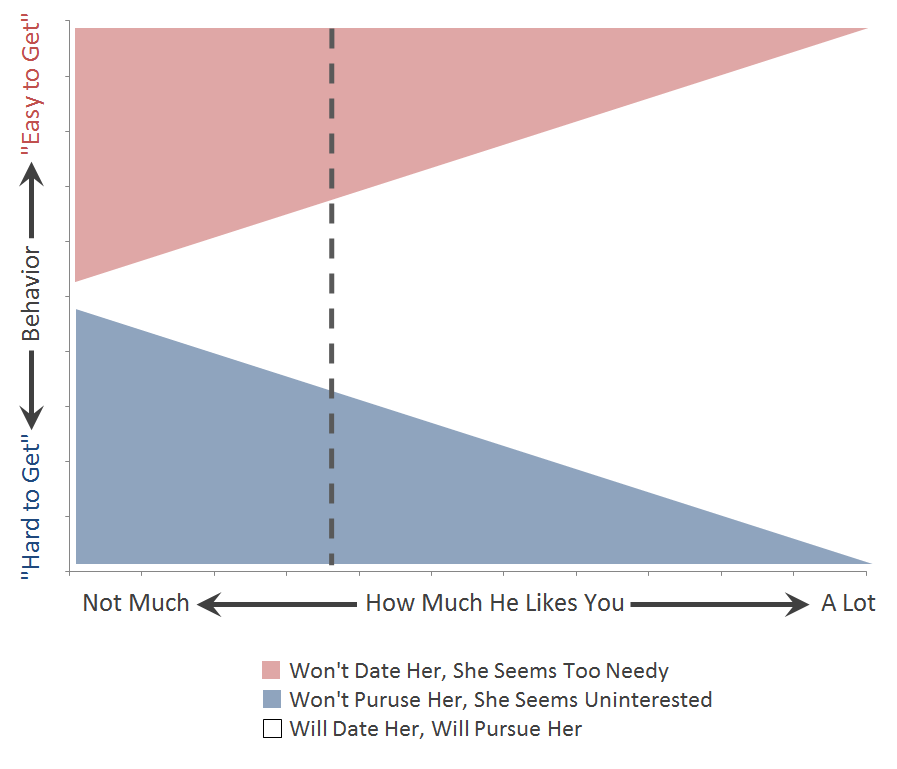
The good news, and the main point I want to make here, is that you really shouldn't over-think this. If a guy is interested in you, there is a wide margin between the behaviors that will make him think of you as "needy" and "uninterested." It will be incredibly difficult to change his interest in you by small things like agreeing too readily to a date, or being too enthusiastic in your texts. As long as you are agreeing to go out with him and not acting bored when you spend time together, you are showing more than enough interest to avoid discouraging the average guy. And as long as you aren't asking him out all the time, or initiating contact with him regularly, you aren't going to appear needy enough to turn him off.

Now, if a guy isn't that interested in you, the thresholds for "needy" and "uninterested" will be closer together, and smaller "mistakes" might cause him to change his mind about you. The girls that obsess over their behavior or the content of their text messages are usually dealing with a guy like this. In fact, his nonchalance about the relationship is usually what drives this hyper-awareness in the first place. The mistake these girls make is to think that their behavior that is responsible for the guy's decision to stop seeing them. While this is true in the limited sense that their behavior triggers the guy's decision, the reality is that his lack of interest was making it next to impossible not to trigger that decision.

Think about it this way: if a guy can be turned off just because you use the wrong adjective in a text, or sleep with him a couple dates too late or soon, or do some other small thing "wrong," then there isn't enough attraction there to sustain a relationship anyway. It was a losing battle from the outset. If the guy doesn't like you enough that you can behave naturally, then he doesn't like you enough for a relationship to last. There is no way you can perpetually guard every word and action around him, or control every emotional impulse forever; at some point you need to be able to relax and be yourself, and he needs to like what he sees when you do so. If you are in a situation where you are stressing out about what to do or say around a guy, your problem isn't your inability to know how to act, or your inability to calibrate your behavior, it is your inability to be comfortable with rejection.

This phenomenon can be illustrated with a simple plot, as shown below. The whole point is that it isn't worth spending your time in a dating situation that falls to the left of the dotted line. If you do, there won't be enough leeway between "needy" and "uninterested" behavior to allow you to be yourself in the relationship. In order to avoid the (red or blue) "no date" zones, you'll have to be constantly guarding your behavior in the same obsessed way that you are right now, as you attempt to get into or hold on to the relationship that is causing you so much stress. Where exactly the dotted line falls is something you need to decide for yourself; but you need to recognize that a limit exists. Until you do, you are going to give yourself a lot of grey hairs - and have nothing to show for it in the end.


Incidentally, guys make the same mistake all the time in their attempt to attract girls. It is particularly evident when you watch guys trying to figure out how to approach and pick girls up. If you could see how obsessively men try to figure out the right thing to say to a girl, or the best way (or time) to approach her, you would know exactly what I mean.* Men are constantly over-analyzing these things. What many men don't realize, is that if they need to force their behavior into a tiny, perfect mold in order to attract a girl, then they aren't going to be able to hold onto her for very long. The act can't be maintained forever; eventually they will need to relax and behave naturally, at which point the tailored personality that attracted her will disappear, and so will she.

In light of all of this, the goal - for men and women - should be to work at self-improvement slowly and steadily - in the long-term, but to relax and be themselves with the opposite sex in the moment. So if you are finding yourself constantly calculating your next "move" in a relationship, or watching your words too much, recognize that you are probably fighting a losing battle. Take a deep breath, relax, and focus instead on making yourself vulnerable to the possibility of rejection. Remember, sometimes it is a good thing.

______________________________________
* In fact, you can see this if you just do a Google search for "pick up artist" or "approach anxiety" and read the uncountable number of websites, blogs and books that have been written in an effort to perfect these things. In fact, I am convinced that men freak out about this stuff way more than women do. Perhaps this is because the pressure is on us to make the first move, but the obsession is still there.


Related Posts
1. Self-Improvement Takes Time
2. On Being a "Typical" Girl
3. Get Used to Rejection
4. Living Vulnerably
5. Don't Initiate Contact

Sunday, September 29, 2013

Why Men Are Capable of Commitment

I've pointed out some things about the male attitude towards relationships that - considered by themselves - might make women despair of the possibility of a real or lasting relationship (two posts that come to mind are Men and Sexual Variety and  Men Don't Have Commitment Problems). But they only represent part of the story... 

I remember a conversation that I had with an ex-girlfriend a few years ago about our fears in relationships. I told her that mine was to wake up one day, ten or twenty years into a marriage, and no longer want to be with my wife. Of course I'd only thought about the situation from the perspective of sexual attraction, and so had unsurprisingly developed the fear that I would grow bored or tired of her after she lost her beauty.

"Yeah, I see what you mean..." she agreed - but she continued, "I guess I've always just figured that the more time you spend with someone, the more you'll have invested in them. You'll have more shared experiences, more history - more memories. You'll know each other's habits, likes, dislikes, routines and quirks so much better than any new person's, that the temptation to leave won't really be that strong. You'd have to throw away everything and start again."

She was right. And I realized right then that my perspective on that hypothetical situation - and on relationships in general - was missing a huge piece of the puzzle. I was ignoring completely the phenomenon of attachment she described. I'd considered only lust and romantic love, the two early phases of relationships, and I'd lacked the experience or foresight to recognize that the situation I feared wasn't realistic.

More importantly, I realized that choosing someone to marry wasn't so much a matter of taking a gamble on the best girl possible as it was a choice of a girl to start to build a life with. In other words, the strength of the resulting relationship wasn't merely a function of the quality of the girl I would choose; much more important would be the life we'd live together - even if it wasn't perfect. By simply choosing to bind our lives together, we would be choosing to invest ourselves in each other; and before long, that investment would outweigh the greater sexual attraction of some hotter girl, or the excitement of sexual novelty.

Now, this isn't a particularly male phenomenon, but it is important for women to know that it isn't a particularly female phenomenon either. It happens to men too. So in the same way that I don't need to fear waking up twenty years from now and finding myself looking for a new wife, neither do you need to worry about your man doing it - assuming, of course, that you are both people of good-will, who are willing to work to maintain a good relationship. Even if he isn't aware of the phenomenon, it will affect him - just as it would have affected me even if I'd never had that conversation with my ex girlfriend.

The mistake I made in thinking about my future relationship is one that plagues young Americans' attitudes towards marriage. It is the reason that couples feel the need to live together before getting married, and stress out so much about choosing a partner. If these fears were rooted in reality, no relationship would succeed. There is always a hotter, richer or more-compatible partner out there; finding them isn't a prerequisite for a happy marriage, and you aren't going to renounce your vows just because you encounter them after marrying someone else. Your partner will always have the advantage of the time you've spent together and the relationship you've built.

It is also worth pointing out that this phenomenon is the main reason why you shouldn't linger in relationships that are stagnant or half-hearted. In doing so, you are investing yourself emotionally, and - despite the shortcomings of the relationship - that investment will make a break-up much more difficult.

In any case, I am writing this post because I was reminded of the whole concept a few hours ago, while listening to the lyrics of a new Dierks Bentley song, I Hold On, which is written to his wife. It's a great song, and one that I think is particularly poignant coming from a man:


If you can't watch the video, here are the words:
It's just an old beat up truck, some say that I should trade up
Now that I got some jangle in my pocket
But what they don’t understand is it's the miles that make a man
I wouldn’t trade that thing in for a rocket
What they don’t know is my dad and me, we drove her out to Tennessee
And she’s still here now he’s gone 
So I hold on... 
It's just an old beat up box, its rusty strings across the top
It probably don’t look like much to you
But these dents and scratches in the wood, yeah that’s what makes it sound so good
To me it's better than brand new
You see this here flat top guitar, has had my back in a million bars
Singing every country song 
So I hold on... 
To the things, I believe in
My faith, your love, our freedom
To the things I can count on
To keep me going strong
Yeah I hold on... I hold on... 
Like the stripes to the flag, like a boy to his dad
I cant change who I am, right or wrong
So I hold on... 
Yeah baby lookin' at you right now, there ain't never been no doubt
Without you I'd be nothing
So if you ever worry about... me walkin' out
Yeah let me tell you something...
I hold on...

Related Posts
1. The Downside of Cohabitation Before Marriage
2. We Have a Shared Responsibility
3. Why Rejection Is a Good Thing
4. The Male Sex Drive Always Recharges

Thursday, July 18, 2013

The Importance of Personal Boundaries

A lot of girls have e-mailed me asking for my opinion of the book Why Men Love Bitches. I'd heard of the book a couple times outside of the blog as well, so about six months ago, after a handful of these requests, I decided to get a copy to see what it was all about. My conclusion was that the book is saying something true, but also saying it poorly.

The truth is that men are attracted to bitches, but we don't love them because they are bitches; we just love women that happen to be bitches. In other words, men are attracted to bitches for a quality other than their bitchiness - a quality that any woman (bitch or not) can have. A similar thing is true of women who like "assholes." They only like those men because they are also strong, or confident, or powerful. They don't like them because they are assholes, they like them in spite of their being assholes.

The book Why Men Love Bitches doesn't make this distinction strongly enough for my taste. It skirts around a point that many women desperately need to hear without ever directly addressing it. It plays on an attention-grabbing title, at the expense of clearly telling women the crucial point - namely, that being a bitch, in-and-of-itself, is actually very unattractive to men. My worry is that some women read the book and start being bitchy in an attempt to attract men, just like many men try to be assholes to attract women. Both strategies are dangerous because they are often partially successful, despite missing the real point.

In any case, this criticism obviously begs the question: what are “bitchy” girls doing right? If women like men who are assholes, not because they are assholes, but because they are confident or strong in some other way, then what is the analogous quality in "bitches" that attracts men? And the answer is simple: bitchy women have strong personal boundaries.

Personal boundaries are the limits at which you "draw the line" and prevent other people from infringing on your personal world, that is, your personal rights and emotions - essentially, they are the limits of "what you will put up with." Boundaries apply in both big and small matters, and in all areas of your life: romantic, practical, physical, emotional, spiritual. Some people draw their boundaries quite close to themselves, allowing others to infringe upon their personal world dramatically, without resistance. Others draw expansive boundaries, protecting even their smallest and least significant rights and emotions relentlessly. Balancing between these two extremes is critical. But before saying more about how they play into male-female dynamics, I want to illustrate the concept with a few examples...

Example 1 – A woman is riding a busy train. There is one seat available, but a businessman is using it for his laptop bag while he works intently on his computer. The woman wants to sit down, and certainly has a right to the seat, but she will handle the situation differently depending on the strength of her boundaries. If they are very strong, she will walk up to the man and ask him politely to move his bag so that she can sit down. If she has medium boundaries, she might walk into his field of view, a little tentatively, hoping that he will take the initiative to move his bag himself – but standing if he doesn't. If she has weak boundaries, she will be too nervous about upsetting him, and will tell herself "I can just stand, it isn't that far," which is exactly what she will do.

Example 2 – A woman is asked out by a man who doesn't show up for a date, and doesn't apologize. If the woman has strong boundaries, she won’t hesitate to delete his contact information, and tell him when he calls back three days later that he can go fuck himself. If the woman has medium boundaries, she will probably keep his contact info and ask him what happened, but ultimately agree to another date – despite being under-impressed with his excuse. If she has weak boundaries, the woman will probably just pretend nothing happened, assume that she must have misunderstood the plans, and maybe even apologize for the text she sent that night asking what happened (which he never answered).

Example 3 – A girl walking down the street is asked to contribute to an organization or charity whose ideals she does not believe in. The person asking for donations is enthusiastic and persistent. If the girl has strong boundaries she will say "no" immediately, ignore the second request, and maybe even snap back "I said no!" if asked a third time. If the girl has medium boundaries she is likely to apologize and makes an excuse about not having any money on her, in order to avoid donating and compromising her beliefs. A girl with weak boundaries will first try to avoid the person asking for money altogether; but once she is asked, she will immediately give in, and actually donate a generous amount because she sees on the list that other people have done the same.

Example 4 – A girl is throwing a neon-themed party, and wants to invite a guy she has a crush on. The idea of the party is that anyone who attends has to wear all neon, and the girl knows that if she lets one person come in normal clothes, others will too, and the theme will be spoiled. Upon inviting the guy she likes, he tells her that he'd like to come, but he has nothing neon to wear, and that he has no time between now and the party to buy something. A girl with weak boundaries will immediately tell the guy that it isn't a strict requirement, and that he should just come anyway. A woman with medium boundaries won't bend on the requirement, but she might offer to help him find some neon clothes. A woman with strong boundaries will smile, maybe throw in a wink or a nudge, and tell the guy that if he really wants to come, he will find a way to get something neon (she isn't going to let him ruin the party just because she likes him).

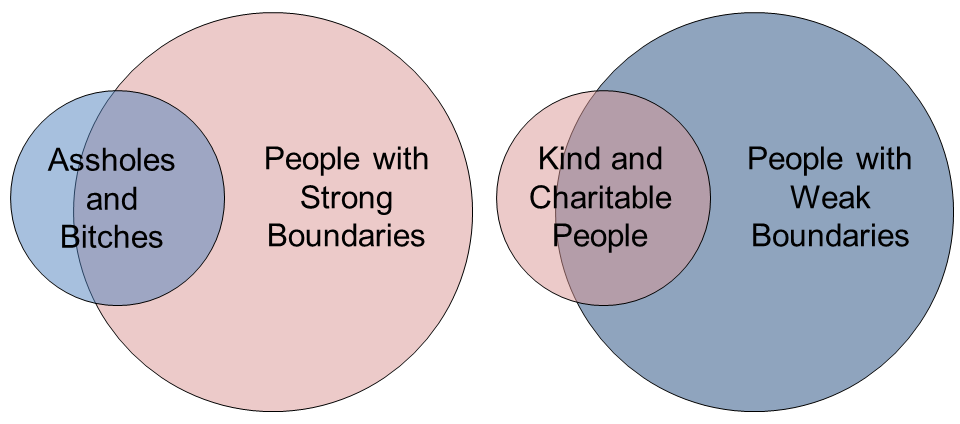
Often people with weak boundaries are thought of as kind or charitable, and a lot of people with strong boundaries are perceived as assholes and bitches, but these labels are inaccurate. It is perfectly possible to have strong personal boundaries without being an asshole (best illustrated in example 1, where the woman is firm, but polite), just as it is perfectly possible to have weak personal boundaries without being kind or charitable (best illustrated in example 3, where the girl gives to charity, but not for altruistic motives). Assholes and bitches are just a subset of the group of people with strong boundaries, just as kind and charitable people are just a subset of the group of people with weak boundaries.

This can be illustrated quite simply with a Venn diagram. There is some overlap between the groups, but there are plenty of people with strong boundaries outside the set of assholes, just as there are plenty of people with weak boundaries outside the set of kind people. Neither group completely encompasses the other.

Perhaps the primary way in which we judge another person's value (and I mean primary both in the sense of "main" and in the sense of chronologically first) is by evaluating what they appear to think about themselves. We do this by observing their confidence, their posture, their grooming, the way they dress, and most importantly, the way they interact with others. We form an opinion of their self-esteem and bearing.

We do this because - unless we know them extremely well - we are privy only to a limited amount of information about their capabilities, talents, and weaknesses (i.e. the things that actually define their value); so we are forced to make a second-hand judgment, an inference. But in general, this judgment is reasonably accurate, because people usually know their own strengths and weaknesses almost perfectly. This self-knowledge usually informs their level of confidence, such that the way that they carry themselves usually reflects their strengths and weaknesses reasonably well.*

Now, healthy boundaries are a sign of confidence, of someone who respects themselves, of someone who knows their own self-worth. Weak boundaries, on the other hand, are a sign of insecurity and low self-esteem. The woman who asks the man on the train for a seat knows that she is just as good as he is, and just as deserving of the seat, so she has no inhibitions about asking (or even telling) him to move his bag. The woman who lets her date get away with not showing up thinks he is the best she can do (i.e. thinks she is below his league). She is afraid to cut him off because she doesn't want to lose him. The girl who can't say no to a donation request, and then gives more than she wanted, has such a poor self-image that she puts even a random charity worker's opinion above her own money and principles. And the girl who tells her crush not to come to the party out-of-costume does so easily because her sense of self-worth is not contingent on one man's willingness to attend a party – or even on how much he likes her.

I am saying all of this is to make a very simple but crucial point: when a man encounters a woman who has strong boundaries, he knows that she values and respects herself, and he therefore makes the reasonable inference that she is a woman of good character. Assuming she meets his minimum criteria for physical attractiveness, his attraction for her – and I am talking about the long-term kind, the kind that makes men fall in love – will skyrocket.

The opposite is also true. When a man meets a woman who lets him (or others) walk all over her boundaries, or even define them, he concludes that she doesn't respect herself, and therefore, that she must not be someone worthy of respect. Even if she is beautiful, his attraction for her will soon plummet.

In my experience, women tend to have weaker rather than stronger boundaries. My guess is that this is true because, from a young age, their boundaries are often handled by the males in their lives – a protective father or brother, suitors who believe they need to be “gentlemen,” male colleagues who suppress their sexual attraction in the office, etc. Surrounded by this behavior, women have relatively less practice than men (on average) maintaining their personal boundaries, defending their personal space, rights and emotions. As a result, they aren't as comfortable confronting someone on the train about moving his bag, or telling those who mistreat them to go fuck themselves.

It has also been my experience that the more attractive a girl is, the more likely she will be to have weak boundaries. This is a little counter-intuitive, and definitely a generalization, but I think I understand why it is the case. From a young age, beautiful women are surrounded by men who are constantly demurring, constantly meeting their needs, and giving them whatever space or compliments they need. Some women like this still manage to develop strong boundaries, and they are the ones that men would kill to be with. But most do not, because they've never had to "fight" for anything. When a woman like this comes across a man who is confident and attractive, she invariably gets banged, walked all over, then dumped. And it is largely because she doesn't show the men in her life that she is someone of value. If she were to maintain strong personal boundaries, men would see that she respected herself, and would want to trace that confidence to its root by getting to know her.

Do not underestimate the importance of this post. For what I suspect is the majority of my readers, it is probably the most important one I've written. I get e-mails all the time from beautiful women (they attach pictures), telling me that they are doing "everything right," but that they still can't land a man. Other women e-mail me asking how they can really "hook" a guy, how they can make him look past the sex, how they can get him to fall in love. They can attract the men they want, they just can't seem to keep to them. This post is fundamental to answering both questions.

For the girls doing “everything right”…
If you read through the posts on this blog, you will notice that many of them – some of which are linked in the Related Posts section, below – advocate the maintenance of strong boundaries in specific situations; but boundaries are not something that you can apply to your life only in a piece-wise fashion. This is transparent. Even if a girl doesn't fuck on the first date, a guy will know that she has poor boundaries when she accepts a date after he’s admitted that he isn't looking for anything serious. Likewise, a girl who doesn't initiate contact still betrays her weak boundaries if she replies immediately to every text a guy writes her. Doing only the things I've posted about on this blog will only get you a fraction of the way to the correct disposition. This post is meant to explain the underlying principle, so that you really can apply it in everything.

For the girls who can attract but can’t keep a man…
Boundaries are fundamental to getting past the initial attraction phase with a man. Looks only get you in the door. As I have said before, while appearances are essential in getting a guy to approach or getting him to ask you out, they are nowhere near enough to get a guy to commit for the long term. Strong boundaries are a primary and therefore critical indicator of a woman's deep, inner worth – the kind of woman that men are not only willing to commit to, but actually want to commit to. There are plenty of women out there who are attractive, but there are very few who have the substance to go with it. Sound, healthy boundaries set a woman apart from the crowd instantly.

So, yes, "men love bitches," in the sense that they love women with strong personal boundaries; but they do not love bitches because they are mean, manipulative, under-handed or have harsh personalities. Men love bitches because their personal boundaries are rooted in a self-respect that tells him more than anything else about their character and inner-value; and it is only with this kind of woman that men want to settle down.

___________________
* While of course there are plenty of exceptions, they are normally short-lived. In the long run, people who are over- or under-confident almost always run into circumstances that serve to correct their distorted self-image. Some good examples are the delusional American Idol contestants who are finally told by the judges (on public television) how much they suck. Similarly, a person who has no self-esteem will eventually find a talent or social niche, and realize that they really aren’t as dumb or awkward as they thought.


Related Posts
1. The Importance of Silence After a Breakup
2. Don't Try to Be One of The Guys
3. Never Tell a Guy When You'll Have Sex With Him
4. No, You Can't Be "Just Friends"
5. Men That Like You Will Explain Themselves
6. Men and "Friends with Benefits"
7. The Downside to Cohabitation Before Marriage

Tuesday, July 9, 2013

Do You Really Want Dating to Be Easier?

Dating isn't easy. In fact, for anyone with romantic ambitions, it is extremely difficult. There was a time where dating options were far more limited by religion, geography, social class, and family pressure. But these days, dating options are virtually limitless, and ideals about romance are pegged to ridiculous standards, both of which make it hard for people to settle down. When you consider this in light of the fact that people have such varied tastes, it isn't hard to see why it is so difficult to fall mutually in love.

The greatest victories in sports are the ones that follow a difficult comeback. We appreciate them because they are born out of unlikely circumstances, and are the result of a tremendous effort. I remember watching basketball games when I was a kid, and actually liking it when my favorite team was down by a large margin. The way I saw it, the deficit was just potential for a big comeback - maybe an unprecedented comeback, a game people would talk about for decades. While I knew that I might be witnessing a blowout, I also knew that I might be watching sports history in the making. I also knew that I wouldn't be anywhere near as excited if my team won by a large margin - it would just be too easy that way.

When you get frustrated at your lack of success with the opposite sex, stop for a moment and recognize that the same principle applies in your dating life.  If finding a boyfriend or husband were easy, you wouldn't care much for your relationships. Every man would be replaceable, just as you would be to every man. The more you improve yourself in order to find love, or the more years you spend maturing before you can recognize it, the more unique your story will be, and the more you will value the man who marks its end.


Related Posts
1. Why Rejection Is a Good Thing
2. Self-Improvement Takes Time
3. Why Do You Want Him Back?
4. Know Why You Are Dating

Tuesday, April 9, 2013

Why Men "Fade Out"

Women sometimes complain about men "fading out" - that is, slowing and then ceasing contact after dating for a little while, or else just stopping it abruptly. The alternative, of course, is for the guy to call the girl and tell her directly (in these words or others) "I am not interested in seeing you again. I had fun with you but I can tell it won't work out so I don't want to continue dating."

No guy wants to make that call, so instead, many men simply stop communicating with the girl altogether. I understand that there are a lot of bad feelings mixed up in the experience of slowly realizing that the guy isn't interested, so I want to explain why men do this, try to excuse it slightly, and offer a way of handling it.*

The reasons men "fade out" are simple:
  1. It is easier than being direct with you (for him). He doesn't have to fumble through a difficult conversation in which he tries to balance the harsh truth about his feelings for you with an explanation that doesn't hurt your feelings too much. Not only is striking this balance difficult, but there are also implications if he fails to do so - damage to your ego if he is too blunt and ambiguity if he isn't sufficiently forthcoming.
  2. It is easier than being direct with you (for you). You don't want to hear the harsh truth any more than he wants to deliver it. True, you might want closure more than you want to avoid the pain of knowing he doesn't want to see you again; but the hit to the ego you receive when a guy fades out slowly is less severe than if he calls you up and says abruptly: "I don't think you are good enough for me" (which is what being dumped amounts to).
  3. It would be presumptuous to assume that you wanted to continue the relationship. This is the reason that I think women understand least. Sometimes a man feels like he doesn't have the right to announce his decision to stop seeing you, because he doesn't feel justified in making the implied assumption that you wanted to see him again. Sure, in some instances he might suspect that you do; but he never knows for sure. If there is enough ambiguity about your interest in him, it can very easily prevent him from being direct with you about his decision to stop seeing you.
  4. It still conveys the message. While in the short term you might be confused by his lack of contact, he knows that after a few months of silence there won't be any ambiguity about his lack of interest. In the long term, he isn't sacrificing clarity by forgoing the direct phone call.
Girls that have been faced with the need to dump a guy know exactly what I am talking about. In fact, this isn't a singularly male phenomenon, except in the sense that men - due to their promiscuity - tend to be the ones breaking things off more frequently than women.

So how do you handle the situation if a man starts to "fade out" on you? Well, I suggest you start by recognizing that your chief annoyance is the temporary ambiguity - with the emphasis on temporary (see #4 above). From there you have two options:
  1. Let the ambiguity dissipate by his continued lack of contact. This is usually difficult in proportion to how disappointed you are that he stopped wanting to see you; but a confident and vulnerable woman does not get very invested in the early stages of a relationship, and anyway is not interested perpetuating things with men who aren't interested (enough) in her.
  2. Remove the ambiguity by calling him. Whether you do it because you are impatient or because you are annoyed that he isn't being direct with you, you can always call him to ask for closure. While technically speaking this is initiating contact, it isn't problematic because you aren't trying to preserve the relationship anymore. I suggest saying something along the lines of "Hey, [name], I know things didn't work out between us, and I can live with that; but I just wanted to actually hear it from you and know what changed in your mind." You will be putting him on the spot here, so don't expect much in terms of an explanation, but at least you will get confirmation that he is no longer interested.
_____________________________

* Note that I am only talking here about "fading out" after early dating. If this happens after a long time together, or in an exclusive relationship, the reasons and obligations on the man's part are different entirely.


Related Posts

Monday, April 1, 2013

What Men Think of You Without Makeup

There is no question that you look better with your hair and makeup done than you do without it. If your boyfriend tells you that you are hotter without it, because he prefers when you "look more natural," he is either lying or you aren't doing your makeup correctly. Makeup is designed to make you look better; saying that it doesn't is like saying that a fresh coat of paint on a house doesn't make the house look better: it is only true when someone screws up the paint job by using the wrong colors or applying the right ones incorrectly.

In any case, although cosmetics give you an undeniable advantage when it comes to controlling your appearance, they come with the burden of deciding when and where their use is appropriate. The following points explain what men think about seeing you done up or in your natural state, so that you can better choose between the two when that decision proves difficult.

1. He cares about first impressions. We all do. They matter. Initial experiences leave an impression on the mind much deeper than most of those that follow; this is simply the way the human brain works. So make sure you are looking great the first few times you meet him; he will remember it. (Note that I did not say that you should be looking "your best" the first few times you meet him. This is because it is always good to keep a little something in reserve. If your "great" isn't good enough for him, your "best" probably won't be either. And even if it were, you would have to be completely focused on your appearance in order to barely keep him interested, making your life a living hell.)

2. He is going to see you without makeup eventually, so don't make inordinate attempts to avoid being seen bare-faced after the first few dates. By inordinate I mean things like canceling a date because you won't have time to do your hair perfectly, or completely avoiding a hike with him because full makeup and hair would be inappropriate. I don't mean spending an hour getting ready for a date. Spending time to make yourself look your best is normal, not inordinate; so err on the side of doing this more frequently rather than less. Just beware that there is an upper limit to the benefit of added effort, since he will see you without makeup eventually.

3. He doesn't stop wanting to see you done up. There is a misconception among some women that as a relationship develops, a man becomes either (a) less turned on by seeing you done up, or (b) more turned on by seeing you in your natural state. Neither of these are true. In fact, if anything, the opposite is true in both instances, since, as a man grows accustomed to your look, his sex drive starts nagging at him, inclining him to desire other women (though in a good relationship, this is counteracted by emotional investment, time investment, love, etc.) In any case, he certainly doesn't stop wanting to see you look your best, or grow less disappointed when you reduce the effort you put into your appearance. There is no point at which you can "relax" without implications while you are both sexually active with each other. If this seems unfair, remember the analogy between confidence and beauty: you taking a break from being beautiful for him is like him taking a break from being strong and confident for you. While you could probably sympathize with your man's desire to relax in this regard, and might even be OK with him showing his weaknesses to you from time to time (see #7 below), you'd prefer to always have him being his strongest, and you wouldn't be any less turned off by his weakness just because time had elapsed in the relationship.

4. He hates a women whose life is dictated by her appearance. The negative effect of being unwilling to do activities that would require you to not wear makeup (camping, surfing, etc.) by far outweighs the advantage you gain by always being seen at your best - especially considering points #2 and #8.

5. He loves a woman who is confident in her own skin. Confidence is a character trait that both sexes find incredibly attractive in the other (even if women value it more than men) because confidence is rooted in a healthy self-perception and acknowledgement of one's own self-worth - which all diligent and contentious people have. The attractiveness of your confidence is much more important than whatever advantage you sacrifice by occasionally being seen without makeup.

6. He loves you looking your best during sex. Remember that men are primarily stimulated visually. While there is a certain attraction to being naked with a woman who bares her whole self to you, most of the time a man wants to be sleeping with the hottest woman he can. Again, remember the analogy between confidence and beauty, and consider how you'd feel if your normally confident man man turned into a weak pushover in the sack. I am not saying that you should never have sex without your hair and makeup done. There are some instances in which getting done up just for sex isn't appropriate, and he'd certainly rather have sex with the "au natural" you than not have sex at all. But when you have the option to get done up, and you find yourself tempted to think "oh, he doesn't really care" or "we love each other so much it doesn't matter," remember this point.

7. There is something intimate about seeing a girl without makeup. When I've seen my ex-girlfriends without their hair and makeup done, I've had two thoughts: (a) she is less attractive, but (b) it is nice that I get to see this side of her. It is an expression of intimacy - and her confidence - that she can be herself in my presence, and this is worth something. Don't use this as an excuse to ignore point #3, but allow it to help you if you struggle with point #5.

8. He isn't expecting you to be as hot without it as you are with it. Men understand that you aren't going to be as beautiful without your makeup on and hair done. This is expected, and it is factored in to their evaluation of your attractiveness. Yes, there are some women who get more benefit from makeup than others, and it is possible for a man to be surprised by how much less attractive a girl looks without it. You can avoid falling into this category by understanding your complexion and wearing makeup that is compatible with your natural look; but regardless, know that men definitely hold you to lower standards when you aren't made up.

A final point is worth noting: a genuinely feminine woman loves looking her best. She takes great pleasure in adorning herself and amplifying her internal beauty via her external beauty. You don't need to be a supermodel to enjoy this; you simply need to know that you are looking your current best. The more you allow yourself to enjoy looking beautiful, the less you will resent the "need" to do so, and the more comfortable you will feel when you don't.


Related Posts