Showing posts with label confidence. Show all posts

Tuesday, September 15, 2015

Older Women Can Still Be Sexy

I recently spent a couple weeks in Europe. While there, I noticed something that genuinely surprised me: older European women are sexy. I found myself attracted to women over the age of 35 or even 45 much more frequently than I do in the U.S., where I almost never notice women over the age of 35. In Europe, it was a regular occurrence.

It didn't take me long to realize why. The difference is obvious. My attraction to these women could be almost completely attributed to the following factors:


This was kind of a revelation to me. I'd thought that wrinkles, loose skin, and thinning hair (the most obvious signs of aging) were the main factors reducing a woman's attractiveness. But this simply isn't true. Feeling my neck instinctively turn and my eyes involuntarily drawn to the hips of these European women as they walked by put an end to that idea. Perfect skin and perfect hair simply don't matter that much. My hormones were saying "YES" over and over again to women without either one.

This was a powerful realization for a couple reasons. The first was the simple satisfaction of realizing that it reinforces a couple points I've been making all along: that feminine beauty is highly controllable and that no women needs to be ugly.

But more importantly, it was powerful because it gave me hope. Yeah that sounds like exaggeration and maybe even a little gay, but it's true. I'd always had this background fear that after getting married and enjoying several years of physical attraction and great sex with my wife, she'd inevitably lose her physical beauty, I'd lose my physical attraction, and sexual fidelity would become a burden. A perpetually satisfying sexual relationship with an aging woman seemed impossible. And given that I never want to cheat on my future wife, that was a pretty disheartening belief. It essentially meant that I had to choose between having a family or a sex life.

I believed this was inevitable because I saw it happening all around me in the United States: the vast majority of women here become unattractive after 35. Physical attraction is by no means everything, but it's pretty damn important. So realizing that I could be legitimately attracted by women over 35 was a huge breath of fresh air. Sure, I'd always known it was possible for women to remain attractive as they age, but in the United States this is a rare exception, and seemingly impossible to predict. In Europe, however, it is the norm. And the fact that almost a whole continent of women can do it proves that it's totally achievable.

But here is the thing: European women don't just happen to wear heels and keep their hair long; it isn't a stroke of genetic luck or some fluke of cultural development. The decision to do those things is rooted in their mindset, in their beliefs. They do these things because as they age, European women continue to think of themselves as sexual beings. The wear dresses and stay in shape because they have zero doubt that they can still be very attractive to the opposite sex - and they are absolutely right.

In the United States, women either don't believe this, or they aren't motivated by American men to do this.* Probably it is some combination of these two factors, but I am skeptical about the importance of the latter, mainly because most European men are pussies, and they still manage to motivate their women to look sexy. Anyway, for the sake of not turning this post into a critique of cultures, I am limiting the discussion to the point about belief - or more specifically, American women's disbelief.

So let's get right to the point: that disbelief is unfounded, because you can totally look sexy to men well into your 50s. The exact same things that make you attractive to men in your 20s continue making you attractive well into your later years; there is no reason to abandon them.

Get rid of this idea that some clothes are "age-inappropriate," or that you have to somehow limit your wardrobe as you get older. The only clothes that are age-inappropriate are those that make women who aren't ready for sex look sexual. If anything, increased age should expand your wardrobe, since you'll be more confident, have stronger boundaries, and therefore be able to pull off sexier looks.

Nope, you don't need more makeup, and you don't need a boob job. Yes, believe it or not, your body is still sexy in spite of the wrinkles and grey hairs. Shit, I don't care if your hair is completely grey. If you are in good shape and you dress in a feminine, sexual manner, you are going to give men erections for a long, long time. The male need for Viagra says just as much about women's unwillingness to think of themselves as sexually desirable beings as it says about the impotence of their men.

Yeah it might be tough to see yourself getting older, especially in light of knowing how much men care about looks. I get that. But it is flat-out wrong and incredibly short-sighted to think that just because you are on a downward slope, the game is over.

Remember this as you age. And for those of you already well past your prime, recognize that it is never too late to reverse your thinking. You can still be sexy; you just need to make an effort and shed these puritanical American ideas. True, you'll be fighting your culture in doing so, and you'll have to learn to come to terms with looks of disapproval from the women who decided that it was acceptable to wear sneakers to the grocery store. But if your personal style is rooted in a firm belief about the kind of woman you want to be, you'll see those criticisms for what they are: comments from women motivated primarily by jealousy and the will to believe they don't have to work.

---------------------------------------
* Some people might argue that American women stop trying to be sexy because the ones who get married and have children foster a culture that prioritizes raising children over being sexually attractive. This might be true, but it misses the point. The error lies not in American women's efforts to be good mothers, but in their belief that this somehow precludes being sexy. There is no reason why women can't do both, as evidenced by European women, who are also great mothers. In fact, this is a topic for another post, but I would argue that you actually can't be a great mother without continuing to think of yourself as a sexual being.


Related Posts
1. Female Game for Women in Their 30s
2. The Advantage of Dating After 30
3. Some Older Women Are Smart
4. What Men Think About Older Women

Tuesday, June 9, 2015

Your PhD Is His Eight-Pack

Everyone's talking about the whole "dadbod" thing, so it's been on my mind recently.

Before I say anything else, let me just make it clear that I resent having to reference something with such a retarded name. Modern American culture's tendency to come up with stupid names for stuff like this is almost as obnoxious as its ability to miss the point.

In any case, while on the surface the whole "dadbod" phenomenon looks like nothing more than a justification for men and women who want to be lazy about their appearance, I think there is something valuable in the idea, even if it lies a little beneath the surface. But in order to draw an important comparison to it, I first need to explain something else I've been thinking about recently, thanks to a recent podcast on Animus Empire and conversations with a couple girls I know...

These days, a lot of women out-perform men in the ostensible measures of "success." Whether this be with achievements in the workplace, academic degrees, financial earnings, or just the capability to make things happen, many women feel like they are better than men at their own game. And many women are.

But at the same time, a woman's physiology compels her to want to "marry up." In spite of the desire and ability to be successful by traditionally male standards, she also feels incapable of settling for a man who doesn't impress her with respect to those same standards.

Source: Snyder and Dillow, 2012

This is obviously problematic. When you as a woman are earning $100k + per year or have dual Bachelor's degrees and a Master's, it is going to be pretty tough feeling like you've found someone impressive, because the vast majority of men earn about $45k and drink their way through laughable degrees. I've met many girls in this situation – accomplished in all respects, but unhappy in their relationships and dissatisfied by their supposed success. (Perhaps unfulfilled is a better word, for reasons I explain in my new book.)

Most women don't intentionally choose this situation. They were raised in a culture that told them their personal worth was dictated by the position they could win in the office, or the degree they could earn in school. When they were too young to think for themselves and understand what their post-pubescent selves would want, they were pointed in the direction of traditionally masculine success, and told that they'd better work hard and marry their "equal" if they wanted to be happy in life. But anyone over the age of 30 knows that this is bullshit. Sure, no one wants to go back to 17th century and arranged marriages; but the idea that a woman can be happily married to a man who has no abilities in excess of her own is absurd. She might find a way to be content in that kind of marriage, sure, but content people take Zoloft.

This isn't something that only applies to women, by the way. Both sexes want spouses that are "better" than them; we just want the opposite sex to be better than us in very different and complimentary ways. Women typically want a man who is better than them when it comes to providing and protecting their family, while men typically want a woman who is better than them when it comes to raising children, creating a "home" (I mean this in the widest possible sense of the word) and keeping the family connected to the outside world. I discuss one small aspect of this dynamic in the post The Analogy Between Confidence and Beauty. If you haven't read yet, I suggest taking a minute to do so before finishing this one. The point is that women want men who are stable and capable ("confident"), while men want a woman who is fertile and a light in their life ("beautiful").

This is what your PhD or upper management position looks like.
Anyway that brings us to the "dadbod." As I said, at first glance, the claim that women like men with mediocre bodies looks like an excuse for men to be sloppy and for women to lower the standard of comparison for their own bodies. And for many people, this is exactly how the concept will be used, without further consideration. But for those of us who are willing to think and work, there is a lesson to take away from the "dadbod." After all, the article that started it all was only popular because it touched on an important yet controversial truth, namely, that women and men want different things in relationships. Both sexes want to be better at certain things than their partner, and both sexes want the other to be better than them in some ways. To some degree, it actually does makes sense for a woman to be "the pretty one." This doesn't excuse men from looking after themselves, but it does mean that men who think that they have to tone and sculpt themselves into a Greek God in order to get girls are missing something much more important than bodyfat.

As usual, the useful takeaway here is reached by flipping the comparison to the other side of the sexual divide. Most women struggle with the concept that men don't like them for their accomplishments. They see accomplished men and feel attracted, so they have a hard time understanding why that same standard doesn't apply to them too. At the same time, most women - even if they don't agree that "dadbods" are sexy - at least can identify with wanting to be the pretty one in the relationship and disliking feelings of competition with their own partner. By this point, you probably get what I am going to say: as a man, dating a woman who is highly accomplished in traditionally male arenas is a lot like being a woman and dating a man with a perfectly sculpted body. Or we could state it like this: guys feel the same way about dating women who are more accomplished than them as you feel about dating men who are sexier than you.

Now, by all means, the correct solution for a girl who feels inclined towards guys with "dadbods" is to hit the gym and learn how to present herself (so she can get guys without "dadbods"); just like a guy who feels tempted to date stupid girls should find his purpose in life and work his ass off (so he can feel confident dating smart and accomplished girls). The fact that the sexes want different things doesn't mean it is right for guys to stop working out any more than it means that it is right for women to intentionally dumb themselves down intellectually. As I've stated in a million different ways on this blog, the answer isn't a reduction of the other, it is an augmentation of the self.

No, the whole "dadbod" thing doesn't excuse laziness, but it does serve as a reminder (albeit an awkward one) that each sex is looking for reciprocal qualities in the other. So think twice before pouring several years into developing the very quality you are looking for in the opposite sex. You only have so much time and energy to spend in developing yourself - spend it wisely.


Related Posts
1. No, Your Intelligence Is Not Your Problem
2. Men Don't Care About Your Accomplishments
3. The Analogy Between Sex and Commitment
4. Human Energy Is Conserved

Thursday, January 30, 2014

Stop Having Sex to Prove He Likes You

I've dated several women who knew that I'd lost interest in a relationship with them long before we stopped having sex. In fact, a couple of times they knew it even before I realized it myself. In retrospect, I see that these girls continued having sex with me for one reason and one reason only: to continue feeling my sexual desire.

Some girls might have done this because they mistakenly believed that male sexual desire is something important or hard to come by; but the girls I am referring to were mostly old enough or smart enough to know better. They wanted to experience my sexual desire because they needed the minimal affirmation it offered in order to feel good about themselves - or at least, in order to avoid feeling bad about themselves after realizing that the end was in sight.

I would call this situation pitiable, but ultimately pity is a wasted emotion, because it doesn't give enough credit to the agency of its object. So if you are still sleeping with a man who isn't as serious about you as you want him to be, I am not going to pity you, and I am not going to blame him. You and only you have the ability to change the situation.

You will only change the situation by demanding more in your relationships, and you will only demand more in your relationships if you believe that you deserve more in your relationships. And by a convenient loophole in human psychology, you will actually start believing that you deserve more in your relationships if you start acting like you deserve more in your relationships. So suck up the rejection and walk away.


Related Posts
1. Self-Improvement Takes Time
2. You Are Responsible for Your Own Romantic Happiness
3. Why Rejection Is a Good Thing

Sunday, January 26, 2014

5 Winter Fashions Men Like

Most men are familiar with the "75 degree rule," which refers to the fact that, in Spring, women seem to come out from their Winter hibernation once the temperature rises above 75 degrees Fahrenheit (for those of you not burdened by an archaic system of scientific units, that is 24 degrees Celsius). Spring comes, and hot girls are suddenly out everywhere wearing shorts, dresses, small t-shirts and skirts. When I first heard of the rule, I remember speculating that perhaps girls weren't actually indoors any more than men during the winter; it was just that we noticed them less when it was cold because they were all bundled up in clothes that hid their beauty.

I still stand by my speculation, because the simple truth is that the feminine figure is more attractive when it isn't concealed  (yes, even if the woman is overweight), and the more delicate and feminine parts of a woman's body - like her neck, jawline and breasts - add nothing to her attractiveness when they are covered by a jacket or scarf. So female winter fashion is all about minimizing the effect of the extra material. To this end, the fit of your winter clothes is more important than anything else. The more your clothes follow the natural lines of your figure, the better. This doesn't mean that you always need to wear tight clothes, but it does mean that the bulky jacket your mom bought for you last year probably makes you look like a man. Three tight layers are far better than one heavy layer.

Anyway, here are five female winter fashions/considerations that will make men find you more attractive in winter. There are obviously plenty of other ways to look attractive in cold weather, but these are good starting points:

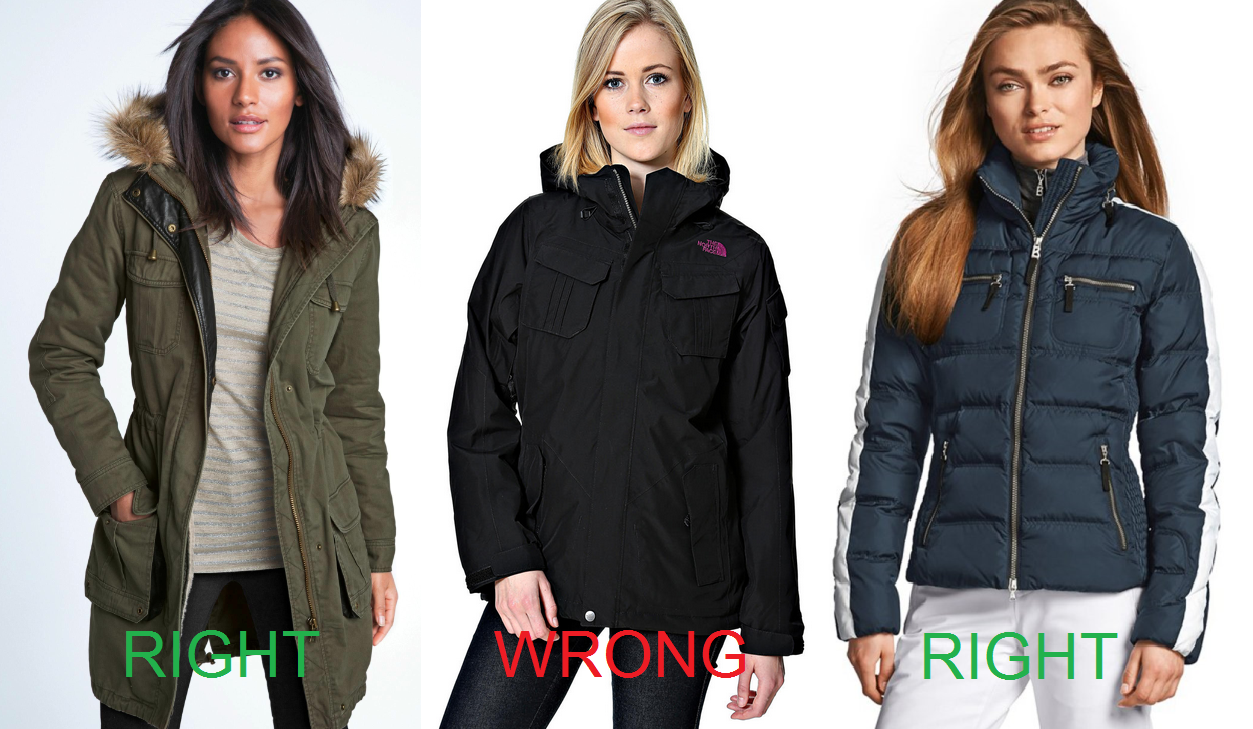
1. A Jacket That Fits You. For the purposes of looking good in cold weather, nothing is more important than the fit of your jacket. Men should be able to see your curves when you are wearing your jacket. This means that it should follow the curves of your waist and hips. It also means having sleeves that don't add bulk to your arms. And then there are the general aesthetics related to having as few wrinkles as possible from excess material. Most popular clothes stores design and cut their clothes for "average" people, which in the United States, means fat people. So for many girls, getting a jacket that fits will mean having to buy something that is more expensive, or else having a cheaper jacket altered by a tailor. A draw-string at the waist can also help to achieve this effect.


2. Fur-Trimmed Hooded Jackets. I've often told my guy friends how much I like these, and they always agree. The fur is extremely soft, warm and playful = feminine; and if you choose the color to properly complement your complexion, it can be extremely attractive visually as well. Popular fashion seems to have caught on to this in the last year or so, and more girls are wearing them. Because of this, you might not stand out as much by wearing one, but it also means that it is much easier to find them in stores. Besides, "looking like every other girl" is only problematic when every other girl looks bad. Here is an example:


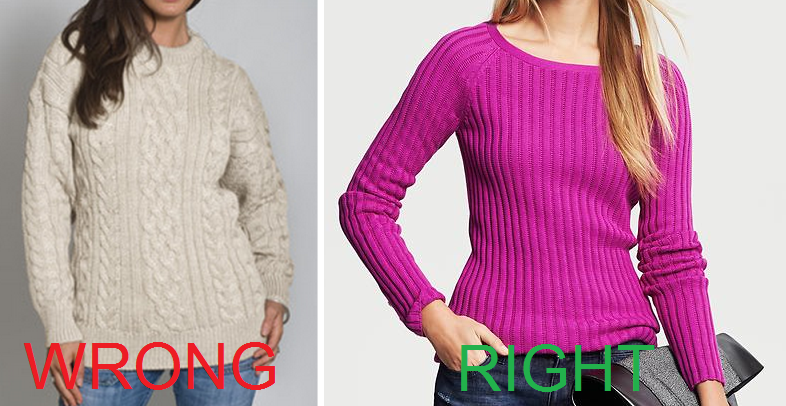
3. Tight Sweaters. A tight sweater embraces everything I said above about the importance of wearing well-fitted clothes. There is something both sexual and nurturing about a woman wearing a tight sweater. It is sexual for the obvious reason that it shows off her figure, but it is nurturing because it gives her an air of warmth and comfort. (Note: We left turtle-neck sweaters in the 90s for a reason: they are hideous on both sexes. Never wear one.)


4. Tall, Heeled Boots. Uggs are great if you want to look like a little girl; but if you want to attract guys over the age of 15, you will need to embrace a more mature look. Tall, heeled boots are sexy. They achieve all of the effects of attractive posture that you get from high heels, and their height draws attention to your thighs and waist. Heels are more important than height, but if heels aren't possible, tall boots without heels are still better than most other shoes - probably warmer too. All three of the examples below are great.


5. Leggings. Because they contain no vital organs, your limbs are the parts of your body least prone to the effects of cold weather; so most women are capable of going outdoors in leggings, even in the middle of winter. This is good, because they are sexy as hell. They make every woman's legs and ass look 10 - 20 % better than normal, and because they are so popular and reveal no skin, no one thinks they look slutty. Yes, they are hotter than a pair of tight jeans - probably because cotton can never conform to your body as well as synthetic, stretchy materials. And no, you don't need to be thin for them to make you look better. Black is obviously the most versatile color, but designs and patterns can work too, as long as they aren't overly obnoxious (e.g. cartoon characters or logos). Wear two or three pairs if it's too cold.

If any of these looks seem like they "aren't you" it is probably only because you haven't tried them yet.


Related Posts
1. The Most Important Time to Dress Well
2. Appearance Checklists
3. How to Make Any Outfit Better
4. Don't Wear Sneakers
5. Sexy Versus Cute

Wednesday, November 27, 2013

How "Hard to Get" Should You Play?

Every woman has been advised at one time or another that she can increase her attractiveness to a man by showing him less interest, that is, by playing "hard to get." Most people don't disagree with this advice, at least not completely; they understand that there is a psychological mechanism by which people tend to want what they can't have. But there is plenty of disagreement about the degree to which this tactic should be applied. A lot of girls obsess over how to strike a balance between "too easy" and "too hard to get." They analyze text messages, scrutinize their response times, stress out about when is the right time to sleep with a guy, or wonder if they will lose their chance with a guy off by not making a move themselves.

The reality is that there isn't any strict rule about how "hard to get" you need to play. Or rather, it varies for each girl and in each situation. Some girls need to apply it more than others. There are girls that immediately cling to any interested guy that meets their minimum requirements, and these girls could benefit quite a bit by showing some self-restraint. On the other end of the spectrum, there are girls with colder dispositions that would dissuade even the most persistent men by playing any harder-to-get than they already do. How hard-to-get you should play also depends on the guy in each situation. More persistent men will push through a higher amount of resistance, while those with a lot of options or lower degree of interest in a girl will be more easily deterred. You could drive yourself crazy trying to figure out where exactly along each spectrum you and he lie, and how to calibrate your behavior accordingly.

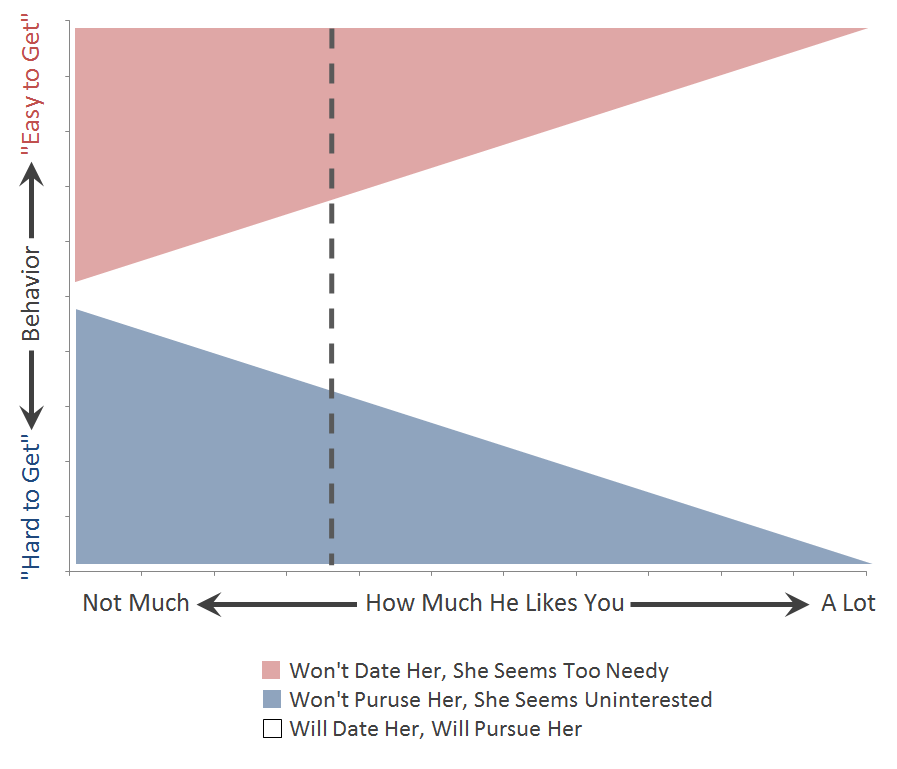
The good news, and the main point I want to make here, is that you really shouldn't over-think this. If a guy is interested in you, there is a wide margin between the behaviors that will make him think of you as "needy" and "uninterested." It will be incredibly difficult to change his interest in you by small things like agreeing too readily to a date, or being too enthusiastic in your texts. As long as you are agreeing to go out with him and not acting bored when you spend time together, you are showing more than enough interest to avoid discouraging the average guy. And as long as you aren't asking him out all the time, or initiating contact with him regularly, you aren't going to appear needy enough to turn him off.

Now, if a guy isn't that interested in you, the thresholds for "needy" and "uninterested" will be closer together, and smaller "mistakes" might cause him to change his mind about you. The girls that obsess over their behavior or the content of their text messages are usually dealing with a guy like this. In fact, his nonchalance about the relationship is usually what drives this hyper-awareness in the first place. The mistake these girls make is to think that their behavior that is responsible for the guy's decision to stop seeing them. While this is true in the limited sense that their behavior triggers the guy's decision, the reality is that his lack of interest was making it next to impossible not to trigger that decision.

Think about it this way: if a guy can be turned off just because you use the wrong adjective in a text, or sleep with him a couple dates too late or soon, or do some other small thing "wrong," then there isn't enough attraction there to sustain a relationship anyway. It was a losing battle from the outset. If the guy doesn't like you enough that you can behave naturally, then he doesn't like you enough for a relationship to last. There is no way you can perpetually guard every word and action around him, or control every emotional impulse forever; at some point you need to be able to relax and be yourself, and he needs to like what he sees when you do so. If you are in a situation where you are stressing out about what to do or say around a guy, your problem isn't your inability to know how to act, or your inability to calibrate your behavior, it is your inability to be comfortable with rejection.

This phenomenon can be illustrated with a simple plot, as shown below. The whole point is that it isn't worth spending your time in a dating situation that falls to the left of the dotted line. If you do, there won't be enough leeway between "needy" and "uninterested" behavior to allow you to be yourself in the relationship. In order to avoid the (red or blue) "no date" zones, you'll have to be constantly guarding your behavior in the same obsessed way that you are right now, as you attempt to get into or hold on to the relationship that is causing you so much stress. Where exactly the dotted line falls is something you need to decide for yourself; but you need to recognize that a limit exists. Until you do, you are going to give yourself a lot of grey hairs - and have nothing to show for it in the end.


Incidentally, guys make the same mistake all the time in their attempt to attract girls. It is particularly evident when you watch guys trying to figure out how to approach and pick girls up. If you could see how obsessively men try to figure out the right thing to say to a girl, or the best way (or time) to approach her, you would know exactly what I mean.* Men are constantly over-analyzing these things. What many men don't realize, is that if they need to force their behavior into a tiny, perfect mold in order to attract a girl, then they aren't going to be able to hold onto her for very long. The act can't be maintained forever; eventually they will need to relax and behave naturally, at which point the tailored personality that attracted her will disappear, and so will she.

In light of all of this, the goal - for men and women - should be to work at self-improvement slowly and steadily - in the long-term, but to relax and be themselves with the opposite sex in the moment. So if you are finding yourself constantly calculating your next "move" in a relationship, or watching your words too much, recognize that you are probably fighting a losing battle. Take a deep breath, relax, and focus instead on making yourself vulnerable to the possibility of rejection. Remember, sometimes it is a good thing.

______________________________________
* In fact, you can see this if you just do a Google search for "pick up artist" or "approach anxiety" and read the uncountable number of websites, blogs and books that have been written in an effort to perfect these things. In fact, I am convinced that men freak out about this stuff way more than women do. Perhaps this is because the pressure is on us to make the first move, but the obsession is still there.


Related Posts
1. Self-Improvement Takes Time
2. On Being a "Typical" Girl
3. Get Used to Rejection
4. Living Vulnerably
5. Don't Initiate Contact

Saturday, September 7, 2013

On Being a "Typical" Girl

I always cringe when I hear girls talk about a situation with a guy they like (or are dating), and they end with something like “…of course I am over-analyzing the situation, like a typical girl.” On the most recent occasion, which prompted me to write this post, a girl that I know was causally sleeping with a guy who would sometimes be affectionate and boyfriend-like, but at other times would seem completely disinterested. She explained this to me, and ended her narrative with the line I quoted above.

There are three things that bother me about this comment whenever I hear it. The first is that it is an expression of voluntary ignorance. It can be roughly translated to mean:
"Something feels wrong about my relationship, but the right thing for me to do is sit back and ignore my feeling of discontent. Silence and time will make me realize that there really is no problem – aside my own anxious and emotionally-driven behavior."
However, the glaringly obvious reality in these situations is that there is a very legitimate problem that needs to be addressed – or at least admitted. In most instances, the problem is that the guy is less interested in the girl than she wants him to be. The guy's behavior betrays this in subtle (and sometimes not-so-subtle) ways, the perception of which the girl is trying to sweep under the carpet. The action of categorically blaming "typical" female tendencies is actually just a psychological reflex or excuse, designed to postpone the inevitable pain that will come with rejection.

The second problem is a more serious one: by calling herself a "typical girl," with negative connotations, a woman is categorically insulting her own sex. The obvious implication is “women are all idiots because we stress out about men too much, are overly-emotional, and can't think reasonably about our relationships.” Not only is this not true (see below), but it is self-deprecating. Talking badly about yourself – let alone your whole sex – is always a bad policy. It is never necessary, and it demonstrates a lack of confidence that is hugely unattractive. Even if being a “typical girl” were obviously a bad thing, voluntarily drawing attention to it (or any associated behavior) would be a bad move.

The third problem, which is the most serious, is that a women who dismisses her feelings by calling herself a "typical girl" has no confidence in her emotions. Of course, it doesn't help that when a woman voices her feelings about a problem in a relationship, men will often tell her that she needs to “chill out,” or “stop being so emotional,” or even that she should “stop being such a girl.” But listening to and agreeing with a man who says this kind of thing – especially one with a vested interest in winning the argument or discussion – is nothing short of spineless. You have feelings, and your feelings tell you that something is wrong. They are legitimate feelings; you have them for a reason. Yet the second someone tells you that you need to stop being so emotional (and sometimes even without being prompted), you immediately doubt everything you feel, apparently convinced that there is something wrong with you for feeling the way you do. And then you actually verbalize that conviction, going as far as to insult your whole sex by blaming it on your womanhood. It is the ultimate expression of self-doubt.

Imagine if men did the equivalent. Imagine if your boyfriend came to you with a logical and well-expressed concern about the way things were going in the relationship. Then imagine if you, in response, flared up with emotion and screamed at him, telling him that he was being too logical and needed to feel more – that he needed to stop thinking so much. Maybe you would throw something at him while screaming this, just to add emphasis. He would stop and think for a moment, then agree, and then say something like “Yeah… yeah, I mean… I guess you’re right. I guess I am just being a typical guy... I really need to stop rationalizing everything.” Then he’d walk away - a bit puzzled, but ultimately convinced, and wondering how he could go about becoming more emotional.

Yeah, exactly – it would be absurd.

But this is precisely what goes on when a woman calls into question her primary tool for navigating relationships - that is, her intuition and emotions. A man is more rationally-focused, more logical in his approach to relationships; but this doesn't make him more right. We live in a world where Reason and Logic are increasingly championed as the only legitimate sources of knowledge. A few hundred years ago, this was chiefly a western error, one that we now refer to as “The Enlightenment.” But the influence of that movement is slowly propagating across the world, and destroying in its wake all confidence in emotional and intuitive knowledge – women’s strengths. In fact, it wouldn't be an exaggeration to say that The Enlightenment induced Feminism, which could only thrive in a society that managed to convince itself that there was something inherently better about the masculine ways of operating in the world and understanding it - in other words, doing so via logic and reason rather via intuition and feeling.

I guess what I am getting at here is that the modern philosophical trends aren't on a woman’s side when her feelings about a relationship are called into question – but that doesn't mean that those feelings are wrong. Likewise, a man who only wants to continue having sex with you isn't exactly going to affirm the emotions telling you that something is off; but that in no way undermines their legitimacy. Just because outside sources are telling you that your feelings are whimsical doesn't mean that you should second-guess yourself.

The next time you feel something inside of you sink at the attitude of a guy's text-message, don’t doubt that feeling just because he asks you “what’s wrong?” and you struggle to pinpoint it. Believe your feelings. Have confidence in your intuition. Similarly, the next time you feel undesired because your boyfriend is spending more time with his friends than he's spending with you, don’t call that feeling into question just because he coldly and “logically” argues that he would be a bad friend if he spent less time with them. Trust your emotions. You wouldn't feel bad about the situation if there was nothing wrong about it. (For example, in this situation the problem is probably that you want a man who loves you enough that he is at least tempted to ignore his friends for you, which he clearly is not.)

So to conclude: be vulnerable in acknowledging the reality of your relationships. Even if you struggle with this, stop talking down on your own sex by stereotyping your reluctance to face the truth as “typical.” Most importantly, stop undermining the legitimacy of your feelings by backing down every time they are questioned, or even mistrusting them yourself. Don't be shy about using your emotions and intuition to navigate your relationships; they are legitimate sources of knowledge, and they are your unique strengths as a woman: be proud of them.


Related Posts
1. Never Tell a Man Why He Shouldn't Want to Date You
2. Get Used to Rejection
3. The "Three Mistake Minimum" Rule on Dates
4. Femininity, Authenticity and Compatibility

Wednesday, August 28, 2013

If a Man Talks to You, He Likes You

I have made this point before, but only briefly; and as simple as the point is, it warrants further explanation.

If a man goes out of his way to interact with you, he is interested in you romantically or sexually - at least to some degree. A lot of women don’t realize this, because when they approach a man (for example, to ask directions in the street), they don’t do so with romantic or sexual intention. They wrongly project their own lack of intention onto the men who approach them. They think “When I approach a man, I don’t have romantic or sexual motives; so this guy asking me for directions has no ulterior motives.” But they are wrong.

If you are skeptical about this, consider that the same phenomenon is manifested in men. Men always “get the wrong idea” when a woman responds to their texts, or engages them in conversation in a bar, or doesn't spit on them and walk off when they ask her for directions. The truth may be that the girl is just being polite, or that she genuinely believes the guy just needs directions, but the man projects his own intentions onto her. He thinks “When I talk to a woman even for casual reasons, it is because I like her. This woman is talking to me, so she must like me.”

Yes, of course, there are exceptions to this rule. Sometimes a guy genuinely needs directions, or really is just talking to you to kill time at the bus station. But the point is that these exceptions are far rarer than you think. In fact, the exceptions are so rare that you are better off always assuming that men who approach you are interested than you are questioning it each time. In the rare instances that a man isn't interested, you have nothing to lose by assuming that he is; and the increased confidence you’ll have knowing that he is into you will help you to be your best self in his presence, which will attract him further.


Related Posts

Thursday, July 18, 2013

The Importance of Personal Boundaries

A lot of girls have e-mailed me asking for my opinion of the book Why Men Love Bitches. I'd heard of the book a couple times outside of the blog as well, so about six months ago, after a handful of these requests, I decided to get a copy to see what it was all about. My conclusion was that the book is saying something true, but also saying it poorly.

The truth is that men are attracted to bitches, but we don't love them because they are bitches; we just love women that happen to be bitches. In other words, men are attracted to bitches for a quality other than their bitchiness - a quality that any woman (bitch or not) can have. A similar thing is true of women who like "assholes." They only like those men because they are also strong, or confident, or powerful. They don't like them because they are assholes, they like them in spite of their being assholes.

The book Why Men Love Bitches doesn't make this distinction strongly enough for my taste. It skirts around a point that many women desperately need to hear without ever directly addressing it. It plays on an attention-grabbing title, at the expense of clearly telling women the crucial point - namely, that being a bitch, in-and-of-itself, is actually very unattractive to men. My worry is that some women read the book and start being bitchy in an attempt to attract men, just like many men try to be assholes to attract women. Both strategies are dangerous because they are often partially successful, despite missing the real point.

In any case, this criticism obviously begs the question: what are “bitchy” girls doing right? If women like men who are assholes, not because they are assholes, but because they are confident or strong in some other way, then what is the analogous quality in "bitches" that attracts men? And the answer is simple: bitchy women have strong personal boundaries.

Personal boundaries are the limits at which you "draw the line" and prevent other people from infringing on your personal world, that is, your personal rights and emotions - essentially, they are the limits of "what you will put up with." Boundaries apply in both big and small matters, and in all areas of your life: romantic, practical, physical, emotional, spiritual. Some people draw their boundaries quite close to themselves, allowing others to infringe upon their personal world dramatically, without resistance. Others draw expansive boundaries, protecting even their smallest and least significant rights and emotions relentlessly. Balancing between these two extremes is critical. But before saying more about how they play into male-female dynamics, I want to illustrate the concept with a few examples...

Example 1 – A woman is riding a busy train. There is one seat available, but a businessman is using it for his laptop bag while he works intently on his computer. The woman wants to sit down, and certainly has a right to the seat, but she will handle the situation differently depending on the strength of her boundaries. If they are very strong, she will walk up to the man and ask him politely to move his bag so that she can sit down. If she has medium boundaries, she might walk into his field of view, a little tentatively, hoping that he will take the initiative to move his bag himself – but standing if he doesn't. If she has weak boundaries, she will be too nervous about upsetting him, and will tell herself "I can just stand, it isn't that far," which is exactly what she will do.

Example 2 – A woman is asked out by a man who doesn't show up for a date, and doesn't apologize. If the woman has strong boundaries, she won’t hesitate to delete his contact information, and tell him when he calls back three days later that he can go fuck himself. If the woman has medium boundaries, she will probably keep his contact info and ask him what happened, but ultimately agree to another date – despite being under-impressed with his excuse. If she has weak boundaries, the woman will probably just pretend nothing happened, assume that she must have misunderstood the plans, and maybe even apologize for the text she sent that night asking what happened (which he never answered).

Example 3 – A girl walking down the street is asked to contribute to an organization or charity whose ideals she does not believe in. The person asking for donations is enthusiastic and persistent. If the girl has strong boundaries she will say "no" immediately, ignore the second request, and maybe even snap back "I said no!" if asked a third time. If the girl has medium boundaries she is likely to apologize and makes an excuse about not having any money on her, in order to avoid donating and compromising her beliefs. A girl with weak boundaries will first try to avoid the person asking for money altogether; but once she is asked, she will immediately give in, and actually donate a generous amount because she sees on the list that other people have done the same.

Example 4 – A girl is throwing a neon-themed party, and wants to invite a guy she has a crush on. The idea of the party is that anyone who attends has to wear all neon, and the girl knows that if she lets one person come in normal clothes, others will too, and the theme will be spoiled. Upon inviting the guy she likes, he tells her that he'd like to come, but he has nothing neon to wear, and that he has no time between now and the party to buy something. A girl with weak boundaries will immediately tell the guy that it isn't a strict requirement, and that he should just come anyway. A woman with medium boundaries won't bend on the requirement, but she might offer to help him find some neon clothes. A woman with strong boundaries will smile, maybe throw in a wink or a nudge, and tell the guy that if he really wants to come, he will find a way to get something neon (she isn't going to let him ruin the party just because she likes him).

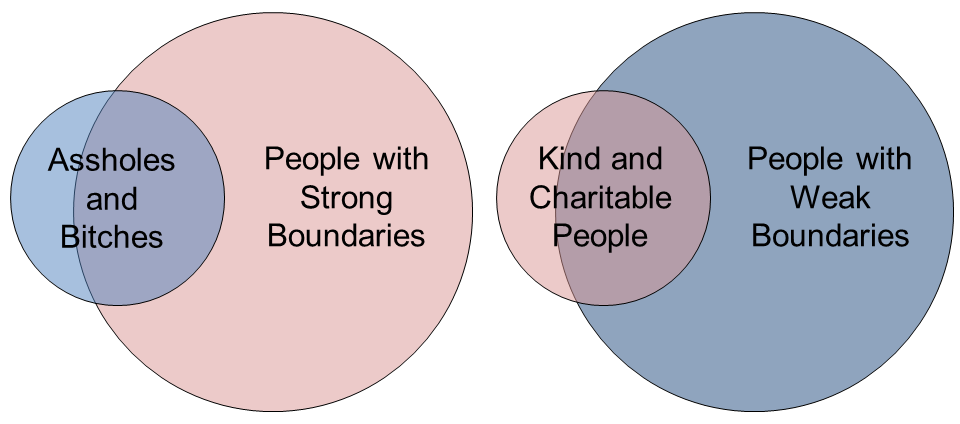
Often people with weak boundaries are thought of as kind or charitable, and a lot of people with strong boundaries are perceived as assholes and bitches, but these labels are inaccurate. It is perfectly possible to have strong personal boundaries without being an asshole (best illustrated in example 1, where the woman is firm, but polite), just as it is perfectly possible to have weak personal boundaries without being kind or charitable (best illustrated in example 3, where the girl gives to charity, but not for altruistic motives). Assholes and bitches are just a subset of the group of people with strong boundaries, just as kind and charitable people are just a subset of the group of people with weak boundaries.

This can be illustrated quite simply with a Venn diagram. There is some overlap between the groups, but there are plenty of people with strong boundaries outside the set of assholes, just as there are plenty of people with weak boundaries outside the set of kind people. Neither group completely encompasses the other.

Perhaps the primary way in which we judge another person's value (and I mean primary both in the sense of "main" and in the sense of chronologically first) is by evaluating what they appear to think about themselves. We do this by observing their confidence, their posture, their grooming, the way they dress, and most importantly, the way they interact with others. We form an opinion of their self-esteem and bearing.

We do this because - unless we know them extremely well - we are privy only to a limited amount of information about their capabilities, talents, and weaknesses (i.e. the things that actually define their value); so we are forced to make a second-hand judgment, an inference. But in general, this judgment is reasonably accurate, because people usually know their own strengths and weaknesses almost perfectly. This self-knowledge usually informs their level of confidence, such that the way that they carry themselves usually reflects their strengths and weaknesses reasonably well.*

Now, healthy boundaries are a sign of confidence, of someone who respects themselves, of someone who knows their own self-worth. Weak boundaries, on the other hand, are a sign of insecurity and low self-esteem. The woman who asks the man on the train for a seat knows that she is just as good as he is, and just as deserving of the seat, so she has no inhibitions about asking (or even telling) him to move his bag. The woman who lets her date get away with not showing up thinks he is the best she can do (i.e. thinks she is below his league). She is afraid to cut him off because she doesn't want to lose him. The girl who can't say no to a donation request, and then gives more than she wanted, has such a poor self-image that she puts even a random charity worker's opinion above her own money and principles. And the girl who tells her crush not to come to the party out-of-costume does so easily because her sense of self-worth is not contingent on one man's willingness to attend a party – or even on how much he likes her.

I am saying all of this is to make a very simple but crucial point: when a man encounters a woman who has strong boundaries, he knows that she values and respects herself, and he therefore makes the reasonable inference that she is a woman of good character. Assuming she meets his minimum criteria for physical attractiveness, his attraction for her – and I am talking about the long-term kind, the kind that makes men fall in love – will skyrocket.

The opposite is also true. When a man meets a woman who lets him (or others) walk all over her boundaries, or even define them, he concludes that she doesn't respect herself, and therefore, that she must not be someone worthy of respect. Even if she is beautiful, his attraction for her will soon plummet.

In my experience, women tend to have weaker rather than stronger boundaries. My guess is that this is true because, from a young age, their boundaries are often handled by the males in their lives – a protective father or brother, suitors who believe they need to be “gentlemen,” male colleagues who suppress their sexual attraction in the office, etc. Surrounded by this behavior, women have relatively less practice than men (on average) maintaining their personal boundaries, defending their personal space, rights and emotions. As a result, they aren't as comfortable confronting someone on the train about moving his bag, or telling those who mistreat them to go fuck themselves.

It has also been my experience that the more attractive a girl is, the more likely she will be to have weak boundaries. This is a little counter-intuitive, and definitely a generalization, but I think I understand why it is the case. From a young age, beautiful women are surrounded by men who are constantly demurring, constantly meeting their needs, and giving them whatever space or compliments they need. Some women like this still manage to develop strong boundaries, and they are the ones that men would kill to be with. But most do not, because they've never had to "fight" for anything. When a woman like this comes across a man who is confident and attractive, she invariably gets banged, walked all over, then dumped. And it is largely because she doesn't show the men in her life that she is someone of value. If she were to maintain strong personal boundaries, men would see that she respected herself, and would want to trace that confidence to its root by getting to know her.

Do not underestimate the importance of this post. For what I suspect is the majority of my readers, it is probably the most important one I've written. I get e-mails all the time from beautiful women (they attach pictures), telling me that they are doing "everything right," but that they still can't land a man. Other women e-mail me asking how they can really "hook" a guy, how they can make him look past the sex, how they can get him to fall in love. They can attract the men they want, they just can't seem to keep to them. This post is fundamental to answering both questions.

For the girls doing “everything right”…
If you read through the posts on this blog, you will notice that many of them – some of which are linked in the Related Posts section, below – advocate the maintenance of strong boundaries in specific situations; but boundaries are not something that you can apply to your life only in a piece-wise fashion. This is transparent. Even if a girl doesn't fuck on the first date, a guy will know that she has poor boundaries when she accepts a date after he’s admitted that he isn't looking for anything serious. Likewise, a girl who doesn't initiate contact still betrays her weak boundaries if she replies immediately to every text a guy writes her. Doing only the things I've posted about on this blog will only get you a fraction of the way to the correct disposition. This post is meant to explain the underlying principle, so that you really can apply it in everything.

For the girls who can attract but can’t keep a man…
Boundaries are fundamental to getting past the initial attraction phase with a man. Looks only get you in the door. As I have said before, while appearances are essential in getting a guy to approach or getting him to ask you out, they are nowhere near enough to get a guy to commit for the long term. Strong boundaries are a primary and therefore critical indicator of a woman's deep, inner worth – the kind of woman that men are not only willing to commit to, but actually want to commit to. There are plenty of women out there who are attractive, but there are very few who have the substance to go with it. Sound, healthy boundaries set a woman apart from the crowd instantly.

So, yes, "men love bitches," in the sense that they love women with strong personal boundaries; but they do not love bitches because they are mean, manipulative, under-handed or have harsh personalities. Men love bitches because their personal boundaries are rooted in a self-respect that tells him more than anything else about their character and inner-value; and it is only with this kind of woman that men want to settle down.

___________________
* While of course there are plenty of exceptions, they are normally short-lived. In the long run, people who are over- or under-confident almost always run into circumstances that serve to correct their distorted self-image. Some good examples are the delusional American Idol contestants who are finally told by the judges (on public television) how much they suck. Similarly, a person who has no self-esteem will eventually find a talent or social niche, and realize that they really aren’t as dumb or awkward as they thought.


Related Posts
1. The Importance of Silence After a Breakup
2. Don't Try to Be One of The Guys
3. Never Tell a Guy When You'll Have Sex With Him
4. No, You Can't Be "Just Friends"
5. Men That Like You Will Explain Themselves
6. Men and "Friends with Benefits"
7. The Downside to Cohabitation Before Marriage

Sunday, May 26, 2013

The "Three Mistake Minimum" Rule on Dates

I've had a lot of girls ask recently how they can be more "open," more authentic, more vulnerable. They recognize that these dispositions not only allow them to be their true feminine selves, but are also attractive to men in a non-sexual way. This post is for them. If you are the kind of girl who prides herself for "speaking her mind" on dates, this post is not for you. In fact, you probably need to shut up more.

When my friend and I used to go out in San Diego, we would sometimes make a rule at the beginning of the night: no one could go home until they'd approached and been rejected five times by girls. If you were successful and chose to leave the interaction or got a phone number, it didn't count towards the total. Sometimes we would aim for three rejections, other times five rejections, and on ambitious nights we'd shoot for ten. It made for some fun times. The way we saw it, if we weren't getting rejected often, it meant we weren't trying hard enough. More importantly, it made approaching easier. If we knew we had to get rejected ten times anyway, we'd think "might as well get started now." It always worked. What at first seemed like recklessness actually made us successful, because our indifference to rejection gave us the bearing we needed to communicate our confidence; and women ended up liking us more.

As I pointed out in a seemingly unrelated post, taking risks is something we all need to do in order to succeed. We tend to avoid risks because they lead to failure, but risk-taking is also a prerequisite for success. We have to embrace the chance of failure if we want to succeed. This applies to dating as much as every other aspect of our lives. While there are many things we can control to attract the opposite sex, experience shows us that not everything can be manipulated, and there is a point at which we need to let go and accept the limits of our influence.

A lot of women find first dates nerve-racking. Whether or not they realize or admit it, they are nervous because they see a first date as a time to perform, a single opportunity to show their best side to a man, a critical chance to impress him. They are self-conscious because they want to avoid doing something stupid or unattractive. If you are one of these women, you know exactly what I am talking about. It can be paralyzing.

When you are having a conversation on a first date, all kinds of thoughts and reminders are constantly passing through your mind. Some of them seem appropriate and you verbalize them, but many you veto because you aren't sure if he'll agree, or whether he'll be interested. These are things that you would say without a moments' hesitation in front of a work acquaintance or a friend; but you don't want to say something that will turn off your date, or make him think that your tastes or opinions differ too much from his. So you leave these things unsaid.
Example 1 - He mentions a boring, generic Hollywood movie he saw the other day and really liked, and asks what the most recent movie you've seen was. You tell him that it was A Separation. When he asks how you liked it, you balk. You thought it was incredible, the best movie you've seen in years; but you are hesitant to tell him so because you doubt he appreciates foreign (let alone Persian) films, and he might even think you are a little weird because of it. You tell him "It was good... different, but good" and change the subject.
Example 2 -  You met online and it's your first date. He invites you to dinner but doesn't tell you the name of the restaurant ahead of time. You've had a long day so you are hoping for someplace casual where you can just kick back and have a beer with him. When he picks you up he is a lot hotter in-person than you expected. He takes you to a fairly fancy place, and when the waitress comes, he orders a cocktail. You do too, even though you never drink anything other than Bud Light and think cocktails are kind of pretentious.
In both instances you lack authenticity. This kind of guarded, deferential mentality is preventing you from being your true self. More to the point here, it is preventing you from finding a man that is truly compatible with you. I've been on dates with girls that have been very open and genuine, and I've had absolutely no interest in them because of it. They showed their true colors, and I didn't like them. But these girls are far closer to finding a guy than the women I've dated several times without ever feeling like I knew who they were. A few of these girls gave me glimpses of their true selves occasionally, and I loved what I saw. But the glimpses were far too brief and fleeting for me to really know whether it was representative or not - in other words, whether or not it was worth hanging around for. So I didn't.

You probably assume this guarded mentality in order to prevent yourself from failing with men (looking stupid); but it is also preventing you from succeeding with them. The kind of guy who would like what you decided against saying will think less of you for your silence, while the guy who would think poorly of you for it probably isn't right for you anyway. Your attempt to make the date work by avoiding your natural inclinations is futile, because, although your instinct is right - it will prevent you from looking stupid - it will also prevent you from being attractive to the men you are most suited for.

So next time you are on a date, do the equivalent of what my friends and I used to do in the bars of San Diego: do not go home until you've made a conscious effort to push through your reservations and express the things you would say in non-date situations - at least three times. In other words, don't go home until you've made three "mistakes." Remind yourself of this just before meeting him for the date, and then anytime you are alone during it (e.g. when you go to the bathroom). If you want to get hyper-practical about it, set an alert on your phone, so that you get a little vibrate reminder part-way into the date. If you get to the end of the date and still haven't hit three, just ask him anything you want  to know about him but "isn't appropriate" to ask.


Related Posts
1. Self-Improvement Takes Time
2. Men Care About How You Talk
3. Texting Tip 3 - When Should You Reply?
4. Living Vulnerably
5. Femininity, Authenticity and Compatibility

Friday, December 28, 2012

Living Vulnerably

I read the blog POSTMASCULINE regularly. The author is a guy who spent years wading through the bullshit world of pick-up tactics, only to finally break through all of that into a place of confidence and authentic success with women. His blog seeks to help other men do the same.


Recently, he made a hugely insightful post about practicing authenticity (or as he calls it, being vulnerable) with the opposite sex. In it, he gives four example dialogues that perfectly illustrate male-female interactions between different combinations of men and women who are either confident and secure (vulnerable) or else insecure: closed and defensive, seeking affirmation from (rather than connection with) the opposite sex.

I've spoken before about being open in the presence of men. His post gives concrete examples of women (and men) being both open and closed.

Although the post is written for men, the concepts are just as applicable to women. I highly recommend reading this post, especially if you are over the age of 25 (younger women will still get something from it, but less perhaps than those with more life and dating experience).

Here is the link: http://postmasculine.com/vulnerability-and-manipulative-women


Related Posts
1. Femininity, Authenticity and Compatibility
2. Are You Repressing Your Femininity?
3. How To Improve Your Posture

Monday, December 3, 2012

Why Do You Want Him Back?

I get a lot of e-mails from women who are desperate to win back a guy that has slowly stopped contacting them, or explicitly broken up with them, or refused to engage in an exclusive relationship. They want to know what they can do to "make him want me again." Rather than giving them advice about what will hook him and pull him back in, I point out something to put the situation in perspective...

When a man rejects a woman, her desire to get him back usually consists of two parts:
(a) her desire to be with a man she really values and is attracted to, and
(b) her desire to prove that, deep down, he actually does want her.
In my experience, women are often (if not usually) motivated more by (b) than they are by (a). That is, they want to regain their pride more than they actually want to be with the guy in question. I've had a number of women even tell me (after taking a moment to think about it) that the guy they want back so badly is nothing like the man they imagine themselves marrying. In some cases, they admit that they probably would have ended things with him if he hadn't done it first - or even that they can see themselves ending things sometime down the road if he takes her back. Their authentic desire to be with him is rarely the motivating factor for wanting him back - even if it still plays a small part.

So before you drive yourself crazy trying to salvage a newly-ended relationship, think for a moment about your motivations: do you really want to be with him, or are you just trying to fix your wounded pride? Because your pride will naturally heal over time. But forcing yourself back into a relationship that he chose to end once already is a good recipe for having him end it again, which will just scar your ego further.

By acknowledging your real motivations, you will make it easier to come to terms with the breakup and be able to move on as quickly as possible.

-------------------------------------
If you liked this post, you'll definitely like my book, Beyond the Breakup, which says a lot more about understanding your mindset and your ex's in the wake of a breakup.


Related Posts
1. Why Rejection Is a Good Thing
2. Get Used to Rejection
3. Don't Initiate Contact
4. Know Why You Are Dating

Sunday, November 25, 2012

Texting Tip 1 - Laughter

A lot of people use laughter in their texts to convey that they are just kidding, or only semi-serious, or just to be light-hearted. By laughter I mean "haha" or hahaha," rather than "lol."

Consider the text conversation in the screenshot from my phone on the right. Specifically, consider the girl's second text, "How do you guys feel about karaoke tonight? Haha"

The placement of the "haha" at the end of the text betrays insecurity. It makes the laughter sound like it was an after-thought, pinned on at the end to soften the text's meaning - because it was. In this instance, the girl wanted to invite me and my friends out, but was unsure about whether I would like her suggestion - hence the awkward laugh after her question. (It is worth noting that the karaoke suggestion text arrived about an hour after the one suggesting that we join them.)

In normal speech we laugh as an idea forms in our mind, and then we verbalize it - often while still laughing; but we almost never say something and laugh afterwards (one exception to this is when we tell a joke with a punch line). So the "haha" at the end of a text sounds forced and awkward, and therefore insecure. It is the text-equivalent of a person saying something sarcastically when they actually mean exactly what they are saying, but don't have the balls to say it to you straight.

Imagine if the same text, in the same conversation, were instead written with the laughter at the start:
"Haha how do you guys feel about karaoke tonight?"
Suddenly the laughter sounds genuine and the insecurity is gone. The text changes from connoting "I hope you will like the idea of karaoke but I am worried that you won't so I'm going to pretend it's only semi-serious" to "Here is a ridiculous but fun idea: let's go do karaoke tonight. Are you in?"

So this tip is simple: never place laughter at the end of a text, and certainly don't follow up a text with another that just says "haha" (this has the same bad effect but to a greater degree).

Sticking to this rule can help you save face when you are texting men. More importantly, it will force you to acknowledge and correct your insecurity each time you feel it: the act of fixing the laughter in your text will force you to internalize the more confident stance it conveys, and this confidence will gradually become a habit.


Related Posts
1. other Texting Tips (coming soon)
2. How to Improve Your Posture - Part 2
3. Learn How to Be Social

Wednesday, November 21, 2012

Men Care About How You Talk

Consider two ways that a girl can (and American girls often do) speak the same message:
[In a whiney, high-pitched voice] "Do you even KNOW how difficult it is being a girl in a bar? last night I WANTed to just, like, hang out, but then this suuuper weird guy, like, comes up to me or whatever, and just STANDS there and is all awkward, like, as if he was going to start a conversation or whatever, but like, then - I don't know - he just... looked at me... it was just, I don't know, weird. So then he just goes 'can I buy you a drink?' and I didn't know what to say because I felt bad, but then Jenna just steps in all of a sudden and goes like, 'what do you want? do you wanna to talk to her? why don't you just TALK to her? because buying her a drink is just like buying a conversation from her anyway.' I mean, like, the whole thing was sooooo. embarrassing. I should have just, like, never even gone out."
...compared to:
[In a normal female voice] "It's awkward sometimes being a girl in a bar. Last night I didn't particularly want to meet any guys, but I went out with some girlfriends anyway. One guy - who was more than a little strange - approached me, hesitated awkwardly for a few long seconds, then nervously asked if he could buy me a drink. I froze up because I didn't want to hurt his feelings by refusing. But then Jenna stepped in and rudely demanded to know what he really wanted from me. She even asked him why he didn't just start a conversation with me, rather than trying to 'buy' the opportunity with a drink. The whole situation was embarrassing; I wish I'd stayed home."
I am sure you don't need me to tell you which of the two is more attractive to men. But here is the interesting thing: I know plenty of genuinely smart women who talk like the first example. It isn't always so bad, but often it is. Rather than using their abilities to do otherwise, they subconsciously attempt to mimic stupid women. They do this because stupid women are usually also beautiful and popular. In other words, they emulate them out of insecurity and a desire to be more beautiful or popular. Smart, confident women - even if they aren't beautiful - do not talk like the first example.

Smart girls that do talk like idiots are right in one sense: men are attracted to the women who talk that way. But what they don't realize is that men like these women because they are beautiful - that is, in spite of their apparent lack of intelligence, not because of it.

You've seen the same phenomenon in men. Think about how many guys you know that are smart, but still talk like jocks or meat-heads (whose speech habits actually do represent their lack of intelligence) to some degree, in order to feign masculinity, "coolness" and confidence:
[In an exaggeratedly deep, "macho" voice] "Dude, so, after we hit the beach, do you wanna maybe... I don't know, hit up downtown tonight? I mean, but first we should grab something to eat or somethin' 'cause I'm gonna be starving. Gotta make sure we eat before we party, you know? Otherwise tomorrow morning will be suuuper painful man."
...compared to:
[In a normal male voice] "Hey, what do you think about going out downtown tonight after we get back from the beach? We should stop to eat first though; we don't want to drink on an empty stomach - that's like begging for a hangover."
Think about how much less attractive the first example of male speech is compared to the second. That is how ugly you sound to men when you talk like the first female example. I have met or seen a few gorgeous women that I was uncontrollably attracted to until they opened their mouths, and I've experienced the same loss of attraction in lesser degrees countless other times.

So stop and think for a moment about your speech habits:

  • Do you articulate ideas or stories concisely?
  • Do you say "like" or "you know" or "um" all the time?
  • Do you over-emphasize modifiers rather than choosing ones with stronger meanings?
  • Do you talk in run-on sentences?
  • Do you hyperbolize your vocal tone into an obnoxious pseudo-feminine whine?

If you do any of these, stop. You are crushing your ability to attract a man on a personal level. Even if men don't need you to have a PhD, we are attracted to women who can think; and if this isn't evident in your speech, we will assume that you cannot.

Tuesday, November 13, 2012

How to Reject a Guy at a Bar - Part 2

[Continued from How to Reject a Guy at a Bar - Part 1]

The worst rejections men endure are the ones that are surrounded by rudeness. Men know that not all women will like them; this is expected. If it weren't, approaching girls would be easy. It is only because we know there is the possibility of rejection that most men get nervous and find approaching girls difficult. Being rejected rudely adds insult to injury. So if you are worried about rejecting a guy but preserving his ego, your two goals should be politeness and sincerity.

Most men know long before you say it explicitly that you are rejecting them. We may not be as intuitive as women, but we know attraction when we see it, and we recognize its absence with equal certainty. Your lack of enthusiasm in responding, the inattention of your eyes, your closed body language - all of these things convey the subconscious (and sometimes conscious) message that you don't particularly want to be interacting with us.

So in most cases, men know what's about to happen. What matters is that you show him that you don't think he is worthless just because you don't want to spend your night talking to him. Giving this impression depends on the tone of your voice, your body language and your facial expressions; but it will primarily be conveyed through your smile and your eyes:

  • Smile - If a smile doesn't come naturally, try to remember the fact that a man with enough balls to approach you essentially just told you that he thought you were beautiful (even if he just wanted sex, he still thinks this). Let this thought simmer in your mind for a moment before making your move to leave him. It should be enough fuel for a smile of gratitude, if nothing else.
  • Eyes - With your eyes, do not try to look apologetic or sad. This would be insincere. Instead, make sure to make eye contact with him. You shouldn't hold his eye contact in a lingering way, which would signal your desire to talk to him again; but neither should you let it be fleeting. Look him in the eye when you tell him that you are leaving. This is a sign of respect, which is something you should have for any well-intentioned man who makes an effort to meet you. Again, remember that he overcame his nerves, or at least was a confident enough person not to have them, and you will feel respect for him; then the eye contact will come naturally.

It is important to note that you do not need an interruption from a friend in order to make an exit. When girls "cockblock" for their friends it is crass and rude (if your friend does this against your will, you should still be able to smile and make eye contact as she drags you away). You don't need this. Instead, you can simply take the next natural lull in a conversation and say "Well, I am going to go find/talk to/dance with my friends. It was nice talking with you. Have a good night." Then walk away.

Do not say "I need to..." Instead say "I am going to..." By telling him what you are going to do, you remove any hint of an excuse from your language: you are telling him what you've decided, not blaming it on something else. Again, this is part of being sincere. It is a little more abrupt, but if it is said politely, with eye contact and a smile, it is better than lying to him about why you "can't" talk to him anymore. It will also save you from his wishful thinking that you would have stayed if you could have - which might result in him showing up again later.

If you struggle with the "walk away" part, it is probably because you don't have the appropriate momentum for your exit. It might seem harsh to walk off suddenly after standing there for a while talking to him. This is easily overcome. As you sense that you want to leave, start to collect your things, or get your money out to pay for your drink, or get down or up from your seat, etc. Do these things without stopping the conversation. He will see this and therefore be primed for your exit, which in turn will make it less awkward for you. It will also help you commit to leaving so that you don't falter and give in if he tries to convince you to stay.

As for men who are extremely rude or inappropriate in their approach, or guys that grope you: just walk away. You owe them nothing, least of all respect.


Related Posts

Monday, November 12, 2012

How to Reject a Guy at a Bar - Part 1

I recently wrote a post about rejecting men, but a reader (in fact, the author of an interesting blog about women's fashion) recently asked a more specific question: "What is the best way to reject a guy at a bar, as to lessen the blow to his ego?"

Before I get into how to lessen the blow to his ego, consider the following:
  1. Recognize that you like being hit on. A lot of girls that say they don't want to be hit on, when what they actually mean is that (a) they don't like having to reject guys they aren't interested in, or (b) they don't want guys to expect them to dance or kiss or go home with them. The actual act of being hit itself on is a pure ego boost, and I've never met a woman who doesn't enjoy this part of it. By acknowledging this fact, you will be better-able to recognize when you are encouraging men's approaches for the sake of your own ego, as opposed to doing so out of genuine interest in him.
  2. Don't worry about his feelings too much. While everyone has an obligation to be polite, you definitely don't owe him your attraction, and you don't need to baby him. If he can't handle rejection, he needs to learn how to. Consider your rejection a test of his manliness, and try not to worry about his feelings too much.
  3. Stop the interaction early if you realize you aren't interested in him. The less time you spend talking to someone, the less surprising it is when you end the conversation. But if you are trapped in the conversation (in a group setting, for example), you can...
  4. Steer the conversation away from personal topics. Focus instead on talking about superficial things, like what is happening around you, how busy the bar is, the lighting, etc. When you don't like a guy, think of your conversation like a hole you find yourself in: the less depth there is, the easier it will be to get out. Steering a conversation involves withholding your feedback on the things you want to avoid discussing (you should actually stay silent or give one-word answers) and then picking out things from his comments that you want to talk about, and playing them up - or else introducing your own topics.
  5. If he bought your drink and you accepted, you do owe it to him to stay until your drink is finished, unless he is inappropriate in some severe way (touching you, for example). You don't need to stay until he finishes his, but don't slurp yours down either. A polite exit will sound like this: "Well I enjoyed talking with you, but I need to go find/talk to/dance with my friends now. Thank you for the drink. I hope you enjoy your night." It is important not to start or end these statements by thanking him for the drink, since this will place too much emphasis on the fact that he paid for it, which could make you sound like you are just fishing for free alcohol, and piss him off. But if you are polite and he is upset that you leave, that is his problem, not yours.
  6. If you are a nice person, you don't need to worry too much. That is to say, if you are actually concerned about how to reject a guy kindly, you are probably already doing it as kindly as you will be able to. Focus most of your efforts on #2.
So with that backdrop, here is the practical answer...


Related Posts