Showing posts with label how women think. Show all posts

Tuesday, August 25, 2015

Amy Young

I haven't come across many online dating advice resources for women that I consider valuable. You might have noticed that (until today) I didn't follow anyone on Twitter, and you probably notice that I don't have links to other websites anywhere on here. This is because most other dating advice resources for women basically suck. They either give advice that feeds people's need to feel like there are easy solutions, don't say anything insightful, or their authors are clearly more interested in their personal success than putting out quality content. I don't want to undermine my readers' trust for my content by recommending them.

Well, today I stumbled upon* an impressive exception. Her name is Amy Young and she has a YouTube channel and a blog. I haven't watched all of her videos or read all of her articles, but I've seen more than enough to recognize three things that set her apart:
  1. She's smart. Why this matters is kind of self-explanatory, but I am going to spell it out anyway: it means that she gets down the crux of your issues with men and dating, and she explains them clearly. (And to anticipate the comments: yes, in spite of what you may have inserted between the lines of my posts on the topic, intelligence in women is attractive.)
  2. She's genuine. She isn't dishing out advice from the "I do everything right and that's why you should listen to me" perspective like many supposed dating gurus. It comes much more from a place of "Yeah, I fucked this up too, but I see now where I went wrong; don't make the same mistake I did." And her advice is all the more trustworthy because of it.
  3. She's not a complainer. This is by far what sold me the most. People who don't complain are rare. Very, very, rare. And this is all the more true when it comes to talking about the behavior of the opposite sex. Aside from a couple tongue-in-cheek comments, her content is 100% devoid of the hackneyed, indulgent, "girls are good, guys are bad," victim-type undertones that pervade so much of the dating advice out there for women. That absence is a hallmark of someone with strong boundaries, and it demonstrates the kind of mindset you need to attract a quality guy. This is the kind of girl you want to be taking advice from.
Yeah, OK, she starts her videos by saying shit in an weird voice, and she puts gay music in the background of her videos. But you're girls so you probably like that stuff anyway.

I posted some videos below, but go check her out:

https://www.youtube.com/channel/UCxbz8CzmZFjgKHJ3sbUoa1g
(link to her YouTube channel)

http://www.amyyoungcoaching.com/
(link to her website)

Here's one video that I kept saying "Holy shit, that is so true" to:

How to Reveal A Guy's True Intentions

Here is one that most girls need to hear:

What if All the "Good Guys" are Taken?

And in the vein of my last post (again, so true):

Dudes Lovin Lady Bodies 101

Enjoy.

--------------------------------
* Or, to be more accurate, I was recommended her channel by YouTube's apparently effective content match-up algorithms.

Tuesday, June 9, 2015

Your PhD Is His Eight-Pack

Everyone's talking about the whole "dadbod" thing, so it's been on my mind recently.

Before I say anything else, let me just make it clear that I resent having to reference something with such a retarded name. Modern American culture's tendency to come up with stupid names for stuff like this is almost as obnoxious as its ability to miss the point.

In any case, while on the surface the whole "dadbod" phenomenon looks like nothing more than a justification for men and women who want to be lazy about their appearance, I think there is something valuable in the idea, even if it lies a little beneath the surface. But in order to draw an important comparison to it, I first need to explain something else I've been thinking about recently, thanks to a recent podcast on Animus Empire and conversations with a couple girls I know...

These days, a lot of women out-perform men in the ostensible measures of "success." Whether this be with achievements in the workplace, academic degrees, financial earnings, or just the capability to make things happen, many women feel like they are better than men at their own game. And many women are.

But at the same time, a woman's physiology compels her to want to "marry up." In spite of the desire and ability to be successful by traditionally male standards, she also feels incapable of settling for a man who doesn't impress her with respect to those same standards.

Source: Snyder and Dillow, 2012

This is obviously problematic. When you as a woman are earning $100k + per year or have dual Bachelor's degrees and a Master's, it is going to be pretty tough feeling like you've found someone impressive, because the vast majority of men earn about $45k and drink their way through laughable degrees. I've met many girls in this situation – accomplished in all respects, but unhappy in their relationships and dissatisfied by their supposed success. (Perhaps unfulfilled is a better word, for reasons I explain in my new book.)

Most women don't intentionally choose this situation. They were raised in a culture that told them their personal worth was dictated by the position they could win in the office, or the degree they could earn in school. When they were too young to think for themselves and understand what their post-pubescent selves would want, they were pointed in the direction of traditionally masculine success, and told that they'd better work hard and marry their "equal" if they wanted to be happy in life. But anyone over the age of 30 knows that this is bullshit. Sure, no one wants to go back to 17th century and arranged marriages; but the idea that a woman can be happily married to a man who has no abilities in excess of her own is absurd. She might find a way to be content in that kind of marriage, sure, but content people take Zoloft.

This isn't something that only applies to women, by the way. Both sexes want spouses that are "better" than them; we just want the opposite sex to be better than us in very different and complimentary ways. Women typically want a man who is better than them when it comes to providing and protecting their family, while men typically want a woman who is better than them when it comes to raising children, creating a "home" (I mean this in the widest possible sense of the word) and keeping the family connected to the outside world. I discuss one small aspect of this dynamic in the post The Analogy Between Confidence and Beauty. If you haven't read yet, I suggest taking a minute to do so before finishing this one. The point is that women want men who are stable and capable ("confident"), while men want a woman who is fertile and a light in their life ("beautiful").

This is what your PhD or upper management position looks like.
Anyway that brings us to the "dadbod." As I said, at first glance, the claim that women like men with mediocre bodies looks like an excuse for men to be sloppy and for women to lower the standard of comparison for their own bodies. And for many people, this is exactly how the concept will be used, without further consideration. But for those of us who are willing to think and work, there is a lesson to take away from the "dadbod." After all, the article that started it all was only popular because it touched on an important yet controversial truth, namely, that women and men want different things in relationships. Both sexes want to be better at certain things than their partner, and both sexes want the other to be better than them in some ways. To some degree, it actually does makes sense for a woman to be "the pretty one." This doesn't excuse men from looking after themselves, but it does mean that men who think that they have to tone and sculpt themselves into a Greek God in order to get girls are missing something much more important than bodyfat.

As usual, the useful takeaway here is reached by flipping the comparison to the other side of the sexual divide. Most women struggle with the concept that men don't like them for their accomplishments. They see accomplished men and feel attracted, so they have a hard time understanding why that same standard doesn't apply to them too. At the same time, most women - even if they don't agree that "dadbods" are sexy - at least can identify with wanting to be the pretty one in the relationship and disliking feelings of competition with their own partner. By this point, you probably get what I am going to say: as a man, dating a woman who is highly accomplished in traditionally male arenas is a lot like being a woman and dating a man with a perfectly sculpted body. Or we could state it like this: guys feel the same way about dating women who are more accomplished than them as you feel about dating men who are sexier than you.

Now, by all means, the correct solution for a girl who feels inclined towards guys with "dadbods" is to hit the gym and learn how to present herself (so she can get guys without "dadbods"); just like a guy who feels tempted to date stupid girls should find his purpose in life and work his ass off (so he can feel confident dating smart and accomplished girls). The fact that the sexes want different things doesn't mean it is right for guys to stop working out any more than it means that it is right for women to intentionally dumb themselves down intellectually. As I've stated in a million different ways on this blog, the answer isn't a reduction of the other, it is an augmentation of the self.

No, the whole "dadbod" thing doesn't excuse laziness, but it does serve as a reminder (albeit an awkward one) that each sex is looking for reciprocal qualities in the other. So think twice before pouring several years into developing the very quality you are looking for in the opposite sex. You only have so much time and energy to spend in developing yourself - spend it wisely.


Related Posts
1. No, Your Intelligence Is Not Your Problem
2. Men Don't Care About Your Accomplishments
3. The Analogy Between Sex and Commitment
4. Human Energy Is Conserved

Tuesday, January 20, 2015

Interpreting Male Compliments

When people change something about their appearance – their hairstyle, clothes, makeup, hair color, etc. – they often rely on the feedback that they get from others in deciding whether or not they themselves like the change. I hear people say all the time (after updating their look) “Yeah, I wasn’t so sure about it, but people seem to like it." Of course, this often goes unspoken, but in general people take others’ compliments at face value. This is the problem I want to address.

Let me start with a couple examples. A female coworker recently showed up at the office with short hair. Whereas previously it had been mid-back length, she’d cut it to be only a few inches long. It looked OK at best; but she looked significantly worse than she had with long hair. When she walked into our area of the office for the first time, the “feedback” started…
Guy 1: “Oh, wow you cut your hair – it looks great!”  
Guy 2: “Yeah, wow, looks good.” 
Guy 3: “You look much younger.”
(I didn’t contribute, because I’d run into her earlier in the day and after expressing my surprise at barely recognizing her, told her it looked “stylish” in an unenthusiastic tone.)

When she walked out of our area and out of earshot, we all looked at each other. Guy 1, who had previously always talked about how sexy this girl was, burst out immediately: “Maaann, it looks horrible! What did she do???” We all agreed.

Another time, a girl walked into the same area of our office wearing a new shirt, which was bright green. It drew attention, but it looked horrible. It didn't work with her complexion at all. Immediately, one guy – who is particularly attractive to most of the girls in the office – said “Nice shirt. Good color; green looks good on you.” I am sure she walked away thinking to herself “Wow, I guess green is my color.”

In the first example, obviously the intention behind the compliment was to make the cute girl feel good, or at least to avoid making her feel bad. This is fairly easy to recognize and understand. But something different is at work in the second example, and I've been recognizing it happening more and more in my daily life as I've come to realize what is going on: people respond positively to the things they notice, not to things that are positive. A person might see a friend and think “wow look at that new belt” because it really stands out, or “wow her hairstyle (or color) is completely different today.” But then, because it is so noticeable, they feel the need to acknowledge it. Once they've acknowledged it, the same phenomenon at work in the first example kicks in: they feel the need to make the person feel good about it, and an inaccurate compliment is the result. So in the end, “nice haircut” actually just means “I noticed your haircut.” And if you subscribe to the school of style that says "you should wear your clothes; your clothes shouldn't wear you," then you realize that this is more often a bad sign than a good one.

I've occasionally been given compliments like "you look good in grey." However, knowing what I do about wearing colors that compliment my complexion (I look OK in grey, but not great. I wear grey because it is an easy color to find in stores and doesn't look horrible on me), and recognizing that these compliments came from someone with the desire to make me feel good, I realize that what they really meant was "You look good," and "you wear a lot of grey." But the causal link between those two facts what purely in the eye of the beholder - or rather, the complimenter.

But the problem isn't only that people get inaccurate feedback when they wear or change things in extreme or otherwise noticeable ways. The problem is that when people change things in subtle-yet-powerful ways, they get no feedback whatsoever. The best changes more often than not draw no feedback, while the worst changes draw compliments. If you pay attention to others’ opinions, you’ll end up with a completely skewed opinion of what makes you look good.

The best compliments are those that are mistaken, or indefinite. I've had this happen to me several times. One time my receptionist told me “Andrew, you look great today! Did you change your hair?” I hadn't touched it. In fact, nothing was different about me that day except for my shirt. It happened to be one that I didn't normally wear, but which, in retrospect, perfectly complemented my complexion. Her compliment of my hair was actually a compliment of my shirt.

So pay attention when people give you general or indefinite compliments: “you look very… vibrant today,”  or “something looks different; I like it,” or “did you change your hair?” (even though you haven’t). If you reflect when you receive compliments like this, you can often decipher them to understand their source. And if you succeed, you can rely on your interpretation of that vague or mistaken compliment far more than you can rely on normal “compliments,” which are often little more than sugar-coated observations.


Related Posts

Friday, September 26, 2014

Nice Guys Don't Exist

Everyone adapts their behavior to the people around them, and in response to the situation at hand. We are nice to people we like and mean or bitchy to people we don’t. We are friendly and cheerful when things go well and short-tempered or depressed when they don’t. Yeah, sure, there are some people who are generally more disposed to (for example) mean or more egocentric behavior than others, just as there are some people who are more disposed to (for example) kind or generous behavior than others; but even they are more mean or kind to some people, and less egocentric or generous to others. And of course there are some people whose behavior is less affected by circumstance than others, but not to the point that it isn't affected at all – and not even to the point that it isn't affected significantly. We like to think of personality as static and constant, intrinsic to each person. But the reality is that personality is merely a name we give to a set of behaviors coming from an individual; and those behaviors are very much mood-driven, situational and dynamic.

This misconception plays into our perception of the opposite sex significantly. Consider how frequently you change your behavior towards the men in your life…

If I approach a girl in a bar awkwardly, and then speak to her in a low voice because I am nervous, she isn't going to be attracted, and isn't going to respond well. The fact that she is short with me, or excuses herself immediately to go to the bathroom doesn't mean that she is a "bitch;" it just means that I didn't attract her enough. The next guy who approaches her might approach her confidently and genuinely, and have her wrapped around his finger the rest of the night.

If I have a dead-end job and lack ambition, my girlfriend isn't going to respond to me in the same way as the guy she dates next (i.e. after she dumps me), who is intentional in his career and gainfully employed in a position he truly enjoys. I might tell my friends that she was “cold” or “distant” but they'll know as well as I will that her next boyfriend probably has none of the same problems. Or maybe she is the one complaining that he is cold and distant.

The same kind of girls that ignored me when I was young and lacked confidence now treat me entirely differently, because I am older and far more sure of myself. At twenty years old, it was tempting to view those girls as stuck-up or bitchy; but the reality is that they were probably acting like angels towards some 30-year-old who was much more attractive due to his age, maturity and position in life.

I am not saying all of this to make a point about women, but to make a point about men – because men work exactly the same way. It is easy to believe that a certain guy is an asshole because he dumps you without an explanation, or that another is an authentically nice guy because he treats you well. But I am telling you: those men behave in entirely different ways with different girls.

The guy who you think is a player because he hits on three other girls before taking you home, then never calls you the next day – I guarantee that he is genuine and respectful and serious with other girls he dates. I know this because I've been that guy plenty of times. Some women I treat well and with respect, and others I don’t. If I see a girl I'm attracted to and whom I respect, I change my game completely. My male friends do the same.

The guy who is a dismissive asshole to you is a babbling, nervous idiot with the girl he is crazy about, and the guy who is such a gentleman to you absolutely crushes the hopes of girls that he doesn't find attractive, or doesn't respect. Likewise, the guy who never calls you back isn't “flaky,” he just doesn't care that much about you. I am sure there is a girl out there who has complained that he was needy and contacted her too much. And I am equally sure that the guy you were dating who seems to have “commitment anxiety” has at some point in his life practically begged to be in a relationship with a girl.

The thing is, nice guys don’t exist. “Douchebags” don’t exist. The behaviors we describe with these terms are not innate and static characteristics of any given person; they are behaviors that change depending on the other person involved and the circumstances surrounding the interaction. Of course there are men out there who are more disposed to certain types of behavior than others; but the degree of attraction a man feels for you will affect his behavior towards you far more than anything intrinsic to his personality, and the degree of attraction he feels for you is significantly affected by the kind of behavior you'll accept from him.

So instead of complaining about the dearth of nice guys or the abundance of douchebags, start thinking about what you can do to make then men in your life treat you the way you want. Because that is what is going to make the difference – not finding some "perfect guy" with some supposed personality type. You don't find perfect men, you elicit perfection from men.


Related Posts

Thursday, March 20, 2014

CLEO Magazine Interview

I was contacted a few months ago by an editor from the Australian women's magazine, CLEO, asking if I could answer a few questions for an article that would be in their March 2014 issue. I agreed, and we exchanged the questions by e-mail.

In the end, my answers were quoted considerably in the article, as was the post Men Don't Fall in Love the Same Way Women Do. The editor was kind enough to send me a hard copy of the magazine, as well as an electronic copy of the article, so I've included it in full as images in this post (you can click on the images to enlarge them, or open them in a new tab or window to zoom in and read the text).

Not all of the interview was quoted, of course, but as it touched on some interesting points about men and women, and gives a nice "meta" view of the blog, I thought it might be of general interest. The full text of the interview follows.
_____________________________

1. How did ‘The Rules Revisited’ come about?

I’d say The Rules Revisited was conceived out of the convergence of three factors in my life. The first was the process that I went through myself in learning how to attract women. This started soon after I graduated from college, and in many ways is still on-going; but it showed me that self-improvement is a very real possibility – even for someone like me, who at first felt utterly powerless with the opposite sex. The second was my love of writing and the need for a substantial way to exercise it. Initially I considered starting a blog for men, but most of the ideas that I found engaging and useful had already been pretty well articulated by others. The third factor was the recognition that, in spite of there being this vast network of men producing material to help each other improve their chances with women, there really wasn't anything out there for women trying to improve their chances with men. It felt a bit one-sided, especially because I knew from my own dating experience how badly the advice was needed. With that realization, the concept of the blog was obvious, and I immediately sat down to write the first few posts. I haven’t stopped since.

2. Your advice is quite blunt and to-the-point – what was the initial response like from readers?

It was very positive, actually. To this date, I've never received a single complaint about the tone of the blog being too harsh or too blunt; but I've received hundreds of e-mails from readers expressing their appreciation for the bluntness specifically. In hindsight this doesn't surprise me. Women today are absolutely starved of honesty. Less attractive women are constantly told that “inner beauty is all that matters” (yet their experience tells them exactly the opposite), while more attractive women are plagued by the insincerity of men trying to get them into bed, or being transparently nice to them just because they are pretty. If a girl asks a male friend for dating advice, she knows that it is liable to be skewed by his attraction to her; and her girlfriends can sometimes be too nice, or even jealous. The tone of the blog was never something premeditated; it is just the way I think and write. But I understand why it is appreciated.
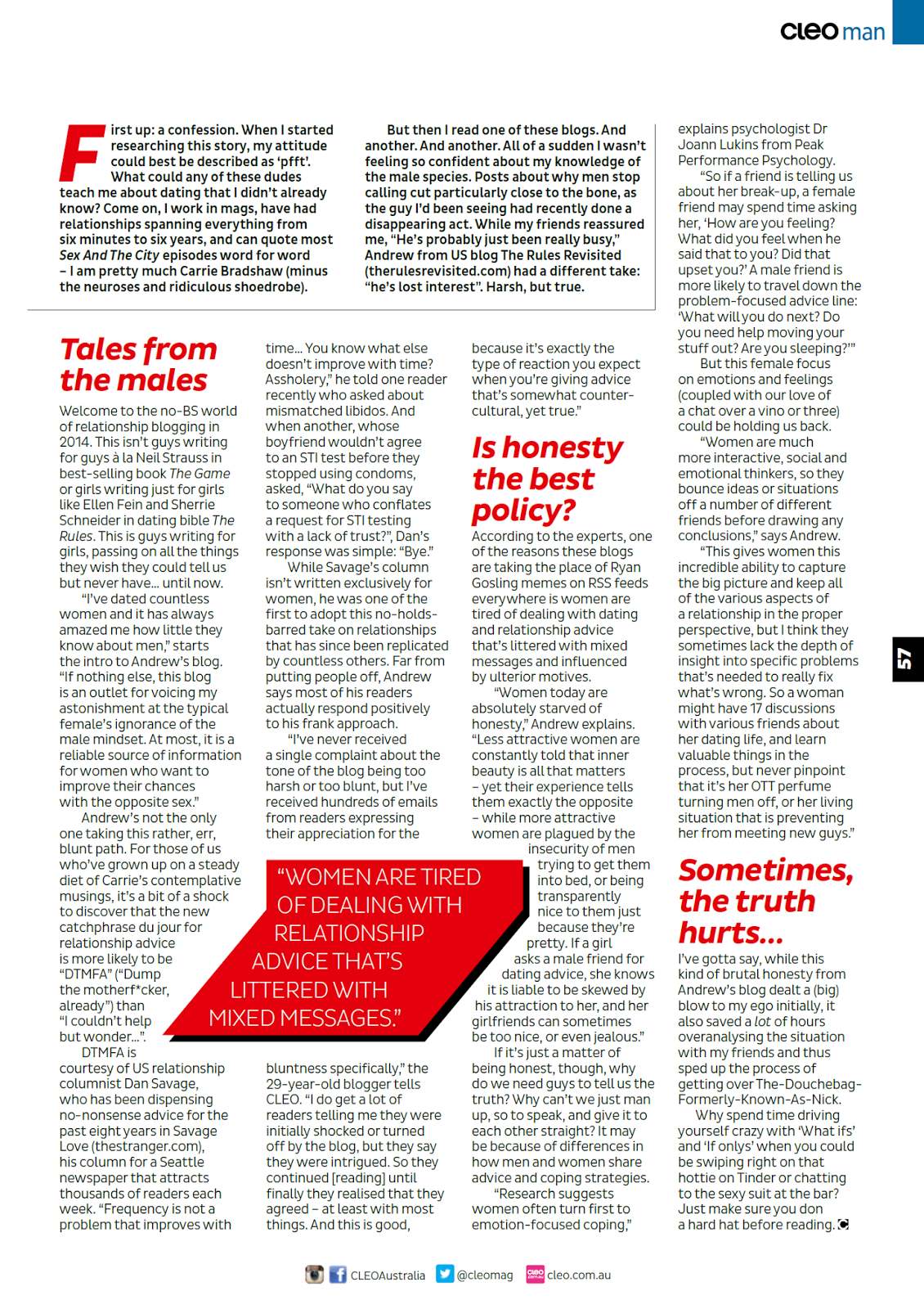
(Right-click and choose "Open link in new tab," then you can zoom in on the text)
I do get a lot of readers telling me that they are initially shocked or turned-off by the blog; but they say that they were intrigued. So they continued… and continued… until finally they realized that they agreed – at least with most things. And this is good, because it is exactly the type of reaction you expect when you are giving advice that is somewhat counter-cultural, yet true. Of course, I have to assume that some readers never get passed the “shocked” phase; I just never hear from them because they close their browser and move on. But that is expected also. Not everyone has an attention span and an open mind.

Ultimately, I understand that my readers appreciate my blog because they can trust it. They’d rather read a blog that they disagree with occasionally but trust completely, than a book or website that is trying to sell them something – even if it sounds good every time.

3. Has that response changed at all over time? How so?

It hasn't really, no. The number of people giving feedback has increased dramatically, but the types of responses (and the relative percentages of each type) haven’t changed.

4. What have been some of your most popular topics/posts?

One of the most popular has definitely been The Importance of Silence After a Breakup. Even though I wrote it fairly recently, it has already accumulated the second highest amount of traffic, and has by far the highest number of comments, which are overwhelmingly positive. I am in the final stages of writing a book that expands considerably on this topic, and how to handle breaking up with a man in general.

The post with the highest number of hits is Men Don’t Fall In Love The Same Way Women Do. The comments aren't all positive, but it has the largest number of and +1s on Google by far. I suspect its popularity is partially driven by the number of girls searching the internet for “how men fall in love,” (which is the number one search term leading to my blog) and the absolute absence of other material trying to explain it. I am in the process of writing a better post on the same topic at the moment.

A few others that have been very popular are:
What Men Think of You Without Makeup (this gets shared a lot on beauty forums)
What Men Think About Older Women (fairly controversial, as judged by the comments)

Some of my best posts are the newer ones, which dig a little deeper:

5. Your blog tagline says that, in your experience, women understand very little about men and the male mindset. Why do you think this is?

Well, for starters, it definitely isn't just women who are confused about the male mindset; men are equally confused about the female mindset – I just happen to write for women. There is a notion floating around that it has “always been this way,” but I absolutely disagree. A hundred years ago in Western societies, men knew what women wanted and women knew what men wanted. Even if they weren't happy with the rules of the game, and even if the rules were wrong, everyone knew them and played by them. But all that has recently changed, because we've rejected the old script. We live in a hugely tumultuous time for male-female relations. Men and women are “equal” now, but no one knows what to do anymore to attract the opposite sex. In the absence of any authority telling us how to behave, both sexes hear the word “equal,” shrug their shoulders in confusion, and assume that it means “the same.” We conclude that men want from women the same things that women want from men, and we act accordingly. But it isn't true. Social evolution (let alone biological evolution, which I think plays a part) doesn't occur that quickly. Both sexes still want significantly different things, but no one is telling us this anymore. And even though there is some overlap in our desires, this actually makes things more confusing, because it just serves to further mask the differences. Both sexes are currently standing in the rubble of a social battlefield, each trying to give the other what it doesn't want – mainly because we just don’t know any better.

6. In your opinion, what are the main differences in how men and women give each other dating advice?

That is a great question, because there are enormous differences. One of the largest symptoms of this difference, as I explained before, is actually one of the reasons that I started The Rules Revisited, and that is the complete lack of dating advice available for women on the internet – or in the media in general, for that matter. In the last 15 years, men have generated thousands upon thousands of books, blogs, websites, videos, businesses, etc. – each picking apart a different aspect of attracting women: overcoming approach anxiety, being authentic in a woman’s presence, mastering one-night stands, attracting women online, and so on. The sheer volume is impressive, and actually a huge testament to how much the male world revolves around the pursuit of women. But when you search for similar books or websites for women, you find very few – and many of them are actually written by men.

In my experience, women tend to seek dating advice mostly from friends. For example, my female acquaintances often ask me for dating advice; and I know that girls discuss it amongst themselves all the time. They love discussing it. They love telling their friends about what “he” said or did, gauging their friends’ reactions, and comparing related stories. Such a discussion is an event, to be enjoyed in-and-of-itself, whereas for men it is brief and purely practical – if it occurs at all.

There obviously are some women turning to the internet for dating advice, otherwise The Rules Revisited wouldn't have an audience. Probably this number is increasing, as people in general become more familiar with the power of the internet, realizing what lies at their fingertips. But there is no question that women lag men significantly in their use of written and internet-based dating advice.

In any case, we can say that the female approach to dating advice tends to be more social and discursive, while the male approach tends to be more individual and analytic.

7. Why do you think men and women approach dating advice so differently?

The sexes approach dating advice differently because the sexes think differently. The male mind is more inclined towards the kind of obsessive focus one needs in order to scrutinize even the tiniest of social interactions and break it down into usable rules. This is what we know how to do best, so this is the kind of advice we know how to follow.

Women are much more interactive, social and emotional thinkers. So they do what they do best: they bounce ideas or situations off of a number of different friends before drawing any conclusions. They feel their way through their questions, focusing on their gut instincts more. I also suspect that they are much more in tune with their friends’ and family’s emotional reaction to their dating situation, which is something that many men would never even consider.

I think it is important to point out that both approaches have certain strengths, but also certain flaws. The masculine ability to analyze is impressive, but men can get too easily trapped in a single problem, losing sight of the forest for the trees. For example, a man might perfect his online dating profile to the point that he has cute girls messaging him daily, or learn exactly how to react when his girlfriend tests his honesty or courage, only to realize – years later – that he still doesn't know how to keep a girl interested for more than three months.

The female strategy, on the other hand, gives women this incredible ability to capture the big picture and keep all of the various aspects of a relationship in the proper perspective; but I think women sometimes lack the depth of insight into specific problems that is sometimes needed to fix what’s wrong. So a girl might have 17 discussions with various friends about her dating life – and learn valuable things in the process – but never pinpoint that it is her short hair that’s turning men off, or her living situation that is preventing her from meeting new guys.

To borrow from the adage: a man is liable to forget the forest for the trees, while a woman is liable to forget the trees for the forest.

8.  Do you read other dating/relationship blogs? If so, which ones?

I read HookingUpSmart.com, written and run by Susan Walsh, which I very highly recommend for both sexes. For men I very highly recommend the sections of AnimusEmpire.com that are dedicated to “Manliness” and “Dating.”

Wednesday, November 27, 2013

How "Hard to Get" Should You Play?

Every woman has been advised at one time or another that she can increase her attractiveness to a man by showing him less interest, that is, by playing "hard to get." Most people don't disagree with this advice, at least not completely; they understand that there is a psychological mechanism by which people tend to want what they can't have. But there is plenty of disagreement about the degree to which this tactic should be applied. A lot of girls obsess over how to strike a balance between "too easy" and "too hard to get." They analyze text messages, scrutinize their response times, stress out about when is the right time to sleep with a guy, or wonder if they will lose their chance with a guy off by not making a move themselves.

The reality is that there isn't any strict rule about how "hard to get" you need to play. Or rather, it varies for each girl and in each situation. Some girls need to apply it more than others. There are girls that immediately cling to any interested guy that meets their minimum requirements, and these girls could benefit quite a bit by showing some self-restraint. On the other end of the spectrum, there are girls with colder dispositions that would dissuade even the most persistent men by playing any harder-to-get than they already do. How hard-to-get you should play also depends on the guy in each situation. More persistent men will push through a higher amount of resistance, while those with a lot of options or lower degree of interest in a girl will be more easily deterred. You could drive yourself crazy trying to figure out where exactly along each spectrum you and he lie, and how to calibrate your behavior accordingly.

The good news, and the main point I want to make here, is that you really shouldn't over-think this. If a guy is interested in you, there is a wide margin between the behaviors that will make him think of you as "needy" and "uninterested." It will be incredibly difficult to change his interest in you by small things like agreeing too readily to a date, or being too enthusiastic in your texts. As long as you are agreeing to go out with him and not acting bored when you spend time together, you are showing more than enough interest to avoid discouraging the average guy. And as long as you aren't asking him out all the time, or initiating contact with him regularly, you aren't going to appear needy enough to turn him off.

Now, if a guy isn't that interested in you, the thresholds for "needy" and "uninterested" will be closer together, and smaller "mistakes" might cause him to change his mind about you. The girls that obsess over their behavior or the content of their text messages are usually dealing with a guy like this. In fact, his nonchalance about the relationship is usually what drives this hyper-awareness in the first place. The mistake these girls make is to think that their behavior that is responsible for the guy's decision to stop seeing them. While this is true in the limited sense that their behavior triggers the guy's decision, the reality is that his lack of interest was making it next to impossible not to trigger that decision.

Think about it this way: if a guy can be turned off just because you use the wrong adjective in a text, or sleep with him a couple dates too late or soon, or do some other small thing "wrong," then there isn't enough attraction there to sustain a relationship anyway. It was a losing battle from the outset. If the guy doesn't like you enough that you can behave naturally, then he doesn't like you enough for a relationship to last. There is no way you can perpetually guard every word and action around him, or control every emotional impulse forever; at some point you need to be able to relax and be yourself, and he needs to like what he sees when you do so. If you are in a situation where you are stressing out about what to do or say around a guy, your problem isn't your inability to know how to act, or your inability to calibrate your behavior, it is your inability to be comfortable with rejection.

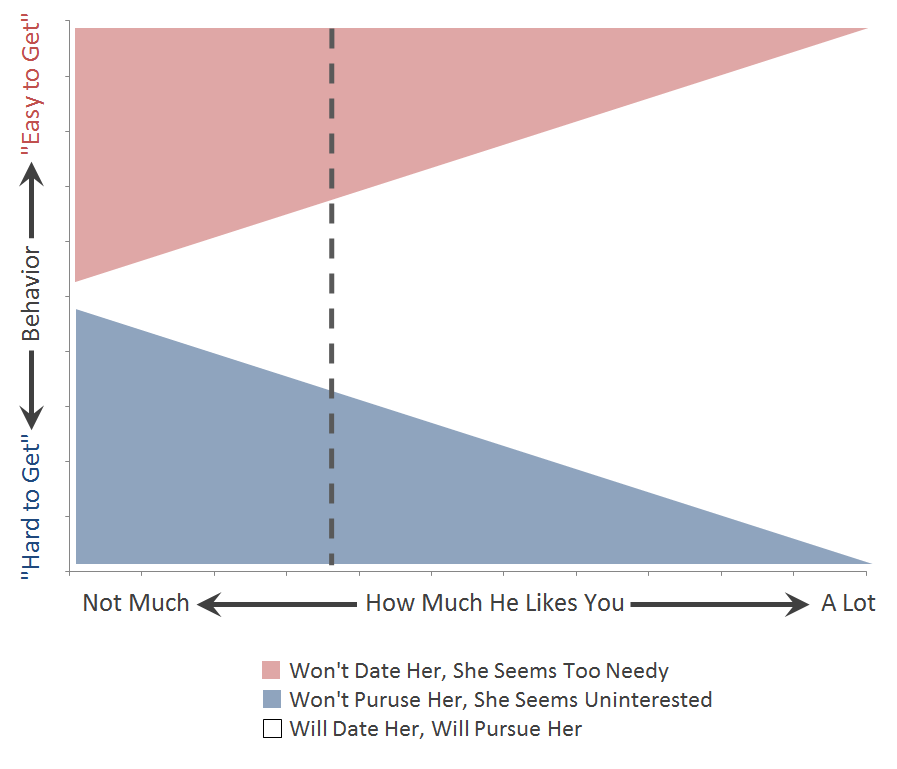
This phenomenon can be illustrated with a simple plot, as shown below. The whole point is that it isn't worth spending your time in a dating situation that falls to the left of the dotted line. If you do, there won't be enough leeway between "needy" and "uninterested" behavior to allow you to be yourself in the relationship. In order to avoid the (red or blue) "no date" zones, you'll have to be constantly guarding your behavior in the same obsessed way that you are right now, as you attempt to get into or hold on to the relationship that is causing you so much stress. Where exactly the dotted line falls is something you need to decide for yourself; but you need to recognize that a limit exists. Until you do, you are going to give yourself a lot of grey hairs - and have nothing to show for it in the end.


Incidentally, guys make the same mistake all the time in their attempt to attract girls. It is particularly evident when you watch guys trying to figure out how to approach and pick girls up. If you could see how obsessively men try to figure out the right thing to say to a girl, or the best way (or time) to approach her, you would know exactly what I mean.* Men are constantly over-analyzing these things. What many men don't realize, is that if they need to force their behavior into a tiny, perfect mold in order to attract a girl, then they aren't going to be able to hold onto her for very long. The act can't be maintained forever; eventually they will need to relax and behave naturally, at which point the tailored personality that attracted her will disappear, and so will she.

In light of all of this, the goal - for men and women - should be to work at self-improvement slowly and steadily - in the long-term, but to relax and be themselves with the opposite sex in the moment. So if you are finding yourself constantly calculating your next "move" in a relationship, or watching your words too much, recognize that you are probably fighting a losing battle. Take a deep breath, relax, and focus instead on making yourself vulnerable to the possibility of rejection. Remember, sometimes it is a good thing.

______________________________________
* In fact, you can see this if you just do a Google search for "pick up artist" or "approach anxiety" and read the uncountable number of websites, blogs and books that have been written in an effort to perfect these things. In fact, I am convinced that men freak out about this stuff way more than women do. Perhaps this is because the pressure is on us to make the first move, but the obsession is still there.


Related Posts
1. Self-Improvement Takes Time
2. On Being a "Typical" Girl
3. Get Used to Rejection
4. Living Vulnerably
5. Don't Initiate Contact

Wednesday, August 28, 2013

If a Man Talks to You, He Likes You

I have made this point before, but only briefly; and as simple as the point is, it warrants further explanation.

If a man goes out of his way to interact with you, he is interested in you romantically or sexually - at least to some degree. A lot of women don’t realize this, because when they approach a man (for example, to ask directions in the street), they don’t do so with romantic or sexual intention. They wrongly project their own lack of intention onto the men who approach them. They think “When I approach a man, I don’t have romantic or sexual motives; so this guy asking me for directions has no ulterior motives.” But they are wrong.

If you are skeptical about this, consider that the same phenomenon is manifested in men. Men always “get the wrong idea” when a woman responds to their texts, or engages them in conversation in a bar, or doesn't spit on them and walk off when they ask her for directions. The truth may be that the girl is just being polite, or that she genuinely believes the guy just needs directions, but the man projects his own intentions onto her. He thinks “When I talk to a woman even for casual reasons, it is because I like her. This woman is talking to me, so she must like me.”

Yes, of course, there are exceptions to this rule. Sometimes a guy genuinely needs directions, or really is just talking to you to kill time at the bus station. But the point is that these exceptions are far rarer than you think. In fact, the exceptions are so rare that you are better off always assuming that men who approach you are interested than you are questioning it each time. In the rare instances that a man isn't interested, you have nothing to lose by assuming that he is; and the increased confidence you’ll have knowing that he is into you will help you to be your best self in his presence, which will attract him further.


Related Posts

Tuesday, June 18, 2013

Why Getting Him Back Won't Help

I need to give some advice that doesn't fall strictly into the category of "here is what you don't realize about men" (or what men like) - not because I want to change the theme of the blog, but because the misunderstanding it corrects is rampant in young relationships, and hopefully pointing it out will free some mental space in the minds of young women so they can instead focus more on their misconceptions about what men want, or other more-important things.

I have answered dozens if not hundreds of e-mails asking for advice about how to correct a relationship after a break-up or a break-up attempt. They usually sound something like this:
My boyfriend and I have been together for over three and a half years. About two weeks ago, he told me he was questioning the relationship and thinks he wants to break up. He told me that he dislikes X, Y and Z about the relationship and thinks they are signs that we'd both be better off with someone else.
We talked about it, and eventually he changed his mind, because we were both more open and honest with each other. We ended agreeing to give it another shot, and to do X, Y and Z differently. So we're still together.
I am glad we worked things out, but now I feel like he has all the power. It's like I got "almost-dumped." I'm not completely happy with the situation but I am also unsure about how to proceed. What should I do??
In other situations, one person breaks up with the other, and then (by either party's initiative) the couple gets back together, thinking that "this time it will be better." In either case, the important characteristic is that the relationship reaches or nears its end, only to make what seems to be a thankful recovery.

The main problem in these situations normally isn't that one person can't follow through with the promise to change X, Y or Z (though this too is very frequently true, and a close secondary problem). The main problem, and what most people fail to recognize, is that when a relationship nears or reaches a failure point, its limits are defined.

Prior to such an episode, each party could believe - and usually at least hoped - that the relationship was strong enough to sustain limitless difficulties. Neither party knew how much it would take to break the other's feelings or commitment. But a break-up (or near-break-up) changes that irreversibly. Suddenly one partner knows that the other's commitment has real limits. What was once "a love that knew no bounds" and apparently bottomless, is shown to be of finite dept - maybe even shallow. So the disappointment comes, not because the relationship is broken, but because it is shown to be breakable.


There is an additional aspect of this phenomenon that makes it all the more condemning. While each partner previously compared their other dating options to something of unknown and conceivably infinite strength (i.e. their existing relationship), a doubt-forming episode will mean that they now compare their options to something they know to be finite, and perhaps even weak. Both the man and woman will convince themselves far more easily that things could be perfect with someone else, because their optimism about dating, stripped of its previous object, needs a new outlet. So in addition to seeming weaker in-and-of itself, the existing relationship will now be compared to inflated alternatives.


I have a very good guy friend who has been married for six years. His wife recently asked him for a divorce. He confided in me recently that this is actually the second time it's happened; two years into the marriage she did the same thing. At the time, he refused the divorce. He wanted to try to make it work, so they talked it through and she agreed. He essentially convinced her to "work on the relationship" and try to make the best of it.

Four years later, she's done the same thing, and this time, he isn't fighting it - because now he recognizes what I am saying here. Those four years, he admitted to me recently, were always spent in doubt of her feelings and fidelity, caused by the simple fact that she voiced her discontent. The relationship was ostensibly maintained, but the reality was that it had already been undermined by her attempt to end it; and my friend proceeded to waste four years trying to salvage what he essentially knew was dead after two.

Granted, there are some instances in which a break-up or fight doesn't reveal a relationship's depth, just as there are situations in which you might be willing to live with the limitations that such an episode often does reveal. The point here isn't to imply that all break-ups or fights are premonitions of ultimate failure, but to point out that if you find yourself disappointed in spite of having "saved" your relationship from a bad episode, it is almost certainly because that episode showed you that your relationship is more fragile than you'd hoped. So before you spend all kinds of emotional energy trying to get your boyfriend back or resisting a break-up, ask yourself whether just having him (or just having him back) is actually enough to satisfy you.

-------------------------------------
If you liked this post, you'll definitely like my book, Beyond the Breakup. In fact, this post has been included as one of the chapters, along with others that explain how to react when your ex tries to contact you, how to understand his motives for doing so, and much more.


Related Posts
1. Why Do You Want Him Back?
2. Why Rejection Is a Good Thing
3. Get Used to Rejection

Thursday, April 4, 2013

Men and "Friends With Benefits"

While explaining her relationship with a guy she is interested in, a reader who recently wrote to me for advice reminded me of the difference between the typical male and female approach to being "friends with benefits":
I guess we're friends with benefits because there's no commitment on both parts. I also made a conscious choice that it was only purely physical with what happened between us (only twice by the way). But I liked his company and the flowing conversations we had. I didn't put any pressure on him either. I had no illusions, in other words. I was, however, hoping that we could learn more about each other slowly and establish a good foundation before going to the next level. But again, I had no illusions.
The simple fact is that men almost never fall in love this way, despite what you saw in the fictional movie (emphasis on fictional), No Strings Attached. The woman quoted above might not have had any illusions about the fact that the relationship was purely sexual, but I suspect she did have some illusions about just how unlikely it was that her love interest would change his perspective on the relationship. If she hadn't, she wouldn't have wasted her time.

It has been my experience - both personal and vicarious - that the vast majority of women view a casual sexual relationship as a potential stepping stone towards a relationship. Men, on the other hand, see it as nothing more than what it sounds like: sex with no emotional ties, no commitment, nothing. If anything, men treat it as a step away from a committed relationship, because if they wanted more from a woman, they wouldn't settle for mere sex; they'd want her exclusivity also. (If this sounds familiar, it is probably because it is almost identical to the difference between the male and female perspectives on moving in together before marriage.)

Any man who is mildly observant of the opposite sex will have a hunch in the back of his mind that this kind of relationship is bound to explode eventually. But he isn't going to turn down all of the commitment-free sex he'll get in the meantime just because of some "feeling." Men don't trust feelings the way women do. Men are hyper-rational, literal creatures. If it is called "no-strings-attached" relationship, that's exactly how he treats it, no matter how much cuddling and hanging out is involved.

Furthermore, a man will often be willing to engage in a relationship like this with a woman who is below his league, in the same way that many people will have lower standards for the quality of the house they lease, as opposed to the one they eventually buy.

Yes, of course, I know, there are occasional exceptions. There are always exceptions. Once in a while, a long-term relationship or even a marriage can grow out of something that started as friends-with-benefits. But the point is that, when it comes to casual sexual relationships, the exceptions are so rare that you'll be far better off avoiding them completely than taking a gamble on even the most apparently promising ones.

So before you jump at the opportunity to "get closer" to the man you want by making things sexual, recognize that his willingness to engage in a casual sexual relationship with you is actually a step away from commitment, not a step towards it.

Saturday, February 23, 2013

Why You Can't Get the Men You Want

Most women who complain that they "don't get any attention from men" actually mean that they don't get attention from the men they want. And the simple advice for women in this situation (which I have seen on other blogs, and have occasionally given out myself) is sometimes appropriate: "you aren't hot enough to get the guys you want; lower your standards." However, in most cases, I think there is deeper phenomenon at work.

Women tend to be aware of and rate their looks fairly accurately. I know this because a lot of readers send me pictures saying "I think I am an X out of 10, can you tell me what I really am?" Although I always refuse to give them my numerical opinion (because all men think differently), their guesses are usually very close to what I would have ranked them.

So why would they set the bar so much higher than what they know they can get? Some might point out that their "delusion" is caused by their experiences getting men who are out of their league for sex and casual dating. And though I agree that this happens, it doesn't capture the whole picture. Women just aren't that easily deceived about their own physical attractiveness. It shouldn't be surprising, then, that the problem is primarily an internal one.

Each of us has an inherent knowledge of our own capabilities and dispositions. We know the inner workings of our own mind: how honest we are, how prone we are to mood swings, our insecurities and strengths, what we've experienced, what we still need to learn, the strength of our ambitions, etc. This translates into an excellent knowledge of our personal capabilities, our personal potential. We all know roughly what we could achieve, whether or not we have achieved it. Occasionally we modify this self-perception when we realize the extent of strengths we didn't know we had, or weaknesses that have greater implications than we'd imagined. But in general, we know ourselves well; we know what we are capable of becoming. This is true in all aspects of our lives: business, working out, academic learning - everywhere. It also applies to dating. Because we know ourselves, we also know roughly what we should be able to get when it comes to the opposite sex.

A statement that often accompanies women's complaints about not getting the men they want is something to the effect of "I know I am a catch. I have so much love to give a man. Why can't men see that??" This is a symptom of the above-described phenomenon: you know that you have the right "raw material" to attract the kind of man you want (in fact, "the kind of man you want" is partially defined by your self-knowledge), but you are confused about why it hasn't happened for you yet.

The reason for this is simple: your self-perception of your potential is roughly accurate, but you aren't living up to that potential. You aren't the person you know you can be. You have the capability, but you haven't used it. You have the potential, but you haven't fulfilled it. You know you can be a fun and exciting person to be around when you feel comfortable, but you haven't confronted your insecurity in social situations, so men don't realize this. You know you have a great figure, but you haven't learned yet to show it off by correcting your posture, so no one notices it. You know you have great hair, but you don't put the effort in to style it well, so it does you little good. You know you are pretty, but you haven't confronted your fear of looking a little awkward, and this has dramatically slowed your efforts at learning how to dress yourself well. Your are well aware of your inner feminine self and you instincts to nurture and love, but you suppress them (as you've been implicitly told to do by your parents or the culture around you) and men assume you are cold and boring. You know that you are an incredibly sexual person, but because of your strict conservative upbringing, you cloak it in "modesty" and men are turned off.

The reason women can't get what they think they deserve is that we (men and women alike) always peg our standards to what we know we can be, not to what we are, while members of the opposite sex judge us - understandably - only on what we are currently. They have no access to the inner workings of our mind; and even if they did, they would have no guarantee that we'd ever reach the potential this would reveal to them. So your discontent in dating boils down to the fact that you aren't living up to your own standards - yet. Incidentally, this also explains why most people have such an aversion to settling: our subconscious knowledge of what we "should" be able to get is achievable (if not currently accurate), so it seems defeatist to accept something less.

I've illustrated an example of this in the diagram below. A woman who is a 5.5 out of 10 has the potential to be a 7.5, so she "knows" that she can get men of that caliber (red arrows). She is constantly setting her sights on men who are in the 7-8 range (dark blue arrows), and she is constantly being rejected by them. She doesn't understand why, since she thinks these men are in her league, when the truth is that she could get into their league. Her situation isn't helped by the fact that a lot of the men she wants haven't met their full potential yet either, meaning that they - also wrongly - have their sights set on women of an even higher caliber (light blue arrows).

Rank out of Ten (Combined Looks and Appearance)

So the bad news is that you probably can't get the men that you think you can get. But the good news is that you probably can eventually get the men that you think you can get - assuming you are willing to work at it, and do. The biggest takeaway, though, is that if you aren't getting the men you want (but you think that they are in your league), your first move shouldn't be to lower your standards, it should be to self-improve.


Related Posts

Friday, February 8, 2013

The Analogy Between Sex and Commitment

A recent post on Hooking Up Smart really grabbed my attention. The first item in the post 7 Reasons Why Women Reject Eager Men reads:

Women understand the male role as the gatekeeper of commitment, just as we [women] are the gatekeepers of sex. In the same way that a man may question the long-term potential of a woman who grabs his junk on the first date, women are wary of men who are “emotionally promiscuous.”

This idea is huge, and it has been on my mind since I read that post. I've practically been able to feel the gears in my head turning as I've considered the various implications, and recalled instance upon instance in which I've seen it demonstrated. It's been eye-opening just thinking about it. I thought I would share some of the ways I've recognized the concept at work in typical inter-sex dynamics:

  • Men are always trying (and failing) to elicit sex from women; women are always trying (and failing) to elicit commitment from men.
  • A man doesn't owe a woman his commitment any more than a woman owes a man her body.
  • Women complain about men being "afraid of commitment" when the men refuse to date them seriously, in the same way that men complain about women being "prudes" or "bitches" because they won't go home with them.
  • Ideally, in a long term relationship, a man freely gives his loyalty to his woman, and a woman freely gives her body to her man.
  • This blog and books like The Rules or Why Men Love Bitches - which all essentially try to help women attract and get commitment from men - are the perfect analogues to the thousands of blogs and books teaching men how to get laid.
  • Men and women are both disappointed by the opposite sex equally: women get dumped (or not called back) by men just as often as men go home from the bar or club empty-handed.
  • Men don't respect women who have sex too soon; women don't respect men who say "I love you" too soon.
  • While neither of these are something either sex looks for in the other, a man is unsurprised if a girl has given herself to many men emotionally in the past (i.e. committed to them), just like a woman is unsurprised if a man has fucked a lot of girls (i.e. given himself to them sexually).
  • Men like that a woman can easily attach to a man emotionally, just like women like that a man can easily attract women sexually.
  • Men get frustrated at women who deny them sex after dating for a long time in the same way that women get frustrated with a guy who won't say "I love you" after dating for a long time.
  • A man feels bad when his woman says "I love you" before he is ready to reciprocate the expression, in the same way that a woman feels bad telling a guy she isn't ready to sleep with him when he tries to have sex with her. 
  • Some women feel drawn towards a man when they learn that he has never been in love before, while some men have fantasies about taking a woman's virginity.
  • Women love to discuss relationships and each others' involvement in them (who has commitment from whom) with the same enthusiasm men have for discussing their sexual escapades.
  • Men usually escalate a relationship physically (towards sex) whereas women usually escalate a relationship emotionally (towards commitment).
  • Women take pride in being able to get a guy to want and commit to her (even if she isn't that into him) in the same way that men take pride in getting a girl to let him have sex with her (even if he isn't that into her).


Related Posts