Showing posts with label boyfriend. Show all posts

Saturday, January 30, 2016

Your Ex's Birthday Doesn't Matter

One question I receive from readers frequently goes something like this:
"My boyfriend broke up with me because of X, Y or Z reason. It has been tough, but I've been following your advice, and I haven't contacted him at all since it happened. He texted me a couple times asking how I am, but I didn't reply. The thing is, his birthday is next week. It is OK to send him a message to say 'happy birthday'? I don't want him to think I am rude."
The answer is definitively, absolutely, always, without a question "no."

I don't care that you've decided to "remain friends" or how close you still are. I don't care if he got you a huge present last year and you "feel the need to return the gesture." I don't care if you say "but we just broke up a couple days ago," or that "I always do that kind of thing for people I care about, and I still care about him." And I definitely don't care if you "just think it would be kind of mean not to."

Don't do it.

All of the above are rationalizations - mere excuses for remaining in contact with him, for trying to re-initiate something or seeing if he'll take the opportunity to re-initiate something given the chance. He isn't your boyfriend anymore, and as I explain in my book, he really isn't a friend or acquaintance anymore either. He is an ex, you're single, and as long as you are keeping strings attached to him you aren't attaching new strings to someone else.


Related Posts
1. Book Release: Beyond the Breakup
2. No, You Can't Be "Just Friends"
3. Stop Having Sex to Prove He Likes You

Tuesday, May 19, 2015

You Shouldn't Want a Boyfriend

The other day, a girl I've been seeing casually for a long time told me that she "really needs to find a boyfriend." I've known several single girls who have communicated this to me in one way or another, and they haven't only been hinting at the fact that they wanted me to be that boyfriend; they've also been expressing an honest desire. Some have suggested it through their behavior or by talking around it; but a few, like this girl, have said it explicitly.

The problem with wanting a boyfriend is that it isn't wanting a husband. Yes, of course, for some girls, saying "I need a boyfriend" is just an abbreviated way of saying that they want to meet a guy who they can date and who will eventually propose; but I wouldn't be writing this post if that applied in every case. Some girls only mean that they are tired of being lonely - that they just want companionship and to feel loved again. They might have some minimal requirements for the boyfriend, but the point is that those requirements fall significantly short of the ones they have for their future spouse.

If your end-game is getting a boyfriend, you aren't going to be filtering the men you date for their long-term compatibility. You'll get into relationships that you could have known from the outset would be terminal (if you'd stopped for a moment to think about it), and you'll end up wasting your time. So be honest with yourself about what you want in a man - maybe even write it down - and don't give in to the temptation of temporary companionship and affection.


Related Posts
1. Know Why You Are Dating
2. Don't Let a Guy Waste Your Most Eligible Years
3. Why Men Are Capable of Commitment
4. How "Hard to Get" Should You Play?
5. Men and "Friends with Benefits"

Friday, August 22, 2014

How to Set Up Your Friends

Most women I've met like the idea of setting up the single men in their lives with the single girls in their lives. In other words, they like match-making. Mothers seem to love this more than most, presumably because it puts them back in touch with the romantic spark that is often dead in their own relationships. Perpetually single girls love this too, probably because having influence over someone else’s love life is the next best thing to having control over your own. But normal girls like it too, and this is understandable because it is only human to want to have an influence on other people's lives (it is human to want to have influence in general). In the same way that it is empowering to know that you were the one who got your friend the job that was the springboard for her career, it is empowering to know that you introduced her to the guy that finally gave her confidence in her dating life, or even the guy that she eventually married.

Now, let me preface what I am about to say by pointing out that setups are usually a bad idea. In the vast majority of cases, the very fact that your friend needs help finding love is a good indication that your attempt to help is going to fail. This is because the problem is never one of "just not having met the right person yet." It always runs deeper. Maybe she is insecure, or too introverted, or overweight. Maybe she is trying to be masculine, or makes herself unapproachable. Whatever the case, her inability to take charge of her own romantic life isn't merely a matter of bad luck; it is a symptom of a deeper problem, which your attempt to introduce her to someone new isn't doing anything to solve. It's like giving another book to a child with a learning disability, and thinking "this time he'll get it." Exactly. It isn't going to happen.

So with that background, let's take a look at what most people do when they try to set up their friends (because this blog is for women I am going to use the example of a girl, but guys make the same mistake). Once a girl sees a potential match in her social circle, she goes to the girl and guy separately, and tells each of them that she knows "someone that they have to meet." She might tell each person a few things about the other, maybe show them some photos, and she gets them to agree to the setup. Then she arranges some kind of event at which the two people have the opportunity to meet each other. She's "really good at this" because she never lets either person know that the other one knows it's a set up. That way it won't feel forced or awkward. Perfect, right? Wrong.

The problem isn't that the person thinks that the other knows about the setup. The problem is that the person themselves knows they are being set up. And they knew this the very moment the girl told them there was "someone that they had to meet." This does two things: first, it generates expectations and makes both parties feel like they have to perform, which of course results in an encounter more awkward than a new graduate's first job interview. More importantly, however, and what I want to point out here, is that it destroys the single most important thing for someone who struggles with their dating life: autonomy.

Let's look at this from a the guy's perspective...

One of the hallmarks of masculinity is self-control: men want to be in control of their lives, and by extension, they want to be in control of their dating lives. A man will never feel good about himself if he can't initiate and perpetuate his own relationships. (Remember that his inability to do so is the reason his friends want to set him up in the first place.) By setting a guy up, you are essentially stepping in and putting training wheels on his bike - reminding him that he cannot handle himself. Yes, it might be true that he rides poorly (or not at all) without those training wheels; but by taking control of his dating life you are making him feel like a child, and he won't respect himself for any girl he "gets" with your help. He also won't respect any girl that he needs help to meet, because men know instinctively that women are attracted to men who don't need help: men who are in control and confident with their own capabilities. In other words, he knows he can get a better girl if he gets his shit together and deals with his lack of options himself.

You might argue that without some initial help, a guy (or girl) will never date anyone at all. To use the bike analogy, you might argue that, yes, a guy might not respect himself for using training wheels, but without training wheels he will never learn how to ride. But this argument assumes that his problem is balance. In real terms, your insistence on setting him up assumes that his problem is meeting girls. But as I pointed out at the beginning, this is never the case. His problem isn't one of balance, it is the fear of crashing. His problem isn't one of meeting girls, it is the fear of rejection; and setups do nothing to help him overcome that fear.

There is a feminine perspective on this too. When it comes to match-making, the feminine problem is that a girl will not respect a man who needed the help of a friend (i.e. you) to meet and attract her. This isn't only a matter of judging the man's courage, or the social abilities needed to make a connection with her. Women know that if a man is motivated enough, he will dig down and find that courage, and make something happen - or at least he will try. You want a man who desires you enough to push through a crowd to meet you, or takes some kind of initiative. At very least, you want a guy who does more than accept dates that are handed to him because his friends think he has no other options. A girl who finds herself in a relationship that started that way won't respect him, won't respect the relationship, and won't respect herself. So deep down, girls doesn't like being set up any more than guys do. They might like being single even less, but they'll be even less enthusiastic still about being dumped once their boyfriends wake up, and realize that they are only with those girls because they never had the balls to go for what they really wanted.

I am sure many readers know people who have had successful relationships after being set up, some of which might have even lead to marriage. My parents were set up, and they've been married more than 30 years. Maybe you were set up and are still with your boyfriend. And that's fine. But it doesn't mean that those cases are ideal or likely, or that they do anything to strengthen the inner core of the relationship.

So what do you do? How do you help facilitate a match that you think has potential? Well, you let both the guy and the girl ride without training wheels. You encourage them to take control of their own dating lives, and then you let them do so. This doesn't mean that you can't set them up, but it does mean that you can't tell either of them you are setting them up. Here is what you do: you invite them both to whatever event you've organized, then you sit back and see if they connect. Nothing more, nothing less. If he doesn't take the initiative on his own, nothing happens, and that's OK - or at least, it isn't something you can correct by stepping in and facilitating the connection any more than you already have.

Of course, it isn't always the case that the person you are trying to set up has any problems dating or attracting the opposite sex. Maybe they have plenty of options, and you just happen to know someone who would be a great match for them. But in these cases, you won't need to do anything other than introduce the two people anyway; they will be perfectly fine on their own if there is an attraction, so the strategy is the same: introduce, step back, and let it happen. Nothing more.


Related Posts
1. You Are Responsible For Your Own Romantic Happiness

Monday, February 24, 2014

6 Ways Men Mask Their Indifference

Whenever you are dating or seeing a guy, and there is some kind of external impediment to a normal relationship (or to the normal progress of a relationship), be skeptical of what "feels" true. By external impediment, I mean some factor outside the relationship that is making things between you difficult or impossible. You can scan the headings below to get an idea of what I mean. A man's affection in these situations will sometimes feel very much like the real thing, when the truth is that he is only allowing himself to fully express his feelings - or even slightly exaggerate them - because he knows that he is engaging in an impossible (or terminal) relationship. In other words, he will indulge in the relationship because he knows that he has an "out," and commitment will never be demanded of him.

Some men will do this in a manipulative way: they will consciously acknowledge to themselves that the relationship is a dead end, but act like everything is fine in order to continue in a fun or exciting or comfortable situation. More commonly, however, men will simply enjoy the relationship or the interaction with you, and will sub-consciously allow themselves to be more free with their affections or emotions or compliments, because they know in the back of their mind that they will never be forced to prove them by committing to you.

This isn't always the case, and your intuition is probably a strong guide in judging whether it applies in your case; but that intuition will be stronger still after understanding that this kind of behavior is a possibility, and recognizing the following ways in which this phenomenon can manifest itself:

1. Long Distance
This is probably the most common one. When a man is in another city or country, the pressure is off. He might not be cheating, but he is automatically expected to see you less, call you less, and generally be less involved in your life. Even though there is no impediment to him calling frequently, as he would if he were living down the street, it isn't expected of him. I've never been in a long distance relationship, but a few times I've kept in touch (for several months) with girls that I've met while traveling, so I know what this freedom feels like, and how low-investment those relationships are. The fact is that, if you are in different cities, you aren't on his mind anywhere near as much as you would be otherwise. When you are in the same place as a man, you occupy his thoughts frequently because there is always a possibility that you will be able to see each other soon. He is constantly entertaining this possibility in his mind, weighing it against other options. Even if you don't see each other as much as you'd like, he is still forced to think about that possibility (and therefore you) far more often. You are much more immediate to him. But when you are dating long-distance, there is no possibility to be together, and he mentally "shelves" you - that is, he makes you less of a priority in his life - because he knows that physical intimacy is not possible (and I don't only mean sexual intimacy). So a man in a long-distance relationship can put in far less effort to maintain the same level of commitment from you.

2. Technology
By technology I mean cell phones, text messaging, e-mail, etc. While these might seem to be facilitators of a relationship (as they make communication easier), they can often be exactly the opposite. Technology diminishes the amount of personal interaction that we have when we communicate, and, perhaps more importantly, allows us to multi-task. A guy can chat with you online every day, sometimes for hours, but because he is bored at work, while you are thinking "He texts me all the time even though he is busy at work." One time a girl thought I was falling in love with her because I called her almost every day for a couple weeks while I was driving home from work. The reality was that I just enjoyed talking to her and flirting, and I had nothing else to do during my commute. By the time I realized how much she'd read into it, it was too late. In extreme instances, a guy could be texting you from another woman's bed. Even if he doesn't multi-task like this, and uses his free time to contact you via chat or phone or video, it is less valuable than it is if you see him in person. If a guy spends an hour with you on video-chatting, for example, he only needs to be in front of his computer (or these days, his smartphone) in order to do it. In order to spend time with you in person, he would have to shower and get changed, travel to be with you, allow extra time for uncertainties like traffic or a change of plans, and then commute back. That one hour would be effectively two or three by the end of it. So interpret anything less than in-person one-on-one time with the caution it deserves.

3. His Relationship
Married men who are cheating on their wives, or guys who flirt with you even though they have a girlfriend, will never have to demonstrate how willing they are to commit to you. They can always hide behind their inability to leave their current woman. Judging from the e-mails I get, it is fairly common for men in marriages to profess their love to a mistress, but simultaneously claim that their hands are tied: "I would do anything for you, you know that - but I have a family; I can't just leave them." Getting involved with married men is a bad idea for many reasons, but this is an important one. He can continue to have the benefits of a secret relationship, always blaming his lack of intimacy on the fact that he is married and has and family, when the truth is that he wouldn't enter a serious relationship with you even if he were single. More commonly, a guy with a girlfriend might flirt with you and get your hopes up, when the reality is that he wouldn't want to be your boyfriend even if he were single; and it is precisely the knowledge that he can't be your boyfriend that gives him the liberty to engage in flirting with you. 

4. Your Relationship
You might be dating a guy that you are only semi-enthusiastic about, or thinking about breaking up with. Or perhaps you are married but unhappy. And there is a hot, single guy in your life that gives you a lot of attention. In fact, you are sure that if you weren't tied up, he'd be all over you. Think again. Men often allow themselves to enjoy the flirting, the sexual tension, the affirmation of your attraction and all the other makings of a courtship when they know that there is no pressure on them to follow through. They might not be attracted to you enough to make a move, but they will allow themselves to engage in the fun parts of the exchange because they know they will never have to. This is essentially the same mechanism as described in the previous point, except that it is a little more risky for the man, in the sense that he isn't in control of whether or not you end the relationship that is "preventing" something from happening between you and him.

5. Academic Degrees or Careers
I am sure some readers have been told "I love you, but I can't get engaged now; I need to graduate first." This might be true, but evaluate that statement with a heavy degree of cynicism. He could truly feel the need to get a piece of paper before making a commitment, or he could be uncertain about making a commitment to you at all and using his education as an excuse. Are you willing to wait until he graduates only to find out that he actually isn't as serious about you as you thought, or that he wants to "spend some time on his own" before he can commit to a future with you? The same kind of thing can be said about getting a promotion at work, or achieving financial stability (whatever that means), or buying a house. It all has potential to be bullshit.

6. Religious or Cultural Differences
Maybe your guy has told you that he "can't marry a non-Indian girl" (and you are American) or "I can't marry a non-Jewish girl" (and you are Catholic). While both of these might be perfectly true, men will often acknowledge their cultural or religious limitations and still continue to date you. I know plenty of guys who have done this, and the women simply hold on, thinking that maybe he will change his mind. Especially when it comes to culture and religion, you should take these men at their word: the relationship is a dead end. While there are a few Romeo and Juliet stories in the world, they tend to be played out only when both parties have little else in life to lose, not by people with comfortable lives and limitations imposed by cultures or creeds that they don't actually engage in or practice anyway. If you are trying (for example) to get a Hindu Indian doctor from a wealthy family to marry you, when you are a dark-skinned Muslim without an advanced degree, and his family has "expectations" about who he will marry, you are fighting a a losing battle against unreasonable prejudice: give up and cut your losses.


Related Posts
1. Men Don't Have Commitment Problems
2. The Analogy Between Sex and Commitment
3. The Dynamics of Dating Shy Men
4. Don't Let a Guy Waste Your Most Eligible Years

Wednesday, November 27, 2013

How "Hard to Get" Should You Play?

Every woman has been advised at one time or another that she can increase her attractiveness to a man by showing him less interest, that is, by playing "hard to get." Most people don't disagree with this advice, at least not completely; they understand that there is a psychological mechanism by which people tend to want what they can't have. But there is plenty of disagreement about the degree to which this tactic should be applied. A lot of girls obsess over how to strike a balance between "too easy" and "too hard to get." They analyze text messages, scrutinize their response times, stress out about when is the right time to sleep with a guy, or wonder if they will lose their chance with a guy off by not making a move themselves.

The reality is that there isn't any strict rule about how "hard to get" you need to play. Or rather, it varies for each girl and in each situation. Some girls need to apply it more than others. There are girls that immediately cling to any interested guy that meets their minimum requirements, and these girls could benefit quite a bit by showing some self-restraint. On the other end of the spectrum, there are girls with colder dispositions that would dissuade even the most persistent men by playing any harder-to-get than they already do. How hard-to-get you should play also depends on the guy in each situation. More persistent men will push through a higher amount of resistance, while those with a lot of options or lower degree of interest in a girl will be more easily deterred. You could drive yourself crazy trying to figure out where exactly along each spectrum you and he lie, and how to calibrate your behavior accordingly.

The good news, and the main point I want to make here, is that you really shouldn't over-think this. If a guy is interested in you, there is a wide margin between the behaviors that will make him think of you as "needy" and "uninterested." It will be incredibly difficult to change his interest in you by small things like agreeing too readily to a date, or being too enthusiastic in your texts. As long as you are agreeing to go out with him and not acting bored when you spend time together, you are showing more than enough interest to avoid discouraging the average guy. And as long as you aren't asking him out all the time, or initiating contact with him regularly, you aren't going to appear needy enough to turn him off.

Now, if a guy isn't that interested in you, the thresholds for "needy" and "uninterested" will be closer together, and smaller "mistakes" might cause him to change his mind about you. The girls that obsess over their behavior or the content of their text messages are usually dealing with a guy like this. In fact, his nonchalance about the relationship is usually what drives this hyper-awareness in the first place. The mistake these girls make is to think that their behavior that is responsible for the guy's decision to stop seeing them. While this is true in the limited sense that their behavior triggers the guy's decision, the reality is that his lack of interest was making it next to impossible not to trigger that decision.

Think about it this way: if a guy can be turned off just because you use the wrong adjective in a text, or sleep with him a couple dates too late or soon, or do some other small thing "wrong," then there isn't enough attraction there to sustain a relationship anyway. It was a losing battle from the outset. If the guy doesn't like you enough that you can behave naturally, then he doesn't like you enough for a relationship to last. There is no way you can perpetually guard every word and action around him, or control every emotional impulse forever; at some point you need to be able to relax and be yourself, and he needs to like what he sees when you do so. If you are in a situation where you are stressing out about what to do or say around a guy, your problem isn't your inability to know how to act, or your inability to calibrate your behavior, it is your inability to be comfortable with rejection.

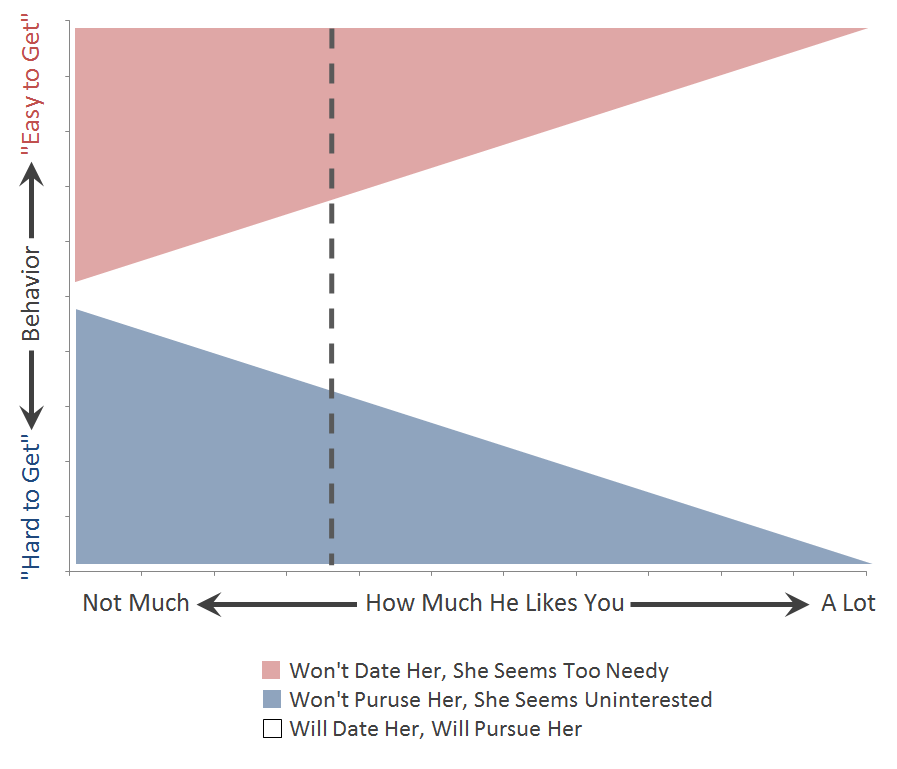
This phenomenon can be illustrated with a simple plot, as shown below. The whole point is that it isn't worth spending your time in a dating situation that falls to the left of the dotted line. If you do, there won't be enough leeway between "needy" and "uninterested" behavior to allow you to be yourself in the relationship. In order to avoid the (red or blue) "no date" zones, you'll have to be constantly guarding your behavior in the same obsessed way that you are right now, as you attempt to get into or hold on to the relationship that is causing you so much stress. Where exactly the dotted line falls is something you need to decide for yourself; but you need to recognize that a limit exists. Until you do, you are going to give yourself a lot of grey hairs - and have nothing to show for it in the end.


Incidentally, guys make the same mistake all the time in their attempt to attract girls. It is particularly evident when you watch guys trying to figure out how to approach and pick girls up. If you could see how obsessively men try to figure out the right thing to say to a girl, or the best way (or time) to approach her, you would know exactly what I mean.* Men are constantly over-analyzing these things. What many men don't realize, is that if they need to force their behavior into a tiny, perfect mold in order to attract a girl, then they aren't going to be able to hold onto her for very long. The act can't be maintained forever; eventually they will need to relax and behave naturally, at which point the tailored personality that attracted her will disappear, and so will she.

In light of all of this, the goal - for men and women - should be to work at self-improvement slowly and steadily - in the long-term, but to relax and be themselves with the opposite sex in the moment. So if you are finding yourself constantly calculating your next "move" in a relationship, or watching your words too much, recognize that you are probably fighting a losing battle. Take a deep breath, relax, and focus instead on making yourself vulnerable to the possibility of rejection. Remember, sometimes it is a good thing.

______________________________________
* In fact, you can see this if you just do a Google search for "pick up artist" or "approach anxiety" and read the uncountable number of websites, blogs and books that have been written in an effort to perfect these things. In fact, I am convinced that men freak out about this stuff way more than women do. Perhaps this is because the pressure is on us to make the first move, but the obsession is still there.


Related Posts
1. Self-Improvement Takes Time
2. On Being a "Typical" Girl
3. Get Used to Rejection
4. Living Vulnerably
5. Don't Initiate Contact

Tuesday, July 9, 2013

Do You Really Want Dating to Be Easier?

Dating isn't easy. In fact, for anyone with romantic ambitions, it is extremely difficult. There was a time where dating options were far more limited by religion, geography, social class, and family pressure. But these days, dating options are virtually limitless, and ideals about romance are pegged to ridiculous standards, both of which make it hard for people to settle down. When you consider this in light of the fact that people have such varied tastes, it isn't hard to see why it is so difficult to fall mutually in love.

The greatest victories in sports are the ones that follow a difficult comeback. We appreciate them because they are born out of unlikely circumstances, and are the result of a tremendous effort. I remember watching basketball games when I was a kid, and actually liking it when my favorite team was down by a large margin. The way I saw it, the deficit was just potential for a big comeback - maybe an unprecedented comeback, a game people would talk about for decades. While I knew that I might be witnessing a blowout, I also knew that I might be watching sports history in the making. I also knew that I wouldn't be anywhere near as excited if my team won by a large margin - it would just be too easy that way.

When you get frustrated at your lack of success with the opposite sex, stop for a moment and recognize that the same principle applies in your dating life.  If finding a boyfriend or husband were easy, you wouldn't care much for your relationships. Every man would be replaceable, just as you would be to every man. The more you improve yourself in order to find love, or the more years you spend maturing before you can recognize it, the more unique your story will be, and the more you will value the man who marks its end.


Related Posts
1. Why Rejection Is a Good Thing
2. Self-Improvement Takes Time
3. Why Do You Want Him Back?
4. Know Why You Are Dating

Tuesday, June 18, 2013

Why Getting Him Back Won't Help

I need to give some advice that doesn't fall strictly into the category of "here is what you don't realize about men" (or what men like) - not because I want to change the theme of the blog, but because the misunderstanding it corrects is rampant in young relationships, and hopefully pointing it out will free some mental space in the minds of young women so they can instead focus more on their misconceptions about what men want, or other more-important things.

I have answered dozens if not hundreds of e-mails asking for advice about how to correct a relationship after a break-up or a break-up attempt. They usually sound something like this:
My boyfriend and I have been together for over three and a half years. About two weeks ago, he told me he was questioning the relationship and thinks he wants to break up. He told me that he dislikes X, Y and Z about the relationship and thinks they are signs that we'd both be better off with someone else.
We talked about it, and eventually he changed his mind, because we were both more open and honest with each other. We ended agreeing to give it another shot, and to do X, Y and Z differently. So we're still together.
I am glad we worked things out, but now I feel like he has all the powerIt's like I got "almost-dumped." I'm not completely happy with the situation but I am also unsure about how to proceed. What should I do??
In other situations, one person breaks up with the other, and then (by either party's initiative) the couple gets back together, thinking that "this time it will be better." In either case, the important characteristic is that the relationship reaches or nears its end, only to make what seems to be a thankful recovery.

The main problem in these situations normally isn't that one person can't follow through with the promise to change X, Y or Z (though this too is very frequently true, and a close secondary problem). The main problem, and what most people fail to recognize, is that when a relationship nears or reaches a failure point, its limits are defined.

Prior to such an episode, each party could believe - and usually at least hoped - that the relationship was strong enough to sustain limitless difficulties. Neither party knew how much it would take to break the other's feelings or commitment. But a break-up (or near-break-up) changes that irreversibly. Suddenly one partner knows that the other's commitment has real limits. What was once "a love that knew no bounds" and apparently bottomless, is shown to be of finite dept - maybe even shallow. So the disappointment comes, not because the relationship is broken, but because it is shown to be breakable.


There is an additional aspect of this phenomenon that makes it all the more condemning. While each partner previously compared their other dating options to something of unknown and conceivably infinite strength (i.e. their existing relationship), a doubt-forming episode will mean that they now compare their options to something they know to be finite, and perhaps even weak. Both the man and woman will convince themselves far more easily that things could be perfect with someone else, because their optimism about dating, stripped of its previous object, needs a new outlet. So in addition to seeming weaker in-and-of itself, the existing relationship will now be compared to inflated alternatives.


I have a very good guy friend who has been married for six years. His wife recently asked him for a divorce. He confided in me recently that this is actually the second time it's happened; two years into the marriage she did the same thing. At the time, he refused the divorce. He wanted to try to make it work, so they talked it through and she agreed. He essentially convinced her to "work on the relationship" and try to make the best of it.

Four years later, she's done the same thing, and this time, he isn't fighting it - because now he recognizes what I am saying here. Those four years, he admitted to me recently, were always spent in doubt of her feelings and fidelity, caused by the simple fact that she voiced her discontent. The relationship was ostensibly maintained, but the reality was that it had already been undermined by her attempt to end it; and my friend proceeded to waste four years trying to salvage what he essentially knew was dead after two.

Granted, there are some instances in which a break-up or fight doesn't reveal a relationship's depth, just as there are situations in which you might be willing to live with the limitations that such an episode often does reveal. The point here isn't to imply that all break-ups or fights are premonitions of ultimate failure, but to point out that if you find yourself disappointed in spite of having "saved" your relationship from a bad episode, it is almost certainly because that episode showed you that your relationship is more fragile than you'd hoped. So before you spend all kinds of emotional energy trying to get your boyfriend back or resisting a break-up, ask yourself whether just having him (or just having him back) is actually enough to satisfy you.

-------------------------------------
If you liked this post, you'll definitely like my book, Beyond the Breakup. In fact, this post has been included as one of the chapters, along with others that explain how to react when your ex tries to contact you, how to understand his motives for doing so, and much more.


Related Posts
1. Why Do You Want Him Back?
2. Why Rejection Is a Good Thing
3. Get Used to Rejection

Tuesday, March 26, 2013

What Men Think About Your Disability

Hi Andrew,

I don't think I'm your target audience but found myself agreeing with many of your posts (mercifully they are short, to the point and well written).

When I am out and about I get a fair amount of attention from men and women. People smile often, say hello, compliment me on my hair, generally really nice to me. Well the women do. I even have complete strangers pouring their heart out to me. I notice men looking at me and once in awhile they smile. Without appearing 'full of myself' I know I have a nice, friendly, open face and personality. I do get very nervous if I'm aware a man might be interested in me. Consequently, all that easy breezy confidence I usually have disappears.

The thing is, I have weakness in my legs and I use a walker. I think this is an impediment (along with my age, although most people think I'm much younger than I am). I have had men approach me even though it's clear I need an aid. Mostly they do not. Most people really do notice my face first and then their eyes wonder down to notice my walker; they look back up then away.  My guess is that a lot of people are intrigued by the dissonance: a young looking, pretty woman using an "old lady" walker.

I appear very normal other than using a walker. I'm only interested in meeting a guy to date seriously. By the way, I'm 46.

I know my physical disability slashes my chances with most men but do you have any suggestions about how I may increase them?

Kind regards,
Nancy
__________________________________________

Nancy,

If I imagine myself in a public place where I was open to meeting women, and I saw an attractive woman with a walker, my reaction would be something like this:
"Woah, she is good looking. Is that a walker? That's kind of strange... but also interesting. It might be a little awkward trying to 'talk around' it [i.e. avoid bringing it up in conversation, or making sure to do so tactfully] but I still want to meet her. I wonder if it affects her ability to have sex? Would it be weird dating a girl like that? Would the walker be in the way all the time? I bet she is a good and interesting person." 
Then a series of images would flash through my mind about how the walker might play into a relationship with her. I might imagine helping her get seated at dinner, getting into and out of the car, etc.

This is not just a hypothetical situation for me. I had a similar experience one time, fairly recently, when I came across a cute girl's profile on a dating website. When I clicked-down into her photo album, I saw that she had deformed legs and a wheelchair. I remember thinking essentially the same things I've paraphrased above.

You can be 100 % sure that the sex question will go through any guy's mind if he is otherwise interested in you - whether it is for a temporary or long term relationship. In fact, I think it is safe to say that for any guy, this will be his biggest question, even if it seems obvious to you that there wouldn't be any issue. While it would be pretty awkward to convey your ability to have sex in a spoken conversation, you might consider internet dating, where you could literally add a note about it to your profile - maybe just a sentence at the bottom saying something like "By the way, even though I have a walker, I just want to put it out there that I am still capable of normal sexual relationship." This might seem a little awkward to post online, but it would be well received by the men, and it would remove an impediment - again, probably the largest - from their willingness to contact you.

If you date a guy and you get to a point where you would be comfortable having sex, I suggest letting him know indirectly that you are capable of it. You can do this by taking a natural opportunity in conversation to point out that your disability "doesn't prevent anything except your ability to walk." No need to wink, raise an eyebrow or even say it in a suggestive tone. Even if he doesn't understand that you are trying to convey your ability to have sex (in fact, it would be better that he didn't), that comment will be in the back of his mind when he thinks about having sex with you later, and it will have helped to form his understanding of the limited effect of your disability. He will therefore be more comfortable making a sexual advance. If he makes an advance before you are comfortable having sex, I suggest pointing out the reason why you aren't ready (maybe it's just too soon, or you are waiting for marriage, etc.), so that he knows that it isn't because of your disability. I do not suggest making an advance yourself.

The second biggest consideration will be the overall effect of the walker on day-to-day activities. I don't see this being a huge problem to an open-minded guy, but some men would prefer not to have to deal with it at all. The latter group of guys are probably not the kind you are interested in anyway, and I suggest just being happy that they won't waste your time. However, the ignorant and open-minded guys are the extremes on a scale. Different guys will consider your disability a "big deal" to different degrees, and it will play into each's decision accordingly. So with all guys, the best thing to do will be to help them become familiar with its minimal effect on your life as soon as possible. You can do this mostly by showing him how casual you are about it: if you go on a date, be nonchalant about your walker in any situations it creates. Mention the walker in passing without focusing too much on it, or casually telling a story in which it played a role, but moving on naturally in the conversation afterwards. Your casual references will speak volumes about the normal-ness of the walker in your life.

Humor will be a very big tool for you in this regard. In fact, I think it can be your biggest ally if it isn't too forced. For example, I envision you talking with a girlfriend and a guy you like, and you telling a story that happens to involve a funny situation that was caused by your walker. For a split second after the punch line, the guy is mildly uncomfortable (because he doesn't know how he "should" respond), but that awkwardness instantly melts away when he sees you and your friend talking casually and laughing about the whole thing. Then you return to normal conversation, just like after telling any funny story - except that he now realizes a bit better how natural it is for you, and how natural it would be for him if he were to date you. If you can show him that you can laugh about your walker and disability, he will be much more comfortable with the idea of dating you.

The converse is also true: nothing will turn off men more than to get the impression that your disability is a big deal, and is awkward, and is an impediment to a normal relationship. The girl I mentioned earlier with the wheelchair on the dating website made one huge mistake: she put a disclaimer at the bottom of her profile saying something like "and if you send me a message asking about my chair I will find where you live and beat you up." Obviously her threat was a joke (she was tiny), but it showed that she was uncomfortable with any attention drawn to the fact that she was different. She thought her wheelchair was a much bigger deal than it really was, and that was a red flag to me and other men that we would constantly have to tip-toe around the subject. Ugh. I would have been so much more attracted if she'd had written "Oh, and if you think my wheelchair holds me down, just wait 'til I kick your ass on the basketball court! ;)"

The general idea, I think, is that your walker isn't a big deal and you just need to show potential boyfriends this. I can tell from your e-mail that you are very comfortable with its effect on your life. But realize that for the guy, it is a new thing with a lot of associated uncertainty. The sooner you can remove that uncertainty and replace it with normal-ness and humor, the more he will be able to envision himself living with it and you.

It is worth mentioning that your walker is certainly acting at least partially as a filter. If a man approaches you, you know he is interested in something more than sex. Therefore I think you can ignore any advice about gauging his interest or making him wait. This doesn't mean you should take the initiative yourself (asking him out or for his number, for example), because this will come across as needy; but it does mean that you can be more open to his advances than other girls. (If you aren't getting a lot of attention from men at the moment, this openness will probably come naturally, since you will be excited about the prospect of finding a guy.)

So maybe I can summarize by saying I suggest the following:

  • If possible, convey to him that you are capable of sexual relationship
  • Demonstrate immediately that your disability is not a big deal, and that you are comfortable with it
  • Recognize that a man approaching you has already been "filtered" so there is far less need to test him. Be open but not needy.

Oh, and about being nervous when a guy gives you attention: you can be sure that the guy is nervous about giving you attention, and most likely does not notice your nervousness - unless you show some painfully visible sign of it (shaking for example). The first time I hit on a girl at the grocery store I was nervous as hell. I'd passed her in the aisles a couple times and she'd made eye contact back at me, so I suspected she might be interested, but I was still nervous. I forced myself to approach her and she was clearly nervous too (fidgeting, awkward, etc.). All this did was to calm my own nerves, which in turn calmed hers, and we had a nice conversation.

I hope some of this helps. Good luck and thanks for the kind words about the blog.

Andrew
__________________________________________

Hello Andrew,

Thank you so much for your thoughtful and practical advice. It is very helpful. I can't tell you how much I appreciate it.

You have helped me realize that I had made the walker more of an issue than needed. I suppose I lacked faith that any man would look past my disability. I'm glad you pointed out that I need not play hard to get with a man who has shown interest. It is a reminder that we really need to assess our unique positions when reading material on dating.

My confidence has gone up a notch. Now, all I need to do is get out there.

You really ought to write a book if you haven't already.

Once again; thank you.

Kind regards,

Nancy
_________________________________________

Andrew,

I was thinking if and when the time comes, do I need to be completely honest about how far my disability has affected my life? For instance, I am in continual pain but I have learnt how to manage it. Or do you think it would be better if I don't make an issue of it?

Nancy
__________________________________________

Nancy,

I would focus more on making sure he knows that you are used to it than trying to point out how bad it is. Just telling him how much it hurts isn't the whole story, because, as you say, you have learned how to manage it.

Recently my coworker and his wife bought a new house. They got a great deal on it, but realized only after they moved in that it was under the flight path of a local airport.

When they first moved in, they started hearing the planes, and were worried that they'd made a huge mistake. But after a couple weeks they literally couldn't even tell you when an airplane had passed because they were so used to it. If the real estate agent had shown them the home during heavier airplane traffic, or called their attention to it, they'd probably have immediately walked away, not realizing how minor a disturbance it would actually be. They would have missed out on a great deal.

Likewise, if it comes up in conversation for some reason, I would be honest and admit that yes, it hurts - sometimes a lot - but emphasize that you know how to manage it and it isn't a big deal because of that. I wouldn't even go into detail about how you manage it, because that calls more attention to it than it warrants. The point is that you do manage it, and it isn't a huge thing. End of story.

Hope that helps,

Andrew


Related Posts
1. You Are Responsible for Your Own Romantic Happiness
2. Self-Improvement Takes Time
3. Why You Don't Get Approached by Men

Wednesday, March 20, 2013

What Men Think About Your Virginity

Imagine you are dating a guy who doesn't know that you are a virgin. Everything is going well until, one night, he starts to push things past the limits of your sexual comfort zone. After a quick battle in your conscience, you stop him and reluctantly tell him "I can't..." followed by an apologetic, blush-filled explanation about how you were raised, how hard it is to constantly disappoint men, and how difficult it is to live with the fear of being "found out" by your friends. He is a little bit surprised at the news initially, but he says that it isn't a big deal. He even seems sincere when he tells you how much he admires your decision and sometimes wishes that he'd stayed a virgin too. However, in the next few days, his contact and initiative plummet. Before long he stops talking to you altogether. You are confused. You understand that men want sex, but this guy seemed different...

Sound familiar?

Of course, there are many variations on this story. Maybe you wanted to sleep with him, but something made him suspicious, and he asked if you were a virgin before anything happened. Or maybe you made it clear that you really didn't want to stay a virgin, but that you just needed a little longer together before having sex. Or maybe you actually asked him to sleep with you, right then and there, because you were fed up with being a virgin and figured you might as well lose it with him as with the next guy. However it happened for you, the result was probably the same: he disappeared.

You've probably assumed that men act this way for one or more of the following reasons:
  1. They think it will be too much work to sleep with you,
  2. They are "weirded out" by the fact that you've never had sex,
  3. They don't want to "suffer" through your inexperience.
For some men, a combination of these things will play a role in their decision, but usually it will be a minor one. If you are hot enough, men won't give up very easily at all - particularly players, who know that women often say no at first, only to give in soon afterwards. No man is "weirded out" by the idea of virginity to the point that it would actually prevent him from enjoying sex. And although sex might not be as great with a virgin as with a more experienced girl, few if any men have so many women at their fingertips that they can afford to discriminate based solely on anticipated performance. There is something deeper at work.

The primary reason that most men disappear after learning you are a virgin is simple but often overlooked: men don't want the responsibility of taking your virginity. Rightly or wrongly, men assume that in proportion to how long you've remained a virgin, your experience losing it will be "a big deal," and something that you want to do within the context of a serious relationship - even if you tell them otherwise. Men aren't afraid of or "weirded out" by your virginity; they are wary of the expectations that will accompany taking it from you.

It should go without saying that the men who are going to be most turned off by expectations or responsibility are the ones who know, in the back of their minds (or the forefront), that there isn't potential for a relationship. If a man really likes you, your virginity will not be impediment to dating. He will not balk at the idea of waiting until you are in a committed relationship (or possibly longer) for sex. In this sense, your virginity can actually serve as a good filtering mechanism for avoiding men who aren't interested in anything serious.

There are limits to this phenomenon, however. Once inside a committed relationship, even a man with the best intentions is likely to be put off if his girlfriend insists on waiting until marriage for sex. The convenient reality in these cases, however, is that the few women who insist on waiting until marriage are probably most compatible with the few men who are also willing to wait until marriage. So if you really believe that prolonged virginity or abstinence until marriage is important, consider this belief a filtering mechanism - no man without similar beliefs will be willing to wait that long.

It is also worth pointing out that men will be somewhat less scrupulous about taking a younger girl's virginity. Because younger girls haven't been virgins for as long, men (even young men) will assume that the girls care less about giving it away. Although there isn't a strict age cutoff for this assumption, it falls somewhere between 20 and 22. Before 20, almost no guy will be surprised at a girl's virginity. After 22, almost all men will assume that a girl's virginity is intentional. Keep in mind that the average age at which American girls reportedly lose their virginity is 17.

Also keep in mind that being surprised that a girl is still a virgin is not the same as thinking that she is "weird" because of it. I considered writing a paragraph explaining the age at which men will think a woman is "weird" for still being a virgin (since I know that some women worry about this), but in the process of trying to pinpoint that age, I realize two things: (a) there really isn't one, and (b) you shouldn't care anyway.

To conclude: men who disappear after learning you are a virgin wouldn't have stuck around in the long run anyway, and they certainly don't disappear because they are lazy or feel awkward about your inexperience. They are simply unwilling to deal with the moral hangover or relationship pressure of taking you through such an "important" event in your life, then walking away afterwards. And they will avoid doing so even if it means foregoing easy or guaranteed-STD-free sex. So if a guy disappears on you after you tell him about your virginity, don't feel the need go and to lose it at the next opportunity; just be glad you dodged a bullet.


Related Posts
1. What Men Think About Your Sexual History
2. How to Date as a Virgin
3. How to Look Good During Sex
4. Never Tell a Guy When You'll Have Sex With Him

Sunday, March 10, 2013

Men Don't Fall in Love the Same Way Women Do

A reader recently asked me if I've learned anything new about women from writing this blog. I have. To be specific, I've learned one thing - one important thing. I want to explain that one thing here, because the corresponding lesson for women is equally important.

So many of the women that write to me for advice have stories that go something like this...
I met my boyfriend through mutual friends. I wasn't very attracted to him at first. He wasn't the best looking guy in the world and he was a little quiet. I never really considered him a potential boyfriend, but then he asked me out. I agreed because I wanted to give it a chance, and I hadn't been on a date in a while.
The first date went OK, so we kept seeing each other. Before long I started getting attached and soon I found myself falling for him. We spent a lot of time together, and by three months I was in love. Now we are five months into the relationship and things have stagnated a little. He seems to be losing interest. Our phone calls are getting shorter, we see each other less frequently, and he's been answering my texts sporadically. In general the excitement he showed at the outset seems to have faded. I don't know what to do... I am completely in love with him and don't know if I can handle a break up. Is there any way I can re-spark his interest? What can I do??
Obviously this is just a paraphrase; the details of each story vary. But the common thread among them, and the thing that I found so interesting, was that the woman's love grew gradually, over months, often starting as complete indifference. It amazed me that a woman could end up being so in love with a man that, initially, she wouldn't have seriously considered dating.

In fact, I was so surprised by this that I initially doubted the truth of the stories. I speculated that the women writing to me were subject to some kind of wishful thinking or tunnel-vision, by which they focused only on the good in their boyfriend rather than the advantages of other men. But this really couldn't explain the phenomenon. A woman couldn't wishfully think herself into a degree of love so strong that she would feel compelled to write me for help. I eventually realized that these women were being genuine, and I was forced to admit that there was a uniquely feminine mechanism at work.

By now most of you have probably recognized the important point for women, which is implicit in my astonishment: men do not fall in love gradually, and they do not find themselves suddenly falling for women in whom they weren't initially interested. I was surprised because I had wrongly assumed that women work the same way as men in this respect. But this is not the case.

Now, let me qualify a couple things before going any further. By "love" I mean deep romantic attraction, as opposed to lust or long-term attachment. Lust is primary, physical and fleeting for both sexes, and long-term attachment takes years of shared experience to develop in either sex. Also, I am not saying that this is the only way women fall in love, or the most common. I recognize that women can experience something closer to "love at first sight."

The important thing to recognize is that you cannot expect (much less make) a man gradually fall in love with you in the same way that you might fall in love with a man. It doesn't work that way for us. Male romantic love is something that either starts early and continues, or else doesn't start at all.

Since recognizing this difference in the sexes, I've had time to consider why it exists, and I think I have a reasonable understanding of what is going on. The information that a man needs to trigger romantic love is information that he can perceive within a few interactions with a woman. I believe this is true for a couple reasons:
  1. A great deal of his attraction to a woman is physical, and her approximate physical beauty can be demonstrated by seeing her in a handful of outfits (or, to some degree, through photos).
  2. A great deal of his attraction to a woman is rooted in her personality and energy, which can be demonstrated by experiencing her in a handful of moods. This takes longer than the physical attraction, but is still possible within a fairly limited number of encounters.
Other data, such as a woman's religious or political beliefs, her social class, her family, etc. are either immediately available to a man via conversation, or else far less significant in garnering his attraction. So, in general, a man can evaluate a woman quite quickly.

Now, for women, the situation is different. Many of a woman's triggers for romantic love are less immediate:
  • His personal strength and emotional stability, which can only be demonstrated by seeing him react to challenging situations, and these are unlikely to arise on a daily basis.
  • His intelligence and confidence, which - although more readily assessed - can also take time to evaluate, as they are best demonstrated via situations in which his wit or knowledge is pitted against others', or by seeing how he responds to other men in a variety of real-life social situations.
  • His commitment, which is only demonstrated in proportion to its duration. The longer he is with you, the longer he is likely to stay with you.
In other words, while a man judges his woman primarily in relation to himself, which he does quite quickly, a woman evaluates her man on how he relates to the outside world, and this takes longer. In addition, and perhaps more importantly, a woman needs to gauge her man's reliability, and this demands time.

From an evolutionary biology standpoint, this makes good sense: the man who propagates his genes successfully does not need months to judge the reproductive potential of his mate, or her ability to nurture and raise children; he can see these things from physical cues, as well has her energy, moods, and her instinct to take care of him. But the woman who propagates her genes is one who accurately judges whether the man with whom she mates is not only strong, but also stable - that is, capable of protecting and providing for her children until they are grown.

The implications of this are enormous for both sexes in dating, but let me underline the biggest lesson for women: if a man isn't falling for you from an early stage - say, the first month - it isn't going to happen. Don't wait around for his feelings to "grow" the way yours sometimes do. They will not. While this doesn't necessarily mean that he should be ruled out as a potential boyfriend or husband, it does mean that he will never be the woozy, infatuated lover you've seen in the movies. And if this is something you can't live without, you'd do better to break up with him now than to become more emotionally or sexually invested before breaking up with him later.

-------------------------------------
If you liked this post, you'll definitely like my book, Beyond the Breakup, which explains everything you need to know about dealing with you ex: what he's thinking, what is motivating him to stay friends with you, how to maximize your chances of getting him back - and if that doesn't happen, how to focus on your future.


Related Posts
1. Why Women Don't Know What Men Want
2. The Female's Internal Conflict
3. The Analogy Between Confidence and Beauty
4. The Analogy Between Sex and Commitment

Tuesday, February 26, 2013

The Importance of Silence After a Break Up

If you've been reading this blog for any time now, you are familiar with the idea of cutting off a man after he breaks up with you. I want to explain a little more systematically the reasons why this is important. Keep in mind that by "break up" I mean any situation in which a man makes it clear that he is no longer interested in pursuing a sexual or romantic relationship with you: not calling after he gets your number, fading out after sex or a few dates, or explicitly ending a long term relationship. In any of these situations, cutting him off completely will accomplish five things:

  1. It will show him that you are a woman of high value. It will demonstrate that you are a woman who isn't desperate or needy - a woman who can live without him (because you can). Men find this attractive in a woman. Although this demonstration is unlikely to increase his attraction for you enough to make him change his decision, you will avoid confirming him in his decision by showing him that you are needy, pathetic and desperate - all of which are obvious symptoms of being below his league.
  2. It will show him what he is missing by way of contrast. By forcing him to experience life with you, and then suddenly without you (in other words, before and after the break up), you will emphasize whatever feelings he has as a result of his decision. First he has you, then he doesn't. The starker that contrast is, the more he will feel your absence, and the more likely it is that he will miss you and want you back. Again, it is unlikely that this effect will be enough to make him change his mind, but in some instances it will be. (Note: it is also possible that cutting him off will show him how much he doesn't miss you, but if this is this case then there is nothing you can gain by contacting him anyway - it is unquestionably over.)
  3. It will force him to think about his options seriously. As long you stay in touch with him, he will know that he can have you back at any moment, and he will feel no urgency to reverse his decision. By staying in touch with him, you effectively give him a "safety net." Even if he doubts his decision, he will have nothing forcing him to act one way or the other. He will simply go about his life, waiting until his “feelings about you become clear” (which they never will). 
  4. It will empower you. Although you have no control over his decision to break up with you or stop dating you, you can control what happens as a result of that decision. In fact, you are the sole person capable of "enforcing" the consequences of his decision. By hanging on and hoping to get him back, you give him all of the power. But if you force him to live with the consequences of his decision (i.e. making him live without you when he says "it's over"), you exercise your agency, your power. You seize what little control you can in the interaction. Although this probably won't change the outcome of the situation, it will go a long way towards bolstering your ego and self-esteem in the face of his rejection. You will transform yourself from someone who is pathetic and dejected in light of inevitable circumstances, into a person who exercises influence on the outcome of her situation - and her ex's situation. The added benefit (as explained in the other points of this post) is that by doing so you don't even sacrifice any of the likelihood that he will take you back - in fact, if anything, you increase it. 
  5. It will make him doubt his future options. This is probably the most important mechanism at work in your attempt to get him back, and it will be powerful in proportion to the length of the relationship with you that he is ending. If you stay in touch with him in an attempt to salvage things, you will confirm his belief that he can find someone better (which is his implicit motive for dumping you). The longer you stay in touch with him after the break up, the more he will think "Hmm... if she wants me so badly, girls who are hotter and sweeter will probably like me enough to date me too. Why would I take her back when I know I could do better?” While he might not be so calculating as to have this thought explicitly, I absolutely guarantee you that this thought passes through his subconscious and has a profound influence on his thinking about the break up. And it will occur to him even if you aren't making an active effort to get him back, but "just" texting or calling each other from time to time. He knows you wouldn't stay in touch unless you were interested in getting back together - he knows being "just friends" isn't workable. But, if you cut him off, he won’t know whether or not he just threw away the best girl he could get, and that doubt is priceless in making him consider coming back to you.
-----------------------------------------
If you liked this post, you'll definitely like my book, Beyond the Breakup, in which I add a 6th point that I overlooked when writing this post originally. I also explain a lot more about the practical side of cutting a guy off - what to say, when is "too late," and what to do if he gets back in touch.


Saturday, February 23, 2013

Why You Can't Get the Men You Want

Most women who complain that they "don't get any attention from men" actually mean that they don't get attention from the men they want. And the simple advice for women in this situation (which I have seen on other blogs, and have occasionally given out myself) is sometimes appropriate: "you aren't hot enough to get the guys you want; lower your standards." However, in most cases, I think there is deeper phenomenon at work.

Women tend to be aware of and rate their looks fairly accurately. I know this because a lot of readers send me pictures saying "I think I am an X out of 10, can you tell me what I really am?" Although I always refuse to give them my numerical opinion (because all men think differently), their guesses are usually very close to what I would have ranked them.

So why would they set the bar so much higher than what they know they can get? Some might point out that their "delusion" is caused by their experiences getting men who are out of their league for sex and casual dating. And though I agree that this happens, it doesn't capture the whole picture. Women just aren't that easily deceived about their own physical attractiveness. It shouldn't be surprising, then, that the problem is primarily an internal one.

Each of us has an inherent knowledge of our own capabilities and dispositions. We know the inner workings of our own mind: how honest we are, how prone we are to mood swings, our insecurities and strengths, what we've experienced, what we still need to learn, the strength of our ambitions, etc. This translates into an excellent knowledge of our personal capabilities, our personal potential. We all know roughly what we could achieve, whether or not we have achieved it. Occasionally we modify this self-perception when we realize the extent of strengths we didn't know we had, or weaknesses that have greater implications than we'd imagined. But in general, we know ourselves well; we know what we are capable of becoming. This is true in all aspects of our lives: business, working out, academic learning - everywhere. It also applies to dating. Because we know ourselves, we also know roughly what we should be able to get when it comes to the opposite sex.

A statement that often accompanies women's complaints about not getting the men they want is something to the effect of "I know I am a catch. I have so much love to give a man. Why can't men see that??" This is a symptom of the above-described phenomenon: you know that you have the right "raw material" to attract the kind of man you want (in fact, "the kind of man you want" is partially defined by your self-knowledge), but you are confused about why it hasn't happened for you yet.

The reason for this is simple: your self-perception of your potential is roughly accurate, but you aren't living up to that potential. You aren't the person you know you can be. You have the capability, but you haven't used it. You have the potential, but you haven't fulfilled it. You know you can be a fun and exciting person to be around when you feel comfortable, but you haven't confronted your insecurity in social situations, so men don't realize this. You know you have a great figure, but you haven't learned yet to show it off by correcting your posture, so no one notices it. You know you have great hair, but you don't put the effort in to style it well, so it does you little good. You know you are pretty, but you haven't confronted your fear of looking a little awkward, and this has dramatically slowed your efforts at learning how to dress yourself well. Your are well aware of your inner feminine self and you instincts to nurture and love, but you suppress them (as you've been implicitly told to do by your parents or the culture around you) and men assume you are cold and boring. You know that you are an incredibly sexual person, but because of your strict conservative upbringing, you cloak it in "modesty" and men are turned off.

The reason women can't get what they think they deserve is that we (men and women alike) always peg our standards to what we know we can be, not to what we are, while members of the opposite sex judge us - understandably - only on what we are currently. They have no access to the inner workings of our mind; and even if they did, they would have no guarantee that we'd ever reach the potential this would reveal to them. So your discontent in dating boils down to the fact that you aren't living up to your own standards - yet. Incidentally, this also explains why most people have such an aversion to settling: our subconscious knowledge of what we "should" be able to get is achievable (if not currently accurate), so it seems defeatist to accept something less.

I've illustrated an example of this in the diagram below. A woman who is a 5.5 out of 10 has the potential to be a 7.5, so she "knows" that she can get men of that caliber (red arrows). She is constantly setting her sights on men who are in the 7-8 range (dark blue arrows), and she is constantly being rejected by them. She doesn't understand why, since she thinks these men are in her league, when the truth is that she could get into their league. Her situation isn't helped by the fact that a lot of the men she wants haven't met their full potential yet either, meaning that they - also wrongly - have their sights set on women of an even higher caliber (light blue arrows).

Rank out of Ten (Combined Looks and Appearance)

So the bad news is that you probably can't get the men that you think you can get. But the good news is that you probably can eventually get the men that you think you can get - assuming you are willing to work at it, and do. The biggest takeaway, though, is that if you aren't getting the men you want (but you think that they are in your league), your first move shouldn't be to lower your standards, it should be to self-improve.


Related Posts

Wednesday, January 30, 2013

When Your Ex Contacts You...

Hello there Andrew,

I reached out to you about three months ago regarding a man that had recently left me after three years. Well you will be happy to know that I have been dating and self-improving like its my job ;). Your keen advice had a major impact on the manner in which I handled the rejection.

So, my ex-boyfriend sent me a text message last week. It was one of those "Hey, thinking about you, just want to say Hi, how are you?" kind of text messages. Not wanting to sound bitter or unhappy, I gave him a three-word reply. He asked another question and I again gave him a very short reply. He stopped texting after that brief interaction.

Part of me is wondering if that was his attempt to hang out with me again and if he was testing the waters with a text message?

I gave him very uninterested answers which he caught onto quickly. Odds are he will not be trying to contact me anymore but I would really like to see him so that I can show-off a little bit. If my motives are not wanting to get back together but reminding him what he gave up, am I exempt from the "cutting him off rule"? Can I contact him in a few weeks to meet up somewhere casual?

Thank you for reading this!! ;)

Brooke
______________________________________________

Brooke,

Wow. This is the perfect example of how you are supposed to handle a man who contacts you after he breaks up with you. So many women would have gotten back in touch with him before he popped up again, or responded to his text with much more than three words. But you played it perfectly - I am impressed.

By the way, wasn't it so much sweeter getting that text after three months of silence than it would have been if you'd been in contact all along? There is absolutely no ambiguity about the fact that he contacted you for the sole reason that he was thinking about you, wondering how you were, and maybe even questioning whether or not he made the right decision in ending the relationship. The clarity of that fact is beautiful.

Now, in terms of showing him what he's missing, I'd be careful about asking him to hang out with you. True, you might sit there and tell him that everything is going fine (i.e. without him) - and it might even be true, as it is in your case. But he could easily misinterpret the fact that you wanted to spend time with him after only three months. After six months or a year, your desire to meet him would be more obviously a case of platonic curiosity about what he's been up to since you last talked. But after only three months, the fact that you made time to see him might outweigh the indifference you demonstrate in a face-to-face setting. So I suggest sidelining that idea for a few months (though I'm willing to bet that by then you won't care what he thinks; you'll probably just be genuinely curious to see what he's been doing).

The more important point, however, is that your silence already speaks volumes - especially because you never once broke it. Your replies, and in particular their brief and unmoved, matter-of-fact tone also communicated to him how much you've moved on. If you hadn't replied at all, he would have assumed that you were so upset or heartbroken that you couldn't bring yourself to talk to him (which would have been a fine way to handle the situation if this had been the case). And if you'd replied with more enthusiasm or tried to engage him in conversation, he would have assumed that you were still in love with him and trying to get him back. In either case, his ego would have swelled, even in spite of any feelings of sympathy or guilt he had. But your brief replies were at once so casual and indifferent that you can be sure his ego was kept in check, probably even deflated. Moreover, he was acutely reminded of his decision to walk away from a confident woman who respects herself and now has a promising future.

As I said, I am impressed. I hope things continue to go well for you.

Good luck,
Andrew
______________________________________________

Update: I had another e-mail from Brooke shortly after the one above, telling me that her ex contacted her again the next day, this time on Facebook, and said "ugh, just read through our log of messages, it takes me back. miss you [pet name]. hope you are well, I miss you a lot! im sure you dont want to hear that but its true..." She did not indicate whether or not she would reply, but it was clear that she viewed this - rightly - as a personal victory (not a victory over him) rather than an opportunity to get back together with him.

Men make mistakes. It is up to you to help them realize it by showing what life is like without you.

-------------------------------------
If you liked this post, you'll definitely like my book, Beyond the Breakup. In fact, this post has been improved and significantly expanded as one of the chapters, and I explain some important attitudes to foster when you engage him. Most importantly, I give examples of what you can say to him, tailored for various situations.


Related Posts
1. Why Rejection Is a Good Thing
2. No, You Can't Be "Just Friends"
3. Cut Him Off

Monday, December 31, 2012

How to Deal With His Wandering Eyes

Below is a question I recently received from a reader, followed by my response to her. I will be posting questions and answers like this more frequently now, as requested by many of you in the recent reader survey. Posts of this nature will be tagged as "reader question."
_____________________________________________

Andrew,

I'd greatly appreciate any insight you would share about my question:

How do I respond when the guy I am with is flirting and/or staring at other women when we are in situations such as dinner with just the two of us in a restaurant? I see it as a red flag and dismiss the potential for a relationship with men who do this at any relationship stage, and try to accept that they are just not interested enough in me by displaying such disrespect. How do I conduct myself with dignity when this happens? In such situations, I never confronted them about it, I just stopped looking at them, tried to get the meal to end rapidly, and distanced myself by pretty much ignoring them afterwards. Please let me know what I can specifically say or do to address the disrespect I feel when placed in that situation, to potentially give the relationship a chance, depending on how the man conducts himself afterwards. Thank you so much.

Thank you again and have a good day,

Cassidy
_____________________________________________ 

Cassidy,

There are a few things to consider when it comes to your man and other women:
  • First, recognize that men are always going to be attracted to other women and will look at them, whether or not you see them doing it. The real problem (in most instances) is not his sexual interest in other women, but his lack of discretion and his carelessness about your feelings or reputation.
  • Realize that your leverage over the situation depends on how serious your relationship with the guy is. If it is just a date with someone new, there is nothing you can or should do about it other than suffer through it and let it influence your decision to accept or reject him the next time he asks you out. If he is a boyfriend or spouse, however, you have the right to demand that he stops (see below).
  • Realize that you have a right to a man's attention when he has chosen to be with you. He shouldn't be letting his eyes wander or flirt with other girls when he is with you. If it happens occasionally, by accident, fine; but if he isn't attracted to you enough to keep his eyes in one place, he should break up with you. He is a coward if he does not.
  • Very few men look at other women without any regard for the girl they are with. Usually, this is what happens: an incredibly attractive women walks by, and the guy you are with slips up. Despite his efforts to resist, he looks, taking the risk that you might see him. Although I don't think women can completely understand the temptation of visual stimuli for men, his temptation to look is similar to your temptation to bend the rules on your diet once in a while - it is hard to resist. 
  • Flirting takes greater intention, is much easier for a man to resist, and should therefore be treated with greater severity.
Now, to answer your question directly: in response to occasional glances, react the way the man's date in this video does (at 0:26 and 0:48):


In other words, maintain an attitude of "Men will be men, but I have boundaries and I would appreciate it if you could look this way please..." The key is to remain calm in these situations, but also to make sure that he knows you don't approve.

Now, if a guy isn't just making an occasional slip-up, but is simply letting his eyes wander everywhere all the time, or flirting with women openly in your presence, you will need a commensurately stronger approach. This is how you should deal with it:
  1. Your first move should be to point it out to him: "You realize that I see you checking out all these girls right? Do you know how that makes me feel?" This should be a rhetorical question, but if he answers "no," tell him honestly how you feel.
  2. If that doesn't stop him (which it probably won't, but at least he will be primed for this next step), you should make a demand: "Look, [his name], it makes me look bad when you are checking out every girl that walks by, and it doesn't do anything for my self-esteem either. You need to stop." Again, I am assuming you are in a relationship with the guy in question here, which gives you the leverage to make a demand like this.
  3. That might have an effect. If it continues further, tell him the same thing again, but add "...if you don't like me enough to keep your eyes off other women, at least have the balls to break up with me and go chase them like a real man. Don't just stare at them from the safety of a relationship that you clearly don't want." That should get his attention. 
  4. If at that point he still doesn't stop, break up with him. End of story. You don't deserve a man who constantly reminds you of your inadequacies, or, more importantly, one who disregards your feelings when you openly tell him they are being hurt.
Hope that helps,

Andrew


Related Posts