Showing posts with label personality. Show all posts

Wednesday, December 17, 2014

No, Your Intelligence Isn't the Problem

I get e-mails from girls all the time telling me that they are attractive, sweet, well-dressed, fun, etc. but can't seem to get the guys they want. They then point out that they are working on a PhD and conclude their question by asking whether or not their intelligence is intimidating men and therefore turning them off. I get similar questions about career success: "I am doing everything right but I am very highly paid - does that intimidate men?"

This is the equivalent of a guy pointing out that he is smart, tall, reasonably good-looking and successful in his job, but struggles to attract girls - then asking if it is because his muscles are too big. I mean, after all, maybe that's what is keeping the girls at bay, right?

If you are a rocket scientist, there is a chance that your academic prowess might be intimidating to an average guy, in the same way that a steroid-injected meat-head's muscles might be a a little much for the average girl. Yeah, sure, there is a risk that pouring too much of your energy into academics will turn guys off a bit, especially if it is done as a mask for your feelings of inadequacy with respect to other women. It's the same risk that a guy runs when he devotes the majority of his free time to getting jacked, especially when it is done as a mask for his feelings of inadequacy relative to other men. But the muscles themselves aren't the chief problem, and neither is your degree or your job.

It's way more likely the case that you are underestimating the importance of your weight, or that you cut your hair way too short, that your posture is horrible, that you talk like you want men to believe you're stupid, or that you don't realize how much your lack of boundaries is making men dismiss you. These are the kinds of things that actually turn men off, in the same way that low self-esteem and low intelligence are the kinds of things that actually turn women off (not coincidentally, these are common problems among meatheads).

The women who ask this question are always asking "why don't I get any attention from the men I want?" Their question is never "why do I get tons of sexual attention from men, but none stick around?" (some do ask this question, but they never then go on to blame it on their degree or job). If a woman were asking the latter question, I still wouldn't jump to the immediate conclusion that her degree or salary was the problem; I would look first to her personality. But if a girl isn't even getting sexual attention from the guys she is concerned about intimidating, I guarantee her hypothesis about her threatening intelligence is wrong. Why? Because there is a remote possibility that men will be intimidated or turned off by a woman's brains or job when they are considering her as a girlfriend or spouse, but there is no possibility that it will prevent at least some guys from trying to get in her pants. None whatsoever. Men go for the girls they are physically attracted to, then choose from those the ones they are personally attracted to. Only after that do they take into account things like brains and (much later) salary or professional success. You can't blame academic or financial intimidation on your inability to get a boyfriend or husband if you aren't at least getting sexual attention from the men you want; it'd be like blaming the power outage in your house on a government conspiracy or that neighbor you hate... during a raging thunder and lightening storm.

No, in all likelihood, your academic degree or high-paid position isn't the fundamental problem; but it is an very convenient scapegoat - and an ego-boosting one at that. It is a hell of a lot easier and more satisfying to blame big muscles or advanced degrees for your lack of success with the opposite sex than it is to find out (or admit) what's really wrong. And for women, what is really wrong almost always has something to do with your looks or personality, which, thankfully, are both very much controllable.


Related Posts
1. Men Don't Care About Your Accomplishments
2. The Importance of Personal Boundaries
3. Human Energy is Conserved
4. Are You Repressing Your Femininity?
5. What Men Think About Your Intelligence

Friday, September 26, 2014

Nice Guys Don't Exist

Everyone adapts their behavior to the people around them, and in response to the situation at hand. We are nice to people we like and mean or bitchy to people we don’t. We are friendly and cheerful when things go well and short-tempered or depressed when they don’t. Yeah, sure, there are some people who are generally more disposed to (for example) mean or more egocentric behavior than others, just as there are some people who are more disposed to (for example) kind or generous behavior than others; but even they are more mean or kind to some people, and less egocentric or generous to others. And of course there are some people whose behavior is less affected by circumstance than others, but not to the point that it isn't affected at all – and not even to the point that it isn't affected significantly. We like to think of personality as static and constant, intrinsic to each person. But the reality is that personality is merely a name we give to a set of behaviors coming from an individual; and those behaviors are very much mood-driven, situational and dynamic.

This misconception plays into our perception of the opposite sex significantly. Consider how frequently you change your behavior towards the men in your life…

If I approach a girl in a bar awkwardly, and then speak to her in a low voice because I am nervous, she isn't going to be attracted, and isn't going to respond well. The fact that she is short with me, or excuses herself immediately to go to the bathroom doesn't mean that she is a "bitch;" it just means that I didn't attract her enough. The next guy who approaches her might approach her confidently and genuinely, and have her wrapped around his finger the rest of the night.

If I have a dead-end job and lack ambition, my girlfriend isn't going to respond to me in the same way as the guy she dates next (i.e. after she dumps me), who is intentional in his career and gainfully employed in a position he truly enjoys. I might tell my friends that she was “cold” or “distant” but they'll know as well as I will that her next boyfriend probably has none of the same problems. Or maybe she is the one complaining that he is cold and distant.

The same kind of girls that ignored me when I was young and lacked confidence now treat me entirely differently, because I am older and far more sure of myself. At twenty years old, it was tempting to view those girls as stuck-up or bitchy; but the reality is that they were probably acting like angels towards some 30-year-old who was much more attractive due to his age, maturity and position in life.

I am not saying all of this to make a point about women, but to make a point about men – because men work exactly the same way. It is easy to believe that a certain guy is an asshole because he dumps you without an explanation, or that another is an authentically nice guy because he treats you well. But I am telling you: those men behave in entirely different ways with different girls.

The guy who you think is a player because he hits on three other girls before taking you home, then never calls you the next day – I guarantee that he is genuine and respectful and serious with other girls he dates. I know this because I've been that guy plenty of times. Some women I treat well and with respect, and others I don’t. If I see a girl I'm attracted to and whom I respect, I change my game completely. My male friends do the same.

The guy who is a dismissive asshole to you is a babbling, nervous idiot with the girl he is crazy about, and the guy who is such a gentleman to you absolutely crushes the hopes of girls that he doesn't find attractive, or doesn't respect. Likewise, the guy who never calls you back isn't “flaky,” he just doesn't care that much about you. I am sure there is a girl out there who has complained that he was needy and contacted her too much. And I am equally sure that the guy you were dating who seems to have “commitment anxiety” has at some point in his life practically begged to be in a relationship with a girl.

The thing is, nice guys don’t exist. “Douchebags” don’t exist. The behaviors we describe with these terms are not innate and static characteristics of any given person; they are behaviors that change depending on the other person involved and the circumstances surrounding the interaction. Of course there are men out there who are more disposed to certain types of behavior than others; but the degree of attraction a man feels for you will affect his behavior towards you far more than anything intrinsic to his personality, and the degree of attraction he feels for you is significantly affected by the kind of behavior you'll accept from him.

So instead of complaining about the dearth of nice guys or the abundance of douchebags, start thinking about what you can do to make then men in your life treat you the way you want. Because that is what is going to make the difference – not finding some "perfect guy" with some supposed personality type. You don't find perfect men, you elicit perfection from men.


Related Posts

Thursday, July 18, 2013

The Importance of Personal Boundaries

A lot of girls have e-mailed me asking for my opinion of the book Why Men Love Bitches. I'd heard of the book a couple times outside of the blog as well, so about six months ago, after a handful of these requests, I decided to get a copy to see what it was all about. My conclusion was that the book is saying something true, but also saying it poorly.

The truth is that men are attracted to bitches, but we don't love them because they are bitches; we just love women that happen to be bitches. In other words, men are attracted to bitches for a quality other than their bitchiness - a quality that any woman (bitch or not) can have. A similar thing is true of women who like "assholes." They only like those men because they are also strong, or confident, or powerful. They don't like them because they are assholes, they like them in spite of their being assholes.

The book Why Men Love Bitches doesn't make this distinction strongly enough for my taste. It skirts around a point that many women desperately need to hear without ever directly addressing it. It plays on an attention-grabbing title, at the expense of clearly telling women the crucial point - namely, that being a bitch, in-and-of-itself, is actually very unattractive to men. My worry is that some women read the book and start being bitchy in an attempt to attract men, just like many men try to be assholes to attract women. Both strategies are dangerous because they are often partially successful, despite missing the real point.

In any case, this criticism obviously begs the question: what are “bitchy” girls doing right? If women like men who are assholes, not because they are assholes, but because they are confident or strong in some other way, then what is the analogous quality in "bitches" that attracts men? And the answer is simple: bitchy women have strong personal boundaries.

Personal boundaries are the limits at which you "draw the line" and prevent other people from infringing on your personal world, that is, your personal rights and emotions - essentially, they are the limits of "what you will put up with." Boundaries apply in both big and small matters, and in all areas of your life: romantic, practical, physical, emotional, spiritual. Some people draw their boundaries quite close to themselves, allowing others to infringe upon their personal world dramatically, without resistance. Others draw expansive boundaries, protecting even their smallest and least significant rights and emotions relentlessly. Balancing between these two extremes is critical. But before saying more about how they play into male-female dynamics, I want to illustrate the concept with a few examples...

Example 1 – A woman is riding a busy train. There is one seat available, but a businessman is using it for his laptop bag while he works intently on his computer. The woman wants to sit down, and certainly has a right to the seat, but she will handle the situation differently depending on the strength of her boundaries. If they are very strong, she will walk up to the man and ask him politely to move his bag so that she can sit down. If she has medium boundaries, she might walk into his field of view, a little tentatively, hoping that he will take the initiative to move his bag himself – but standing if he doesn't. If she has weak boundaries, she will be too nervous about upsetting him, and will tell herself "I can just stand, it isn't that far," which is exactly what she will do.

Example 2 – A woman is asked out by a man who doesn't show up for a date, and doesn't apologize. If the woman has strong boundaries, she won’t hesitate to delete his contact information, and tell him when he calls back three days later that he can go fuck himself. If the woman has medium boundaries, she will probably keep his contact info and ask him what happened, but ultimately agree to another date – despite being under-impressed with his excuse. If she has weak boundaries, the woman will probably just pretend nothing happened, assume that she must have misunderstood the plans, and maybe even apologize for the text she sent that night asking what happened (which he never answered).

Example 3 – A girl walking down the street is asked to contribute to an organization or charity whose ideals she does not believe in. The person asking for donations is enthusiastic and persistent. If the girl has strong boundaries she will say "no" immediately, ignore the second request, and maybe even snap back "I said no!" if asked a third time. If the girl has medium boundaries she is likely to apologize and makes an excuse about not having any money on her, in order to avoid donating and compromising her beliefs. A girl with weak boundaries will first try to avoid the person asking for money altogether; but once she is asked, she will immediately give in, and actually donate a generous amount because she sees on the list that other people have done the same.

Example 4 – A girl is throwing a neon-themed party, and wants to invite a guy she has a crush on. The idea of the party is that anyone who attends has to wear all neon, and the girl knows that if she lets one person come in normal clothes, others will too, and the theme will be spoiled. Upon inviting the guy she likes, he tells her that he'd like to come, but he has nothing neon to wear, and that he has no time between now and the party to buy something. A girl with weak boundaries will immediately tell the guy that it isn't a strict requirement, and that he should just come anyway. A woman with medium boundaries won't bend on the requirement, but she might offer to help him find some neon clothes. A woman with strong boundaries will smile, maybe throw in a wink or a nudge, and tell the guy that if he really wants to come, he will find a way to get something neon (she isn't going to let him ruin the party just because she likes him).

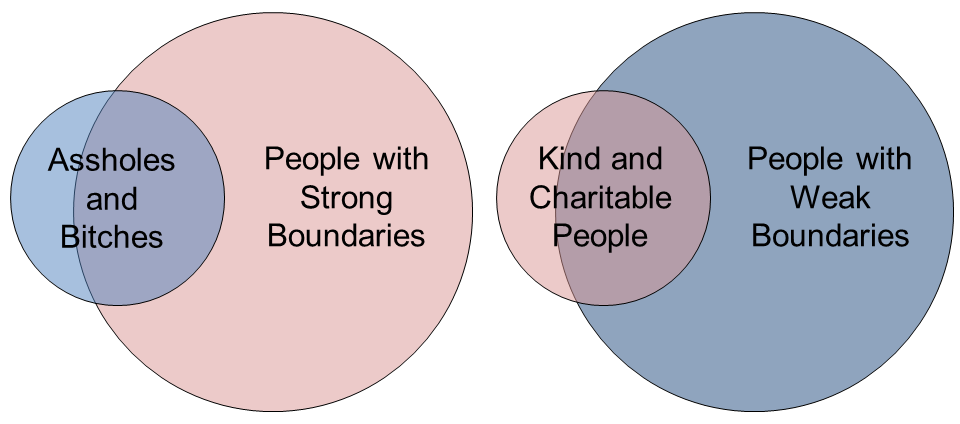
Often people with weak boundaries are thought of as kind or charitable, and a lot of people with strong boundaries are perceived as assholes and bitches, but these labels are inaccurate. It is perfectly possible to have strong personal boundaries without being an asshole (best illustrated in example 1, where the woman is firm, but polite), just as it is perfectly possible to have weak personal boundaries without being kind or charitable (best illustrated in example 3, where the girl gives to charity, but not for altruistic motives). Assholes and bitches are just a subset of the group of people with strong boundaries, just as kind and charitable people are just a subset of the group of people with weak boundaries.

This can be illustrated quite simply with a Venn diagram. There is some overlap between the groups, but there are plenty of people with strong boundaries outside the set of assholes, just as there are plenty of people with weak boundaries outside the set of kind people. Neither group completely encompasses the other.

Perhaps the primary way in which we judge another person's value (and I mean primary both in the sense of "main" and in the sense of chronologically first) is by evaluating what they appear to think about themselves. We do this by observing their confidence, their posture, their grooming, the way they dress, and most importantly, the way they interact with others. We form an opinion of their self-esteem and bearing.

We do this because - unless we know them extremely well - we are privy only to a limited amount of information about their capabilities, talents, and weaknesses (i.e. the things that actually define their value); so we are forced to make a second-hand judgment, an inference. But in general, this judgment is reasonably accurate, because people usually know their own strengths and weaknesses almost perfectly. This self-knowledge usually informs their level of confidence, such that the way that they carry themselves usually reflects their strengths and weaknesses reasonably well.*

Now, healthy boundaries are a sign of confidence, of someone who respects themselves, of someone who knows their own self-worth. Weak boundaries, on the other hand, are a sign of insecurity and low self-esteem. The woman who asks the man on the train for a seat knows that she is just as good as he is, and just as deserving of the seat, so she has no inhibitions about asking (or even telling) him to move his bag. The woman who lets her date get away with not showing up thinks he is the best she can do (i.e. thinks she is below his league). She is afraid to cut him off because she doesn't want to lose him. The girl who can't say no to a donation request, and then gives more than she wanted, has such a poor self-image that she puts even a random charity worker's opinion above her own money and principles. And the girl who tells her crush not to come to the party out-of-costume does so easily because her sense of self-worth is not contingent on one man's willingness to attend a party – or even on how much he likes her.

I am saying all of this is to make a very simple but crucial point: when a man encounters a woman who has strong boundaries, he knows that she values and respects herself, and he therefore makes the reasonable inference that she is a woman of good character. Assuming she meets his minimum criteria for physical attractiveness, his attraction for her – and I am talking about the long-term kind, the kind that makes men fall in love – will skyrocket.

The opposite is also true. When a man meets a woman who lets him (or others) walk all over her boundaries, or even define them, he concludes that she doesn't respect herself, and therefore, that she must not be someone worthy of respect. Even if she is beautiful, his attraction for her will soon plummet.

In my experience, women tend to have weaker rather than stronger boundaries. My guess is that this is true because, from a young age, their boundaries are often handled by the males in their lives – a protective father or brother, suitors who believe they need to be “gentlemen,” male colleagues who suppress their sexual attraction in the office, etc. Surrounded by this behavior, women have relatively less practice than men (on average) maintaining their personal boundaries, defending their personal space, rights and emotions. As a result, they aren't as comfortable confronting someone on the train about moving his bag, or telling those who mistreat them to go fuck themselves.

It has also been my experience that the more attractive a girl is, the more likely she will be to have weak boundaries. This is a little counter-intuitive, and definitely a generalization, but I think I understand why it is the case. From a young age, beautiful women are surrounded by men who are constantly demurring, constantly meeting their needs, and giving them whatever space or compliments they need. Some women like this still manage to develop strong boundaries, and they are the ones that men would kill to be with. But most do not, because they've never had to "fight" for anything. When a woman like this comes across a man who is confident and attractive, she invariably gets banged, walked all over, then dumped. And it is largely because she doesn't show the men in her life that she is someone of value. If she were to maintain strong personal boundaries, men would see that she respected herself, and would want to trace that confidence to its root by getting to know her.

Do not underestimate the importance of this post. For what I suspect is the majority of my readers, it is probably the most important one I've written. I get e-mails all the time from beautiful women (they attach pictures), telling me that they are doing "everything right," but that they still can't land a man. Other women e-mail me asking how they can really "hook" a guy, how they can make him look past the sex, how they can get him to fall in love. They can attract the men they want, they just can't seem to keep to them. This post is fundamental to answering both questions.

For the girls doing “everything right”…
If you read through the posts on this blog, you will notice that many of them – some of which are linked in the Related Posts section, below – advocate the maintenance of strong boundaries in specific situations; but boundaries are not something that you can apply to your life only in a piece-wise fashion. This is transparent. Even if a girl doesn't fuck on the first date, a guy will know that she has poor boundaries when she accepts a date after he’s admitted that he isn't looking for anything serious. Likewise, a girl who doesn't initiate contact still betrays her weak boundaries if she replies immediately to every text a guy writes her. Doing only the things I've posted about on this blog will only get you a fraction of the way to the correct disposition. This post is meant to explain the underlying principle, so that you really can apply it in everything.

For the girls who can attract but can’t keep a man…
Boundaries are fundamental to getting past the initial attraction phase with a man. Looks only get you in the door. As I have said before, while appearances are essential in getting a guy to approach or getting him to ask you out, they are nowhere near enough to get a guy to commit for the long term. Strong boundaries are a primary and therefore critical indicator of a woman's deep, inner worth – the kind of woman that men are not only willing to commit to, but actually want to commit to. There are plenty of women out there who are attractive, but there are very few who have the substance to go with it. Sound, healthy boundaries set a woman apart from the crowd instantly.

So, yes, "men love bitches," in the sense that they love women with strong personal boundaries; but they do not love bitches because they are mean, manipulative, under-handed or have harsh personalities. Men love bitches because their personal boundaries are rooted in a self-respect that tells him more than anything else about their character and inner-value; and it is only with this kind of woman that men want to settle down.

___________________
* While of course there are plenty of exceptions, they are normally short-lived. In the long run, people who are over- or under-confident almost always run into circumstances that serve to correct their distorted self-image. Some good examples are the delusional American Idol contestants who are finally told by the judges (on public television) how much they suck. Similarly, a person who has no self-esteem will eventually find a talent or social niche, and realize that they really aren’t as dumb or awkward as they thought.


Related Posts
1. The Importance of Silence After a Breakup
2. Don't Try to Be One of The Guys
3. Never Tell a Guy When You'll Have Sex With Him
4. No, You Can't Be "Just Friends"
5. Men That Like You Will Explain Themselves
6. Men and "Friends with Benefits"
7. The Downside to Cohabitation Before Marriage

Sunday, May 26, 2013

The "Three Mistake Minimum" Rule on Dates

I've had a lot of girls ask recently how they can be more "open," more authentic, more vulnerable. They recognize that these dispositions not only allow them to be their true feminine selves, but are also attractive to men in a non-sexual way. This post is for them. If you are the kind of girl who prides herself for "speaking her mind" on dates, this post is not for you. In fact, you probably need to shut up more.

When my friend and I used to go out in San Diego, we would sometimes make a rule at the beginning of the night: no one could go home until they'd approached and been rejected five times by girls. If you were successful and chose to leave the interaction or got a phone number, it didn't count towards the total. Sometimes we would aim for three rejections, other times five rejections, and on ambitious nights we'd shoot for ten. It made for some fun times. The way we saw it, if we weren't getting rejected often, it meant we weren't trying hard enough. More importantly, it made approaching easier. If we knew we had to get rejected ten times anyway, we'd think "might as well get started now." It always worked. What at first seemed like recklessness actually made us successful, because our indifference to rejection gave us the bearing we needed to communicate our confidence; and women ended up liking us more.

As I pointed out in a seemingly unrelated post, taking risks is something we all need to do in order to succeed. We tend to avoid risks because they lead to failure, but risk-taking is also a prerequisite for success. We have to embrace the chance of failure if we want to succeed. This applies to dating as much as every other aspect of our lives. While there are many things we can control to attract the opposite sex, experience shows us that not everything can be manipulated, and there is a point at which we need to let go and accept the limits of our influence.

A lot of women find first dates nerve-racking. Whether or not they realize or admit it, they are nervous because they see a first date as a time to perform, a single opportunity to show their best side to a man, a critical chance to impress him. They are self-conscious because they want to avoid doing something stupid or unattractive. If you are one of these women, you know exactly what I am talking about. It can be paralyzing.

When you are having a conversation on a first date, all kinds of thoughts and reminders are constantly passing through your mind. Some of them seem appropriate and you verbalize them, but many you veto because you aren't sure if he'll agree, or whether he'll be interested. These are things that you would say without a moments' hesitation in front of a work acquaintance or a friend; but you don't want to say something that will turn off your date, or make him think that your tastes or opinions differ too much from his. So you leave these things unsaid.
Example 1 - He mentions a boring, generic Hollywood movie he saw the other day and really liked, and asks what the most recent movie you've seen was. You tell him that it was A Separation. When he asks how you liked it, you balk. You thought it was incredible, the best movie you've seen in years; but you are hesitant to tell him so because you doubt he appreciates foreign (let alone Persian) films, and he might even think you are a little weird because of it. You tell him "It was good... different, but good" and change the subject.
Example 2 -  You met online and it's your first date. He invites you to dinner but doesn't tell you the name of the restaurant ahead of time. You've had a long day so you are hoping for someplace casual where you can just kick back and have a beer with him. When he picks you up he is a lot hotter in-person than you expected. He takes you to a fairly fancy place, and when the waitress comes, he orders a cocktail. You do too, even though you never drink anything other than Bud Light and think cocktails are kind of pretentious.
In both instances you lack authenticity. This kind of guarded, deferential mentality is preventing you from being your true self. More to the point here, it is preventing you from finding a man that is truly compatible with you. I've been on dates with girls that have been very open and genuine, and I've had absolutely no interest in them because of it. They showed their true colors, and I didn't like them. But these girls are far closer to finding a guy than the women I've dated several times without ever feeling like I knew who they were. A few of these girls gave me glimpses of their true selves occasionally, and I loved what I saw. But the glimpses were far too brief and fleeting for me to really know whether it was representative or not - in other words, whether or not it was worth hanging around for. So I didn't.

You probably assume this guarded mentality in order to prevent yourself from failing with men (looking stupid); but it is also preventing you from succeeding with them. The kind of guy who would like what you decided against saying will think less of you for your silence, while the guy who would think poorly of you for it probably isn't right for you anyway. Your attempt to make the date work by avoiding your natural inclinations is futile, because, although your instinct is right - it will prevent you from looking stupid - it will also prevent you from being attractive to the men you are most suited for.

So next time you are on a date, do the equivalent of what my friends and I used to do in the bars of San Diego: do not go home until you've made a conscious effort to push through your reservations and express the things you would say in non-date situations - at least three times. In other words, don't go home until you've made three "mistakes." Remind yourself of this just before meeting him for the date, and then anytime you are alone during it (e.g. when you go to the bathroom). If you want to get hyper-practical about it, set an alert on your phone, so that you get a little vibrate reminder part-way into the date. If you get to the end of the date and still haven't hit three, just ask him anything you want  to know about him but "isn't appropriate" to ask.


Related Posts
1. Self-Improvement Takes Time
2. Men Care About How You Talk
3. Texting Tip 3 - When Should You Reply?
4. Living Vulnerably
5. Femininity, Authenticity and Compatibility

Thursday, December 6, 2012

Male Age and Attractiveness

When I first published the post Your Age and Your Attractiveness (which graphically illustrates the change in a woman's attractiveness as she ages) I received a number of requests to create similar charts for men. I declined, since - being a straight male - I didn't consider myself an objective judge of male attractiveness. And anyway it was outside of the scope of this blog.

But recently I was reading an interesting post on Hooking Up Smart, and I followed a link to another post that does exactly what those readers requested of me - it plots male attractiveness against time, and even breaks it down into its primary components. I've included the main plot on the right, but the post is definitely worth a read. Here is the link:

The Socionist: Male Attractiveness Over Time

It is a striking complement to the post I wrote on here. There are a lot of similarities. The author discusses variations on typical attractiveness curves and his plots are similarly generated. In fact, if he didn't write his a couple months before mine I'd probably start throwing around accusations of plagiarism. But he did, so I should probably start expecting one from him...


Related Posts
1. Your Age And Your Attractiveness
2. Some Older Women Are Smart
3. Don't Let a Guy Waste Your Most Eligible Years
4. What Men Think About Older Women

Monday, July 30, 2012

Katy Perry is Brainwashing Women

I recently watched the music video for Katy Perry's song Part of Me (I was just hoping she would look hot in it).


I was sorely disappointed by her looks in the video, but more importantly, the story line also bothered me. It didn't take me long to realize why...

After apparently being cheated on, Katy Perry dumps her boyfriend (which is smart), and then decides to overcome the emotional pain by cutting her hair, joining the military and being "tough" and independent. I am hoping the not-so-subtle message of the video is less catchy than the song (which is still stuck in my goddamn head...), because it essentially says "if you are hurt by a man, an appropriate and liberating response is to de-feminize yourself."

Nothing could be further from the truth. No reaction to rejection will damage your chances with other men more (especially if you cut off your hair like she does in the video). A woman who responds to rejection by becoming more masculine is like an athlete who responds to a difficult loss in sports by intentionally injuring himself or skipping trainings and practices - it is absurd. The athlete damages the body or lose the skills that made him a competitive athlete in the first place, just as like Katy Perry throws away the disposition and looks that attract men the most. She gains her personal independence at the expense of attracting men. That is to say, by throwing away her femininity and closing herself to male companionship, she sacrifices the potential for long-term happiness in a good relationship (however difficult it might be to find) for the momentary happiness of personal "liberation."

When a message like this is surrounded by a catchy song and a flashy music video with a famous celebrity, it is inevitably romanticized, and the message can be difficult to divorce from its medium. Be careful about getting sucked in.

Wednesday, June 13, 2012

"The Difference Between" and "The Difference Among"

Many people’s understanding of the differences between the sexes is plauged by a single misconception, namely, that the difference between the sexes is greater than the difference among either of the sexes. This misconception can severely limit your chances with men, so it is worth acknowledging and correcting.

We are all familiar with the stereotypes of the sexes’ various capabilities or character traits: men are physically stronger than women; women are more intuitive than men; men are more independent than women; women are better at multi-tasking than men; etc. Few of us would dispute that these stereotypes are accurate.

Yet all of us have seen instances that disagree with these stereotypes in varying degrees. I’ve met a few women that could easily kick my ass and plenty that can beat me in sports; we’ve all encountered incredibly effeminate men, or women who are domineering and independent.

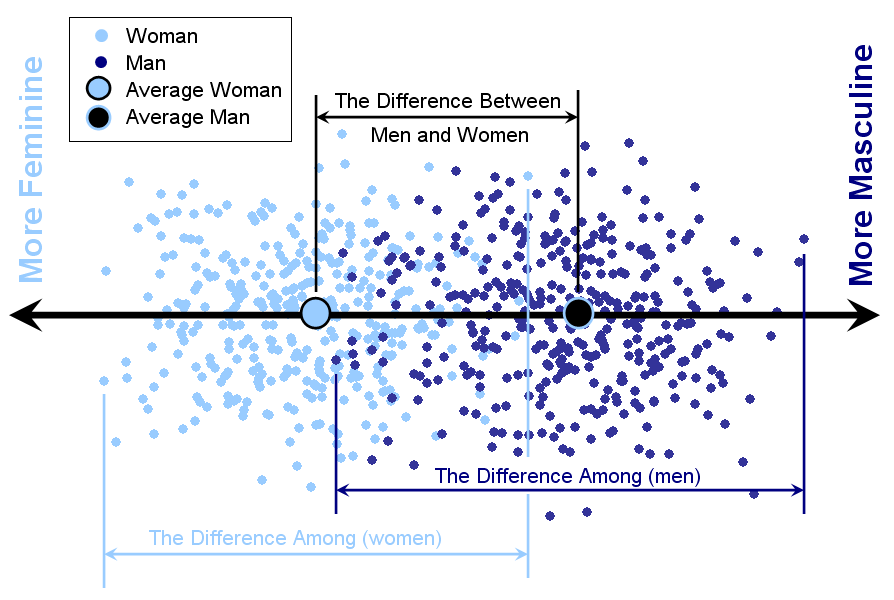
If you plotted each man or woman’s “rank” with respect to a given character trait on a linear scale, you would see a large amount of dispersion or “scatter” in the data. For example, a plot on the intuition scale might look something like this (each point represents a single man or woman):
(Note that the vertical dispersion of the data is just used to better-illustrate the horizontal dispersion)

Similar plots could be made for all kinds of characteristics:
  • Height
  • Physical strength
  • Sex drive
  • Risk aversion
  • Sexual promiscuity
  • Independence
  • etc.
On this blog I make a lot of statements about men and women, about masculinity and femininity, and about the effects of these dispositions on male-female relationships. Understanding these differences is important – critical, even – in learning how to dispose oneself towards the opposite sex. But it is equally important to keep in mind that these differences are only the differences between the averages. Not all men and women will conform to these stereotypes, and it would be a mistake to insist that because some do not, they are not “real men” or “real women,” or to ignore them in your attempts to attract the opposite sex. Be aware of this while reading this blog and others.

For example, I might make a statement like "Men desire sex more than women," and this is perfectly true when you look at the average man and the average woman. But it is just as important to recognize that you may encounter men that are less sexually driven than most women you know, or women who are hornier than any guy you’ve ever met. More importantly, you may not conform to the female stereotype yourself, which would probably mean that you would benefit from looking for a guy who doesn’t conform to the male stereotype (in that respect) either.

The following plot illustrates how a random group of men or women might fall on a masculine-feminine scale – which can be thought of as the combination of a large number of character traits.

Notice that the difference between men and women with respect to the masculinity-femininity scale is actually smaller than the male or female variance on the same scale. Again, the difference among men or women is larger than the difference between them. If you ignore this fact, one of the following could result:

(a) By only paying attention to the stereotypical male, you might miss out on a type of guy that is more appropriate for you than the stereotype – a better match.

(b) In the course of trying try too hard to conform to the stereotype of femininity, you could deny your naturalinclinations. Although your natural self may not attract as many men as your stereotyped self, it may attract more of the kind of men you are interested in. (Though be careful not to confuse your natural inclinations with social pressure – for example, the pressure to succeed in your job.)

So while you are thinking about or reading about the differences between the sexes, remember that, in most respects, the difference among is greater than the difference between; and this in turn means that the guy best for you or most attractive to you may be somewhere closer to the limits of the “scatter” rather than the average when it comes to a particular personality or physical trait.


Related Posts
1. Femininity, Authenticity and Compatibility
2. Men and Sexual Variety
3. The Analogy Between Confidence and Beauty
4. The Analogy Between Sexual and Emotional Support

Sunday, May 20, 2012

The Female's Internal Conflict

It is built into our very nature as human beings to have to endure the conflict imposed by the combination of our biology and rationality, our bodies and our minds. For reasons that are beyond our abilities to completely understand, our minds work in such a way that we are driven by pride, while our bodies operate according to their inclinations to reproduce and (presumably) perpetuate the species. These two drives often push us towards opposite goals, resulting in a conflict that is reflected - perhaps at its strongest - in the dating world.

As a woman, your pride wants a man who values you above all other women, one who would do anything for you out of an overwhelming compulsion of feeling. You (like every person) need to know you are valuable and important, which is largely evidenced by feeling wanted.

Your biology, on the other hand, aches for a man who is strong and powerful, unfettered by his feelings, who can protect you and impregnate you with healthy children - children who in turn will survive and reproduce successfully.

But the fact is that men also have biologies that drive them, almost uncontrollably. They desire the most beautiful and healthiest women - those most capable of bearing their children. This means that the men who best fulfill the needs of your pride are those who are farthest below your league, and therefore want you most. But at the same time, almost by definition, the men who best fulfill the needs of your biology are those who are farthest above your league, and therefore want you least.

The reality is that - eventually, after all efforts at self-improvement - you have to choose a man who represents a balance between those two extremes. If you want a man who values you immeasurably, he isn't going to be the heroic hunk you desire sexually. If you want a man who can provide you with perfect babies, he isn't going to want you above all other women - because he probably can have all other women (at least all those at "your level").

Two factors mitigate the apparently unfortunate nature of this situation:
  1. Men are faced with a similar conflict, and they too have to compromise, meaning that the object of your biological desires has fewer women to choose from if he wants a girl that also loves him as a person. Perhaps more important than the needs of his pride is the fact that he cannot have a woman that doesn't want him. Your best possible partner will be one who recognizes this, values your love for him, and is willing to curb his desire for other women because of it. Still, the fewer options he has to forego, the easier (and more likely) this commitment will be for him to make and maintain.
  2. All men and women have different tastes when it comes to the opposite sex, so a single woman sits very differently on various men's scales. This is why I've placed "your level" in quotation marks above; is relative to each man's personal taste.
Admonitions not to "settle" are actually admonitions against settling too much - against choosing a man that doesn't fulfill one of these two needs sufficiently. In reality, we all settle in the sense that we settle for a man or woman that fulfills both of these needs, but fulfills them both only partially. No single person can fulfill both completely because the two sets of character traits that do so are (with the above caveats) mutually exclusive.

Friday, April 13, 2012

The Analogy Between Confidence and Beauty

Popular magazines routinely publish the results of polls in which both sexes are asked what qualities they are most attracted to in the other. And they routinely discover the same thing: above all other traits, men desire beauty in women, and women desire confidence in men. I am always skeptical of studies based on surveys, but in this instance, observation corroborates the survey results: men really do prioritize beauty in women, and women really do prioritize confidence in men.

While the fact itself might be old news, very few people realize how instrumental it can be in understanding the opposite sex. Typically confusing actions are instantly illuminated in light of these priorities. And you can understand them in terms that make sense to you, by using one of the most powerful tools of thought: analogy.


The next time you are confused by a man’s actions, try the following: Put his actions into words; then replace all of the masculine nouns and pronouns with feminine ones, and any rephrase any references to beauty so that they instead relate to confidence. The situation will make miles more sense that way.

Here are a few examples:

Example 1: “I surprised him at his office, wearing my new dress, with my hair and makeup done; and even though he was preoccupied with an employee who had just stopped by his office to ask him a question, I could tell by the look in his eye that he wanted to close the door, throw me on his desk and ravage me right there.” While you might take it for granted that your beauty attracts him, the fact that you don’t feel the same surge in attraction simply because he has a new haircut, a fresh shave and is wearing a well-fit shirt might make it a little difficult to understand his reaction. But consider the analogous situation in which you witness a display of his confidence: “I walked into his office to hear him giving instructions for the week to the project team. They were all listening intently, obviously impressed by his authority and experience. He looked so sexy giving orders and being admired like that. The second they left, I went over to him, grabbed his shirt and kissed him deeply. He seemed surprised.” While he might not understand how attracted you are by what is a routine occurrence for him, your response is similar to the urge he feels when he sees you looking your best.

Example 2: “We were driving to the party and he started getting on the freeway, but I knew that back roads would be faster. I told him this, and he immediately become annoyed and cold towards me – when moments before he’d been affectionate.” Why would he take such offense to this? After all, when he corrects your driving, you usually take his advice, and he was going the wrong way. The problem is that you’ve effectively undermined his confidence by questioning his judgment. You can understand the effect of this by considering how you would feel if he undermined your beauty: “I’d bought a new dress and had done my hair and makeup perfectly. I knew I looked hot. My husband and I were driving to a party together, when a 20-odd-year-old in a tight dress and heels crossed the street in front of our car. His eyes locked on her and his head turned as she walked across our field of view. Though I’d felt cheerful and affectionate towards him seconds earlier, I immediately felt hurt and distant.” By checking out the girl as she walks by, your husband undermines your desire to be beautiful – and especially, beautiful to him. The hit to your self-esteem is identical to the hit he takes when you question his judgment and thereby undermined his confidence.

Example 3: “Ugh, he is obsessed with looks; he will never find a good girl that is hot enough for him. He’ll end up single.” I expect this sentiment is very common among women. I’ve had it said about me. But you will find just as many men complaining that “She wants a guy that treats her well, but only dates assholes, she deserves what’s coming to her.” Women, of course, realize that they like assholes not because they are assholes, but because they are confident. (They like them in spite of the fact that they are assholes, not because of it.) In the same way, men date women who are boring or stupid, not because they are boring or stupid, but because they are beautiful. The fact of the matter is that men are no more interested in woman’s beauty than women are interested in a man’s confidence.

Example 4: “She dresses kind of slutty, but she still gets much more attention from guys than me; don’t these guys see that she is trashy?” Men are much more likely to look among hot and sexy women for a girl that has a good personality, than to look among nice and friendly girls for one who is attractive. This is because looks matter more than personality to men. To understand this, consider the analogy with confidence: men often say about guys who do well with women “He is so arrogant, but he still gets more girls than me. Don’t these women realize that he is unintelligent and a hot-head?” Women are far more inclined to look for a guy with a good job and at least half a brain among the ones who are confident enough to approach them, than to look among the smart and level-headed guys for one who is confident enough. In the same way that looks trump personality for men, confidence often matters more than personality for women.

Example 5: “She is funny, smart, genuine, cheerful and confident, but I just can’t make myself attracted to her because she isn’t that hot.” Girls are routinely professing their confusion at men’s inability to prioritize what seem (to them) to be the most important characteristics in a potential girlfriend or spouse. The relative unimportance of these qualities will make a lot more sense when you compare them to his confidence rather than her beauty: “He is funny, smart, genuine, cheerful and good-looking, but he is always waiting for me to take the lead, always asks me what I want to do, and is deferential to other men. I just can’t make myself attracted to him because he isn’t confident enough.” (Incidentally, a lot of men are just as confused by this kind of statement as you are by theirs: “But he is letting you do whatever you want – isn’t that a good thing? Why wouldn’t you like that?”)

Thursday, March 29, 2012

Should You Focus on Your Looks or Personality More?

My audience on this blog is not uniform by any means:

  • Some readers are good looking, others are not. 
  • Some readers are interesting, others are not.
  • Some readers are confident, others are not. 
  • Some readers know how to dress, others do not.
  • etc.
The advice that I give is similarly varied. Depending which of these groups (and others) you fall into, different pieces of advice (from this blog or other sources) may or may not apply to you. A girl who already knows how to dress well and look her best should not be scrutinizing every aspect of her appearance, even if I post about it frequently. Those posts are not intended for her. If a girl like this gets rejected it would be an exercise in futility for her to fret about the fact that she wore one top instead of another, or wore heels instead of flats, or put on too much make-up, when the real problem is that she is boring, or is always trying to identify with men, or is a slob. Perfecting some single part of her look is not going to have anywhere near as much of an effect as trying to improve her personality.

The fact of the matter is that improvements in appearance follow a law of diminishing returns. Added efforts produce less and less results. And there comes a point at which it makes more sense to shift focus to the areas of your life that will have a larger effect:


The phenomenon doesn't only apply to appearance. In a similar manner, a girl who has a good personality - who is radiant, fun to be around, nurturing, intelligent, cheerful - a girl like this would be stupid to spend her time harping on the fact that she sometimes feels a little awkward in social situations, or lamenting her less-than-impressive intelligence. Instead, this girl should focus more about her appearance (which was probably neglected while she was becoming an awesome person). In doing so she might realize that her clothes often clash with her complexion, or that her hair doesn't suit her face shape, or that heels make her look sexy - all of which would be far more effective in making her more attractive to men than making some minute improvement to her personality.


Many women will lie somewhere between the states represented by the two plots, depending on how they have invested their time and effort. But when you read advice from this blog - or elsewhere - first understand what type of girl you are and where on each plot you lie before you decide whether or not it applies to you, or to what degree. 
 
(By the way, the 50-odd % location of the dividing line in the charts above is fairly arbitrary, and the shape of the curve will probably be different for every girl anyway. Don't pay much attention to it.)

Tuesday, February 28, 2012

Never Tell a Man Why He Shouldn't Want to Date You

One of the funniest but wisest quotes I've ever read was from the recent bestselling book & Twitter feed "Shit My Dad Says." The author recounts a time when he was telling his father about a girl he'd just been on a date with. Dejected, he tells his dad that she is obviously out of his league. His dad replies:
"That woman was sexy...Out of your league? Son. Let women figure out why they won't screw you, don't do it for them."
Of course the advice in this specific instance is about sex and women. But encapsulated in his words is a lesson that many people - men and women - painfully need to learn. Regardless of how bad your situation in life is, you should always hold your head high and illustrate or describe your personal situation in the best light possible. There is simply never a need, under any circumstances, to highlight the negative aspects of your life. There will always be external factors working against you - biology, genetics, social stigmas, gossip, etc. You don't need to contribute to them. Never tell a man why he shouldn't want to date you.

I've been dumbfounded at some of the shit women tell me on dates. It reflects so poorly on them, yet they tell it to me voluntarily. I get the impression that they are trying to be "candid" or "unfiltered," but that intention is only appropriate for people who have nothing in their life that needs to be filtered.

Although there are some situations in which it is necessary to do so, as a rule you should never voluntarily talk about or even mention any of the following:
  1. Guys that have broken up with you, or any failed relationships
  2. Difficulties you have finding a guy
  3. How much it sucks being single
  4. That you have been raped or physically abused
  5. Any bad life experiences you've had (or are having)
  6. Family drama (e.g. that your mother despises your father's parents)
  7. Your lack of a social life
  8. Your dissatisfaction with your current life situation
  9. Your struggles with depression, a disability, or being a single mother
  10. How much you hate your job
I am not making this list up. I went on a second date with a girl once who spent the whole time telling me about her parents' ongoing divorce, how crazy it was and how she and her siblings kept fighting. Word-by-word, she painted a hugely unattractive picture of her life, and I lost attraction for her because of it. Another time - before we'd even gone on a date - a girl told me she'd been raped by two black men in college (she was trying to disarm a comment I made about her being "innocent"). I never asked her out.

It isn't as if all negative comments need to be purged from your conversation. It is fine to mention small things, like "God, it's so frustrating; the seats of my BMW are taking sooo long to break in..." or "Argh! I hate this cell phone, it is constantly auto-updating." While these kinds of comments might make you seem frivolous, it is better that these are the problems on your mind, rather than your upcoming psychiatric exam or how you can't possibly pay the rent next month. When it comes to big things, keep your mouth shut about anything negative.

If you have serious issues that you think your boyfriend should probably know about, like a serious STD or an alcoholic father, you can and probably should tell him about them - eventually. Bring up the bad things only after he's had a chance to see the positive aspects of your life that outweigh them.

Wednesday, February 22, 2012

Don't Talk Yourself Up

I've been on a number of first dates, or early dates anyway, during which the girl essentially tried convincing me that she was hot shit. This hasn't typically been outright bragging. In fact, I think in all instances that I can recall, the girl has ostensibly just been telling me about her dating history or personal experiences. But her narrative has been laced with comments about how she is usually the one to end relationships, or how she goes on a lot of first dates, or how she just can't seem to find someone that is intelligent but confident, extroverted but thoughtful, good looking but humble, etc. - all of which imply that she has options with men and is generally amazing. Other girls have talked almost immediately and incessantly about how much they've traveled, or their multiple degrees, or their great jobs. Their underlying message is "See? I am a great catch; you should want to date me." They are talking themselves up.

This doesn't annoy me or turn me off from a girl. As I said, it is usually stated very casually and comes across as factual rather than arrogant or cocky. I've never thought "Wow, this girl is full of herself," or decided that I shouldn't hang out with her again because of it. In most instances I've just listened, and quitely acknowledged that the girl was trying to put her best foot forward. Yet in most cases, after getting to know her, I've been the one to end the relationship and she's been the one trying to hold on. And she's looked stupid because, after coming in with such an obvious "look how great I am" speech, she's been the one to walk away unwanted. When pride comes before the fall it makes you look stupid, even if it isn't your pride that causes the fall.

So next time you are on a first date and trying to impress, consider the following:

1. If you talk yourself up, you are likely to look foolish to the guys that you are most interested in impressing. If you are attracted to them, chances are that they will also turn out to be/do/have the things that you consider "impressive." After initially showing off, you may gradually start to realize that the guy you were showing off for is actually in the same league as you, if not one higher. The frame will flip. Your game will actually work against you, because you will end up looking pathetic for bragging about what (to him) isn't such a big deal.

2. A man will be infinitely more impressed by a girl that reveals herself gradually and naturally, than he will be by one that plays all of her best cards at the outset. Behaving this way is attractive because it demonstrates not only humility, but also security and depth of personality. As a man gradually and naturally learns about your strengths (for example, when they come up in the natural course of conversation, or when he asks you about them), he will get the subtle yet strong impression that you are "bottomless," and that you feel no need to impress him. He will be drawn into your depth and attracted by your confidence.

Sunday, January 15, 2012

Your Age And Your Attractiveness


Notes:
  1. These curves are based on observation and careful thought, not empirical data.
  2. Internal attractiveness consists of personality, femininity, openness, etc.
  3. External attractiveness consists of weight, natural looks, hair, clothes, etc.
  4. Percentage of potential means the level a woman achieves relative to what she could achieve, taking into account uncontrollable limitations such as body shape (not to be confused with weight), facial structure, etc.
  5. Combined attractiveness is a weighted average of internal and external attractiveness. 
    • Internal attractiveness is weighted at 40 % importance.
    • External attractiveness is weighted at 60 % importance.
  6. Don't pay too much attention to the values on the vertical axis. What matter more here are the rough values on the horizontal axis, i.e. when the peaks or changes occur.
  7. This is typical, not representative of all women. See this page for example variations.
  8. Other sources have real studies that are interesting and tend to agree with this illustration.

While I think this plot can largely speak for itself, I do want to highlight and qualify a few things.

The graph is not meant to hone in on the exact age of peak attractiveness. Don't draw conclusions based on the peak (A) occurring at 32 rather than 29 or 33. Instead, draw conclusions based on the peak occurring at 32 rather than 22 or 26 (which are more typical assumptions). More importantly, consider that although physical attractiveness peaks at one point (C), internal attractiveness plateaus later (D). While the "late" (i.e. post-30) peak in overall attractiveness is likely to draw some criticism, I doubt that such criticism is honest, or considers a woman's internal attractiveness. Furthermore, a recent study seems to back up this conclusion.

I shaped the curves for internal and external attractiveness separately, without giving consideration to each's effect on the combined curve. When I plotted internal and external attractiveness combined, and saw the "lull" in the early twenties (A), I was a little surprised. But upon reflection, it made sense. The "lull" is the point where a girl looks beautiful but has yet to come into herself. She is hot but boring to spend time with. So many girls in their early twenties are this way. Their overall attractiveness stalls until they develops their personality throughout their twenties. Some women never make this internal development, as illustrated in one of the example variations, posted here.

Notice that the full potential for combined attractiveness is never reached, because the peak of internal and external attractiveness do not occur simultaneously. While this is not always the case, I think it is often so, because women tend to spend their effort on looks or personality at different times in their life.

Notice, too, how the decline in external attractiveness is ameliorated by the increase in internal attractiveness, flattening out the decline.

Read Next: American Women Are the Best

Related Posts
1. Men and Sexual Variety
2. Don't Let A Guy Waste Your Most Eligible Years
3. Some Older Women Are Smart
4. What Men Think About Older Women

Tuesday, October 18, 2011

Human Energy Is Conserved

Every person has a limited amount of time and energy, as well as the ability to choose how to spend it. At every moment of our conscious lives, we are making decisions about how to invest our time and effort - how to spend our "human energy." We do this either explicitly, by consciously making a decision to change the course of our action, or else implicitly, by not choosing to change the course of our action. For example, right now I can either choose to continue typing this post, or decide that it is not worth my time and instead go read a book or work out. Likewise, I can choose at anytime (explicitly) to quit my job and move to a new city, or else (implicitly, i.e. by not making that choice), to continue in my current employment and residence. Obviously there are influences swaying our decisions, making one path simpler or another more difficult; but in light of those factors, the decision is always ours to make.

While it is certainly possible to spend your time and effort poorly, or inefficiently, let's ignore that possibility for a moment and first consider two people - two girls - that both spend their time and effort well, but differently. Girl A learns at an early age that her beauty and presentation matter, and out of the 60 hours a week she has free from school and sleep, puts ten hours into improving her look, while the rest goes to other typical activities. Girl B, on the other hand, is taught at an early age that her intelligence and education matter. She takes this to heart, and out of the same 60 hours a week, spends ten on homework and reading (over and above what Girl A and other typical students spend on homework and reading). The rest she puts towards other activities just like Girl A. So we have two girls, the same in all respects, except in their decision about how to spend those ten hours each week. Assume also that they are about the same in their natural intelligence and appearance.

You can be sure that by the time the girls reach the age of 18, Girl A will be getting a lot more attention from guys, while Girl B will be a lot smarter. You can also be sure that Girl B will probably be a failure with men, while Girl A will probably be stupid. Now, contrast them both with Girl C, who (ceteris paribus) spends those ten hours being lazy. I don't mean that she literally sits down and does nothing for ten hours a week, but those hours are distributed among the same daily tasks that the other girls do, because Girl C chooses to do them slowly, or she has to repeat them because she does them poorly. You can be almost sure that when she turns 18 she will be both a failure with men and stupid.

While I am sure you have your opinion about who is making the "right choice," that opinion is mostly immaterial to the point I am trying to make, which is that every person who spends their time efficiently has something to show for it. This is true in general - not just for women, and not just in terms of beauty and intelligence. For example, Guy A decided to spend his time practicing golf and is now semi-pro, while Guy B fostered his musical talent and started a successful band - or even Guy C, who has spent all of his free time just hanging out with his friends. While he doesn't have a talent in the traditional sense to show for it, he has strong friendships and will have good memories.

I think all of us recognize this phenomenon to one extent or another, intuitively. It was confirmed in my mind recently while driving past a small church in a tiny Italian village with my coworker. Sitting on a bench in front of the old church wall were several old men, in sweaters, caps and tweed jackets, just hanging out and talking among themselves. When we drove back past that same church a few hours later on our return trip, the same men were sitting there as if only a few minutes had passed. And from the nonchalance of their collective demeanor, it was clear that this was a typical occurrence, probably even something they did daily. I snapped this photo as we passed the second time:


The scene made me think that it is a shame that men in America don't do the same thing. It is incredibly rare to see old men with friendships so strong that they look forward to simply sitting together in the afternoons, talking and watching the world go by. If we, as a culture, set aside the time to do that each day, think how much stronger our social lives would be.

But then I immediately wondered "why don't we do that?" The answer was obvious: we don't do that because we don't have the time for it. That is, we don't choose to make the time for it. We spend it instead on enterprise or personal fitness. We work longer hours, get more accomplished, get to the gym and are probably in better shape. The Italians (and I don't think this is restricted to men) might have stronger relationships, but look at their economy - it is a mess; and it is a mess because they've chosen to sacrifice the hours that could be spent on industry or commerce on sitting outside the church each afternoon, or on longer (arguably better) meals, or (clearly better) fashion.

Again, my point is not to praise or criticize the Italians, or the Americans. The point is that different investments of human energy produce different results. Like all forms of energy, human energy is conserved. As long as it is spent efficiently, you will have something to show for it, even if what you have to show is not the most obvious thing in the world. The Italians have strong social fabric, great food and beautiful people; we as Americans have a strong economy and great achievements in sports and technology. Guy A is winning a big golf tournament this weekend, Guy B is about to release his first record and Guy C will have a huge attendance at his funeral and an amazing photo album. Each person has something different to show for their efforts.

So back to Girl A and Girl B. I suspect many of the girls reading this blog are closer to Girl B than A, which (partially) explains the emphasis I've placed on appearance in some posts. Your intelligence does not mean you are "deeper" or "better" than Girl A. Nor is Girl A better than you because she is hotter, or has perfect hair, or a great figure. It just means that while you were hitting the books, she was hitting the gym. In fact, the best investment of time and energy for a woman is one that cultivates intelligence and appearance, among a number of other life skills. If you actually are Girl B then you better get to the gym and the mall immediately and learn what "fit" means (for your clothes and your body). And if you actually are Girl A, you better spend some time at the library, learn how to stop saying "like" all the time and start thinking before you speak - and and get curious about life. (If you are Girl C, just give up, because you... oh, never mind, you already have.)

But perhaps more importantly, and at the risk of sounding really gay, the implication is that everyone has something to offer. As long as you haven't been sitting on your ass or living a repetitious life, or keeping yourself in a vacuum, your time and effort have yielded some form of knowledge, personality, or skills that are attractive to at least some men. I am not saying that some investments aren't more likely to score you a higher percentage of guys than others; but whatever your choices have been in life, you have something to show for it if you haven't been lazy. Learn how to make that "something" more evident to the men that will value it, or else convert it into something that the men you want will value. Then re-focus your energy on the areas of your life you've neglected while you've been spending so much of it elsewhere.